
BLR-210 · Lesson 9 of 12 · 19 min
Pad welds, window welds and tube replacements
No two tube repairs are the same, but most fall into a few kinds. A tube that has failed or thinned over a length is replaced: a section is cut out and a new piece, called a dutchman or tube insert, is welded in, as on Riverbend's tubes 47 and 48. A joint whose back cannot be reached is welded through a window cut in the new tube. A small, shallow area of wall loss on a tube that is otherwise sound may, in some cases and with the inspector's acceptance, be restored with a pad weld, a weld buildup on the outside of the tube. And a tube that cannot be repaired, or does not need to be in service, may be plugged at both ends, which is a decision for the owner and the inspector, not the crew. This lesson covers how the crew plans and makes these repairs.
Tube replacements
A tube replacement section must be the same material specification, diameter and wall thickness as the original, or as the owner's engineer and inspector approve, with its material test report on file and its heat number marked on it. For Riverbend, the new section is SA-210 Grade A1 tube from stock in Ironbridge's yard, with its test report checked by Harjit when it was received and its heat number transferred to every piece, as in BLR-130.
The minimum length of a replacement section is set by the owner's specification or the repair procedure, so that the two new butt welds are not too close to each other or to bends, attachments and existing welds. Short dutchmen, just long enough to bridge a small defect, put two welds very close together, and their heat-affected zones overlap. Riverbend's specification calls for a minimum replacement length, and the section also has to clear the buckstay clip, which sets the top cut line.
Kiera plans the new section's cut length, the windows the top joints will need, the total length of welding, and the actions for the neighboring tubes that Peg checked by ultrasonic thickness testing.
# Planning the tube section, the windows and the weld lengths (US units)
from math import pi

def show(x):
    return f"{x:.2f} in"

od, wall = 2.5, 0.25
opening = 47.5                 # distance between the cut tube ends after end prep
gap, shrink = 0.125, 0.06        # root opening and shrinkage per butt weld
piece = opening - 2 * gap + 2 * shrink
print(f"cut the new section {show(piece)} long")

# a window is cut in the front of the tube at a joint the welder cannot reach from behind
arc_deg, win_len = 100, 3
arc = pi * od * arc_deg / 360
perimeter = 2 * (arc + win_len)
print(f"window: {show(arc)} around the tube by {show(win_len)} along it, perimeter {show(perimeter)}")

butts, windows = 4, 2
bar_len = 193                  # new membrane fillet welds, both sides of each bar
total = butts * pi * od + windows * perimeter + bar_len
print(f"{butts} butt welds + {windows} windows + membrane fillets = {show(total)} of weld")

# UT readings on neighboring tubes: replace below the minimum wall, pad weld only a small local area
tmin, pad_lo = 0.190, 0.212
for tube, reading, size in [(45, 0.232, 0), (46, 0.205, 1.2), (49, 0.217, 0), (50, 0.240, 0)]:
    if reading < tmin:
        act = "replace"
    elif reading < pad_lo and size <= 2.0:
        act = "pad weld candidate (inspector to accept)"
    elif reading < pad_lo:
        act = "replace (area too large for a pad)"
    else:
        act = "OK, record and monitor"
print(f"tube {tube}: {reading} in -> {act}")cut the new section 47.37 in long window: 2.18 in around the tube by 3.00 in along it, perimeter 10.36 in 4 butt welds + 2 windows + membrane fillets = 245.14 in of weld tube 45: 0.232 in -> OK, record and monitor tube 46: 0.205 in -> pad weld candidate (inspector to accept) tube 49: 0.217 in -> OK, record and monitor tube 50: 0.24 in -> OK, record and monitor
The new section is cut 47.37 in long, a little shorter than the opening because of the two root openings, plus the shrinkage the welds will cause. The windows are small, about 2 1/8 in round the tube by 3 in along it. In all, the repair is about 245 inches of welding, most of it membrane fillets. The thickness readings show tube 46, beside the repair, has a small thinned spot from the steam jet that cut tube 48.
Window welds
On a vertical waterwall tube, the back of the butt weld, against the casing side, is often hard or impossible to reach, because a buckstay, a clip, a header or the next tube is in the way. On Riverbend's top joints, the buckstay sits just above the cut line on the casing side and blocks Dale's access. The answer is a window weld. Before the new section goes in, a window, a rectangular piece of the tube wall, is cut out of the front of the new tube at its top end, next to the joint. With the section fitted, the welder welds the front of the butt joint from the furnace side in the normal way, then reaches through the window to weld the back of the root from the inside of the tube. The window piece is then fitted back into its opening and welded round its edges, restoring the tube.
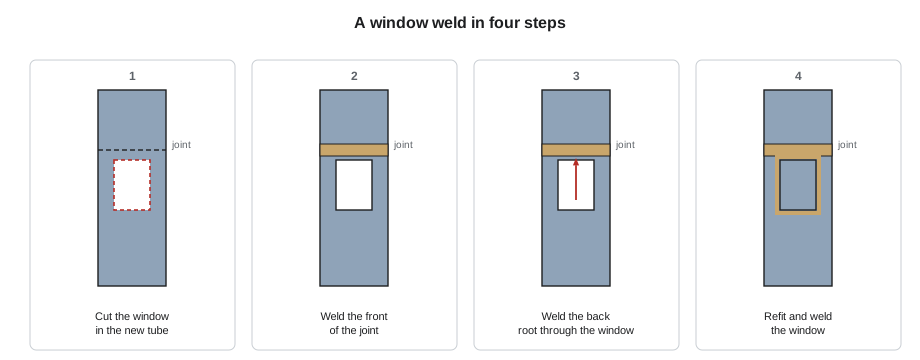
Window welding has its rules. The window is cut in the new tube, never in the old, so any damage from cutting is in metal that was going to be welded anyway. It is cut with a saw or a thin abrasive wheel, keeping the kerf narrow, and its edges are beveled so the window can be welded back in with full penetration. The window piece is kept, marked, and fitted back in the same orientation it came out. The inside root weld through the window is made in an awkward position, often with a bent GTAW torch and a short filler rod, and the welder must watch it carefully for incomplete fusion where the inside weld meets the front half. The window's own weld is a full-penetration weld round all four sides, and it is radiographed with the butt weld.
A window weld doubles the welding at a joint, and it is a place where defects hide. That is why the repair plan uses windows only where access cannot be gained any other way. On Riverbend, the bottom joints are reached from both sides, so only the two top joints need windows.
Pad welds
A pad weld restores a thinned area on the outside of a tube by depositing weld metal over it, building the wall back up. On boiler tubes, pad welding is used for small, shallow, localized wall loss: a small erosion pit, a mark from a sootblower, a nick from a tool, or the small steam-cut spot on Riverbend's tube 46. It is not a fix for general thinning, cracks, or for areas where the remaining wall is so thin that the heat of welding could burn through or the tube could fail under the weld. Whether a pad weld is accepted at all, and on what conditions, is the owner's and inspector's decision under the repair code and the owner's specification; some owners treat pad welds as temporary repairs, to be replaced with new tube at the next planned outage.
When the inspector accepts a pad weld, it is made to a WPS that covers buildup on that tube material. The area is ground to clean, sound metal with a smooth, shallow contour and examined by penetrant or magnetic particle testing to make sure there is no crack. The tube must contain water or be dry and at a safe condition as the WPS requires; on an outage, it is drained and dry. The buildup is made with small stringer beads, overlapping each other, extending a little beyond the thinned area, with low heat input so the thin wall is not burned through. It is then ground to a smooth contour with the tube surface, examined again, and its thickness checked by ultrasonic testing.
Peg and Grant Mahler look at tube 46's spot. The remaining wall is above the minimum the tube needs for its pressure, the area is small, about 1 1/4 in across, and the steam jet that cut it is gone. They accept a pad weld under the repair plan, made after the replacement section is in, with ultrasonic and magnetic particle examination afterward.
Plugging tubes
Sometimes a failed tube is plugged rather than repaired, so the unit can return to service quickly, especially in a boiler bank or an economizer where losing one tube's flow is acceptable for a while. Plugging is not a crew decision. The owner's engineer has to confirm that the plugged tube will not overheat, which matters little in an economizer but a great deal in a furnace wall, where an empty tube in the flame will fail quickly, and the inspector must accept it as a repair. Plugs are welded into the tube ends at the headers or drums to a procedure, and the plugged tube is recorded so it can be restored at the next planned outage. On Riverbend's furnace wall, plugging is not an option.
Planning the repair package
Every tube repair is planned on paper before the first cut, and the plan becomes the repair package that the inspector accepts. On Riverbend, Harjit's package has:
- A repair drawing showing the tubes, the cut lines, the new section with its windows, the new membrane bars and the elevation references.
- The WPS for each weld type: tube butt welds, window welds, membrane fillets and pad welds, and the WPQs of the welders who will make them.
- The material: tube specification, size and wall, heat numbers, and the test reports.
- The examination plan: which welds get visual, radiographic, ultrasonic, magnetic particle or penetrant examination, and the acceptance standard.
- The pressure test the inspector has accepted, and the hold points.
- The traveler for each joint, where the readings, signatures and examination results will be recorded.
The package is the reason the repair can be done fast. When Marcel needs a decision on the scaffold, the answer is already in it.
Worked problem
Window size
A window spans 100 degrees of a 2 1/2 in tube and is 3 in long. How long is the arc of the window round the tube, and how long is its perimeter weld?
Show solution
- Circumference: π × 2.5 = 7.85 in.
- Arc: 7.85 × 100 ÷ 360 = 2.18 in.
- Perimeter: 2 × (2.18 + 3) = 10.36 in.
Answer: The window is about 2 3/16 in round by 3 in along, with about 10 3/8 in of weld round its edges.
Tube shields and other attachments
Not every repair is a pressure weld. Boiler tubes in the gas path carry attachments: tube shields, curved stainless or alloy plates clamped or tack-welded over tubes where erosion from ash or sootblower steam would thin them; spacers and alignment ties that hold superheater loops in place; and clips that carry the casing and buckstays. Repairs to these are common on every outage, and they matter because a careless attachment weld can damage the tube under it. Welds that attach a shield or clip to a tube are on the pressure part, so they are made to a WPS by a qualified welder, they must not undercut the tube, and their ends must be sealed so the shield does not trap moisture against the tube. Many owners specify shields that clamp or hook on rather than being welded, so that no weld touches the tube.
Common mistakes
MistakeMaking the dutchman as short as possible.
InsteadMeet the minimum replacement length so the welds and their heat-affected zones are apart.
MistakeCutting a window in the old tube.
InsteadCut windows only in the new tube, and keep and mark the window piece.
MistakePad welding a crack or a large thinned area.
InsteadPad welds are for small, shallow, sound areas the inspector accepts; replace the tube otherwise.
MistakePlugging a furnace wall tube to get back on line.
InsteadPlugging is an owner and inspector decision and is unsafe where the tube sees flame.
MistakeStarting the repair without a package.
InsteadPut the drawing, WPSs, WPQs, material, examination plan and test in the package first.
Summary and key terms
- Tube replacements use matching, traceable material and meet a minimum length between welds.
- Window welds let the back of a root be welded from inside the new tube where it cannot be reached outside.
- Windows are cut in the new tube only, beveled, refitted in the same orientation and welded with full penetration.
- Pad welds restore small, shallow wall loss only with the inspector's acceptance, using low heat stringers, then UT.
- Plugging is an owner's engineering and inspector's decision.
- A repair package with drawings, WPSs, WPQs, material, examinations and the test is accepted before work starts.
- Dutchman
- A short replacement section of tube or pipe welded in place of a removed piece.
- Window weld
- A repair technique in which a window cut in a new tube gives access to weld the back of a joint from inside.
- Pad weld
- A weld buildup that restores a thinned area of a tube or pipe wall.
- Tube plug
- A welded plug that takes a tube out of service.
- Repair package
- The documents for a code repair, accepted by the inspector before work starts.
- Minimum wall
- The least thickness a tube may have for its pressure and temperature.
Practice problems
Work each problem on paper first, then reveal the answer to check.
A prepared opening is 40 in, root openings are 1/8 in and shrinkage is 1/16 in per weld. How long is the new section?
Show answer
40 − 0.25 + 0.125 = 39.875 in, or 39 7/8 in.
Why is the window cut in the new tube rather than the old one?
Show answer
So any damage from cutting is in new metal that is being welded anyway.
A tube's minimum wall is 0.190 in and a reading is 0.180 in. What is the action?
Show answer
Replace the tube; it is below the minimum wall.
Name two things a pad weld cannot be used to fix.
Show answer
A crack and general thinning over a large area.
Lesson quiz · 5 questions
Score 60% or more to complete this lesson.
Create a free account to save your progress, take quizzes and earn a certificate.