
BLR-210 · Lesson 5 of 12 · 19 min
SMAW on plate in all positions
The Tank 14 insert plate is a good example of boilermaker plate welding. The plate is 1 1/8 in thick, it sits in the bottom course of a tank that cannot be turned, and its joint runs all the way round: up one side, across the top, down the other side and across the bottom, so the welder works vertical, horizontal and, along the top inside, overhead. The crew welds it with shielded metal arc welding, SMAW, for the root and the vertical joints, and with flux cored arc welding for the fill and cap on the long horizontal joints, which lesson 6 covers. This lesson is about stick welding on plate in the positions boilermakers meet.
Kiera is not yet welding the tank's pressure-retaining joints; J. Okeke, a qualified plate welder, runs them. Kiera's jobs are to keep the electrodes in the oven, clean between passes, check preheat and interpass temperature, and watch. In the evenings in the yard booth, she runs vertical and overhead plates of her own, working toward her plate test.
Welding positions on plate
Welding positions are named by a number and a letter: the number for the position and the letter for the joint type, G for a groove weld and F for a fillet weld. On plate, 1 is flat, 2 is horizontal, 3 is vertical and 4 is overhead. A welder qualified in the vertical and overhead positions on plate is usually also qualified for flat and horizontal, within the limits of the WPQ.
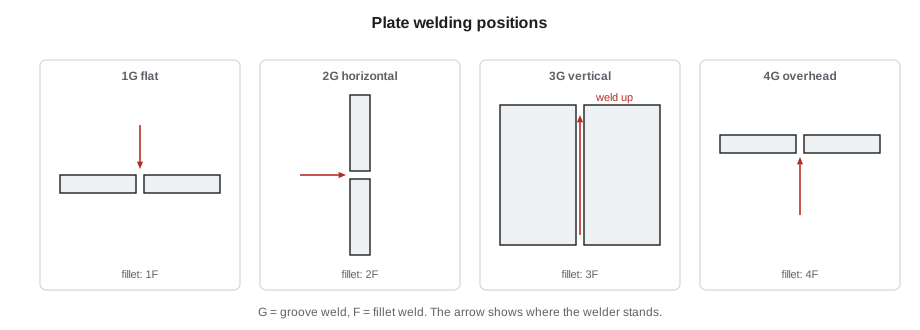
On Tank 14, the insert's two vertical joints are 3G, the long top and bottom joints are 2G, and because the inside V of the top joint faces downward from inside the tank, part of the inside welding is close to overhead. Each position asks for a different technique, and the WPS gives a different current range for each.
The electrode
Almost all SMAW on boilermaker pressure work uses low-hydrogen electrodes, E7018 or its metric equivalent E4918 in the Canadian standard, because hydrogen in the weld is the main cause of cracking in thick and restrained joints. Low-hydrogen electrodes absorb moisture from the air, and moisture brings hydrogen back. So the electrodes come in sealed containers, go into a heated holding oven once opened, and are taken out only a few at a time. Electrodes left out longer than the WPS or the code allows are returned to be reconditioned, if that is allowed, or thrown away. On a tank in the open, in spring, with rain in the forecast, the rod oven at the job is not a convenience; it is part of the procedure. The lesson in WLD-120 on electrode storage applies here in full.
The size of electrode depends on the position and the pass. On Tank 14, J. Okeke uses 1/8 in electrodes for the root and the vertical-up passes and 5/32 in for fill passes in the horizontal position, where the larger puddle can be controlled.
Vertical-up welding
Vertical welds on pressure plate are made uphill, starting at the bottom and traveling up. Uphill welding gives deeper penetration and better fusion than downhill, and almost every WPS for pressure plate requires it. The welder holds the electrode angled slightly upward, about 5 to 15 degrees above perpendicular, with a short arc, and builds a shelf of weld metal to stand each new layer of molten metal on. The root pass is a stringer, a straight bead with little side-to-side motion, or a small weave that keys into both root faces. Fill passes are made with a weave, often a Z or triangle pattern, pausing at each side to fill the edges and crossing the center quickly, so the bead is flat rather than humped in the middle.
The common faults in vertical welding are undercut at the toes from too much current or too short a pause at the sides, a humped bead from too slow a crossing, slag trapped at the edges of a humped bead, and sag from too much heat. Current for vertical-up runs at the low end of the electrode's range.
Horizontal welding
A horizontal groove on a vertical plate is the commonest joint on tank shells. The molten metal wants to sag onto the lower plate, so the joint is usually prepared with more bevel on the upper plate than the lower, or a single bevel on the upper plate only, and welded in a series of stringer beads laid from the bottom up, each bead overlapping the one below by about half. The electrode points slightly upward, 5 to 15 degrees, and is angled in the direction of travel. Because the beads are stringers, horizontal welding is slower in passes but each pass is easy to control, and the finished weld is layers of neat, overlapping beads.
Overhead welding
Overhead welding is the most tiring position and the hardest to keep sound. Gravity pulls the puddle down, so the welder uses a short arc, a lower current than flat, small beads, and a fast travel speed, letting each bead freeze before it can drip. The electrode is held nearly perpendicular to the plate, angled slightly in the direction of travel. Slag from overhead beads falls on the welder, so overhead work calls for full leathers, a cap under the helmet and closed cuffs. Fatigue matters: an overhead welder whose arm is shaking makes a poor bead, and good crews rotate overhead work.
Preheat, interpass and heat input
The WPS for the Tank 14 insert sets a minimum preheat and a maximum interpass temperature, and a range of heat input for each pass. Preheat for this plate is low, but on a cold morning it is not optional: the steel must be at or above the WPS minimum for a set distance either side of the joint before the arc is struck, and Kiera checks it with a temperature-indicating crayon or a contact thermometer on the side away from the heat, as WLD-130 taught. The interpass temperature is checked before each pass so the joint does not get too hot, which would coarsen the weld metal.
Heat input is the energy the arc puts into each unit length of weld. It is worked out from the voltage, current and travel speed, and the WPS gives the range it must stay in.
Here H is the heat input in kilojoules per inch, V the arc voltage, I the current in amperes and S the travel speed in inches per minute. Vertical-up passes have the highest heat input, because travel is slow; horizontal stringers have the lowest. Kiera times J. Okeke's passes with a stopwatch over a measured length and works out the heat input of each to check it against the WPS, along with the weld metal and electrodes the insert needs.
# SMAW on the insert plate: weld metal, electrodes and heat input (US units)
from math import tan, radians

t, f, g, ang = 1.125, 0.0625, 0.125, 30.0        # plate, root face, root opening, bevel angle each side
d = (t - f) / 2                            # depth of each V of the double-V groove
area = 2 * d * d * tan(radians(ang)) + g * t
area *= 1.10                               # reinforcement and overfill
length = 301.7
weight = area * length * 0.2836
print(f"groove area {area:.3f} in2, weld metal for the insert {weight:.1f} lb")

per_rod = 0.048                         # weld metal from one electrode after stub and spatter
print(f"electrodes needed: about {weight / per_rod:.0f}")
print(f"arc time at {3.1} lb/h: {weight / 3.1:.1f} h")

# heat input = V x A x 60 / (1000 x travel speed); WPS range for this joint
wps_lo, wps_hi = 20, 75
passes = [("root, vertical up", 22, 105, 2.4), ("fill, vertical up", 24, 140, 3.0),
          ("fill, horizontal", 23, 150, 7.0), ("cap, horizontal", 23, 145, 8.0)]
for name, v, a, s in passes:
    hi = v * a * 60 / (1000 * s)
    ok = "OK" if wps_lo <= hi <= wps_hi else "OUTSIDE WPS"
print(f"{name:18} {v} V {a} A at {s} in/min -> {hi:.2f} kJ/in {ok}")groove area 0.513 in2, weld metal for the insert 43.9 lb electrodes needed: about 915 arc time at 3.1 lb/h: 14.2 h root, vertical up 22 V 105 A at 2.4 in/min -> 57.75 kJ/in OK fill, vertical up 24 V 140 A at 3.0 in/min -> 67.20 kJ/in OK fill, horizontal 23 V 150 A at 7.0 in/min -> 29.57 kJ/in OK cap, horizontal 23 V 145 A at 8.0 in/min -> 25.01 kJ/in OK
All four passes are inside the WPS range. The insert needs about 44 lb of weld metal in all, and if it were all done by stick, it would need over 900 electrodes and about 14 hours of arc time. The weld metal estimate is why the crew uses FCAW for the fill and cap on the long horizontal joints: lesson 6 shows the difference.
Cleaning between passes
Every SMAW pass leaves slag, and every pass must be cleaned before the next. Slag left at the edges of a pass, where the bead meets the groove face or the previous bead, becomes a slag inclusion in the finished weld, the commonest defect on radiographs of stick welds. Kiera chips each pass with a chipping hammer, wire brushes it with a power brush, and grinds any humped bead, high start or sharp valley between beads before the next pass goes in. Starts and stops are ground to a taper so the next bead ties in smoothly. On the cap, the last pass, the welder aims for a smooth, even surface with no undercut and a reinforcement within the WPS and code limits.
Weld quality checks on plate
When the insert is welded, the welds are examined visually for cracks, undercut, overlap, porosity and profile, and then by the methods the tank repair standard requires. For a full-penetration insert in a tank shell, that usually includes radiography or ultrasonic examination of the butt welds, and magnetic particle or penetrant examination where the weld meets existing welds. The repair is planned and accepted by the tank's authorized inspector under the tank inspection standard the owner follows. The details of the tank repair rules belong to BLR-230; here, what matters is that a stick weld that looks good on the cap can still hide slag, so cleaning between passes is the welder's best defense.
Worked problem
Heat input on the root
J. Okeke's vertical-up root pass on the insert runs at 22 V and 105 A, traveling 2.4 in in one minute. The WPS range is 20 to 75 kJ/in. Is the pass inside the range?
Show solution
- H = 22 × 105 × 60 ÷ (1000 × 2.4).
- H = 138,600 ÷ 2,400 = 57.8 kJ/in.
Answer: Yes, 57.8 kJ/in is inside the range.
Starting and stopping on a long seam
On a joint that runs all the way round an insert, starts and stops are where defects collect. Each time a stick welder runs out of electrode, the crater at the end of the bead shrinks as it freezes and can crack, and the start of the next electrode, made on cold metal, can lack fusion. Good stick welders fill each crater by pausing briefly, or by turning back over the bead a short distance before breaking the arc, and start the next electrode a little ahead of the crater, then bring the arc back over it before traveling forward, so the start is made on hot metal and the crater is remelted. Starts and stops on successive passes are staggered so they do not stack on top of each other. On the Tank 14 insert, J. Okeke also plans the order in which the four sides are welded, alternating sides and working in short lengths, so that the shrinkage of the welds does not pull the insert plate out of the shell's curve. Kiera marks the order on the shell with soapstone before each pass, and checks the curve with a template at the end of each shift.
Common mistakes
MistakeLeaving low-hydrogen electrodes out of the oven.
InsteadTake out only a few at a time and return or discard any left out too long.
MistakeWelding vertical pressure joints downhill.
InsteadWeld uphill, as the WPS requires, for full fusion.
MistakeHumping the center of a vertical weave.
InsteadPause at the sides and cross the center quickly for a flat bead.
MistakeRunning the next pass over slag at the bead edges.
InsteadChip, brush and grind every pass clean before the next.
MistakeStarting on cold plate.
InsteadCheck the WPS preheat both sides of the joint before striking the arc.
Summary and key terms
- Plate positions are 1 flat, 2 horizontal, 3 vertical and 4 overhead; G for groove and F for fillet welds.
- Pressure plate is welded with low-hydrogen electrodes kept in a heated oven.
- Vertical joints are welded uphill with a weave that fills the edges; horizontal joints with stacked stringers.
- Overhead welding uses short arcs, low current, small fast beads and full protective clothing.
- Heat input = V × I × 60 ÷ (1000 × S); every pass must stay inside the WPS range.
- Clean every pass; slag at the bead edges is the commonest stick weld defect.
- 2G
- A groove weld in the horizontal position on a vertical plate.
- 3G
- A groove weld in the vertical position.
- 4G
- A groove weld in the overhead position.
- Heat input
- The arc energy per unit length of weld, from voltage, current and travel speed.
- Stringer bead
- A straight bead made with little or no side-to-side motion.
- Interpass temperature
- The temperature of the weld area just before the next pass is started.
Practice problems
Work each problem on paper first, then reveal the answer to check.
A pass runs at 24 V, 140 A and 3 in/min. What is the heat input?
Show answer
24 × 140 × 60 ÷ 3,000 = 67.2 kJ/in.
A weld needs 22 lb of weld metal and each electrode deposits 0.048 lb. About how many electrodes?
Show answer
22 ÷ 0.048 = 458 electrodes.
Why is a horizontal groove welded with stacked stringers?
Show answer
Each small bead freezes quickly and does not sag onto the lower plate.
Which position number means overhead?
Show answer
4: 4G for groove welds, 4F for fillet welds.
Lesson quiz · 5 questions
Score 60% or more to complete this lesson.
Create a free account to save your progress, take quizzes and earn a certificate.