
BLR-210 · Lesson 10 of 12 · 19 min
Welding on pressure parts: procedures, preheat and PWHT
Riverbend's waterwall is plain carbon steel, and its repair needs only a modest preheat and no postweld heat treatment. Higher in the boiler, it is different. The superheater, where steam is heated above its boiling point before it goes to the turbine, runs hotter, and its tubes are low-alloy chromium-molybdenum steels that resist creep, the slow stretching of metal held hot under stress. During the outage, Peg's inspection finds one superheater tube with a bulge, a sign of overheating, in a loop made of SA-213 T22, a 2¼ chromium, 1 molybdenum steel. And the final superheater's outlet header stubs, replaced ten years ago, are SA-213 T91, a 9 chromium steel that gives much higher creep strength and is much less forgiving to weld. This lesson is about how the welding procedure changes with the material, and why preheat and heat treatment are part of the weld.
Base metal groups and P-numbers
ASME Section IX groups base metals with similar welding behavior under P-numbers, so that a procedure qualified on one steel in a group covers the others, and a welder's qualification can be stated by group. Carbon steels like SA-210 A1, SA-192 and SA-516 Grade 70 plate are P-No. 1. The 1¼ chromium steels such as SA-213 T11 are P-No. 4. The 2¼ chromium steels such as T22 are P-No. 5A. Grade 91, the creep-strength-enhanced 9 chromium steel, is in its own group, P-No. 15E, in current editions; older documents put it with the 9 chromium steels. Austenitic stainless steels are P-No. 8. Filler metals are grouped by F-numbers and weld metal compositions by A-numbers, and the WPS lists all three.
A WPS qualified on P-No. 1 does not cover T22, and a welder qualified on carbon steel may need a separate qualification for an alloy, depending on the code and the owner's specification. The first question on any tube repair is therefore what the tube is. Old boilers have had tubes replaced over decades, sometimes with a different grade, and the drawing may not match the boiler. Peg confirms the superheater tube's material by its stamped markings and by a portable alloy analyzer, an instrument that reads the chromium and molybdenum content from the surface, before the repair WPS is chosen. This is called positive material identification, or PMI, and many owners require it on every alloy weld, on the old tube and the new.
Why preheat
Preheat slows the cooling of the weld and the heat-affected zone. In carbon steel, it mainly drives hydrogen out and avoids hard, crack-prone microstructures in thick or restrained joints; WLD-130 showed how carbon equivalent and thickness set it. In chromium-molybdenum steels, the heat-affected zone hardens much more easily, and preheat is required at all thicknesses. Higher alloy steels like Grade 91 form martensite in the weld and heat-affected zone however they are cooled, and the preheat is held through the whole weld to keep hydrogen out until the joint is heat treated. Preheat is applied by electric resistance heating pads, induction coils or, for low preheats on carbon steel, a torch, and it is measured on the tube at a distance from the joint the WPS sets, by contact thermometer, crayon or thermocouple.
The interpass temperature has a maximum as well as a minimum. Welding into a joint that has become too hot slows the cooling too much and can reduce toughness and, in some alloys, creep strength. The welder checks it before each pass.
Why postweld heat treatment
Postweld heat treatment, PWHT, heats the weld and the band of tube on either side to a set temperature, holds it there, and cools it at a controlled rate. In carbon steel, PWHT relieves the residual stresses welding leaves behind, which matters in thick sections. In chromium-molybdenum steels, it also tempers the hard heat-affected zone and weld metal, softening them and restoring toughness. In Grade 91, PWHT is essential: the as-welded martensite is hard and brittle, and only a correct temper within a narrow temperature range gives the weld the strength and toughness it needs. Too low, and the weld stays hard and can crack. Too high, above the steel's lower transformation temperature, and the steel is damaged, and the weld must be cut out.
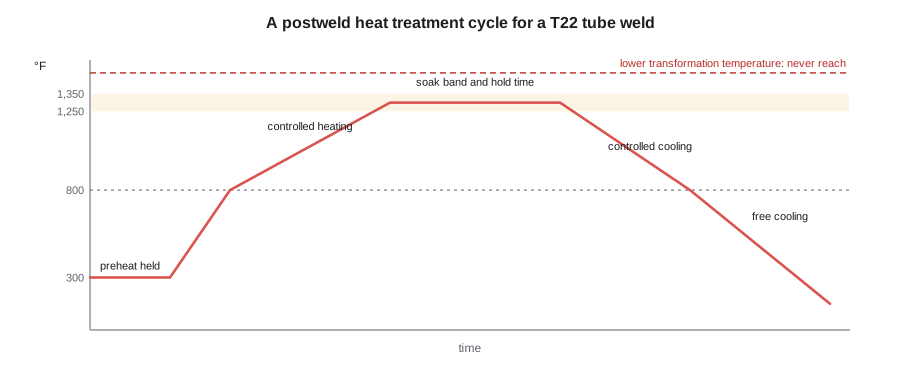
ASME Section I sets the preheat and PWHT rules for boiler pressure parts in PW-38 and PW-39. The PWHT table gives a holding temperature range and a minimum holding time for each P-number group, usually one hour per inch of thickness with a minimum, and limits on how fast the part may be heated and cooled above a threshold temperature, so that thick and thin parts do not crack from uneven heating. The table notes give exemptions: thin carbon steel welds, and some small-diameter, thin-wall tube welds in low-alloy groups when preheat is applied and the carbon is low, may be exempt from PWHT. The exemptions have conditions, and they change between editions; the WPS and the owner's specification state what applies to the job, and many owners require PWHT for alloy tube welds even where the code exempts them.
Kiera works through Riverbend's welds with a planning script that uses illustrative values of the kind found in the code tables. The values in a real job come from the edition of the code the jurisdiction has adopted and the WPS.
Here the hold time is in minutes, T is the weld thickness, T0 is 1 in and the minimum hold depends on the group.
# Preheat and PWHT plan from the material group and thickness (US units) - illustrative values
groups = {  # group: (example tubes, min preheat, PWHT soak low, high, min hold minutes)
    "P-No. 1": ("SA-210 A1, SA-192", 50, 1100, 1200, 15),
    "P-No. 4": ("SA-213 T11, T12", 250, 1200, 1300, 30),
    "P-No. 5A": ("SA-213 T22", 300, 1250, 1350, 30),
    "P-No. 15E": ("SA-213 T91", 350, 1375, 1425, 60),
}
exempt_p1 = 0.75          # P-No. 1 thickness at or below which this plan needs no PWHT

def plan(group, t):
    tubes, pre, lo, hi, hold_min = groups[group]
    needs = not (group == "P-No. 1" and t <= exempt_p1)
    hold = max(hold_min, 60 * t / 1)
    up = min(400, max(100, 400 / t))        # heating rate above 800 °F
    down = min(500, 500 / t)                    # cooling rate down to 800 °F
    out = f"{group:9} {t} in: preheat {pre} °F"
    if needs:
        out += f", PWHT {lo}-{hi} °F for {hold:.0f} min, heat at {up:.0f} and cool at {down:.0f} °F/h or less"
    else:
        out += ", no PWHT in this plan"
    return out

for g, t in [("P-No. 1", 0.25), ("P-No. 1", 1.25), ("P-No. 5A", 0.28), ("P-No. 15E", 0.34)]:
print(plan(g, t))P-No. 1 0.25 in: preheat 50 °F, no PWHT in this plan P-No. 1 1.25 in: preheat 50 °F, PWHT 1100-1200 °F for 75 min, heat at 320 and cool at 400 °F/h or less P-No. 5A 0.28 in: preheat 300 °F, PWHT 1250-1350 °F for 30 min, heat at 400 and cool at 500 °F/h or less P-No. 15E 0.34 in: preheat 350 °F, PWHT 1375-1425 °F for 60 min, heat at 400 and cool at 500 °F/h or less
The waterwall tube, at 1/4 in, needs no PWHT in this plan. A thick carbon steel nozzle repair on the lower header, at 1 1/4 in, does: about 75 minutes at 1,100 to 1,200 °F, heated and cooled at controlled rates. The T22 superheater tube needs preheat and a short soak at a higher temperature, and the T91 header stub needs the highest preheat, a narrow soak band and an hour's hold.
Heat treating in the field
In the field, PWHT of tube and pipe welds is done with local heating: flexible ceramic resistance heating pads wrapped round the joint, or an induction coil, both powered by a heat treatment unit with a controller and a recorder. The heated band must be wide enough on each side of the weld that the weld and heat-affected zone are at temperature through the wall, and it is covered by insulation that extends farther still, so the temperature falls off gradually. Thermocouples are attached to the tube, usually by a small capacitor-discharge welder that tacks the thermocouple wires to the surface, at the weld and at the edges of the band, and the recorder logs each one through the whole cycle. The chart is part of the repair record; a heat treatment without a chart did not happen.
The heat treatment technician, from a specialist company, sets up the pads and thermocouples to a written procedure, and Kiera helps by wrapping insulation and keeping the area clear. On a waterwall or superheater, the heat runs up the tube and into neighboring tubes and the membrane, so the technician places extra thermocouples and insulation to control it. On a tube full of water, PWHT is not possible; the tube is drained and dry.
Grade 91: a material that does not forgive
Grade 91 tubes and pipes have been in boilers for decades, and their field welds have caused a good share of trouble. The common problems are a PWHT that ran too cold, leaving hard welds; a PWHT that ran too hot, damaging the steel; the wrong filler metal, especially one with too much nickel and manganese, which lowers the transformation temperature; welds allowed to cool to room temperature before PWHT and cracking while waiting; and long-term creep cracking in the soft outer edge of the heat-affected zone, known as type IV cracking. The industry's response has been tighter controls: PMI of the base metal and filler, preheat held through PWHT, calibrated heat treatment equipment with thermocouples placed by procedure, and a hardness check on every weld after PWHT, against a range the owner sets, to confirm it was tempered correctly.
On Riverbend, the T91 header stubs are not being welded this outage, but Peg wants them inspected, and a hardness test of each old stub weld is added to the work list. Kiera learns to recognize the alloy marks and the color-coded paint stripes Riverbend uses on alloy tubes, because in a boiler, the steel next to a carbon steel tube may be an alloy that needs a completely different procedure.
The T22 superheater tube
The bulged T22 tube is replaced with a short dutchman, as in lesson 9, but every step changes with the material. The new tube is T22 with its test report, confirmed by PMI. The WPS is a P-No. 5A procedure with a chromium-molybdenum filler of matching composition, GTAW root with an argon purge inside the tube to keep the root clean, and SMAW fill with low-hydrogen chromium-molybdenum electrodes. Preheat of 300 °F is applied by resistance pads before tacking and held through welding. The welds are heat treated with the pads, with a chart, and checked for hardness. Marcel, whose WPQ covers the alloy, makes the welds.
Worked problem
PWHT hold time
A carbon steel header nozzle weld is 1 1/4 in thick. The plan holds one hour per inch of thickness, with a minimum of 15 minutes. How long is the hold?
Show solution
- One hour per inch: 1.25 ÷ 1 = 1.25 h.
- In minutes: 1.25 × 60 = 75 min, above the 15-minute minimum.
Answer: About 75 minutes at the soak temperature.
Dissimilar metal welds
Where an alloy superheater tube meets a different alloy, or a stainless tube meets a ferritic one, the joint is a dissimilar metal weld. Each side wants its own preheat, heat treatment and filler, and the weld must suit both. Dissimilar welds between ferritic steels, such as T22 to T91, are usually welded with a filler matching the lower alloy and heat treated in a band the lower alloy can take. Welds between ferritic steel and austenitic stainless often use a nickel-based filler, because it expands at a rate between the two metals and limits the stress the joint sees every time the boiler heats and cools. These joints have their own WPSs, and their location in the boiler is planned by the owner's engineers so that they sit where the temperature is low enough for the joint to last. A boilermaker who finds an unexpected dissimilar joint in the boiler stops and asks.
Common mistakes
MistakeAssuming a tube is carbon steel because the drawing says so.
InsteadConfirm the material by its markings and PMI before choosing the WPS.
MistakeLetting a Grade 91 weld cool to room temperature before PWHT.
InsteadHold the preheat until heat treatment starts, as the WPS requires.
MistakeRunning PWHT without enough thermocouples.
InsteadPlace thermocouples by procedure at the weld and band edges, and record every one.
MistakeExceeding the soak band to save time.
InsteadStay within the band and well below the transformation temperature.
MistakeHeat treating a tube full of water.
InsteadDrain and dry the tube before PWHT.
Summary and key terms
- P-numbers group base metals: P-No. 1 carbon steel, 4 and 5A chromium-molybdenum, 15E Grade 91 and 8 austenitic stainless.
- Confirm the material by markings and PMI before choosing the WPS.
- Preheat slows cooling and drives out hydrogen; alloy steels need it at all thicknesses.
- PWHT relieves stress and tempers hard zones; Grade 91 must be tempered in a narrow band.
- Field PWHT uses resistance pads or induction with recorded thermocouples; the chart is part of the record.
- Exemptions in the code tables have conditions; follow the WPS and the owner's specification.
- P-number
- A Section IX grouping of base metals with similar welding behavior.
- PMI
- Positive material identification: confirming an alloy by measuring its composition.
- PWHT
- Postweld heat treatment: controlled heating, holding and cooling after welding.
- Creep
- Slow, continuing deformation of metal held at high temperature under stress.
- Soak band
- The temperature range the heat-treated zone must stay within during the hold.
- Type IV cracking
- Creep cracking in the outer, softened edge of the heat-affected zone in some alloy welds.
Practice problems
Work each problem on paper first, then reveal the answer to check.
A weld is 0.75 in thick, hold one hour per inch with a 30-minute minimum. How long is the hold?
Show answer
0.75 × 60 = 45 minutes, which is above 30.
A heating rate limit is 400 ÷ t °F/h, capped at 400. What is it for 1.5 in?
Show answer
400 ÷ 1.5 = 267 °F/h.
Why is PMI done on alloy tubes?
Show answer
To confirm the tube is the alloy the WPS is written for.
What happens if a Grade 91 weld is heat treated above its transformation temperature?
Show answer
The steel is damaged and the weld is normally cut out and redone.
Lesson quiz · 5 questions
Score 60% or more to complete this lesson.
Create a free account to save your progress, take quizzes and earn a certificate.