
BLR-210 · Lesson 1 of 12 · 21 min
Welding and cutting in boilermaker work
In April, two weeks before its planned spring outage, Riverbend Generating Station's Unit 2 trips on a waterwall tube leak. The operators see the drum level falling faster than the feedwater can make up, hear the hiss of steam from the furnace, and take the unit off line. Within a day, Ironbridge Industrial has a crew on site and the outage has been pulled forward. Kiera Lafontaine, now a second-year apprentice, is on that crew. Over the last year she has learned the safety side of the trade, heavy rigging and layout and fitting. This course follows her through a season in which cutting and welding are the work: the waterwall repair at Riverbend, a shell repair on Tank 14 at Bayou Junction, back-gouging on Northgate's spring work, and the floor tube welds in the Pinecrest Paper recovery boiler.
Welding and cutting run through nearly everything a boilermaker does. Before a tube can be replaced, it has to be cut out. Before a shell plate can be welded, its edges have to be cut and beveled. Before a cracked weld can be repaired, it has to be gouged or ground out to sound metal. Most of the welds boilermakers make are on pressure parts: tubes, headers, drums, shells and nozzles that will hold steam, water or process fluid under pressure. Those welds are covered by codes, made to written procedures by qualified welders, and inspected before the equipment goes back into service. The welder program teaches the processes in depth. This course is about using them on the work boilermakers do, in the places boilermakers work.
The processes a boilermaker uses
A boilermaker crew on an outage or a turnaround carries a small set of cutting and welding processes and uses each one where it fits.
| Process | What it does on boilermaker work | Where it is used most |
|---|---|---|
| Oxyfuel cutting (OFC) | Cuts carbon and low-alloy steel of any thickness by burning it in a jet of oxygen | Heavy plate, tank shells, skirts, temporary attachments, scrap |
| Plasma arc cutting (PAC) | Cuts any conductive metal by melting it with a constricted arc | Stainless, membrane bars, thin plate, duct and casing |
| Mechanical cutting | Saws, clamshell cutters, end prep machines and grinders | Boiler tubes and pipe, where slag and heat must be kept out |
| Air carbon arc cutting and gouging (CAC-A) | Melts metal with a carbon arc and blows it out with compressed air | Back-gouging, removing defects and old welds |
| Shielded metal arc welding (SMAW) | Stick welding with coated electrodes | Fill and cap passes on tube and plate, field repairs in any position |
| Flux cored arc welding (FCAW) | Wire-fed welding with a flux core, with or without shielding gas | Tank seams, structural work, heavy plate in the field |
| Gas tungsten arc welding (GTAW) | A tungsten arc with separate filler and an inert gas shield | Root passes on tubes and small pipe, alloy and stainless work |
| Gas metal and submerged arc welding (GMAW, SAW) | Wire-fed processes for high production | Mostly in the shop: vessel seams, panels, cladding |
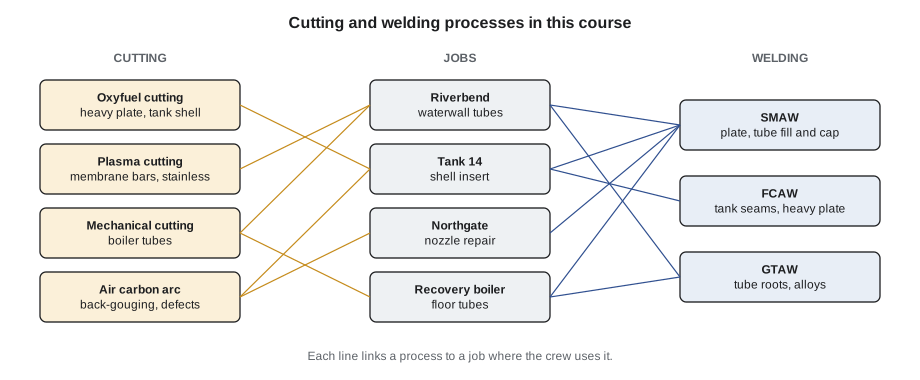
Two things set boilermaker welding apart from shop welding. The first is position and access. A shop welder turns the work so that the weld is flat or horizontal; a boilermaker welds the tube where it is, often overhead or in a fixed position, sometimes with a mirror, inside a furnace on a scaffold, with the next tube 1/2 in away. The second is that the weld is going back into service on equipment that is already running. A repaired waterwall tube will see the full drum pressure and the full heat of the furnace within days of the last pass, so the weld has to be right the first time, and everyone involved, from the welder to the inspector, knows it.
Pressure welding is regulated work
Welding on boilers and pressure vessels is controlled by law in both countries. In the United States, each state that regulates boilers adopts the ASME Boiler and Pressure Vessel Code for new construction and the National Board Inspection Code, the NBIC, for repairs and alterations. Louisiana's boiler rules require that repairs and alterations follow the NBIC and be made by an owner or user, or by an organization holding a National Board certificate of authorization for the R symbol stamp. Ironbridge holds an R certificate, which means its quality program has been reviewed and it works under the eye of an authorized inspector, usually employed by the plant's insurer. Welders are qualified under ASME Section IX by the company they weld for, and each qualification is recorded on a welder performance qualification record, the WPQ.
The documents behind a code weld have names that every boilermaker learns early.
- Welding procedure specification (WPS). The written recipe for a weld: process, base metal group, filler metal, thickness range, positions, preheat, interpass temperature, postweld heat treatment, current, voltage and travel speed ranges. The welder works to the WPS posted at the job.
- Procedure qualification record (PQR). The record of the test weld that proved the WPS makes a sound weld with the required properties. The PQR is why the WPS can be trusted.
- Welder performance qualification (WPQ). The record that a particular welder passed a test weld using a WPS. It sets what that welder may weld: process, position, thickness, diameter, backing and filler group.
- Continuity log. The record that each qualified welder has used each process on code work within the allowed time. Under ASME Section IX, a welder who goes six months without using a process loses that qualification and must requalify.
Kiera is not yet a qualified pressure welder. She will spend her second year doing everything around the weld: cutting out, fitting, preheating, cleaning, grinding, watching the welders and running non-pressure welds. She will practice tube welds in Ironbridge's training booth at Port Allen and take her first test later in her apprenticeship. On the Riverbend repair she works with Marcel Beaudry, Ironbridge's lead tube welder, who has been welding boiler tubes for twenty-two years and still keeps his own notebook of every repair.
Checking the welders before the outage
The first thing Harjit Gill, Ironbridge's quality control manager, does when the crew is called out is check that every welder on the list is current. A welder whose qualification has lapsed cannot strike an arc on a pressure part, however good they are, and finding that out after the weld is made means cutting the weld out. Harjit keeps the continuity log for every welder in a spreadsheet; before the crew leaves the yard, he runs the list against the date.
# Welder continuity check before the Riverbend outage (US units)
from datetime import date

today = date(2027, 4, 12)

def add_months(d, n):
    y, m = divmod(d.month - 1 + n, 12)
    y, m = d.year + y, m + 1
    days = [31, 29 if y % 4 == 0 else 28, 31, 30, 31, 30, 31, 31, 30, 31, 30, 31][m - 1]
    return date(y, m, min(d.day, days))

# (welder, process, date the process was last used on code work)
log = [
    ("M. Beaudry", "GTAW", date(2027, 2, 20)),
    ("M. Beaudry", "SMAW", date(2026, 11, 2)),
    ("S. Nakamura", "GTAW", date(2026, 9, 30)),
    ("S. Nakamura", "SMAW", date(2027, 3, 15)),
    ("J. Okeke", "SMAW", date(2027, 1, 10)),
    ("J. Okeke", "FCAW", date(2026, 12, 1)),
    ("R. Haldane", "GTAW", date(2026, 10, 20)),
]

print("WPQ continuity, checked", today.isoformat())
for who, proc, last in log:
    lapse = add_months(last, 6)          # qualification lapses 6 months after last use
    left = (lapse - today).days
    if left < 0:
        status = "LAPSED - requalify before welding"
    elif left <= 30:
        status = f"OK, but lapses in {left} days"
    else:
        status = "OK"
print(f"{who:12} {proc:5} last used {last.isoformat()} lapses {lapse.isoformat()} {status}")WPQ continuity, checked 2027-04-12 M. Beaudry GTAW last used 2027-02-20 lapses 2027-08-20 OK M. Beaudry SMAW last used 2026-11-02 lapses 2027-05-02 OK, but lapses in 20 days S. Nakamura GTAW last used 2026-09-30 lapses 2027-03-30 LAPSED - requalify before welding S. Nakamura SMAW last used 2027-03-15 lapses 2027-09-15 OK J. Okeke SMAW last used 2027-01-10 lapses 2027-07-10 OK J. Okeke FCAW last used 2026-12-01 lapses 2027-06-01 OK R. Haldane GTAW last used 2026-10-20 lapses 2027-04-20 OK, but lapses in 8 days
The check shows three things. Most of the crew are current. Marcel's SMAW qualification and R. Haldane's GTAW qualification will lapse during the outage unless they use the processes on code work before the dates shown, which they will on the first day. S. Nakamura has not used GTAW on code work for more than six months, so Harjit takes her off the GTAW root list and books her a requalification test in the training booth; she can run SMAW fill and cap passes in the meantime, because that qualification is current. Harjit's rule is to review the log every Monday during a job and the day before every call-out.
Shop work and field work
Ironbridge's yard has a fabrication shop, and some of the welding for the Riverbend repair happens there: the new two-tube panel section is cut, beveled, fitted and welded on a bench, where the welder can position the work and the shop's inspector can check it before it leaves. The field welds, where the new section joins the old wall, happen in the furnace. Field welding brings its own problems: wind and draft, cold steel, poor light, awkward access, dirty and wet surroundings, and a schedule that is costing the plant money every hour. A good field crew controls what it can. It builds a habitat or windbreak, warms the steel to the preheat on the WPS, lights the work, keeps electrodes in a heated oven at the job, and stages its tools so the welder spends the shift welding rather than looking for a grinder.
Cutting is shared between shop and field in the same way. A shell plate for Tank 14 is cut and beveled on the shop's burning table; the opening it fills is cut in the field with a track-mounted torch. Tubes are cut in the field with saws and clamshell cutters, never with a torch inside a boiler, because slag in a tube can block it, and a blocked tube in a furnace overheats and fails.
Hold points and the people who inspect
Every pressure repair is planned around hold points, steps at which the work stops until someone has checked it. On the Riverbend waterwall, the repair plan names five: the cut-out and end preparation, the fit-up of each joint, the completed root pass on the first joint, the radiographs of every butt weld, and the hydrostatic test. At each one, Harjit checks the work for Ironbridge, Peg Lindqvist checks it for Riverbend as the owner's inspector, and Grant Mahler, the authorized inspector, is notified for the points he has asked to witness. Annika Sorensen, a radiographer and ultrasonic technician from Keystone Inspection, takes and reads the radiographs.
Hold points can feel like delays, but they save time. A fit-up rejected at the hold point costs a few minutes with a grinder; the same fault found on a radiograph costs a cut-out and a rewelded joint, and found in service it costs another outage. Kiera's job at every hold point is to have the work ready, clean and measured, with the readings on the traveler, the sheet that follows the joint through the repair.
Safety in cutting and welding on plant work
Every cutting and welding job on a plant site happens under a hot work permit, inside the permit system that BLR-110 covered. In a boiler, the hazards stack up: confined space entry, work at heights on a scaffold inside the furnace, fumes from coated electrodes and from paint and deposits on old tubes, ultraviolet and infrared light, electrical hazards from welding leads running in a wet, steel enclosure, compressed gas cylinders that must stay outside the boiler, and fire in the insulation and lagging on the casing side. The welding crew and the fire watch work together; the fire watch stays after the last arc for the time the permit sets, checking the casing side, where smoldering insulation can hide.
The welding lead itself deserves respect in a boiler. A boiler is a large, grounded steel box, and a welder standing on it is part of the circuit. Leads are inspected for cuts before every shift, the work return clamp goes on the work as close to the weld as possible rather than on the scaffold, and the welder keeps dry gloves and a dry insulating mat. Electrode holders are never left on the scaffold boards with an electrode in them.
Worked problem
Is the welder qualified for this weld?
Marcel's WPQ for SMAW covers groove welds in all positions, pipe and tube down to 1 in outside diameter, base metal in the carbon steel group, and filler of the low-hydrogen group. The Riverbend waterwall tubes are 2 1/2 in carbon steel, welded in a fixed position with E7018 fill and cap. He last used SMAW on code work on November 2, and today is April 12. May he weld the fill and cap?
Show solution
- Process: SMAW, covered.
- Position and diameter: all positions, 2 1/2 in is above the 1 in minimum, covered.
- Base metal and filler: carbon steel tube and low-hydrogen filler, covered.
- Continuity: six months from November 2 is May 2, which is after today, so the qualification is still current.
Answer: Yes. He must use SMAW on code work before May 2 to keep the qualification, which he will do on this repair, and the use must be recorded in the log.
Common mistakes
MistakeAssuming a good welder is a qualified welder.
InsteadCheck the WPQ and the continuity log before the welder starts on a pressure part.
MistakeWelding to memory instead of to the WPS.
InsteadPost the WPS at the job and work within its ranges for preheat, current and filler.
MistakeCutting a boiler tube with a torch inside the furnace.
InsteadCut tubes mechanically so no slag gets inside.
MistakeTreating hold points as paperwork.
InsteadHave the joint ready, measured and recorded before calling the inspector.
MistakeClamping the work return to the scaffold.
InsteadPut the work clamp on the work, close to the weld.
Summary and key terms
- Boilermakers use oxyfuel, plasma, mechanical and air carbon arc cutting, and SMAW, FCAW and GTAW welding, each where it fits the work.
- Welding on pressure equipment is regulated: qualified procedures, qualified welders, an accepted quality program and inspection.
- The WPS is the recipe, the PQR proves it, the WPQ qualifies the welder and the continuity log keeps the welder current.
- Field welding means controlling wind, cold, light, access and electrodes so the weld can be made to the WPS.
- Hold points stop the work so it can be checked when faults are cheap to fix.
- Hot work permits, fire watch, fume control and lead care are part of every cutting and welding job in a plant.
- WPS
- Welding procedure specification: the written instructions for making a code weld.
- PQR
- Procedure qualification record: the test record that supports a WPS.
- WPQ
- Welder performance qualification: the record of a welder passing a test weld and the range it covers.
- Continuity
- Evidence that a welder has used a process on code work within the time allowed.
- Hold point
- A step in the work that cannot be passed until it has been inspected.
- Traveler
- The record sheet that follows a joint through cutting, fitting, welding and inspection.
Practice problems
Work each problem on paper first, then reveal the answer to check.
Name two reasons a boiler tube is cut mechanically rather than with a torch.
Show answer
Slag can get inside and block the tube, and the torch puts heat and oxidation into the tube end that then has to be removed.
A welder last used GTAW on code work on October 15. On what date does the qualification lapse?
Show answer
April 15, six months later, unless the process is used on code work before then.
What does the PQR prove that the WPS alone does not?
Show answer
That a test weld made to the procedure was sound and met the required mechanical properties.
What National Board stamp does a repair organization hold?
Show answer
The R stamp, under a certificate of authorization from the National Board.
Lesson quiz · 5 questions
Score 60% or more to complete this lesson.
Create a free account to save your progress, take quizzes and earn a certificate.