
BLR-210 · Lesson 8 of 12 · 19 min
Boiler tube welding and membrane walls
Marcel welds the first Riverbend joint, tube 47's bottom butt weld, on the morning of the fourth day of the outage. He is standing on a scaffold board 60 ft up inside the furnace, facing the left sidewall, with a light clamped beside him, a rod oven at his feet, a GTAW torch in one hand and a filler rod in the other. The tube runs vertically in front of him; the joint is a horizontal ring around it. Tube 46 and tube 49 are 1/2 in from the new section on either side, joined to it by nothing yet, because the new membrane bars go in last. Behind the tubes, the casing has been opened and Dale is on the outside scaffold, ready to weld the part of the ring that Marcel cannot reach. This lesson follows a tube weld from the root to the cap, and then the membrane that makes the tubes a wall again.
Tube welding positions
Tube and pipe welds have their own position numbers. A pipe or tube that can be rolled while the welder stays in the flat position is 1G. A vertical tube with a horizontal joint, welded in place, is 2G. A horizontal tube that cannot be rolled, so the welder goes round it from the bottom up each side, flat at the top, vertical at the sides and overhead at the bottom, is 5G. A tube fixed at a 45-degree angle is 6G, the hardest test position, which covers all the others. Waterwall tubes are vertical, so their butt welds are 2G. Superheater and reheater loops, hanging in the gas path, are often horizontal or bent, so their welds may be 5G or worse. Most boiler tube welders hold a 6G qualification, often with a restriction ring, a plate tacked round the test joint to imitate the next tube in a bank, because in the boiler there is always something in the way.
The root pass
On Riverbend, the root of every tube butt weld is made with gas tungsten arc welding. GTAW gives the welder fine control: the arc and the filler are separate, the current can be set low, and the welder can see the puddle clearly through the argon shield. The root must penetrate the full wall, fuse both lands and leave a smooth, slightly convex bead on the inside of the tube with no excessive penetration, called icicles or drop-through, that would disturb water flow, and no suck-back, a concave root that leaves the inside thinner than the wall. On carbon steel tubes, the inside of the tube does not need a backing gas purge; on stainless and many alloy tubes, the bore must be purged with argon to keep the inside of the root from oxidizing, and the purge is held in by dams or dissolvable paper plugs.
Marcel starts the root at the back of the tube, the side he can just reach, and welds toward himself, round one side to the front, then the other side. He feeds the filler wire through the root opening, adding just enough to fill the gap, and watches for the keyhole, the small opening at the leading edge of the puddle that shows the root is melting through both lands. When he reaches a tack, he melts through its feathered end and consumes it. At the back of the tube, behind the membrane line, he cannot see the root clearly, so he uses a dental mirror clamped to the next tube and welds watching the reflection, which reverses left and right. Mirror welding is a skill boilermaker welders practice for years.
On the bottom joints, Dale finishes the back quarter of the root from the outside scaffold, through the opened casing, so that each part of the ring is welded by someone who can see it. Where that is not possible, as on the top joints under the buckstay, a window is cut in the new tube to reach the back from inside, as lesson 9 shows.
The hot pass, fill and cap
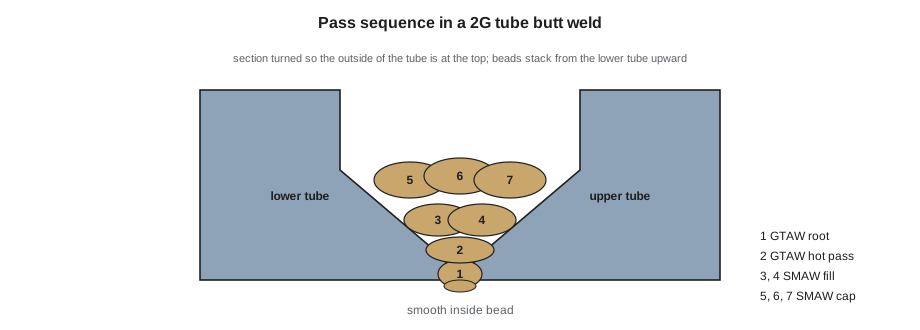
The root is thin and easily cracked or burned through by the first stick pass, so Marcel follows it with a second GTAW pass, the hot pass, which thickens the root and fuses any small cold spots at its edges. Then the fill and cap are made with low-hydrogen stick electrodes, 3/32 in or 1/8 in diameter on this tube wall. On a vertical tube, the 2G joint is horizontal, so the fill and cap are stacked stringers, as on the Tank 14 horizontal seam in lesson 5, but small: on a 1/4 in wall, the whole weld is only about four passes deep, two GTAW and two stick, with the cap in two or three stringers.
Each pass is started at a different place round the tube, so starts and stops do not stack on top of each other, and each start and stop is ground to a taper. Between passes, the slag is chipped and brushed, and the interpass temperature is checked with a contact thermometer or crayon.
Filler and heat input
Because tube welds are small, the filler is counted in rods rather than kilograms, but it is still worth estimating, because a crew that runs out of the right filler at the top of a scaffold loses an hour. Kiera estimates the filler for one joint, and checks Marcel's heat input on each pass against the WPS maximum. Heat input matters on tubes because the wall is thin: too much heat coarsens the weld metal and heat-affected zone, makes the root sag and can distort the tube.
# Filler and heat input for one waterwall tube butt weld (US units)
from math import pi, tan, radians

od, wall, land, gap = 2.5, 0.25, 0.0625, 0.125
area = ((wall - land) ** 2 * tan(radians(37.5)) + gap * wall) * 1.15   # with reinforcement
circ = pi * (od - wall)                       # mean circumference of the weld
weight = area * circ * 0.2836
root = 0.25 * weight                           # GTAW root and hot pass
rest = weight - root                           # SMAW fill and cap
print(f"weld metal per joint {weight * 16:.1f} oz (GTAW {root * 16:.1f}, SMAW {rest * 16:.1f})")
print(f"GTAW wire per joint: about {root / 0.064:.1f} rods of filler wire")
print(f"SMAW electrodes per joint: about {rest / 0.026:.1f}, so {rest / 0.026 * 4:.0f} for {4} joints")

# heat input per pass, against the WPS maximum for the tube material
hmax = 40
for name, v, a, s in [("GTAW root", 11, 95, 2.4), ("SMAW fill", 23, 110, 4.7), ("SMAW cap", 23, 105, 4.3)]:
    h = v * a * 60 / (1000 * s)
print(f"{name:10} {h:.2f} kJ/in", "OK" if h <= hmax else "TOO HIGH")weld metal per joint 2.1 oz (GTAW 0.5, SMAW 1.6) GTAW wire per joint: about 0.5 rods of filler wire SMAW electrodes per joint: about 3.9, so 15 for 4 joints GTAW root 26.12 kJ/in OK SMAW fill 32.30 kJ/in OK SMAW cap 33.70 kJ/in OK
Each joint holds only about 2 ounces of weld metal, half a GTAW rod for the root and hot pass and about four stick electrodes for the fill and cap. The four butt welds need about fifteen electrodes, so Kiera puts a full can in the oven on the scaffold. All the passes are inside the WPS heat input maximum, the GTAW root lowest because the current is low.
Membrane walls
A membrane wall, also called a water wall or tangent wall in older designs, is a row of tubes joined edge to edge by flat bars welded between them, making a gas-tight steel panel. The tubes carry water and steam; the bars seal the furnace, carry heat to the tubes and make the wall a structure, held flat by buckstays, the horizontal beams on the outside that tie the walls together. Modern panels are made in the shop by automatic welding machines that weld the bars to the tubes along their whole length on both sides. Field repairs reproduce that panel by hand.
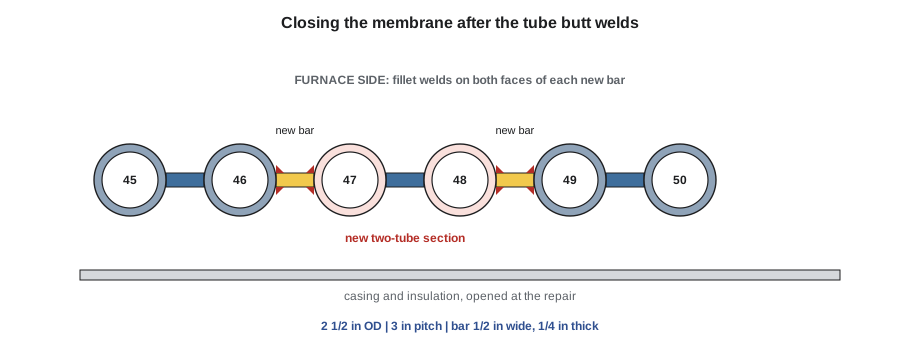
On Riverbend, the new two-tube section came from the shop with its own center bar already welded. The gaps between the new section and tubes 46 and 49 are filled with new bars, cut to fit the half-bar edges left by the plasma split in lesson 3. The membrane is welded only after all the tube butt welds have passed their radiographs, so a rejected butt weld can be cut out without first cutting out new membrane, and so that the tubes are free to shrink as they are welded rather than being locked in place.
Membrane welds are fillet welds, bar to tube, on both faces, furnace side and casing side. They are not pressure welds in the same sense as the butt welds, but they are welds on the pressure tube, so they are made to a WPS by a qualified welder and they matter. A membrane fillet with undercut on the tube, or a crater at the end of a bar, is a stress raiser, and Riverbend's leak itself began at the toe of a membrane weld. Marcel welds membrane in short lengths, alternating sides of the tube and working from the middle of the repair outward, so the heat does not bow the tubes. The ends of the new bars, where they meet the old split bar, are welded with full fusion and ground smooth, never left as open craters.
Why the original weld cracked
Peg's examination of the failed section gives the crew a reason to care about the membrane welds. The crack started at the toe of the fillet that joined the membrane to tube 47, beside a buckstay clip, where the wall is held stiff. Each time the unit starts and stops, the walls expand and contract, and the clip and the stiff membrane concentrate the strain at that toe. Corrosion from the water side helped. A crack grew through the tube wall over years of starts and stops, which is called corrosion fatigue, until it leaked. Peg's recommendation is that the new membrane fillets near the buckstay clip are ground to a smooth toe and examined by magnetic particle testing, and that the clip's attachment is redesigned at the next planned outage.
Worked problem
How many passes in a tube weld?
A 0.250 in tube wall is welded with a GTAW root about 3/32 in thick, a GTAW hot pass adding 1/16 in, and SMAW fill passes about 1/16 in thick each, with the cap finishing about 1/32 in proud. How many fill passes before the cap?
Show solution
- After the root and hot pass: 0.250 − 0.094 − 0.063 = 0.093 in of wall left to fill.
- That is about one and a half fill passes, so one or two fill passes depending on the bead size.
- Then the cap, in two or three stringers, to finish proud of the surface.
Answer: One to two fill layers and a cap; on thin tube walls the weld is only a few layers deep.
Practicing for the boiler
Ironbridge's training booth has a mock-up of a waterwall: a short panel of tubes and membrane bars welded to a frame, with a buckstay bolted across it and a removable casing plate behind. Kiera practices cutting out a tube, preparing the ends and fitting a dutchman on it, and in the second half of her second year, she will start practicing tube welds on it, first in the open, then with a mirror at the back of the tube, then with the buckstay in place. Marcel's advice is to practice the uncomfortable positions most, because in the boiler nobody chooses the position.
Common mistakes
MistakeLeaving icicles or suck-back in the root.
InsteadControl the keyhole and filler so the inside bead is smooth and full.
MistakeFollowing a thin GTAW root directly with a heavy stick pass.
InsteadPut in a GTAW hot pass first to thicken the root.
MistakeStacking every start and stop at the same place.
InsteadStagger the starts round the tube and taper each one.
MistakeWelding the membrane before the butt welds are accepted.
InsteadRadiograph and accept the butt welds, then close the membrane.
MistakeLeaving undercut or open craters on membrane fillets.
InsteadFuse the toes, fill the craters and grind smooth near stiff points.
Summary and key terms
- Tube positions are 1G rolled, 2G vertical tube, 5G fixed horizontal and 6G fixed at 45 degrees.
- The root is GTAW, penetrating fully with a smooth inside bead; carbon tubes need no purge, alloy and stainless ones do.
- A GTAW hot pass protects the root before the SMAW fill and cap.
- Starts and stops are staggered and tapered; slag is removed and interpass temperature checked.
- Membrane bars are fillet-welded on both faces after the butt welds pass, working outward in short lengths.
- Toes and craters on membrane welds are stress raisers; the Riverbend leak began at one.
- 2G
- For tube and pipe, a vertical axis with a horizontal ring joint.
- 6G
- A tube or pipe fixed at 45 degrees; the test position that covers all others.
- Keyhole
- The small opening at the leading edge of a root puddle that shows full penetration.
- Hot pass
- The pass just after the root that thickens and protects it.
- Suck-back
- A root that is concave on the inside, leaving the joint thinner than the wall.
- Buckstay
- A horizontal beam on the outside of a furnace wall that holds the wall flat and ties the walls together.
Practice problems
Work each problem on paper first, then reveal the answer to check.
Why is a carbon steel waterwall tube root welded without a backing purge?
Show answer
Carbon steel's inside root bead does not need protection from oxidation the way stainless and many alloy roots do.
A GTAW pass runs at 11 V, 95 A and 2.4 in/min. What is the heat input?
Show answer
11 × 95 × 60 ÷ 2,400 = 26.1 kJ/in.
Why are new membrane bars welded in short lengths from the middle outward?
Show answer
To spread the heat so the tubes do not bow.
Which position covers a horizontal fixed tube?
Show answer
5G.
Lesson quiz · 5 questions
Score 60% or more to complete this lesson.
Create a free account to save your progress, take quizzes and earn a certificate.