
BLR-210 · Lesson 7 of 12 · 19 min
Tube end preparation and fit-up
The failed section of tubes 47 and 48 is out of the Riverbend wall and on its way to Peg's lab. Four tube ends stick out of the wall, two above the gap and two below, each cut square and plugged. Before any welding, every one of those ends must be prepared: faced square, beveled to the WPS, cleaned inside and out, and checked. Then the new two-tube section must be cut to the right length and fitted between them. In tube welding, more welds fail because of poor end preparation and fit-up than because of poor welding, and Marcel will not strike an arc on a joint he has not checked himself. This lesson is about the work that comes before the arc.
The tube and the joint
Riverbend's waterwall tubes are seamless carbon steel boiler tube to SA-210 Grade A1, 2 1/2 in outside diameter with a 0.250 in minimum wall, on 3 in centers, joined by 1/2 in membrane bars. The WPS for the repair calls for a single-V butt joint: each tube end is beveled at 37.5 degrees, leaving a land of 1/16 in, and the ends are set with a root opening of 3/32 to 1/8 in. The root is welded by GTAW and the fill and cap by SMAW.
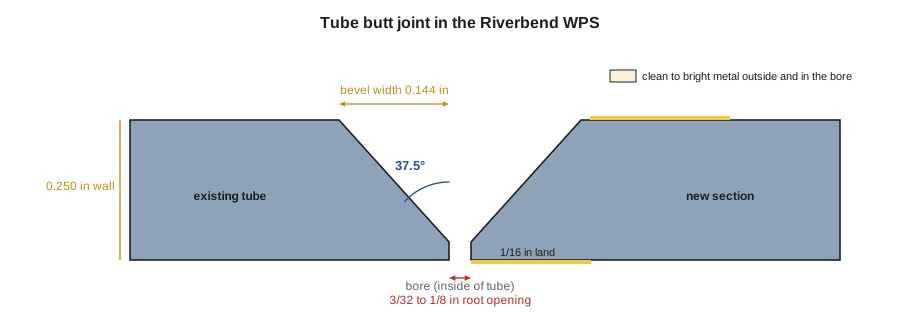
The 37.5-degree bevel is the standard bevel for boiler tube and pipe. The two bevels together make a 75-degree groove, wide enough for the welder to reach the root with a GTAW torch and fill with a small stick electrode, but not so wide that it takes more weld metal than it must. The land, a small flat at the root, gives the root pass something to fuse to and keeps the thin edge from melting away. The root opening lets the GTAW root penetrate through the full wall and form a smooth bead inside the tube.
End preparation tools
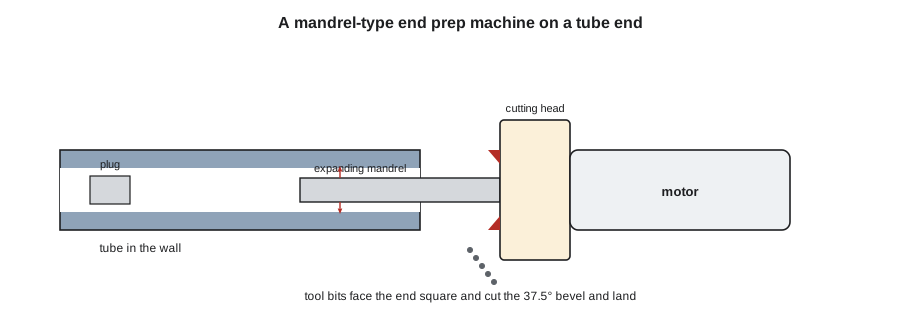
Tube ends in a boiler are beveled with portable end prep machines, often called bevelers or tube facing tools. The common type locks into the bore of the tube with an expanding mandrel, so it centers itself on the tube, and turns a cutting head that faces and bevels the end in one operation. Other types clamp around the outside, like the clamshell cutters of lesson 3, and are used where the bore is not round or where the tool must not touch the inside. The tool is powered by air, electricity or hydraulics; in a furnace, air tools are common because they do not bring electrical risk into a wet steel box.
A grinder can bevel a tube, and in a pinch it does, but a hand-ground bevel is never as even as a machined one. The angle wanders, the land varies around the tube, and the welder has to fight the joint all the way round. Marcel's rule is that every pressure tube end on a planned repair is machine-beveled, and grinding is only for touching up.
Cleaning the ends
After beveling, the end is cleaned to bright metal on the bevel, on the outside for at least 1 in back from the bevel, and on the inside of the bore for a short distance, using flap discs, wire wheels or an inside cleaning tool. Old boiler tubes carry oxide on the inside, a dark magnetite layer that is normal in service, and deposits that can include copper, iron oxides and other material from the water side. Oxide and deposits in the weld zone cause porosity, lack of fusion and, in the root, contamination that can crack. On the outside, there is slag, ash and paint. The newly beveled end is checked under a light: no dark spots on the bevel or land, no lamination, and no cracks.
While the ends are being cleaned, the plugs from lesson 3 stay in place below the cleaning, to catch the grit. Each one is checked off on the traveler as it is removed just before fit-up.
Checking the ends
Kiera checks each prepared end with a bevel gauge for the angle and land, with a square for squareness, and with a tube gauge or calipers for wall thickness at the bevel. Wall thickness at the end matters on old tubes: if the original tube has thinned near the end, the new tube will be thicker, and the mismatch at the root and on the outside must be dealt with by tapering the thicker tube to match, within the limit the WPS and the code set. On tubes 47 and 48, Peg's thickness readings show that the ends left in the wall are close to their original thickness, so no tapering is needed.
Making the new section fit
The new two-tube section was made in Ironbridge's shop from the measurements Kiera took after the cut-out. It was cut a little long on purpose, so that it could be trimmed and beveled to the exact length once the ends in the wall were prepared. Kiera now measures the opening between the prepared ends of each tube, at the inside of the lands, on both tubes, because two tubes side by side are seldom exactly the same. She subtracts two root openings, adds back the shrinkage the two welds will cause, and gives the cut length to the shop crew on the scaffold, who trim and bevel the new section's ends with the same end prep tool. The same calculation appears in lesson 9's planning code.
The section is lifted into place with the chain fall and set between the ends. The tubes are aligned with tube clamps, small clamps that grip both tubes either side of the joint and hold them in line, or with alignment dogs, small lugs tack-welded to the outside of the tube and bridged with a wedge. On Riverbend, Peg does not allow dogs to be welded to pressure tubes, so the crew uses clamps.
Fit-up tolerances
A tube joint is checked at fit-up for three things: root opening, misalignment and straightness. The root opening must be in the WPS range all the way round; too little and the root will not penetrate, too much and it will sag or burn through. Misalignment, often called high-low or hi-lo, is the step between the inside surfaces of the two tubes at the root; the WPS or the owner's specification sets a maximum. A high-low at the root makes it impossible for the root bead to fuse both sides, and it is the commonest cause of incomplete penetration in tube welds. Straightness matters too: the new section must line up with the wall, not kink at the joint, so that it sits flat in the membrane.
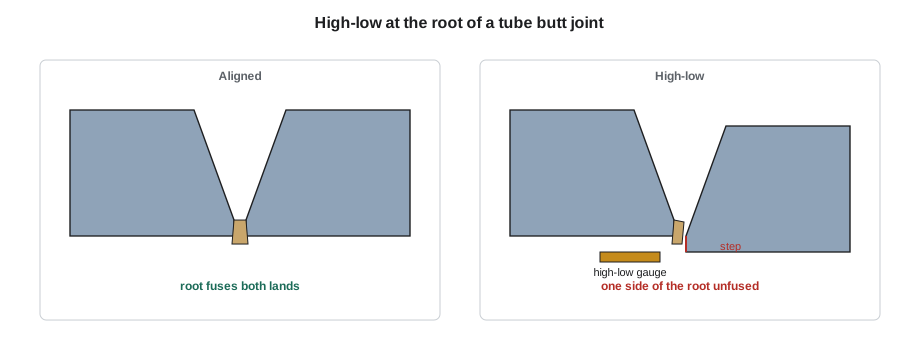
Kiera takes the fit-up readings at four points round each joint, at 12, 3, 6 and 9 o'clock, with a gap gauge and a high-low gauge, and checks them against the WPS. She checks the bevel geometry with the same script.
Here t is the wall, f the land, g the root opening, b the bevel width on the outside of one tube and A the section of the groove.
# Tube end preparation and fit-up checks (US units)
from math import tan, radians, pi

def show(x):
    return f"{x:.3f} in"

od, wall = 2.5, 0.25                    # waterwall tube
ang, land, gap = 37.5, 0.0625, 0.125        # bevel angle, land, root opening
bevel = (wall - land) * tan(radians(ang))   # width of the bevel on the outside of one tube
area = (wall - land) ** 2 * tan(radians(ang)) + gap * wall   # groove section, both tubes
print(f"bevel width on the OD: {show(bevel)}")
print(f"groove width at the OD with the gap: {show(2 * bevel + gap)}")
print(f"groove area {area:.3f} in2, around the tube {pi * (od - wall):.2f} in of weld")

# fit-up readings at 12, 3, 6 and 9 o'clock: (gap, high-low)
gap_lo, gap_hi, hilo_max = 0.094, 0.125, 0.031
joints = {"47 bottom": [(0.118, 0.012), (0.125, 0.020), (0.110, 0.016), (0.122, 0.008)],
          "48 bottom": [(0.122, 0.008), (0.114, 0.016), (0.134, 0.024), (0.118, 0.012)],
          "47 top": [(0.102, 0.035), (0.118, 0.016), (0.122, 0.012), (0.114, 0.020)],
          "48 top": [(0.118, 0.016), (0.114, 0.012), (0.122, 0.020), (0.125, 0.016)]}
for j, reads in joints.items():
    bad = [c for c, (g, h) in zip(("12", "3", "6", "9"), reads) if not (gap_lo <= g <= gap_hi) or h > hilo_max]
print(j, "fit OK" if not bad else "refit at " + ", ".join(bad) + " o'clock")bevel width on the OD: 0.144 in groove width at the OD with the gap: 0.413 in groove area 0.058 in2, around the tube 7.07 in of weld 47 bottom fit OK 48 bottom refit at 6 o'clock 47 top refit at 12 o'clock 48 top fit OK
Two joints are fine. On tube 48's bottom joint, the gap at 6 o'clock is 0.134 in, over the 0.125 in maximum, so the clamp is adjusted to close it. On tube 47's top joint, the high-low at 12 o'clock is 0.035 in, over the 0.031 in limit, so Marcel and Dale loosen the clamp, rotate the new tube slightly to match the ovality of the old one, and reclamp until the step is within the limit. Then the joints are tacked.
Tacking
Tack welds on tubes are made by the qualified welder to the WPS, with the same preheat as the weld, because a tack becomes part of the root. On a 2 1/2 in tube, three or four tacks are usual, each about 3/8 to 1/2 in long, spaced evenly round the joint. Many welders prefer bridge tacks, small pieces of filler or tube tacked across the groove from bevel to bevel without touching the root, which hold the alignment and are removed as the root is welded, so no tack becomes part of the root. Whatever kind, each tack is ground to a feather edge at both ends so the root pass ties in, and any cracked tack is ground out completely. After tacking, Kiera checks the gap and high-low again, because tacks pull.
The fit-up is a hold point. When the four joints are tacked and checked, Kiera writes the readings on the traveler, Marcel signs that he has checked them, and Harjit and Peg look at each joint before Marcel starts the root. Peg looks for three things before she signs: the plugs list is complete, the readings are within the WPS, and she can see daylight through the root opening all the way round.
Worked problem
Bevel width
A tube has a 0.250 in wall, a 37.5-degree bevel and a 1/16 in land. How wide is the bevel on the outside surface, and how wide is the groove at the outside surface with a 1/8 in root opening?
Show solution
- Bevel depth: 0.250 − 0.0625 = 0.1875 in.
- Bevel width: 0.1875 × 0.767 = 0.144 in.
- Groove width: 2 × 0.144 + 0.125 = 0.413 in.
Answer: The bevel is about 9/64 in wide and the groove about 13/32 in across at the outside.
Tubes that are not round
New tube is round within close tolerances, but tubes that have been in a boiler for fifty years often are not. Heat, internal pressure, the pull of the membrane and the clamping of buckstays leave them slightly oval, and a tube that has been bent to make room for a sootblower or a burner opening may be oval for some distance. An oval tube end next to a round new tube gives high-low on two sides of the joint even when the tubes are perfectly centered. The fixes are small. The new tube can be rotated so that its own small ovality lines up with the old tube's. A tube clamp with adjustable jaws can push an oval end slightly round while it is tacked. And on bigger mismatches, the WPS may allow the inside of the thicker or rounder tube to be tapered by machining, to spread the step over a gentle slope. What the crew must not do is force the tubes into line with heavy clamping that leaves them springing against the tacks, because the tacks will crack when the clamp is released.
Common mistakes
MistakeHand-grinding bevels on a planned repair.
InsteadMachine-bevel with an end prep tool; grind only to touch up.
MistakeLeaving inside oxide in the weld zone.
InsteadClean the bore back from the land as well as the outside.
MistakeAccepting high-low at the root because the outside lines up.
InsteadMeasure high-low at the bore; it decides whether the root can fuse both sides.
MistakeCutting the new section before the wall ends are prepared.
InsteadMeasure the prepared opening, then cut, allowing for gaps and shrinkage.
MistakeLeaving a cracked or square-ended tack.
InsteadGrind every tack to feather edges and remove any cracked tack.
Summary and key terms
- The Riverbend tube joint is a single V with 37.5-degree bevels, a small land and a root opening.
- End prep machines face and bevel tube ends evenly; hand grinding is only for touch-up.
- Clean the bevel, the outside and the bore to bright metal and check for laminations and cracks.
- Measure the prepared opening, then cut the new section allowing for root openings and shrinkage.
- Check root opening and high-low at four points round each joint against the WPS.
- Tack with the WPS, feather the tacks, recheck and present the fit-up at the hold point.
- Land
- The small flat at the root edge of a bevel.
- Root opening
- The gap between the two members at the root of a joint.
- High-low
- Misalignment between the inside surfaces of two pipes or tubes at a butt joint.
- End prep machine
- A portable tool that faces and bevels tube or pipe ends.
- Bridge tack
- A tack that bridges the groove between bevels without becoming part of the root.
- Magnetite
- The dark iron oxide layer that forms on the water side of boiler tubes in service.
Practice problems
Work each problem on paper first, then reveal the answer to check.
A tube wall is 0.200 in with a 1/16 in land and a 37.5° bevel. How wide is the bevel?
Show answer
0.1375 × 0.767 = 0.105 in.
The prepared opening is 36 in, each root opening is 1/8 in and each weld shrinks 1/16 in. How long is the new tube?
Show answer
36 − 0.25 + 0.125 = 35.875 in, or 35 7/8 in.
The high-low limit is 1/32 in and a reading is 3/64 in. What is done?
Show answer
Loosen the clamp, rotate or adjust the tube to match, reclamp and remeasure.
Why are tacks feathered at both ends?
Show answer
So the root pass ties into them without a cold lap.
Lesson quiz · 5 questions
Score 60% or more to complete this lesson.
Create a free account to save your progress, take quizzes and earn a certificate.