
BLR-210 · Lesson 4 of 12 · 20 min
Air carbon arc gouging and back-gouging
On Tank 14, the insert plate has been rolled, fitted into its opening and welded from the outside: the root and the first fill passes on the outside V of the double-V groove are in. Before the inside V can be welded, the root has to be back-gouged from the inside. The first passes of a weld from one side seldom fuse completely at the root of a double-V joint; there is often a line of incomplete fusion, slag or porosity at the very bottom of the first pass. Back-gouging removes that root from the second side, down to sound weld metal, so that the second-side welding fuses with clean metal and the joint is completely penetrated. On Tank 14, Dale does it with an air carbon arc gouging torch, the tool boilermakers reach for to remove weld metal fast.
How air carbon arc gouging works
Air carbon arc cutting and gouging, CAC-A, uses an arc between a copper-coated carbon electrode and the work to melt the metal, and a jet of compressed air blowing along the electrode to blow the molten metal out of the groove. Unlike oxyfuel, it does not depend on burning the metal, so it works on stainless steel, cast iron and other metals as well as carbon steel. It removes metal very fast and leaves a smooth, U-shaped groove that is ready for welding after light cleaning, which is why boilermakers use it for back-gouging, for removing defects found by radiography, for taking out old welds and for removing hard-faced or clad layers.
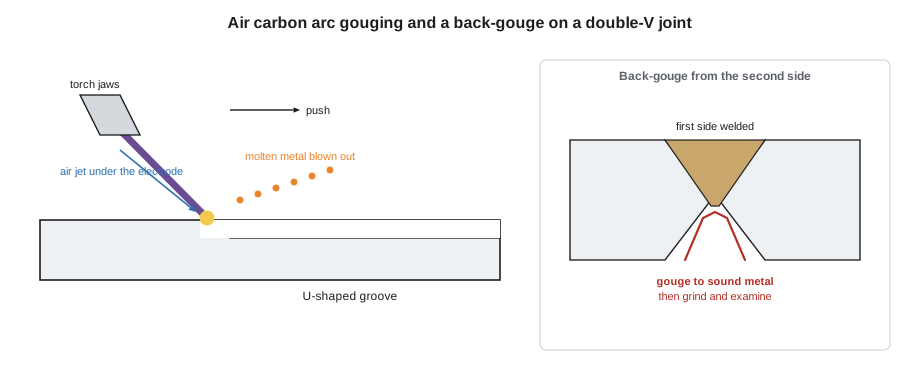
The equipment is a constant-current welding power source, usually used on DC electrode positive, a gouging torch with jaws that hold the electrode and air holes that point along it, and a supply of clean, dry compressed air at the pressure and volume the torch maker specifies, typically around 80 to 100 psi. The air volume matters more than the pressure: a small compressor that holds pressure but cannot deliver enough volume gives a weak jet, and the molten metal stays in the groove as a carbon-rich deposit.
Running a good gouge
Gouging is a skill of angle, speed and steadiness. The electrode sticks out about 6 in from the jaws, the air jet is on the underside of the electrode, between it and the work, and the torch is pushed, with the electrode pointing in the direction of travel, at a shallow angle to the surface. A steeper angle cuts a deeper, narrower groove; a shallower angle cuts a wider, shallower one. Travel speed sets the depth too: faster travel, shallower groove. The arc is short, and the operator keeps it short by feeding the electrode forward steadily as it burns away.
| Problem | Likely cause | Correction |
|---|---|---|
| Black, sooty deposits and carbon left in the groove | Air off, too little air volume, or the jet on the wrong side | Start the air before striking; check volume; jet under the electrode |
| Irregular, wavy groove | Uneven travel or electrode extension changing | Brace the torch; reset extension often |
| Groove too deep and narrow | Angle too steep or travel too slow | Lower the angle; speed up |
| Electrode glows red far back from the arc | Current too high or extension too long | Lower current; shorten extension |
| Copper splashed in the groove | Electrode copper coating melting into the groove | Reduce current; keep the coating back from the arc |
| Arc pops and stutters | Arc too long or AC on a DC electrode | Shorten the arc; use the right polarity |
Carbon left in the groove is the fault that matters most on pressure work. Molten metal that is not blown clear picks up carbon from the electrode, and if it freezes in the groove, it leaves a hard, brittle layer that can crack when welded over. That is why many WPSs for alloy steels and stainless steels require the gouged surface to be ground to bright metal, removing a set depth, before welding, and why every competent gouger grinds the groove lightly after gouging even on carbon steel, to remove the thin oxide and any carbon pickup.
Back-gouging to sound metal
The purpose of a back-gouge is to reach sound metal, not to make a groove of a set depth. Dale starts the gouge on the inside of the Tank 14 seam with a shallow first run along the root, looks into the groove for the dark line or pinholes of the incomplete root, and makes a second, deeper run where he sees them. When the groove bottom is bright and uniform, he stops, lets Kiera grind it clean, and then examines it. On Tank 14, the back-gouged groove gets a visual check under good light and a magnetic particle examination; a line indication means the gouge has not reached sound metal yet. Harjit records the check on the traveler as a hold point before the inside welding starts.
A back-gouge should also make a good weld preparation. The groove should be a smooth U with a rounded bottom, wide enough for the electrode the welder will use on the inside root pass, and with no sharp corners where slag could be trapped. A groove that is too narrow and deep is as bad as one that does not reach sound metal.
Kiera works out the gouging time, the electrodes and the air for the inside root of the insert plate.
The section of a rounded U gouge of width w and depth d is about three-quarters of the rectangle that contains it; multiplied by the joint length and the density of steel, it gives the weight of metal removed.
# Back-gouging the Tank 14 insert plate from the inside (US units)

# carbon electrode: diameter -> (amps, gouge width, electrode used per minute of arc) - illustrative
elec = {0.25: (300, 0.38, 4.0), 0.3125: (420, 0.47, 4.5), 0.375: (500, 0.56, 5.1)}
d = 0.3125
amps, width, burn = elec[d]
depth = 0.31                           # gouge to sound weld metal at the root
speed = 18                           # travel speed for that depth
length = 301.7                            # joint length to gouge (perimeter of the insert)
usable = 9                            # usable length of one electrode before the stub
arc_min = length / speed
used = arc_min * burn
area = 0.75 * width * depth               # gouge section, a rounded U
removed = area * length * 0.2836
print(f"{d} in electrode at {amps} A: gouge about {width} in wide, {depth} in deep")
print(f"arc time {arc_min:.0f} min, electrode used {used:,.0f} in -> {used / usable:.0f} electrodes")
print(f"metal removed about {removed:.1f} lb")
air = 30                               # compressor delivery at the torch
need = 25
print("air supply", "OK" if air >= need else "TOO LOW", f"({air} cfm available, {need} cfm needed)")0.3125 in electrode at 420 A: gouge about 0.47 in wide, 0.31 in deep arc time 17 min, electrode used 75 in -> 8 electrodes metal removed about 9.3 lb air supply OK (30 cfm available, 25 cfm needed)
The whole perimeter of the insert is gouged in about 17 minutes of arc time, using eight electrodes. That is the reason crews choose air carbon arc for back-gouging: grinding the same groove by hand would take most of a shift. The metal removed is about 9.3 lb, most of it blown out as molten droplets and slag that land on the floor plates of the tank, where the fire watch and the clean-up crew deal with them.
Removing defects
When a radiograph or ultrasonic examination finds a defect in a weld, the defect must be removed and the area rewelded. Gouging is fast, but on thin tube walls it is often too fast; a gouge on a 1/4 in tube wall can go through the wall in a moment. For tube welds, defects are usually removed by grinding with small carbide burrs and discs, which lets the welder find the exact end of the indication and stop there. On thicker plate, such as a coker drum shell or a vessel nozzle, gouging is used to remove most of the metal and grinding to finish. The rule is to excavate until the defect is gone, confirm it with penetrant or magnetic particle examination, make the cavity a smooth weldable shape, and then reweld to the WPS. Lesson 11 follows a repair through this sequence.
On Northgate's spring work, Kiera sees the other side of gouging. A crack has been found by ultrasonic examination in an old repair weld on a drum nozzle. The crew gouges out the old repair from the outside, in steps, with the inspector watching, stopping at each step to check with magnetic particle examination, until the last trace of the crack is gone. The cavity is nearly 1 in deep when it is clean.
Gouging safely
Air carbon arc gouging is one of the noisiest and dirtiest jobs on a site. Noise from a gouging torch at high current is well above the level that requires hearing protection, and double hearing protection, plugs under muffs, is common. The molten metal blown from the groove travels several meters and can start fires and burn people, so the area in front of the gouge is cleared, protected with fire blankets and watched. The fumes contain metal oxides and, from the electrode coating, copper; in a confined space like a tank, local exhaust is placed at the gouge and the gouger wears respiratory protection. The arc is as bright as a heavy welding arc and needs a dark filter lens. And the heavy current through the electrode heats the torch and the leads; worn leads and loose connections can overheat.
In Tank 14, the gouging is done inside the tank, which is a confined space under its entry permit. The tank's manways are open, a fan is blowing fresh air in through one, an exhaust hose with a capture hood is at the gouge, and Imran Qureshi has added the gouging noise and fume to the entry permit's hazard list.
Worked problem
Back-gouge depth
The insert plate is 1 1/8 in thick, with a double-V groove: each V is 1/2 in deep, with a 1/16 in root face between them. The outside V has been welded. Dale's first shallow run along the bottom of the inside V shows a dark line of incomplete fusion about 1/8 in below the bottom of the V. How deep should the gouge go?
Show solution
- The root face is 1/16 in and the first-side root pass sits just beyond it, so the defect line lies in the first few millimeters of weld below the V.
- The depth of the dark line is only a guide; incomplete fusion can run deeper in places.
- Gouge until the groove bottom is bright and clean, then grind lightly and examine it with magnetic particles.
Answer: As deep as it takes to reach sound metal, about 5/16 in below the bottom of the V in Kiera's plan, confirmed by examination, not by a set number.
Gouging without air carbon arc
Not every job allows air carbon arc gouging. Inside a boiler during an outage, when other crews are working in the same furnace, the noise, fume and spray of molten metal may make it a poor neighbor, and some owners restrict it in certain areas. On stainless and some alloys, the carbon pickup risk leads owners to prefer other methods. The alternatives are slower but cleaner. Plasma gouging uses a plasma torch with gouging consumables and makes a cleaner groove with less noise and no carbon. Grinding with a heavy grinder and a gouging disc is slow but controllable, and is used for short lengths and thin material. Oxyfuel gouging, with a special gouging tip, works on carbon steel and was common before air carbon arc became widespread; it is still used where electrical equipment cannot be brought in. Whichever method is used, the result must be the same: a smooth, clean groove down to sound metal, confirmed by examination before welding. On Tank 14, air carbon arc is the right tool because the tank is empty, the crew is alone in it and the job is long.
Common mistakes
MistakeStriking the arc before turning on the air.
InsteadStart the air first so metal is blown clear from the first moment.
MistakeGouging with a small compressor that cannot deliver the volume.
InsteadCheck the torch maker's air volume and use an adequate supply.
MistakeWelding over a gouged groove without cleaning it.
InsteadGrind the groove to bright metal and examine it before welding.
MistakeGouging out a defect in thin tube wall.
InsteadGrind small defects in thin walls to control the depth.
MistakeGouging without clearing what is in front of the groove.
InsteadClear the path, protect it with blankets and keep a fire watch.
Summary and key terms
- CAC-A melts metal with a carbon arc and blows it out with compressed air; it works on most metals.
- Angle and travel speed set the groove depth and width; the air jet goes under the electrode.
- Carbon pickup leaves a hard layer; grind gouged surfaces to bright metal before welding.
- Back-gouging removes the first-side root to sound metal, confirmed by visual and particle examination.
- Defects are excavated, confirmed gone, shaped and rewelded; on thin tube walls, grind instead of gouging.
- Gouging needs heavy hearing protection, fume control, fire protection and good leads.
- CAC-A
- Air carbon arc cutting: a carbon electrode arc and an air jet remove molten metal.
- Back-gouging
- Removing the root of a weld from the second side to reach sound metal before welding that side.
- Carbon pickup
- Carbon absorbed by molten metal from the electrode, leaving a hard, brittle layer.
- Excavation
- Removing metal to take out a weld defect before repair.
- Sound metal
- Weld or base metal free of cracks, slag, porosity and lack of fusion.
- Copper-coated electrode
- The carbon electrode used for gouging, coated with copper to carry current and reduce wear.
Practice problems
Work each problem on paper first, then reveal the answer to check.
A gouge runs at 18 in/min. How long to gouge a 360 in joint?
Show answer
360 ÷ 18 = 20 minutes of arc time.
An electrode burns at 4.5 in/min of arc and 9 in of each is usable. How many electrodes for 20 minutes?
Show answer
20 × 4.5 = 90 in ÷ 9 = 10 electrodes.
A gouge is 1/2 in wide and 5/16 in deep. Estimate its section area with the factor 0.75.
Show answer
0.75 × 0.5 × 0.3125 = 0.117 in2.
What examination confirms a back-gouge has reached sound metal on carbon steel?
Show answer
Visual inspection and magnetic particle examination of the ground groove.
Lesson quiz · 5 questions
Score 60% or more to complete this lesson.
Create a free account to save your progress, take quizzes and earn a certificate.