
BLR-210 · Lesson 3 of 12 · 20 min
Plasma cutting and tube cutting tools
Back at Riverbend, the furnace is cool, the scaffold is up to the leak and Peg Lindqvist has marked the repair on the wall. The leak is on the left sidewall, about 60 ft above the furnace floor, in tube 47 counting from the front wall. A crack at the toe of a membrane weld, next to a buckstay attachment, has let steam out, and the jet of steam has cut a groove in the side of tube 48 next to it. Peg's ultrasonic thickness readings show that both tubes must be replaced over a length of about 4 ft. The repair is a two-tube panel section: the old section of tubes 47 and 48, with the membrane between them, is cut out of the wall, and a new section, made in Ironbridge's shop, is welded in.
Cutting that section out takes two kinds of cutting. The membrane bars that join tube 46 to 47, and 48 to 49, have to be split along their length, and plasma cutting is the tool for that. The tubes themselves have to be cut across, square and clean, at the top and bottom of the section, and that is a job for mechanical cutters. This lesson covers both.
Plasma cutting on boiler work
WLD-110 explained how a plasma torch works: an arc between an electrode in the torch and the work is squeezed through a small nozzle with a flow of gas, which heats the gas to a plasma that melts the metal and blows it out of the kerf. Plasma cuts any metal that conducts electricity, including stainless steel and the alloys that oxyfuel cannot cut, and it cuts thin and medium plate much faster than oxyfuel, with a narrower kerf and a smaller heat-affected zone. On boiler and vessel work, boilermakers use plasma for:
- Splitting membrane bars between tubes, where the cut must run straight along a bar about 1/2 in wide without touching the tubes on either side.
- Cutting casing, lagging sheet, ductwork and seal boxes on the outside of the boiler.
- Cutting stainless and alloy parts: liners, clad plate, stainless tube shields and sootblower components.
- Gouging, with gouging consumables, where an air carbon arc torch would be too heavy or too dirty.
Plasma has limits. It needs compressed air or bottled gas and a power supply at the job, and its consumables, the electrode and nozzle, wear and must be changed before the cut quality falls off. On thick carbon steel, above about 1 in for a hand torch, oxyfuel is usually more practical. And a plasma arc does not stop at the back of the plate: whatever is behind the cut is in its path.
Splitting a membrane
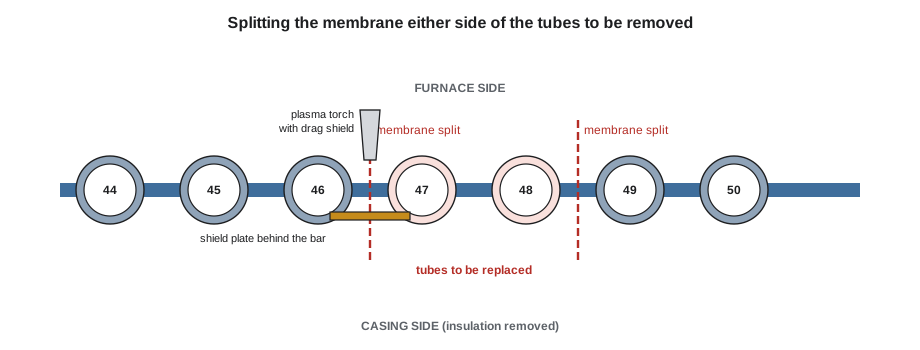
A membrane cut runs down the center of the bar, leaving half the bar on the tube that stays and half on the tube that comes out. The cutter uses a drag shield or a standoff guide that rides on the bar, keeping the nozzle at the right height and the cut on the center. Because the arc goes straight through the bar, the insulation and casing behind it must be protected; on Riverbend, the casing side has been opened and the insulation removed back from the repair for the welders' access, and a steel shield plate is slipped behind the bar as the cut proceeds. The cut must stop short of the ends of the section, about 1 in beyond where the tube cuts will be, so the membrane on the tubes that stay is not split farther than needed.
The most important rule in membrane cutting is to stay off the tubes. A plasma arc that wanders onto a tube that is staying in the wall gouges it, and that gouge must then be ground out, thickness checked and possibly built up or the tube replaced. Kiera practices membrane splits on a scrap panel in the yard before she is allowed to make one in the furnace, and on the day, Dale makes the cuts while she watches the arc and moves the shield.
Choosing amperage and consumables
Plasma systems are rated by current, and each consumable set, the electrode, nozzle and shield, is made for a current. The maker's chart gives the thickness each current cuts at production quality and the speed for each thickness. The membrane bar is 1/4 in thick, so the smallest consumables comfortably cut it; higher currents would only widen the kerf and put more heat into the tubes on either side. The cutter uses compressed air from a dryer, because water in the air shortens consumable life and roughens the cut.
Kiera works out the plasma time for the two membrane splits and the time each tool would take for the four tube cuts, to help Dale decide which tools to bring up the scaffold.
# Splitting the membrane and cutting the tubes for the panel cut-out (US units)

# plasma system: (amps, rated production thickness, typical hand-cut speed) - illustrative
table = [(45, 0.5, 20), (65, 0.75, 18), (85, 1.0, 15), (105, 1.25, 12)]
bar = 0.25                               # membrane bar thickness
amps, rated, speed = next(row for row in table if row[1] >= bar)
print(f"membrane {bar} in -> {amps} A consumables (rated to {rated} in), about {speed} in/min by hand")

splits = [52, 52]                          # vertical membrane cuts, each this long
length = sum(splits)
minutes = length / speed * 1.6            # restricted access, drag shield, repositioning
print(f"membrane to split: {len(splits)} cuts, {length:,} in in all, about {minutes:.0f} min of plasma work")

# tube cuts: tool, minutes per cut on this tube, setup minutes per cut
tools = {"clamshell cutter": (6, 10), "portable band saw": (4, 6), "reciprocating saw": (9, 2)}
cuts = 4                                  # two tubes, cut at the top and the bottom
for tool, (each, setup) in tools.items():
print(f"{tool:18} {cuts} cuts -> {cuts * (each + setup):3d} min (cut ends square, no slag inside)")membrane 0.25 in -> 45 A consumables (rated to 0.5 in), about 20 in/min by hand membrane to split: 2 cuts, 104 in in all, about 8 min of plasma work clamshell cutter 4 cuts -> 64 min (cut ends square, no slag inside) portable band saw 4 cuts -> 40 min (cut ends square, no slag inside) reciprocating saw 4 cuts -> 44 min (cut ends square, no slag inside)
The membrane splitting is only minutes of plasma time. The tube cuts take longer, and most of the time is set-up: getting the tool onto the tube, square to it, in a space where the next tube is a few millimeters away. Dale chooses the portable band saw for the bottom cuts, where the scaffold gives room, and the clamshell cutter for the top cuts, under the buckstay, where a saw will not fit.
Mechanical tube cutting
Tubes are cut mechanically for three reasons. A torch puts slag, oxide and spatter inside the tube, and debris left in a waterwall tube can lodge at a bend or orifice and starve the tube of water, causing an overheating failure. A torch cut leaves a rough, hardened and oxidized end that has to be ground back to sound metal anyway. And a mechanical cut can be made square to the tube axis, which the end preparation tool needs. The common tools are:
| Tool | How it works | Where it fits |
|---|---|---|
| Portable band saw | A hand-held saw with a continuous blade; cuts square with light pressure | Open tubes with room for the saw frame |
| Clamshell or split-frame cutter | A ring that clamps around the tube and carries a cutting tool or slitting saw around it; many also bevel | Tubes in walls and banks, close spacing, cuts that must be square and ready to bevel |
| Reciprocating saw | A hand saw with a straight blade; fast but rough | Rough cuts well back from the final cut line |
| Abrasive cut-off wheel | A grinder with a thin wheel | Small tubes, membrane ends, tight spots; leaves burr and heat |
| Internal tube cutter | A tool that runs inside the tube and cuts it from the bore | Tubes that cannot be reached from outside, such as tube ends at a drum |
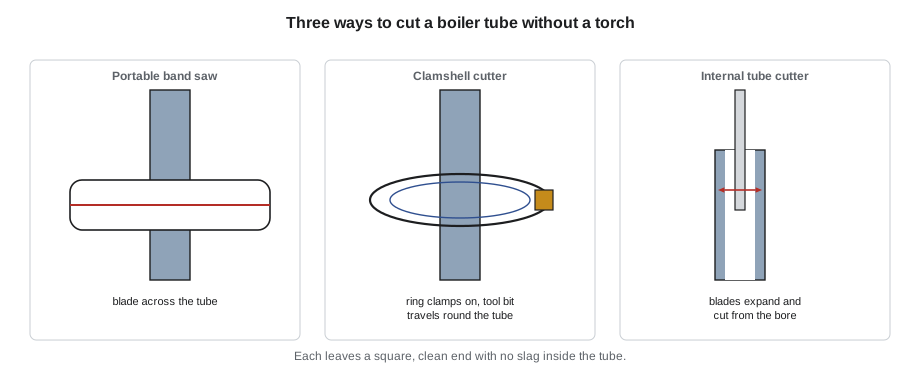
Two habits go with every tube cut. First, before the cut is made, the tube ends that will stay in the boiler are plugged or capped, or a foam plug is pushed into the bore below the cut, so chips and filings cannot fall into the tube. The plug has a string or a tag, and every plug put in is written on the traveler so that every plug is taken out before the joint is welded. Plugs forgotten inside tubes have caused failures. Second, the cut piece is supported before the last cut, because a 4 ft length of two tubes with membrane is heavy and the cut closes on the blade as the piece starts to drop. On Riverbend, Dale hangs the section on a chain fall from the scaffold structure before the final cut, as in BLR-120.
The cut-out sequence
With plasma for the membrane and mechanical cutters for the tubes, the cut-out at Riverbend follows a set order that Peg approves in the repair plan.
- Mark the cut lines on both tubes, square to the tube axis, at the elevations on the repair drawing. The new section will be made to fit between them.
- Split the membrane on both sides of the section with plasma, stopping 1 in beyond the tube cut lines.
- Make rough cuts with the reciprocating saw 2 in inside the final lines to free the section, after rigging it.
- Lower the section and send it to Peg for examination; the failed tube is evidence for the cause of the leak.
- Plug the tube ends that stay, then make the final cuts square at the marked lines with the band saw and clamshell cutter.
- Check that the cut ends are square and at the right elevation before end preparation begins in lesson 7.
The rough cut first, final cut second sequence is common in tube work. It lets the heavy section come out without a tool trapped in a closing cut, and the final cut can be made carefully, square and exactly on the line, in a tube end that is free.
Worked problem
Is a tube cut square?
After the final cut on tube 47, Kiera checks the end with a square against the tube's side at four points around it. She finds the end 1/16 in out of square across the 2 1/2 in diameter. The end prep tool will face the end square, removing up to 5/64 in. Is the cut good enough?
Show solution
- The end prep tool faces the end square as part of beveling.
- It can remove 5/64 in, more than the 1/16 in out of square.
- The faced end will move back by up to that amount, which the fit-up allows for.
Answer: Yes. The end will be faced square in end preparation, and the new section's length is set after end prep, not before.
Looking after the cutters
Tube cutting tools are only as good as their blades and bits. A dull band saw blade wanders and leaves a cut that is not square, and a chipped clamshell bit tears the tube end instead of cutting it. Dale's crew carries spare blades and bits up the scaffold with the tools, checks each one before a cut, and changes it at the first sign of wandering or chatter. Cutting fluid is used sparingly on tube cuts, because whatever goes on the cut ends up in the weld zone and must be cleaned off before welding; many crews cut dry with blades made for it. Chips are swept from the scaffold boards and the furnace floor below after every cut, because a steel chip in a boot sole is a slipping hazard on a scaffold, and chips left on the furnace floor end up in the ash hopper. Plasma consumables are checked the same way: a worn nozzle makes a wide, beveled kerf that can drift toward the tube, and the cutter changes the nozzle and electrode as a set.
Common mistakes
MistakeLetting the plasma arc touch a tube that stays.
InsteadUse a drag shield on the bar center and keep the arc on the membrane.
MistakeCutting the membrane without protecting what is behind it.
InsteadSlide a shield plate behind the bar and remove or guard the insulation.
MistakeCutting tubes with a torch inside the furnace.
InsteadUse saws, clamshell cutters or internal cutters.
MistakeForgetting a plug inside a tube.
InsteadTag every plug, record it on the traveler and check them all out before welding.
MistakeMaking the final cut while the section hangs on the blade.
InsteadRough cut first with the section rigged, then make the final square cuts.
Summary and key terms
- Plasma cuts any conductive metal and is the tool for splitting membrane bars, casing and stainless parts.
- Membrane splits run down the bar center, with a shield behind the bar and the arc kept off the tubes.
- Use the smallest consumables that cut the bar at production quality, with clean, dry air.
- Tubes are cut mechanically to keep slag out of the tube and to leave a square end for beveling.
- Plug and record every tube end before cutting, and remove every plug before welding.
- Free the section with rough cuts, then make the final square cuts in free tube ends.
- Membrane wall
- A furnace wall of tubes joined by flat bars welded between them to make a gas-tight panel.
- Membrane split
- A cut along the center of a membrane bar to separate tubes.
- Drag shield
- A plasma torch shield that can rest on the work and keeps the nozzle at a set height.
- Clamshell cutter
- A split-frame tool that clamps around a tube and cuts or bevels it.
- Consumables
- The plasma electrode, nozzle and shield, which wear and are replaced.
- Tube plug
- A removable plug placed in a tube end to keep debris out during cutting and grinding.
Practice problems
Work each problem on paper first, then reveal the answer to check.
A membrane split is 52 in long and the hand speed is 20 in/min. With an allowance of 1.6, how long does it take?
Show answer
52 ÷ 20 × 1.6 = 4.2 minutes.
Why is the membrane cut stopped 1 in beyond the tube cuts?
Show answer
So the section can come free without splitting the membrane on the tubes that stay farther than needed.
Name the tool for cutting a tube end at a drum from the inside.
Show answer
An internal tube cutter.
Why are the final tube cuts made after the section has been removed?
Show answer
So the cut does not close on the blade and can be made square and exactly on the line.
Lesson quiz · 5 questions
Score 60% or more to complete this lesson.
Create a free account to save your progress, take quizzes and earn a certificate.