
BLR-210 · Lesson 2 of 12 · 19 min
Oxyfuel cutting on vessels and in the field
While the Riverbend crew waits for the furnace to cool and the scaffold to go up, Rosa Delgado sends Kiera and Dale to Bayou Junction for three days. Tank 14, the big crude tank Ironbridge has worked on before, has had its bottom course inspected, and the inspector has found an area of corrosion on the outside of the shell near the bottom, where water collected under the insulation. The repair is a shell insert plate: a rectangular opening with rounded corners is cut out of the corroded area, and a new plate of the same thickness, rolled to the tank's curve, is welded in with full-penetration butt welds. The cut-out is oxyfuel work, and it is the kind of oxyfuel cutting boilermakers do every season: heavy plate, in place, in the open air, on equipment that has held flammable product.
WLD-110 taught the oxyfuel process: preheat flames bring the steel to its kindling temperature, a jet of pure oxygen burns it, and the slag is blown out of the kerf. This lesson is about using that process on vessels and tanks in the field: preparing the equipment, guiding the torch with tracks and templates, cutting bevels, removing temporary attachments without damaging the shell, and planning the gas.
Preparing equipment that has held product
Before any torch is lit on a tank or vessel that has held product, the equipment must be isolated, emptied, cleaned and tested, and the hot work permit must name the cut. Tank 14 has been emptied and cleaned for its inspection, its nozzles are blinded, and the gas tester checks the inside and the area outside the cut for flammable gas before the permit is issued and again at intervals during the work. Sludge and scale can give off vapor when heated, even after cleaning, so the area behind the cut, inside the tank, is checked and kept clear. Insulation is removed well back from the cut, because tank insulation holds hydrocarbon and water and can smolder for hours.
Painted and coated steel needs attention too. Coatings burn and give off fumes that may contain lead, zinc or other metals, and some old tank coatings contain coal tar. The safety advisor decides from the coating records whether the coating must be stripped back before cutting, and what respiratory protection the cutter needs. On Tank 14 the outside coating is a modern epoxy, and the crew grinds a band 2 in wide either side of the cut line to remove it and to give the track a clean surface.
Tracks, bugs and templates
Freehand cutting is fine for scrap, but a cut that will become a weld preparation must be straight, square or beveled to the right angle, and smooth. For long cuts in the field, boilermakers use a carriage, often called a bug, that runs on a rail track clamped or magnetically held to the work. The torch is mounted on the carriage at the bevel angle, and the carriage moves at a set speed. Flexible tracks bend to follow a tank or vessel shell; ring tracks clamp around pipe and small vessels. For curves, such as the corners of Tank 14's opening, the cutter follows a steel template clamped to the shell, or uses a radius bar on the carriage.
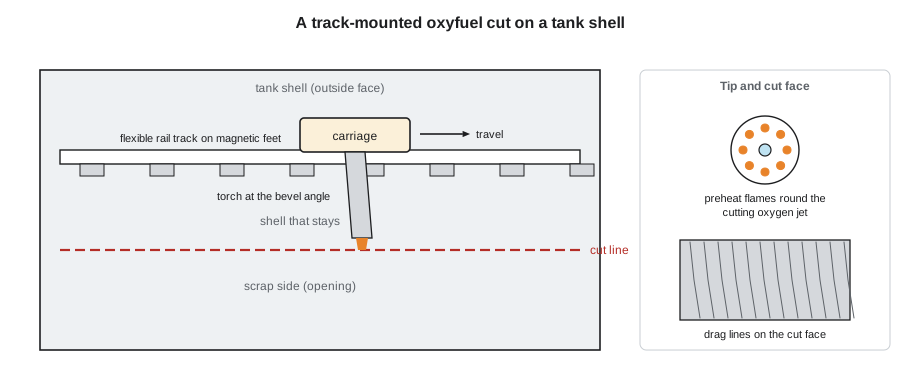
Setting up a track cut takes longer than the cut. The track is laid parallel to the layout line, a set distance from it that suits the carriage, and checked at several points along its length. The torch is set square to the surface for a square cut, or at the bevel angle for a beveled cut, with the tip at the height the chart gives. The cutter makes a dry run with the gas off to check that the carriage clears every clamp, hose and obstruction along the whole length. Only then is the torch lit and the preheat adjusted.
Getting the cut right
A good oxyfuel cut has a smooth face with fine, nearly vertical drag lines, a sharp top edge, little slag on the bottom edge that knocks off easily, and a square or correctly angled face. The cut face tells the cutter what is wrong when the cut is poor.
| What the cut looks like | Likely cause | Correction |
|---|---|---|
| Rounded, melted top edge | Tip too close or preheat too strong | Raise the tip, reduce the preheat |
| Deep gouges in the face | Travel interrupted or uneven; dirty tip | Steady the travel; clean the tip |
| Drag lines sweeping far back, slag hard to remove | Travel too fast or oxygen pressure low | Slow down or raise oxygen to the chart value |
| Wide kerf, rough face, heavy slag | Travel too slow or tip too large | Speed up or use the chart tip size |
| Bevel angle wanders along the cut | Track moving or torch loose | Re-clamp the track, tighten the torch holder |
| Cut fails to go through at the bottom | Tip too small or speed too high for the thickness | Use the next tip size, check the chart |
On a vessel or tank in service, the shell is often thicker than the drawings say on one side of the cut and thinner on the other, where corrosion has taken metal. The cutter watches the cut through tinted lenses and listens; a cut on thinned plate runs faster and sounds sharper. On Tank 14, the corrosion is on the outside face, so the cutter sets the speed for the full thickness of 1 1/8 in, the thickness at the edge of the cut, which is outside the corroded area, as the inspector's layout intended.
Bevels for field welding
The insert plate in Tank 14 will be welded with a double-V groove, beveled from both sides of the shell, because the plate is too thick to weld comfortably from one side. The opening in the shell is cut with a 30-degree bevel on the outside half, then the inside half is ground or cut to its bevel after the cut-out comes free. Many crews instead cut the opening square, then bevel both faces with a hand-held beveling tool or grinder. Whatever the method, the bevel angle, the root face and the straightness of the edge are checked with a bevel gauge and straightedge at regular intervals, and the cut faces are ground to clean, bright metal, removing all slag and oxide, before fit-up. Oxyfuel cutting leaves a thin, hardened layer on the cut face of some steels; on carbon steel tank plate it is ground off in the normal clean-up, and on alloy steels the WPS may require a minimum depth of grinding.
Removing temporary attachments
Every job leaves temporary attachments behind: lifting lugs, strongbacks, scaffold clips, alignment dogs and wedges tack-welded to the shell. Removing them carelessly is one of the commonest ways to damage a pressure part. A lug knocked off with a hammer can tear a gouge out of the shell; a lug cut flush with a torch can leave a burned notch in it. The rule is to cut the attachment off a few millimeters proud of the shell, then grind the remainder flush, then examine the area. On pressure parts, the WPS and the inspector usually require magnetic particle or liquid penetrant examination of the ground area, and a thickness check if the grinding went below the surface.
Planning the gas
A long cut on thick plate uses a surprising amount of oxygen, and running out halfway along a bevel leaves a step in the face that has to be ground out. Kiera plans the gas for the Tank 14 opening before the crew loads the truck. The opening is 96 in long and 60 in high, with 6 in corner radii, cut in 1 1/8 in plate. She takes the travel speed and the gas flows from the torch maker's chart for the tip the crew will use, adds an allowance for starts, track moves and checks, and works out the gas used. She also checks the acetylene withdrawal rate: an acetylene cylinder must not supply more than about one-seventh of its contents per hour, or acetone is drawn out with the gas, and on heavy cutting a single cylinder can fall short.
Here t is the torch time, L the length of cut, v the travel speed from the chart and k the field allowance, 1.4 on this job.
# Oxyfuel track cut for the Tank 14 shell opening (US units)
from math import pi

# cutting chart for one tip series with acetylene (illustrative):
# thickness: (travel speed, oxygen flow, acetylene flow)
chart = {0.25: (24, 60, 10), 0.5: (20, 90, 12), 0.75: (17, 110, 13), 1.0: (15, 140, 14),
         1.25: (14, 160, 15), 1.5: (13, 180, 16), 2.0: (11, 220, 18)}

def interp(t):
    ks = sorted(chart)
    for a, b in zip(ks, ks[1:]):
        if a <= t <= b:
            f = (t - a) / (b - a)
            return [chart[a][i] + f * (chart[b][i] - chart[a][i]) for i in range(3)]
    raise ValueError("thickness outside the chart")

t = 1.125                                  # bottom course plate thickness
L, H, r = 96, 60, 6                  # opening length, height, corner radius
cut = 2 * (L + H) - 8 * r + 2 * pi * r   # perimeter with rounded corners
speed, o2, fuel = interp(t)
field = 1.4                              # starts, track moves and checks
minutes = cut / speed * field
print(f"perimeter of the opening: {cut:,.0f} in")
print(f"chart at {t} in: speed {speed:.0f} in/min, oxygen {o2:.0f} cfh, acetylene {fuel:.1f} cfh")
print(f"cutting time with field allowance: {minutes:.0f} min")
print(f"oxygen used {o2 * minutes / 60:,.0f} ft3, acetylene {fuel * minutes / 60:,.0f} ft3")

# acetylene withdrawal limit: one-seventh of the cylinder contents per hour
cyl = 280                               # acetylene in one cylinder
limit = cyl / 7 / 60 * 60              # per minute, in flow units
print(f"one acetylene cylinder allows {limit:.1f} cfh;",
"OK" if fuel <= limit else "manifold more cylinders")perimeter of the opening: 302 in chart at 1.125 in: speed 14 in/min, oxygen 150 cfh, acetylene 14.5 cfh cutting time with field allowance: 29 min oxygen used 73 ft3, acetylene 7 ft3 one acetylene cylinder allows 40.0 cfh; OK
The cut takes about half an hour of torch time and uses about 73 cubic feet of oxygen, a small part of one full oxygen cylinder. The acetylene flow is well within one cylinder's withdrawal limit for this tip. On the Northgate coker drum skirt, cut with a bigger tip in thicker plate, the same check called for two acetylene cylinders on a manifold.
Piercing and starting cuts
A cut that starts in the middle of a plate, such as the start of the Tank 14 opening, has to pierce the plate first. Piercing thick plate throws molten slag back at the tip and the cutter. The cutter preheats a spot to a bright red, raises the tip a little, opens the cutting oxygen slowly while moving the torch sideways so the slag blows away from the tip, and lowers the tip to cutting height as the pierce breaks through. On very thick plate, a pilot hole drilled first makes the start cleaner. The cut starts in the scrap part of the opening, never on the line, and runs onto the line. Where the cut ends, at the start point, the cutter slows down to make sure the kerf joins cleanly so the cut-out falls free.
A falling cut-out is a hazard of its own. The Tank 14 piece weighs about 1,700 lb. Before the last meter of cut, Dale rigs the piece to a chain fall from a beam clamp on the tank's top angle, so the piece hangs rather than drops when the cut is complete, and the cutter finishes the cut from the side, out of its path.
Worked problem
How long will the bevel take?
After the cut-out is removed, the inside bevel of the 302 in opening is cut by the same carriage at 16 in/min on a bevel face only half the plate deep. How many minutes of torch time is that, with the same field allowance of 1.4?
Show solution
- Time at speed: 302 ÷ 16 = 18.9 min.
- With the field allowance: 18.9 × 1.4 = 26.4 min.
Answer: About 26 minutes of torch time, plus set-up.
Common mistakes
MistakeCutting before the gas test and permit.
InsteadTest the inside and outside of the equipment and get the permit for the specific cut.
MistakeCutting on the layout line with the kerf on the plate side.
InsteadRun the kerf on the scrap side so the weld preparation keeps its size.
MistakeKnocking off temporary lugs with a hammer.
InsteadCut them proud, grind flush and examine the area.
MistakeLetting a heavy cut-out drop.
InsteadRig the piece before the last part of the cut and stand clear of its path.
MistakeDrawing too much from one acetylene cylinder.
InsteadKeep withdrawal under one-seventh of the contents per hour; manifold cylinders for big tips.
Summary and key terms
- Equipment that held product must be emptied, cleaned, isolated, gas tested and permitted before cutting.
- Long field cuts are made with a carriage on a track; curves follow templates or a radius bar.
- The cut face shows the faults: tip height, preheat, oxygen pressure and travel speed.
- Bevels are checked for angle, root face and straightness and ground to bright metal before fit-up.
- Temporary attachments are cut proud, ground flush and examined, never knocked off.
- Plan the gas from the chart, and keep acetylene withdrawal under one-seventh of a cylinder per hour.
- Bug
- A motorized carriage that carries a cutting torch along a track at a set speed.
- Drag lines
- The lines on an oxyfuel cut face that show how the cutting jet moved through the plate.
- Insert plate
- A new plate welded into an opening cut in a tank or vessel shell to replace damaged metal.
- Piercing
- Starting a cut in the middle of a plate by burning a hole through it.
- Temporary attachment
- A lug, clip, dog or strongback welded to the work during fabrication and removed afterwards.
- Withdrawal rate
- How fast gas is drawn from a cylinder; for acetylene it is limited to keep acetone in the cylinder.
Practice problems
Work each problem on paper first, then reveal the answer to check.
A track cut is 200 in long at 14 in/min with a field allowance of 1.4. How long does it take?
Show answer
200 ÷ 14 × 1.4 = 20 minutes.
An acetylene cylinder holds 280 ft3. What is the most it should supply per hour?
Show answer
About 280 ÷ 7 = 40 ft3 per hour, or 40 cfh.
Why is a lug cut proud of the shell rather than flush?
Show answer
So the torch does not cut into the shell; the stub is then ground flush.
The drag lines on a cut sweep far back. What is likely wrong?
Show answer
Travel is too fast or the cutting oxygen pressure is too low.
Lesson quiz · 5 questions
Score 60% or more to complete this lesson.
Create a free account to save your progress, take quizzes and earn a certificate.