
BIOL-470 · Lesson 7 of 12 · 22 min
Biopharmaceuticals: antibodies, vaccines and cell and gene therapies
▶ Video coming soon A video version of this lesson is on the way.
Biopharmaceuticals, or biologics, are medicines made by or from living cells. They now make up a large and growing share of new drug approvals and of drug spending, and they include some of the most important advances in modern medicine: insulin made in microbes, monoclonal antibodies against cancer and autoimmune disease, vaccines designed in days from a genome sequence, and therapies that reprogram a patient's own cells or genes. This lesson surveys these classes, explains how they work and how they differ from small-molecule drugs, and looks at biosimilars, the copies that become possible when patents expire.
Northfield's biosimilar antibody is a copy of an established anti-inflammatory antibody whose patents have expired. Lena spends a week with the analytical team comparing the biosimilar to the reference product on dozens of measures, and learns why the company's regulatory filing runs to thousands of pages for a molecule that, on paper, is the same as one already sold.
Therapeutic proteins
The first recombinant biologics replaced proteins the body makes. Recombinant human insulin, approved in 1982, replaced insulin extracted from pig and cow pancreases. Human growth hormone, previously extracted from the pituitary glands of cadavers and linked to transmission of a fatal prion disease, was replaced by a recombinant version in 1985. Erythropoietin, which stimulates red blood cell production, became a major treatment for anemia in kidney disease. Clotting factors for hemophilia, enzymes for rare metabolic diseases and interferons followed.
Protein engineering then improved on nature. Insulin analogues with one or two amino acid changes are absorbed faster or slower than human insulin, giving better control of blood sugar. Adding polyethylene glycol chains, a process called PEGylation, or fusing a protein to the constant region of an antibody or to albumin, slows its removal by the kidneys and extends the time between doses. These changes illustrate a recurring theme: once a protein can be made from a gene, it can also be redesigned.
Monoclonal antibodies
Antibodies are Y-shaped proteins made of two identical heavy chains and two identical light chains joined by disulfide bonds. The tips of the two arms, the variable regions, bind a specific target, or antigen; the stem, the Fc region, interacts with immune cells and with a recycling receptor that gives antibodies a long life in the blood, about three weeks for the main class, IgG. A monoclonal antibody is a single antibody species, all molecules identical, made by one clone of cells.
In 1975 Georges Köhler and César Milstein fused antibody-producing mouse B cells with myeloma cancer cells to make hybridomas, immortal cell lines secreting one antibody each; they shared the 1984 Nobel Prize in Physiology or Medicine. Mouse antibodies, however, provoked immune reactions in patients, who made antibodies against the mouse protein. Genetic engineering solved the problem in stages. Chimeric antibodies joined mouse variable regions to human constant regions; humanized antibodies kept only the mouse antigen-binding loops in a human framework; and fully human antibodies came from mice engineered with human antibody genes or from libraries displayed on bacteriophages, a method recognized with a share of the 2018 Nobel Prize in Chemistry. Under the international naming system used for decades, these generations were marked by stems such as -ximab, -zumab and -umab.
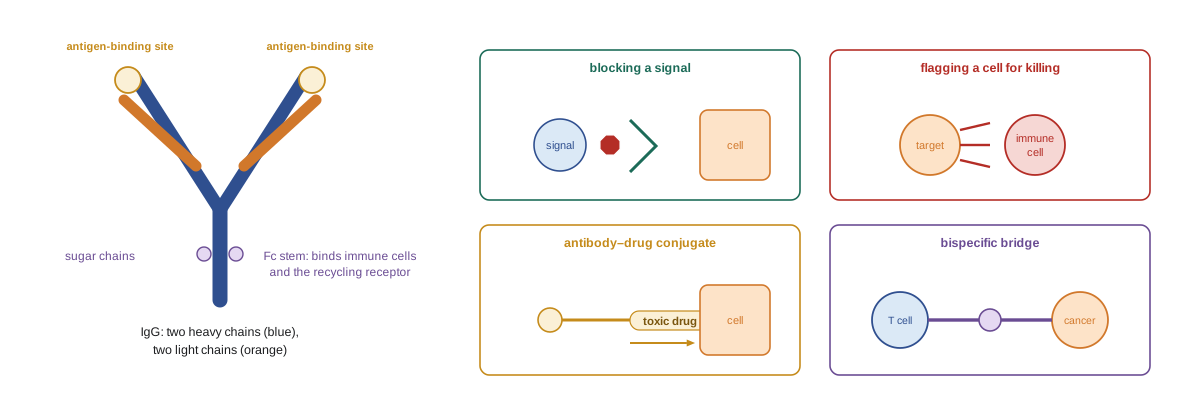
Therapeutic antibodies act in several ways. Some block a signal: adalimumab and infliximab neutralize the inflammatory cytokine TNF in rheumatoid arthritis and inflammatory bowel disease, and pembrolizumab blocks the PD-1 checkpoint on T cells, releasing an anti-cancer immune response. Some flag cells for destruction: rituximab binds CD20 on B cells, which are then killed by immune cells recruited through the Fc region, a process called antibody-dependent cellular cytotoxicity, or by complement. Antibody–drug conjugates attach a potent toxic drug through a chemical linker, so it is delivered mainly to cells carrying the target. Bispecific antibodies bind two targets at once, for example bridging a T cell to a cancer cell.
Antibodies are dosed by body weight or as fixed doses, and their long half-life allows dosing every two to eight weeks for many products. Because the body eliminates them roughly exponentially after distribution, the concentration falls as:
Worked problem
How long does an antibody last?
A patient receives an antibody that reaches 120 micrograms per milliliter in the blood. Its elimination half-life is 18 days. What is the concentration 6 weeks later, assuming simple exponential decline?
Show solution
- Six weeks is 42 days.
- Number of half-lives: 42 / 18 = 2.33.
- Fraction remaining: 0.5 to the power 2.33 = 0.198.
- Concentration: 120 × 0.198 = 23.8 micrograms per milliliter.
Answer: About 24 micrograms per milliliter, one-fifth of the peak.
Vaccines
Vaccines train the immune system to recognize a pathogen before infection. Traditional vaccines use live attenuated organisms, such as the measles vaccine, or killed whole organisms, such as inactivated polio vaccine. Biotechnology added subunit vaccines, which contain only selected antigens. The hepatitis B vaccine, made in yeast from the gene for the virus's surface protein, was the first recombinant vaccine, approved in the 1980s. Virus-like particles, protein shells that resemble a virus but contain no genome, are the basis of the human papillomavirus vaccines that prevent most cervical cancers. Conjugate vaccines link bacterial sugar coats to carrier proteins so that infants can mount strong responses, protecting against pneumococcus, meningococcus and Haemophilus influenzae type b.
Genetic vaccines deliver instructions rather than the antigen itself. Viral vector vaccines use a harmless virus, often an adenovirus engineered so it cannot replicate, to carry the antigen gene into cells; an Ebola vaccine and several COVID-19 vaccines work this way. Messenger RNA vaccines deliver mRNA encoding the antigen inside lipid nanoparticles, tiny fat droplets that protect the RNA and help it enter cells, which then make the antigen briefly before the mRNA is degraded. Decades of work, including Katalin Karikó and Drew Weissman's finding that chemically modified nucleosides keep mRNA from triggering excess inflammation, recognized with the 2023 Nobel Prize in Physiology or Medicine, made it possible to authorize mRNA vaccines against COVID-19 within a year of the virus's genome being published in January 2020. Because mRNA is made by enzymes from a DNA template rather than grown in cells, a new vaccine can be designed and manufactured quickly.
| Vaccine type | What it contains | Example |
|---|---|---|
| Live attenuated | Weakened organism that replicates briefly | Measles, mumps and rubella |
| Inactivated | Killed whole organism | Inactivated polio |
| Recombinant subunit | A protein antigen made in cells | Hepatitis B, recombinant shingles |
| Virus-like particle | Self-assembled viral protein shell, no genome | Human papillomavirus |
| Conjugate | Bacterial sugar linked to a carrier protein | Pneumococcal conjugate |
| Viral vector | Non-replicating virus carrying an antigen gene | Ebola, some COVID-19 vaccines |
| mRNA | Antigen-encoding mRNA in lipid nanoparticles | COVID-19, respiratory syncytial virus |
Cell therapies
Cell therapies use living cells as the medicine. Bone marrow transplants have done this for decades. The most dramatic engineered example is CAR-T therapy. A patient's T cells are collected, given a gene by a viral vector for a chimeric antigen receptor, a synthetic receptor that combines an antibody-like binding domain with T cell signaling domains, expanded in culture and infused back. The engineered cells recognize and kill cells bearing the target, such as CD19 on B cell leukemias and lymphomas. The first CAR-T therapy was approved in the United States in 2017, and Health Canada authorized it in 2018. Many patients with otherwise untreatable blood cancers have had lasting remissions, but the treatment can cause severe inflammatory reactions, must be made individually for each patient and is very expensive. Research is extending CAR-T to solid tumors and autoimmune disease and developing off-the-shelf versions from donor cells.
Gene therapies
Gene therapy delivers a working gene to correct a disease caused by a faulty one. In vivo therapies inject a vector directly; adeno-associated virus (AAV), a small virus that rarely integrates into chromosomes and causes no known disease, is the most used. AAV gene therapies have been approved for an inherited form of blindness caused by RPE65 mutations, for spinal muscular atrophy in infants and for hemophilia, among others. Ex vivo therapies modify a patient's cells outside the body, often blood stem cells transduced with a lentivirus, and return them. Gene therapies can work after a single dose but face limits: the immune system may react to the vector, many people already have antibodies against common AAV types, vectors hold limited DNA, manufacturing is complex and prices can exceed two million dollars per patient. Genome editing, which changes a patient's own DNA directly, is the subject of lesson 8.
Biosimilars
When the patents and other protections on a biologic expire, other companies can make copies. Because biologics are large, complex and made in living cells, a copy cannot be shown to be identical. Instead, a biosimilar must be shown to be highly similar to the reference product, with no clinically meaningful differences in safety, purity or potency. The evidence starts with extensive analytical comparison: amino acid sequence (which must match), higher-order structure, glycan profile, charge variants, aggregates, binding to the target and to Fc receptors, and biological activity. Pharmacokinetic studies in healthy volunteers and usually at least one comparative clinical study follow, though regulators increasingly accept that strong analytical data can reduce the clinical studies needed.
In the United States, the Biologics Price Competition and Innovation Act of 2010 created an abbreviated pathway for biosimilars, and the FDA can also designate a biosimilar as interchangeable, meaning a pharmacist may substitute it for the reference product without the prescriber's intervention, subject to state pharmacy laws. Biosimilars typically enter the market at lower prices, saving health systems large sums on expensive biologics.
# Comparing a biosimilar lot with reference lots for one quality attribute:
# using fractions of afucosylated glycan, which affects immune cell killing.
ref = [0.062, 0.058, 0.066, 0.060, 0.064, 0.059, 0.063, 0.061]
bio = [0.060, 0.065, 0.062]
n = len(ref); mean = sum(ref) / n
sd = (sum((x - mean) ** 2 for x in ref) / (n - 1)) ** 0.5
lo, hi = mean - 3 * sd, mean + 3 * sd
print(f"reference mean {mean:.4f}, SD {sd:.4f}, similarity range {lo:.4f} to {hi:.4f}")
for i, x in enumerate(bio, 1):
print(f"biosimilar lot {i}: {x:.3f} ->", "within range" if lo <= x <= hi else "OUTSIDE range")reference mean 0.0616, SD 0.0027, similarity range 0.0536 to 0.0696 biosimilar lot 1: 0.060 -> within range biosimilar lot 2: 0.065 -> within range biosimilar lot 3: 0.062 -> within range
The example shows one simple approach used in comparability work: setting a similarity range from the variability of many lots of the reference product, here the mean plus or minus three standard deviations, and checking that the biosimilar lots fall within it. Real submissions use a range of statistical methods and many attributes, ranked by how much each could affect safety or efficacy.
What makes biologics different
Biologics differ from small-molecule drugs in ways that affect everything from manufacturing to pricing. They are thousands of times larger; most must be injected or infused because they would be digested if swallowed; they are sensitive to temperature and shaking and need cold storage; they can provoke immune responses, including antidrug antibodies that reduce their effect; and they are made by processes whose details affect the product. Those features also make them powerful: an antibody can bind its target with extraordinary specificity, and a vaccine or cell therapy can harness the immune system itself.
Common mistakes
MistakeCalling a biosimilar a generic.
InsteadGenerics are chemically identical; biosimilars are highly similar biologics supported by comparability data.
MistakeThinking mRNA vaccines change a person's DNA.
InsteadmRNA stays in the cytoplasm, is translated briefly and is degraded; it does not enter the nucleus or integrate.
MistakeAssuming all therapeutic antibodies kill their target cells.
InsteadMany simply block a signal; killing depends on the Fc region and the target.
MistakeTreating CAR-T as an off-the-shelf drug.
InsteadApproved CAR-T products are made individually from each patient's own cells.
MistakeAssuming gene therapy always integrates into chromosomes.
InsteadAAV vectors mostly persist outside chromosomes; lentiviral vectors integrate.
Summary and key terms
- Biologics are medicines made by or from living cells, starting with recombinant insulin in 1982.
- Protein engineering creates analogues and longer-acting forms through PEGylation and fusions.
- Monoclonal antibodies progressed from mouse to chimeric, humanized and fully human forms and act by blocking signals, flagging cells, delivering drugs or bridging cells.
- Antibody concentration falls as \(C_0 e^{-kt}\) with \(k = \ln 2 / t_{1/2}\); IgG half-life is about three weeks.
- Vaccine platforms range from attenuated organisms to subunits, virus-like particles, viral vectors and mRNA in lipid nanoparticles.
- CAR-T cells and AAV or lentiviral gene therapies treat some cancers and inherited diseases, at high cost.
- Biosimilars must be highly similar to the reference product, shown mainly by analytical comparison.
- monoclonal antibody
- An antibody of a single type made by one clone of cells.
- hybridoma
- A fused cell line combining an antibody-producing B cell with a myeloma cell.
- Fc region
- The stem of an antibody, which interacts with immune cells and the recycling receptor.
- humanized antibody
- An antibody with only its antigen-binding loops from a non-human source.
- antibody-drug conjugate
- An antibody linked to a toxic drug delivered to target cells.
- virus-like particle
- A self-assembled viral protein shell without a genome, used as a vaccine.
- lipid nanoparticle
- A small lipid particle that protects and delivers nucleic acids such as mRNA.
- CAR-T cell
- A T cell engineered with a chimeric antigen receptor to recognize a target.
- adeno-associated virus
- A small non-pathogenic virus widely used as a gene therapy vector.
- interchangeable
- A US designation allowing a biosimilar to be substituted at the pharmacy.
Practice problems
Work each problem on paper first, then reveal the answer to check.
Why were recombinant growth hormone and insulin safer than extracted versions?
Show answer
They avoided contamination from animal or human tissue, including prions.
What problem did humanized antibodies solve?
Show answer
Immune reactions against mouse antibody sequences.
An antibody has a half-life of 21 days. What fraction remains after 63 days?
Show answer
0.5 to the power 3 = 0.125.
Name two ways therapeutic antibodies act.
Show answer
Blocking a signal, flagging cells for immune killing, delivering a drug, or bridging two cells.
Why can mRNA vaccines be made quickly?
Show answer
mRNA is made enzymatically from a DNA template, not grown in cells.
What does a chimeric antigen receptor combine?
Show answer
An antibody-like binding domain with T cell signaling domains.
What is the first and largest part of the evidence for a biosimilar?
Show answer
Detailed analytical comparison with the reference product.
Lesson quiz · 5 questions
Score 60% or more to complete this lesson.
Create a free account to save your progress, take quizzes and earn a certificate.