
BIOL-470 · Lesson 12 of 12 · 23 min
Ethics, regulation and intellectual property
▶ Video coming soon A video version of this lesson is on the way.
Biotechnology's power raises questions no experiment can settle: who decides what should be made, who bears the risks, who owns the results and who gets the benefits. This final lesson covers the institutions and rules that answer those questions in practice: biosafety and biosecurity, the regulators who approve products, the patent system and its limits on living things and genes, the ethics of consent and benefit sharing, and the particular debates over genome editing, agricultural biotechnology and the price of biologics. It ends with Lena's capstone task, a briefing note that forces her to weigh several of these at once.
Biosafety and biosecurity
Biosafety protects people and the environment from accidental exposure. Organisms are placed in risk groups by how dangerous they are, and laboratories work at matching containment levels, from level 1 for organisms not known to cause disease in healthy adults up to level 4 for agents that cause severe disease with no treatment. Each level adds requirements: practices, equipment such as biological safety cabinets, and facility features such as directional airflow and airlocks. In the United States, the CDC and NIH publication Biosafety in Microbiological and Biomedical Laboratories, together with the NIH Guidelines for recombinant DNA research, set standards, and institutions with federal funding must have an institutional biosafety committee; a subset of dangerous agents is regulated under the Federal Select Agent Program.
Biosecurity protects against deliberate misuse. It covers physical security and inventories of dangerous agents, screening of personnel, screening of synthetic DNA orders, export controls, and oversight of research whose results could be misused. Research that could reasonably be expected to increase the transmissibility, virulence or evasiveness of a dangerous pathogen attracts additional review, and policies on such work have been revised repeatedly, reflecting continuing disagreement about how to weigh the benefits for preparedness against the risks of an accident or misuse. The Biological Weapons Convention, in force since 1975, prohibits developing or stockpiling biological weapons but has no verification mechanism, so much of the practical burden falls on national rules and on scientists' own norms, in the tradition Asilomar began.
Who approves what
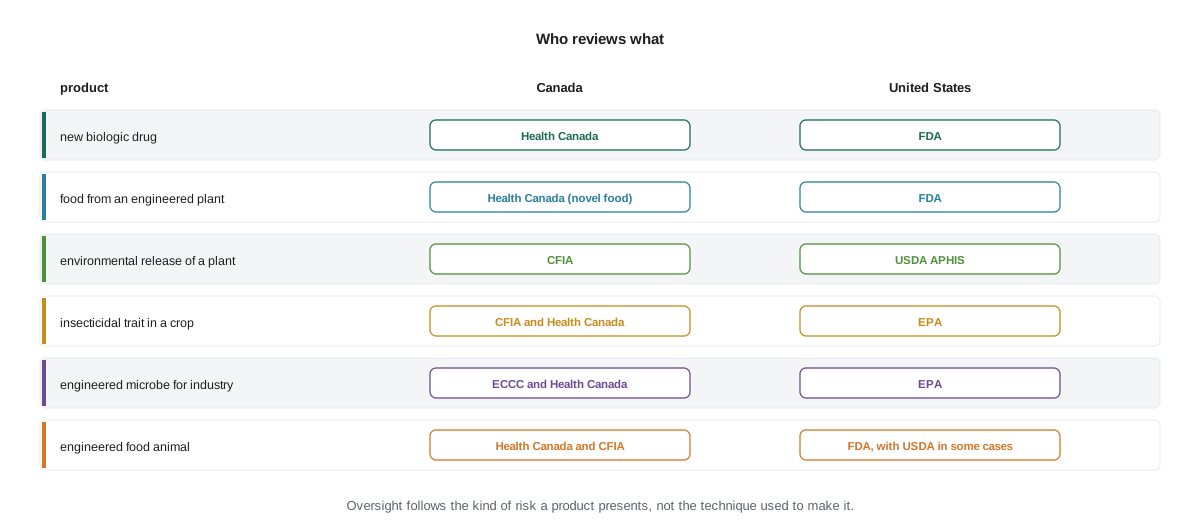
Regulation divides by product and by jurisdiction. In the United States, the FDA approves drugs, biologics and devices and oversees food safety, including foods from engineered plants and most engineered animals. The USDA's APHIS regulates plants that may pose plant pest risk, and the EPA regulates pesticidal traits and some engineered microorganisms under the Federal Insecticide, Fungicide, and Rodenticide Act and the Toxic Substances Control Act. The division dates from the 1986 Coordinated Framework for Regulation of Biotechnology, which fits new products into existing statutes rather than creating a biotechnology law.
Clinical research has its own layer. Trials need approval from a research ethics board, called an institutional review board in the United States, and from the drug regulator, and must be registered publicly. Informed consent must be documented. Good clinical practice standards govern how trials are run, and participants' privacy is protected by HIPAA and state law. For medicines made from human cells and tissues, additional rules govern donor screening and traceability.
| Product | Canadian lead | US lead |
|---|---|---|
| New biologic drug | Health Canada | FDA |
| Food from an engineered plant | Health Canada (novel food) | FDA |
| Environmental release of an engineered plant | CFIA | USDA APHIS |
| Insecticidal trait in a crop | CFIA and Health Canada | EPA |
| Engineered microbe for industry | Environment and Climate Change Canada and Health Canada | EPA |
| Engineered food animal | Health Canada and CFIA | FDA (with USDA for some cases) |
Patents and living things
Patents give an inventor the right to stop others making, using or selling an invention for a limited term, usually 20 years from filing, in exchange for publishing how it works. Whether living things could be patented was settled for the United States in Diamond v. Chakrabarty in 1980, when the Supreme Court held that a bacterium engineered to break down oil was patentable because it was a product of human ingenuity, not a product of nature. Canada took a narrower path: in Harvard College v. Canada in 2002 the Supreme Court held that a transgenic mouse was not patentable, because a higher life form is not a manufacture or composition of matter, while in Monsanto v. Schmeiser in 2004 it held that patents on genes and cells are enforceable even when the gene is present in a plant the patent does not itself cover.
Gene patents have narrowed. In Association for Molecular Pathology v. Myriad Genetics in 2013, the United States Supreme Court held that isolated natural DNA is not patent eligible because it is a product of nature, while complementary DNA, which does not occur naturally, is. The decision ended exclusive control of testing for the BRCA1 and BRCA2 genes and lowered the cost of such tests. Methods, vectors, engineered sequences, cell lines and manufacturing processes remain patentable, and modern biotechnology patents focus on these.
Patents interact awkwardly with research tools. The foundational CRISPR patents were disputed for years between the University of California and the Broad Institute, with different outcomes in different jurisdictions, complicating licensing. Some tools are shared instead: the Registry of Standard Biological Parts, open-source plasmid repositories and patent pools lower barriers, and humanitarian licenses allow royalty-free use in low-income countries, as for Golden Rice. Plant varieties have their own system, plant breeders' rights under the international UPOV convention, which traditionally allowed farmers to save seed, a right narrowed in later versions and often further restricted by contracts.
Consent, privacy and benefit sharing
Biological samples come from people, and people have interests in them. The case of Henrietta Lacks is the best known: cells taken without her knowledge during cancer treatment in 1951 became the HeLa line, used in tens of thousands of studies, while her family knew nothing for decades and received nothing. Modern research ethics requires informed consent for research use of samples and data, with debates about how broad a consent can be when future uses are unknown. Genomic data are peculiarly identifying and reveal information about relatives who never consented, which is why genomic databases use controlled access and why the US Genetic Information Nondiscrimination Act of 2008 prohibits genetic discrimination in health insurance and employment, though it does not cover life, disability or long-term care insurance.
Benefit sharing applies the same idea to countries and communities. The Convention on Biological Diversity and its Nagoya Protocol establish that states have sovereign rights over their genetic resources, that access requires prior informed consent and that benefits must be shared on agreed terms. The rules extend uneasily to digital sequence information, which can be used without physical access to a sample, a question that negotiations have continued to address. For Indigenous peoples, principles of data sovereignty, such as the OCAP principles in Canada, assert community control over how samples and data about them are collected and used.
Three live debates
Genome editing in people divides cleanly along one line. Somatic editing, which affects only the patient, is treated like other advanced therapies and judged on safety and efficacy; the main ethical problems are cost and access, since therapies priced in the millions reach few of the people who need them, most of whom live in countries that cannot afford them. Heritable germline editing, which changes descendants, is prohibited in many countries and rejected internationally for now, both because safety cannot be shown and because consent from future generations is impossible. Between the two sit uses such as editing to prevent rather than treat disease, and questions about where therapy ends and enhancement begins.
Agricultural biotechnology shows how much of the debate is not about safety. Science academy reviews have found foods from marketed engineered crops as safe as conventional ones (lesson 9), yet opposition persists, grounded in concerns about corporate concentration, patents and seed saving, effects on smallholders, environmental effects of the farming systems the traits support, and a wish to choose what one eats, which labeling policies address differently in different countries. Treating these as scientific errors to be corrected misreads them; they are questions about who controls food production.
Pricing and access run through the whole field. Biologics are expensive to develop and make, and prices for cell and gene therapies have reached the millions. Defenders argue that high prices fund the research that produced the therapy and reflect lifelong benefit from a single treatment; critics note the public funding behind much of the underlying science, the role of marketing and patent strategies in extending exclusivity, and that insulin, nearly a century old, remained unaffordable for many patients until policy intervened. Biosimilars and public manufacturing capacity are among the proposed remedies, with their own costs and limits.
Worked problem
A capstone briefing
Samuel asks Lena for a one-page recommendation. Northfield has an opportunity to license an edited canola line, developed with CRISPR, carrying a two-base deletion that improves disease resistance. No foreign DNA remains. The company would sell seed in the United States and Canada and the harvested oil would be exported, including to the European Union. What should she tell the board?
Show solution
- Regulatory status differs by market: in Canada the line is assessed on whether it has a novel trait, and with no foreign DNA and a familiar trait it may fall outside the plants-with-novel-traits category, while US oversight is in flux after the 2024 vacatur of the SECURE rule, so APHIS must be consulted early.
- The European Union has treated organisms from newer techniques as genetically modified, so exported oil may face approval and labeling requirements regardless of how the line is regulated at home; legislative change there is possible but not assured.
- Freedom to operate must be checked: CRISPR licensing is complicated by disputed foundational patents, so legal review of the license terms is needed before committing.
- Detection matters commercially: a two-base deletion is hard to distinguish from natural variation, which eases coexistence but also makes contractual identity preservation harder to verify.
- Recommend proceeding with early regulatory consultation in each market, a freedom-to-operate opinion and an export market assessment before signing.
Answer: Proceed conditionally: consult regulators in each market early, obtain a freedom-to-operate opinion on the CRISPR license, and assess export exposure to the European Union before committing.
How to think about a new application
A workable habit for judging a new biotechnology is to ask five questions in order. What exactly is the product, and what does the evidence show about its risks and benefits? Who bears the risks, and who gets the benefits? What rules apply, and are they about the product or the process? Who owns what, and does that ownership block anyone who needs access? And what would make the decision reversible if it turns out to be wrong? The answers do not follow from biology alone, which is why regulation, ethics and law are part of a biotechnologist's training rather than an afterthought.
Lena's co-op term ends with the briefing note. She has built a plasmid, watched a 2,000 liter culture grow, purified an antibody, validated a test strip, read three countries' rules and written a recommendation that she knows the board may not take. That mixture, of bench skill, quantitative judgment and attention to the rules and interests around the science, is what working in biotechnology actually involves.
Common mistakes
MistakeTreating biosafety and biosecurity as the same thing.
InsteadBiosafety prevents accidents; biosecurity prevents deliberate misuse.
MistakeAssuming a patent gives the right to sell a product.
InsteadA patent only excludes others; selling still needs regulatory approval.
MistakeThinking isolated human genes are still patentable in the United States.
InsteadMyriad held isolated natural DNA ineligible, though cDNA and methods remain patentable.
MistakeAssuming opposition to engineered crops is only about food safety.
InsteadMuch of it concerns patents, corporate concentration, farming systems and choice.
MistakeTreating regulatory approval in one country as global.
InsteadEach jurisdiction approves separately, and some regulate by process rather than product.
Summary and key terms
- Biosafety uses risk groups and containment levels; biosecurity covers security, screening and oversight of risky research.
- Canada regulates through Health Canada, the CFIA and environmental legislation; the United States divides oversight among the FDA, USDA and EPA under the 1986 Coordinated Framework.
- Clinical research needs ethics board and regulator approval, documented consent and good clinical practice.
- Chakrabarty allowed patenting engineered organisms in the United States; Harvard College barred higher life forms in Canada; Myriad excluded isolated natural DNA.
- Consent, genomic privacy, non-discrimination law and benefit sharing under the Nagoya Protocol govern the use of samples and data.
- Somatic editing is judged on safety, efficacy and access; heritable germline editing is widely prohibited.
- Debate about agricultural biotechnology and biologic pricing is largely about control, access and distribution rather than safety alone.
- biosafety
- Protection of people and the environment from accidental exposure to biological hazards.
- biosecurity
- Protection against deliberate misuse of biological materials or knowledge.
- containment level
- A set of practices, equipment and facility requirements matched to an organism's risk group.
- Coordinated Framework
- The 1986 US policy dividing biotechnology oversight among the FDA, USDA and EPA.
- novel food
- A Canadian regulatory category for foods without a history of safe use, including those from engineered plants.
- research ethics board
- A committee that reviews research involving humans; called an institutional review board in the United States.
- plant breeders' rights
- A form of protection for new plant varieties, separate from patents.
- freedom to operate
- An assessment of whether a product can be commercialized without infringing others' patents.
- Nagoya Protocol
- An agreement on access to genetic resources and sharing the benefits of their use.
- germline editing
- Editing of embryos, eggs or sperm, producing changes that descendants would inherit.
Practice problems
Work each problem on paper first, then reveal the answer to check.
What distinguishes biosafety from biosecurity?
Show answer
Biosafety prevents accidental exposure; biosecurity prevents deliberate misuse.
Which Canadian body assesses environmental release of a plant with a novel trait?
Show answer
The Canadian Food Inspection Agency.
Which US agency regulates an insecticidal trait in a crop?
Show answer
The Environmental Protection Agency.
What did Diamond v. Chakrabarty decide?
Show answer
That an engineered bacterium is patentable subject matter in the United States.
What did the Myriad decision hold about isolated DNA?
Show answer
Isolated natural DNA is not patent eligible, though cDNA is.
What does the Nagoya Protocol require for access to genetic resources?
Show answer
Prior informed consent and agreed benefit sharing with the providing country.
Why is heritable germline editing treated differently from somatic editing?
Show answer
Changes are inherited by people who cannot consent, and safety cannot yet be shown.
Lesson quiz · 5 questions
Score 60% or more to complete this lesson.
Create a free account to save your progress, take quizzes and earn a certificate.