
BIOL-470 · Lesson 1 of 12 · 23 min
What biotechnology is: history, sectors and tools
▶ Video coming soon A video version of this lesson is on the way.
Biotechnology is the use of living cells, their molecules and their processes to make products and solve problems. Brewing beer, baking bread and making cheese are biotechnology in this broad sense, and they are thousands of years old. What changed in the 1970s was that biologists learned to read, cut, copy and rewrite DNA directly, so that an organism could be given a new job by design rather than by patient selection. This course is about that modern biotechnology: the molecular tools, the ways cells are used as factories, the products those factories make, and the rules society has built around them.
The course builds on the molecular biology and genetics of BIOL-207: DNA replication, transcription and translation, gene regulation, and the structure of genes and genomes. Here those ideas become methods. Each lesson pairs the biology with the practical questions a working scientist faces: how much product a process makes, how sensitive a test is, how fast a population of cells grows, and what a regulator will ask before a product can be sold.
The running example is an invented company, Northfield Biologics in Madison, Wisconsin, a mid-sized firm with three product lines: a feed enzyme made in yeast, a biosimilar monoclonal antibody made in mammalian cells, and a molecular test kit for a crop disease. Lena Marchetti, a fourth-year biology student, joins the company for a co-op term and is mentored by Dr. Samuel Achebe, who leads process development. Lena's questions, and the problems she is given, recur throughout the course.
From domestication to genetic engineering
People were using organisms long before they knew what genes were. Selective breeding turned teosinte into maize, wolves into dogs and wild cabbage into kale, broccoli and cauliflower. Fermentation by yeast and lactic acid bacteria preserved food and made alcohol. In the nineteenth century Louis Pasteur showed that fermentation is the work of living microbes, and in the early twentieth century Chaim Weizmann used the bacterium Clostridium acetobutylicum to make acetone on an industrial scale for the First World War. The word biotechnology itself was coined around 1919 by the Hungarian engineer Károly Ereky to describe the conversion of raw materials into useful products by living organisms.
The antibiotic era showed what industrial microbiology could do. Alexander Fleming observed penicillin's effect in 1928, but it took the work of Howard Florey, Ernst Chain and a wartime program of strain improvement and deep-tank fermentation in the 1940s to produce it in quantity. Yields rose more than a thousandfold through random mutagenesis and screening of Penicillium strains, combined with better media and fermenter design. That combination of strain improvement and process engineering remains the core of bioprocessing today.
Modern biotechnology began with a set of discoveries in the late 1960s and 1970s. Restriction enzymes, which bacteria use to cut foreign DNA at specific sequences, were characterized by Werner Arber, Hamilton Smith and Daniel Nathans. DNA ligase could join fragments. Plasmids, small circular DNA molecules that replicate inside bacteria, could carry new genes. In 1973 Stanley Cohen and Herbert Boyer joined a fragment of foreign DNA to a plasmid and showed that it was copied and inherited in Escherichia coli: the first recombinant DNA organism. Within a decade, recombinant human insulin made in E. coli was approved, in 1982, as the first drug produced by genetic engineering.
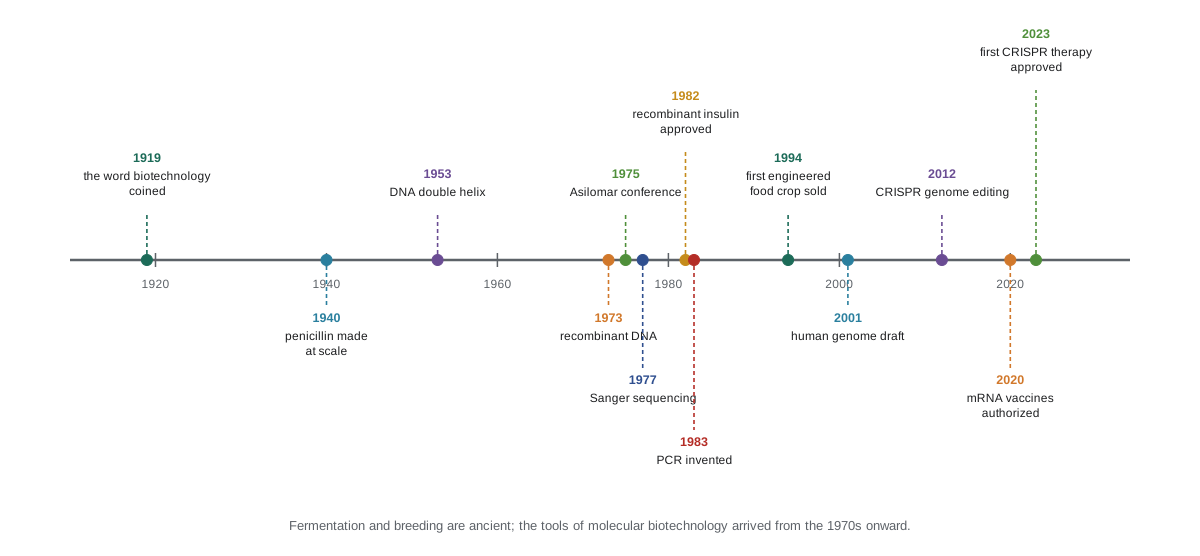
The new power raised immediate concern. In 1974 a group of scientists led by Paul Berg called for a voluntary pause on certain experiments, and in 1975 about 140 researchers, lawyers and journalists met at Asilomar, California, to agree on containment rules matched to risk. The Asilomar approach, in which scientists judged hazards and set graded precautions before governments wrote detailed rules, shaped the biosafety guidelines that followed in many countries and is revisited in lesson 12.
The sectors of biotechnology
Biotechnology is often divided by color, a loose but common shorthand. Red biotechnology is medical: drugs, vaccines, diagnostics and cell and gene therapies. Green biotechnology is agricultural: engineered and edited crops, animal health and plant diagnostics. White biotechnology is industrial: enzymes, chemicals, materials and fuels made by microbes. Blue biotechnology draws on marine organisms, and gray or environmental biotechnology covers bioremediation and waste treatment. The colors overlap: an enzyme that helps pigs digest phosphorus in feed is both industrial and agricultural, and a crop test kit is both diagnostic and green.
| Sector | Typical products | Main production systems | Main regulators |
|---|---|---|---|
| Medical (red) | Therapeutic proteins, antibodies, vaccines, cell and gene therapies, diagnostics | Mammalian cells, bacteria, yeast, viral vectors, patient cells | the FDA |
| Agricultural (green) | Engineered and edited crops, animal vaccines, biopesticides, plant diagnostics | Plants, animals, microbes | the USDA, EPA and FDA |
| Industrial (white) | Enzymes, organic acids, bioplastics, biofuels, specialty chemicals | Bacteria, yeast, filamentous fungi | the EPA, with the FDA for food uses |
| Environmental (gray) | Bioremediation, wastewater treatment, biosensors | Microbial communities, engineered strains | the EPA and the states |
The industry's economics differ sharply among sectors. Biopharmaceuticals are high in value and low in volume: a few hundred kilograms of a monoclonal antibody can supply a whole country for a year, and a single dose may cost thousands of dollars. Industrial products are the reverse, made by the metric ton at prices measured in dollars per kilogram, so the cost of sugar, energy and equipment dominates. Agricultural products earn money through seed sales and licensing, and are shaped by the slow cycle of plant breeding and by regulatory approval in every market where a crop will be grown or eaten.
The biotechnology toolkit
Almost every product in this course is made with a small set of tools, each covered in a later lesson. Recombinant DNA methods (lesson 2) let scientists move a gene from one organism to another and control when and where it is expressed. The polymerase chain reaction (lesson 3) copies a chosen DNA sequence millions of times and, in its quantitative form, measures how much is present. Sequencing (lesson 4) reads DNA, now at the scale of whole genomes for a few hundred dollars. Expression systems (lesson 5) are the cells that make proteins, and bioprocessing (lesson 6) is the engineering that grows those cells in large vessels and purifies their products. Genome editing (lesson 8) changes DNA in place, inside living cells.
Underneath the tools are a few biological facts that make biotechnology possible at all. The genetic code is nearly universal, so a human gene can be read by a bacterium. Enzymes are highly specific, so a reaction can be targeted to one molecule among thousands. Cells replicate, so a single engineered cell can become billions. And cells regulate their genes, so expression can be switched on and off by signals the scientist controls. Each of these facts also has limits: bacteria cannot splice introns or add most of the sugars that human cells attach to proteins, enzymes need the right temperature and pH, growing cells mutate, and regulation is leaky. Much of biotechnology is the work of exploiting the facts while managing the limits.
Growth: the arithmetic of cells
Because cells multiply, the most basic calculation in biotechnology is exponential growth. A bacterial culture in the exponential phase doubles at a constant interval, the doubling time \(t_d\). Starting from \(N_0\) cells, after time \(t\) the population is:
Here \(\mu\) is the specific growth rate, in units of inverse hours. E. coli in rich medium at 37 °C can double every 20 to 30 minutes; the yeast Komagataella phaffii (formerly Pichia pastoris), which Northfield uses for its enzyme, doubles in roughly 2 to 3 hours; Chinese hamster ovary (CHO) cells, used for antibodies, take about a day. Those differences explain why a bacterial process can be finished in a day or two while a mammalian cell process runs for two weeks.
import math
# Doubling times (hours) and a starting density of 1e6 cells per mL
hosts = {"E. coli": 0.5, "K. phaffii (yeast)": 2.5, "CHO cells": 24.0}
N0 = 1e6
for name, td in hosts.items():
    mu = math.log(2) / td
    t_10x = math.log(10) / mu          # time for a tenfold increase
    N24 = N0 * 2 ** (24 / td)          # cells per mL after 24 h, if growth stayed exponential
print(f"{name:20s} mu = {mu:5.3f} per h tenfold in {t_10x:5.1f} h after 24 h: {N24:.2e} per mL")E. coli mu = 1.386 per h tenfold in 1.7 h after 24 h: 2.81e+20 per mL K. phaffii (yeast) mu = 0.277 per h tenfold in 8.3 h after 24 h: 7.76e+08 per mL CHO cells mu = 0.029 per h tenfold in 79.7 h after 24 h: 2.00e+06 per mL
The output shows the scale of the difference. In 24 hours of unrestricted growth, E. coli would multiply by about 2 to the power 48, which is impossible: the culture would run out of nutrients and oxygen long before. Real cultures pass through a lag phase, an exponential phase, a stationary phase when a resource runs out, and a death phase. Designing a process means keeping cells in the productive part of that curve, a theme of lesson 6.
Worked problem
Counting doublings
Lena inoculates a 2 L shake flask of yeast at 0.05 grams of dry cells per liter. The culture grows exponentially with a doubling time of 2.5 hours. How long until it reaches 3.2 grams per liter, the density at which Samuel wants to transfer it to the seed fermenter?
Show solution
- The fold increase needed is 3.2 / 0.05 = 64.
- 64 is 2 to the power 6, so the culture must double 6 times.
- Six doublings at 2.5 hours each take 6 × 2.5 = 15 hours.
- Check with the growth rate: \(\mu = \ln 2 / 2.5 = 0.277\) per hour, and \(\ln 64 / 0.277 = 15.0\) hours.
Answer: About 15 hours, assuming growth stays exponential the whole time.
The product pipeline
A biotechnology product passes through a long pipeline before anyone can buy it. For a drug, research identifies a target and a candidate molecule; preclinical studies in cells and animals test safety and activity; clinical trials in three phases test safety, dose and efficacy in people; and a regulator reviews the evidence and the manufacturing process before authorizing sale. For a protein drug, roughly a decade and well over a billion dollars are commonly cited as the cost of bringing one product to market once failures are counted, though estimates vary widely. For a crop, the pipeline runs through gene discovery, transformation or editing, years of field trials and breeding into elite varieties, food, feed and environmental safety assessment, and approval in each export market.
Manufacturing is not an afterthought. For biological products, regulators often say that the process is the product: small changes in cell line, medium, temperature or purification can change how a protein folds or which sugars it carries, and that can change how it works in the body. That is why a biosimilar, a close copy of an approved biologic made by a different company (lesson 7), needs far more evidence than a generic small-molecule drug, which is chemically identical to the original.
Lena's first week
On her first day Lena tours the three areas of the plant. In the upstream suite, 2,000 liter stainless steel fermenters grow yeast that secretes the feed enzyme phytase into the broth. In the cell culture suite, single-use bioreactors lined with plastic bags grow CHO cells making the antibody. In the molecular lab, technicians run quantitative PCR on leaf samples sent by agronomists checking for a fungal disease. Samuel tells her that each area uses the same biology she learned in second year, but at a scale and with a level of documentation she has never seen: every reagent lot, temperature and pH reading is recorded, because the company must be able to prove to an inspector that each batch was made the same way.
He also gives her a reading list: the company's standard operating procedures for aseptic technique, the biosafety manual for the lab's containment level, and the quality manual that explains good manufacturing practice. The rest of this course follows the questions those documents raised for her.
Common mistakes
MistakeThinking biotechnology began with genetic engineering.
InsteadFermentation, breeding and industrial microbiology are much older; recombinant DNA added the ability to design organisms directly.
MistakeAssuming exponential growth can continue indefinitely.
InsteadGrowth slows when a nutrient, oxygen or space runs out; exponential equations apply only to the exponential phase.
MistakeTreating a biologic like a generic chemical.
InsteadBiological products depend on their manufacturing process, so copies need extensive comparability evidence.
MistakeConfusing doubling time with growth rate.
InsteadThe specific growth rate is ln 2 divided by the doubling time; a short doubling time means a large growth rate.
Summary and key terms
- Biotechnology uses living systems to make products; modern biotechnology began with recombinant DNA in the 1970s.
- Key early milestones include restriction enzymes, the Cohen–Boyer experiment (1973), Asilomar (1975) and recombinant insulin (1982).
- The field is divided loosely into medical, agricultural, industrial and environmental sectors with different economics and regulators.
- The core toolkit is recombinant DNA, PCR, sequencing, expression systems, bioprocessing and genome editing.
- Exponential growth follows \(N = N_0 2^{t/t_d}\), with specific growth rate \(\mu = \ln 2 / t_d\).
- For biologics, the manufacturing process is part of what defines the product.
- biotechnology
- The use of living organisms, cells or their molecules to make products or provide services.
- recombinant DNA
- DNA made by joining sequences from different sources.
- plasmid
- A small circular DNA molecule that replicates independently inside a cell, often used to carry genes.
- restriction enzyme
- A bacterial enzyme that cuts DNA at a specific short sequence.
- doubling time
- The time a growing population takes to double in number.
- specific growth rate
- The rate of increase of cell mass per unit of cell mass, equal to ln 2 divided by the doubling time.
- biologic
- A drug made by or derived from living cells, such as a therapeutic protein or vaccine.
- biosimilar
- A biologic highly similar to an already approved reference biologic, with no clinically meaningful differences.
Practice problems
Work each problem on paper first, then reveal the answer to check.
Name two biotechnologies older than recombinant DNA.
Show answer
Selective breeding and fermentation (for example brewing or penicillin production).
What did Cohen and Boyer show in 1973?
Show answer
That foreign DNA joined to a plasmid could be copied and inherited in E. coli.
Why was Asilomar important?
Show answer
Scientists agreed on graded containment rules matched to risk, a model for later biosafety guidelines.
A culture doubles every 30 minutes. What is its specific growth rate?
Show answer
ln 2 / 0.5 h = 1.39 per hour.
How many doublings take a culture from 1 to 1,024 units?
Show answer
Ten, because 2 to the power 10 is 1,024.
Why do CHO cell processes take longer than E. coli processes?
Show answer
CHO cells double in about a day rather than about half an hour.
Why do regulators say that for biologics the process is the product?
Show answer
Changes in how a protein is made can change its structure, such as folding or glycosylation, and therefore its effects.
Lesson quiz · 5 questions
Score 60% or more to complete this lesson.
Create a free account to save your progress, take quizzes and earn a certificate.