
BIOL-470 · Lesson 11 of 12 · 22 min
Molecular diagnostics and synthetic biology
▶ Video coming soon A video version of this lesson is on the way.
Two fields bookend modern biotechnology. Molecular diagnostics reads biological information to answer a practical question: is this pathogen present, does this tumor carry this mutation, is this grain contaminated? Synthetic biology writes biological information, designing genetic circuits and even whole genomes as engineers design machines. This lesson covers the main diagnostic formats and how their performance is measured, then the ideas, tools and limits of synthetic biology, including biosensors that sit at the border between the two.
Northfield's third product line is a quantitative PCR kit for Fusarium in grain. Lena is asked to help validate a new lateral flow version for use in the field, and to work out what its numbers will mean to a grain buyer, which turns out to be a question about statistics as much as biology.
Diagnostic formats
Nucleic acid tests detect DNA or RNA. Quantitative PCR (lesson 3) is the reference method: sensitive, quantitative and specific, but needing an instrument, cold reagents and a trained operator. Isothermal methods work at a single temperature and so need far less equipment. Loop-mediated isothermal amplification, LAMP, uses a strand-displacing polymerase and several primers that form looped products, amplifying DNA at about 60 to 65 °C in under an hour, with results readable by turbidity or color change. Recombinase polymerase amplification works near body temperature. CRISPR-based detection uses Cas enzymes that, once activated by binding their target, cut reporter molecules nearby, releasing a signal; platforms built on this principle were developed quickly for SARS-CoV-2.
Protein tests detect antigens or antibodies. The enzyme-linked immunosorbent assay, ELISA, captures a target on a plate with one antibody and detects it with a second antibody carrying an enzyme that converts a substrate into a colored product; it is quantitative and runs 96 or more samples at a time. Lateral flow tests put the same chemistry on a strip of nitrocellulose: the sample wicks along the strip, the target is bound by antibodies conjugated to colored particles, and the complex is captured in a line that becomes visible. A second line shows the test ran correctly. Lateral flow tests need no equipment, work in minutes and can be used by anyone, at the cost of sensitivity and quantification. Sequencing-based diagnostics (lesson 4) answer open questions, such as which pathogens are in a sample or which mutations a tumor carries.
| Format | Target | Equipment | Time | Strengths and limits |
|---|---|---|---|---|
| Quantitative PCR | DNA or RNA | Thermal cycler with optics | 1–2 hours | Sensitive and quantitative; lab-based |
| LAMP | DNA or RNA | Heat block or water bath | 30–60 minutes | Simple and fast; primer design is harder |
| CRISPR-based detection | DNA or RNA | Minimal, often with amplification step | 30–60 minutes | Specific, adaptable; newer and less standardized |
| ELISA | Protein | Plate reader | 2–4 hours | Quantitative, high throughput; needs good antibodies |
| Lateral flow | Protein, sometimes nucleic acid | None | 10–20 minutes | Point of care, cheap; less sensitive, usually yes or no |
| Sequencing | DNA or RNA | Sequencer and computing | Hours to days | Open-ended and detailed; costly and complex |
Measuring how good a test is
A diagnostic test is judged against a reference standard. Sensitivity is the proportion of true positives the test detects; specificity is the proportion of true negatives it correctly calls negative. Neither tells a user what a result means, because that also depends on how common the condition is. The positive predictive value, the probability that a positive result is a true positive, follows from Bayes' theorem:
where \(p\) is the prevalence. The negative predictive value is the mirror image. When prevalence is low, even a very specific test produces many false positives, which is why screening programs confirm positives with a second, different test.
# Predictive values of a field test at three prevalences.
sens, spec = 0.92, 0.98
for p in (0.50, 0.10, 0.01):
    tp = sens * p
    fp = (1 - spec) * (1 - p)
    fn = (1 - sens) * p
    tn = spec * (1 - p)
    ppv = tp / (tp + fp)
    npv = tn / (tn + fn)
    print(f"prevalence {p:5.2f}:  PPV {ppv:5.3f}   NPV {npv:5.3f}")
# How many of 1,000 samples are false positives at 1 in 100 prevalence?
print("false positives per 1,000 samples at prevalence 0.01:", round((1 - spec) * 0.99 * 1000, 1))prevalence 0.50: PPV 0.979 NPV 0.925 prevalence 0.10: PPV 0.836 NPV 0.991 prevalence 0.01: PPV 0.317 NPV 0.999 false positives per 1,000 samples at prevalence 0.01: 19.8
The output makes the point that caught Lena's attention. The same strip test is trustworthy when a positive is likely in advance, but at low prevalence most positives are false, so a positive result from the field strip must be confirmed by quantitative PCR in the laboratory before a grain buyer rejects a load. The limit of detection, the lowest amount reliably detected, is also essential: the kit's instructions state it in copies per gram, because a grower needs to know what a negative result rules out.
Diagnostics in practice
Clinical microbiology has shifted from culture to molecular methods for many pathogens, with multiplex panels that test a respiratory sample for a dozen viruses and bacteria at once. Oncology uses sequencing panels to match treatments to mutations, and liquid biopsy measures tumor DNA circulating in blood by digital PCR or sequencing, for monitoring and sometimes early detection. Prenatal screening uses cell-free fetal DNA in maternal blood. Pharmacogenetic testing checks variants that affect drug metabolism before prescribing. In agriculture and food, tests detect pathogens, allergens, species substitution in meat and fish, and engineered events. In public health, environmental and wastewater testing track pathogens across whole populations.
The COVID-19 pandemic compressed this development. Within weeks of the genome being published in January 2020, PCR assays were deployed; within months antigen lateral flow tests were made in the hundreds of millions; and genomic surveillance tracked variants globally. It also exposed the weak points: supply chains for swabs and reagents, the risk of using tests outside the conditions they were validated for, and the difficulty of communicating what a test result means.
Synthetic biology
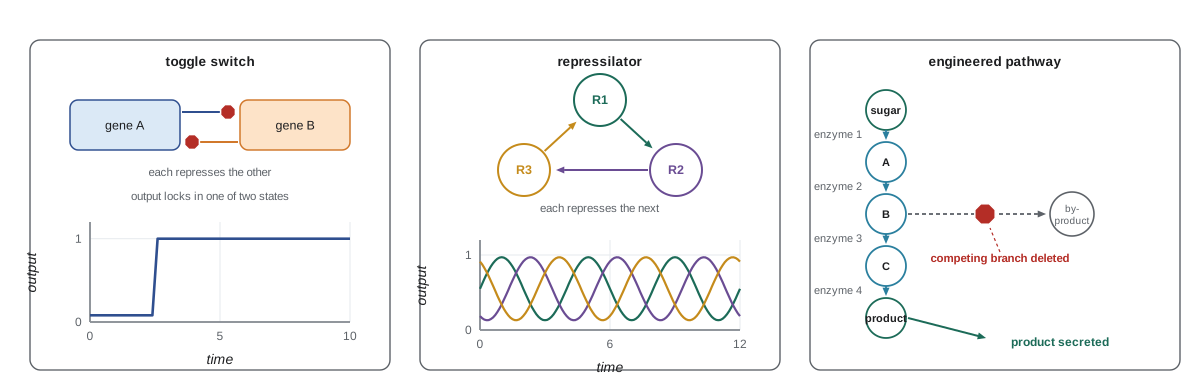
Synthetic biology applies engineering principles to biology: standard parts, abstraction into layers, and a cycle of design, build, test and learn. Its founding demonstrations came in 2000, when two groups built simple circuits in E. coli: a toggle switch that held one of two states, and the repressilator, a loop of three repressors that made cells oscillate. Since then the field has produced sensors, logic gates, counters and memory devices built from promoters, repressors, RNA elements and engineered proteins, as well as tools to rewire metabolism.
Part standardization is central. Golden Gate assembly with defined overhangs (lesson 2) lets libraries of promoters, ribosome binding sites, coding sequences and terminators be combined predictably, and characterized part collections such as the Registry of Standard Biological Parts, used by teams in the student iGEM competition, give measured properties rather than just sequences. Automation helps: robotic platforms, sometimes called biofoundries, build and test thousands of variants, and machine learning models suggest which designs to try next.
Metabolic engineering
The most commercially important branch of synthetic biology is metabolic engineering: rebuilding a cell's chemistry to make a target compound. The strategy is to introduce the pathway, increase flux into it, and remove competing reactions. Jay Keasling's group and collaborators engineered yeast to make artemisinic acid, a precursor of the antimalarial drug artemisinin normally extracted from sweet wormwood, by importing and tuning more than a dozen genes; a semisynthetic supply was commercialized in 2013, intended to buffer shortages, though plant-derived material has remained cheaper. Engineered strains now make flavors and fragrances such as vanillin and nootkatone, cannabinoids, the sweetener steviol glycosides, and heme protein for plant-based meat, as well as precursors for pharmaceuticals.
Genome-scale metabolic models, mathematical reconstructions of all the reactions in a cell, help predict which changes will raise yield. Flux balance analysis assumes the cell is at steady state and solves for the distribution of fluxes that maximizes an objective such as growth or product formation, subject to the stoichiometry of the network and limits on uptake. Such models guided the design of strains for several commercial products, though predictions still need laboratory testing: cells respond to engineering in ways models do not capture, including stress responses and the metabolic burden of expressing many new proteins.
Worked problem
Setting a yield target
Lena's team wants an engineered yeast to make a flavor compound with a molar mass of 154 g/mol from glucose (180 g/mol). The pathway needs 2 moles of glucose per mole of product. What is the maximum mass yield, and what titer would a 0.40 share of theoretical give if 60 grams per liter of glucose are consumed?
Show solution
- Maximum mass yield = 154 / (2 × 180) = 0.428 grams per gram.
- At 0.40 of theoretical: 0.428 × 0.40 = 0.171 grams per gram.
- From 60 g/L of glucose: 60 × 0.171 = 10.3 grams per liter.
- Carbon lost to biomass and energy means the true ceiling is below the stoichiometric maximum, so 0.40 of theoretical is a reasonable early target.
Answer: Maximum 0.428 g/g; at 0.40 of theoretical, about 10 grams per liter.
Biosensors
Biosensors join diagnostics and synthetic biology. A biological sensing element, an enzyme, antibody, nucleic acid or whole cell, is coupled to a transducer that converts binding or reaction into a signal. The glucose meter is the great success: glucose oxidase on an electrode generates a current proportional to glucose, and continuous glucose monitors now give people with diabetes readings every few minutes from a sensor under the skin. Engineered whole-cell sensors use genetic circuits that switch on a fluorescent or colored output in the presence of a target; cells engineered to detect arsenic in drinking water have been field tested. Cell-free sensors put the circuit in a freeze-dried extract on paper, avoiding the regulatory and containment questions raised by releasing living engineered organisms.
Limits and responsibilities
Synthetic biology's engineering metaphor is useful but imperfect. Biological parts are context-dependent: a promoter's strength changes with its neighbors, the host and growth conditions, so designs rarely behave as predicted the first time. Expressing heterologous pathways imposes a metabolic burden that slows growth, and evolution works against the engineer, since cells that lose a costly construct outgrow those that keep it. Containment matters for engineered organisms intended for the environment, and researchers have built safeguards such as kill switches and dependence on synthetic nutrients, though none is perfect.
The ability to write DNA also creates biosecurity obligations. Reputable synthesis companies screen orders against sequences of concern and verify customers, an approach encouraged by international guidance and, in the United States, by federal screening guidance for providers of synthetic nucleic acids. Research that could increase the transmissibility or harm of a pathogen is subject to additional review. Lesson 12 takes up these questions, together with the ethics and regulation of the rest of the field.
Common mistakes
MistakeReading sensitivity as the chance that a positive result is correct.
InsteadThat is the positive predictive value, which also depends on prevalence.
MistakeTrusting a single positive from a low-prevalence screening test.
InsteadMost positives will be false; confirm with a different method.
MistakeAssuming a characterized part behaves the same in every construct.
InsteadPart behavior depends on context, host and conditions.
MistakeExpecting a flux model to give the final strain.
InsteadModels guide design but cannot capture stress responses and burden; testing is essential.
MistakeThinking a kill switch makes release risk-free.
InsteadSafeguards reduce but do not eliminate risk, and can be lost by mutation.
Summary and key terms
- Diagnostics detect nucleic acids (qPCR, LAMP, CRISPR-based) or proteins (ELISA, lateral flow), or sequence a sample.
- Sensitivity and specificity describe a test; predictive values depend on prevalence through Bayes' theorem.
- Low prevalence makes most positives false, so screening programs confirm positives.
- Synthetic biology uses standard parts and a design, build, test, learn cycle; the toggle switch and repressilator were founding demonstrations.
- Metabolic engineering adds pathways, increases flux and removes competing reactions; genome-scale models and flux balance analysis guide design.
- Biosensors couple a biological element to a transducer; glucose monitoring is the leading example.
- Biological parts are context-dependent, constructs impose burden and can be lost, and DNA synthesis carries biosecurity obligations.
- sensitivity
- The proportion of true positives that a test detects.
- specificity
- The proportion of true negatives that a test correctly calls negative.
- positive predictive value
- The probability that a positive result is a true positive.
- limit of detection
- The smallest amount of target a test reliably detects.
- LAMP
- Loop-mediated isothermal amplification, which amplifies DNA at a single temperature.
- ELISA
- An antibody-based plate assay that gives a color signal proportional to the target.
- lateral flow test
- A strip test in which the sample wicks past antibodies, producing visible lines.
- repressilator
- A synthetic three-repressor loop that makes gene expression oscillate.
- metabolic engineering
- Rebuilding a cell's metabolism to make a target product.
- flux balance analysis
- A steady-state model that solves for reaction fluxes maximizing an objective.
Practice problems
Work each problem on paper first, then reveal the answer to check.
What does a second line on a lateral flow strip usually show?
Show answer
That the test ran correctly, the control line.
A test has 0.95 sensitivity. What does that mean?
Show answer
It detects 95 of every 100 true positives.
Why do screening programs confirm positive results?
Show answer
At low prevalence, many positives are false even with a specific test.
What makes LAMP suitable for field use?
Show answer
It runs at a single temperature, so it needs only a heat block.
Name the three strategies of metabolic engineering.
Show answer
Introduce the pathway, increase flux into it and remove competing reactions.
Why might an engineered strain lose its construct during a long run?
Show answer
Expressing it is costly, so cells that lose it grow faster and take over.
How does a glucose biosensor work?
Show answer
Glucose oxidase on an electrode produces a current proportional to glucose concentration.
Lesson quiz · 5 questions
Score 60% or more to complete this lesson.
Create a free account to save your progress, take quizzes and earn a certificate.