
BIOL-470 · Lesson 2 of 12 · 23 min
Recombinant DNA and molecular cloning
▶ Video coming soon A video version of this lesson is on the way.
Molecular cloning means making many identical copies of a particular piece of DNA by putting it into a carrier that a host cell will replicate. It is the first step in almost every biotechnology product: before a cell can make a protein, the gene for that protein has to be isolated or synthesized, joined to the right control sequences and delivered into the cell. This lesson covers the classical cut-and-paste method with restriction enzymes and ligase, the features of a cloning vector, how DNA is put into cells and how the right clones are found, and the faster assembly methods most laboratories now use.
Lena's first project at Northfield is a small one with real stakes. The company wants to test a new variant of its phytase enzyme, with three amino acid changes predicted to make it more stable at the high temperatures used to pellet animal feed. Her job is to build the expression plasmid, check it and hand it to the strain team, who will put it into yeast.
Restriction enzymes
Restriction enzymes are part of a bacterial defense system. A bacterium that makes a restriction enzyme also makes a matching methylase that marks its own DNA at the same sequences, so the enzyme cuts only unmarked, foreign DNA such as an infecting phage genome. The type II restriction enzymes used in cloning recognize short sequences, usually 4 to 8 base pairs, and cut at a fixed position within or next to them. Many recognition sites are palindromes: the sequence reads the same on both strands in the 5′ to 3′ direction. EcoRI, from E. coli, recognizes GAATTC and cuts between G and A on each strand.
Because the cuts on the two strands are offset, EcoRI leaves single-stranded overhangs four nucleotides long, called sticky ends. Any two fragments cut with EcoRI have complementary overhangs that can base-pair with each other. Other enzymes, such as SmaI (CCCGGG), cut both strands at the same place and leave blunt ends, which can be joined to any other blunt end but far less efficiently. The frequency of a site depends on its length: in random sequence with equal base frequencies, a 4-base site occurs on average every 4 to the power 4 = 256 base pairs, and a 6-base site every 4 to the power 6 = 4,096 base pairs. That is why 6-base cutters are the workhorses of cloning; they cut a typical gene a few times or not at all.
# Find restriction sites in a short sequence and predict fragment sizes for a linear piece of DNA.
seq = ("ATGGCTCAGTCGAATTCGGTACCTTAGCAGGATCCAAGCTTGCTAGCGAATTCTGACCATGGTTCGCTAGCATCGGATCCTAA")
sites = {"EcoRI": ("GAATTC", 1), "BamHI": ("GGATCC", 1), "HindIII": ("AAGCTT", 1), "NheI": ("GCTAGC", 1)}
for name, (site, cut) in sites.items():
    pos = [i for i in range(len(seq) - len(site) + 1) if seq[i:i + len(site)] == site]
    cuts = [p + cut for p in pos]
    edges = [0] + cuts + [len(seq)]
    frags = [b - a for a, b in zip(edges, edges[1:])]
    print(f"{name:8s} {site}  sites at {pos}  fragments {frags}")
print("expected spacing of a 6-base site in random DNA:", 4 ** 6, "bp")EcoRI GAATTC sites at [11, 47] fragments [12, 36, 35] BamHI GGATCC sites at [29, 74] fragments [30, 45, 8] HindIII AAGCTT sites at [35] fragments [36, 47] NheI GCTAGC sites at [41, 65] fragments [42, 24, 17] expected spacing of a 6-base site in random DNA: 4096 bp
The script shows the practical question a cloner asks: does an enzyme cut the insert, the vector, or both, and where? An enzyme that also cuts inside the gene of interest cannot be used to cut the gene out intact.
Ligase and the cut-and-paste method
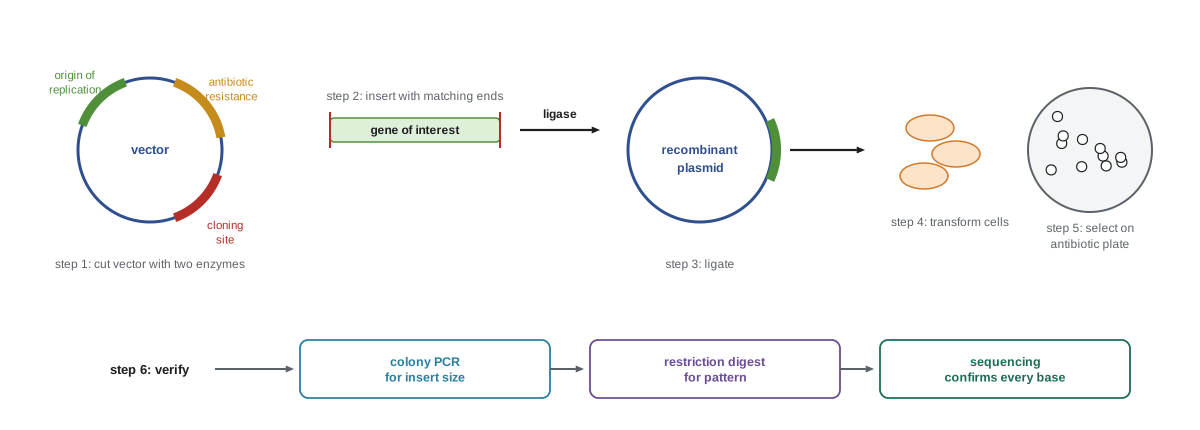
DNA ligase seals the sugar-phosphate backbone, joining the 3′ hydroxyl of one nucleotide to the 5′ phosphate of the next. The enzyme from bacteriophage T4 is used almost universally because it joins both sticky and blunt ends. In the classic method, the vector and the insert are cut with the same enzyme or pair of enzymes, purified, mixed and ligated. Using two different enzymes, one at each end, gives directional cloning: the insert can enter the vector in only one orientation, and the vector cannot close on itself without an insert.
The amounts matter. Ligation works best with a molar excess of insert, commonly three insert molecules per vector molecule. Because DNA is usually measured by mass, the cloner converts using the lengths of the two pieces:
Worked problem
Setting up a ligation
Lena's vector is 3.6 kb long and her phytase insert is 1.3 kb. She wants to use 50 ng of cut vector and a 3:1 insert to vector molar ratio. How much insert should she add?
Show solution
- The length ratio is 1.3 / 3.6 = 0.361.
- Multiply by the vector mass: 50 ng × 0.361 = 18.1 ng of insert gives a 1:1 molar ratio.
- For 3:1, multiply by 3: 18.1 × 3 = 54 ng.
- Her insert stock is 27 ng per microliter, so she adds 2.0 microliters.
Answer: About 54 ng of insert, or 2.0 microliters of her stock.
Vectors: what a plasmid needs
A cloning vector is a DNA molecule that can replicate in a host and carry foreign DNA. Plasmid vectors share a few essential parts. An origin of replication lets the host's machinery copy the plasmid; high-copy origins give hundreds of copies per cell, useful for preparing DNA. A selectable marker, usually a gene for antibiotic resistance such as bla (ampicillin) or kan (kanamycin), lets only cells carrying the plasmid survive on a selective plate. A multiple cloning site, a short stretch packed with unique restriction sites, provides places to insert DNA. Expression vectors add a promoter upstream of the cloning site, a ribosome binding site or Kozak sequence for translation, and a terminator downstream, and may add tags that help purify or detect the protein.
Vectors that move between hosts carry signals for each. The yeast expression plasmid Lena is building has a bacterial origin and an antibiotic marker so it can be built and copied in E. coli, a yeast promoter from the alcohol oxidase 1 gene (AOX1) that is strongly switched on by methanol, a secretion signal so the enzyme is exported into the culture broth, and sequences that let it integrate into the yeast genome. Larger vectors carry larger inserts: bacterial artificial chromosomes hold 100 to 300 kb and were used to map and sequence genomes, and viral vectors deliver genes into animal and plant cells (lesson 7).
Getting DNA into cells
Introducing DNA into bacteria is called transformation. E. coli does not take up DNA readily on its own, so cells are made competent. Chemical competence uses cold calcium chloride and a brief heat shock at 42 °C; electroporation uses a short high-voltage pulse that opens temporary pores in the membrane and gives higher efficiency. Efficiency is reported as transformants per microgram of plasmid DNA. Good commercial chemically competent cells reach around 10 to the power 8 to 10 to the power 9 transformants per microgram with an intact control plasmid; ligation reactions give far fewer, because most molecules are not correctly joined circles.
Plant and animal cells need other methods. Mammalian cells are transfected with lipid reagents, by electroporation or by viral vectors. Plant cells are most often transformed with Agrobacterium tumefaciens, a soil bacterium that naturally transfers a segment of its own plasmid DNA into plant chromosomes, or with a gene gun that fires DNA-coated gold particles into tissue (lesson 9). Yeast is transformed with lithium acetate treatment or electroporation.
Finding the right clone
After transformation and selection, every colony on the plate carries a plasmid, but not every plasmid carries the correct insert. Screening sorts them. In blue-white screening, the vector carries a fragment of the lacZ gene, which, together with a host fragment, makes active β-galactosidase; the enzyme turns the substrate X-gal blue. The cloning site sits inside lacZα, so an insert disrupts it: colonies with an insert are white, colonies with empty vector are blue. Colony PCR uses primers flanking the cloning site to check insert size directly from a few cells. Restriction digests of purified plasmid DNA confirm the expected fragment pattern.
None of these checks proves that the sequence is correct, and a single wrong base can change an amino acid or introduce a stop codon. The final step is always sequencing, now usually of the whole plasmid, which is fast and inexpensive with long-read methods (lesson 4). Lena's three amino acid changes were built into a synthetic gene, so her sequencing must confirm all three, and that no errors crept in during synthesis or assembly.
Beyond cut and paste: modern assembly
Restriction cloning has two weaknesses: it depends on convenient sites, and it leaves those sites behind as scars. Several methods now dominate. Gibson assembly mixes DNA fragments that overlap by 20 to 40 base pairs with three enzymes: an exonuclease chews back 5′ ends to expose single strands, the overlaps anneal, a polymerase fills gaps and a ligase seals the nicks, all in one tube at 50 °C. Several fragments can be joined in a defined order in about an hour, with no scars. Golden Gate assembly uses type IIS restriction enzymes such as BsaI, which cut outside their recognition site; each part can be designed with its own four-base overhang, so many parts snap together in order while the recognition sites are removed from the product. Standardized Golden Gate part libraries underpin much of synthetic biology (lesson 11).
Increasingly the gene itself is not isolated from an organism at all but ordered as synthetic DNA. Gene synthesis companies build sequences from short chemically made oligonucleotides, assemble them and verify them by sequencing, at a cost that has fallen to cents per base pair. Synthesis allows codon optimization: changing codons to those the host uses most, without changing the protein, which can raise expression many fold. Reputable providers screen orders against databases of sequences from dangerous pathogens and toxins and check the identity of customers, a biosecurity practice discussed in lesson 12.
| Method | How fragments are joined | Scars | Typical use |
|---|---|---|---|
| Restriction and ligation | Matching sticky or blunt ends sealed by T4 ligase | Restriction sites remain | Simple single inserts, teaching |
| Gibson assembly | Overlapping ends; exonuclease, polymerase and ligase | None | Several fragments, seamless constructs |
| Golden Gate | Type IIS enzymes make custom overhangs; ligase joins | None in final product | Modular assembly of many standard parts |
| Gateway recombination | Site-specific recombination between att sites | Short att sites | Moving one gene into many vectors |
| Gene synthesis | Chemical synthesis and assembly by a supplier | Designer chooses | Codon-optimized or redesigned genes |
cDNA and libraries
Eukaryotic genes contain introns, which bacteria cannot remove. To express a human or fungal protein in E. coli, biotechnologists work from complementary DNA (cDNA), made by copying mature messenger RNA with reverse transcriptase, an enzyme from retroviruses. The cDNA contains only the exons, joined as in the mRNA. A cDNA library is a collection of clones representing the mRNAs present in a tissue at the time of extraction, and was historically how genes were found: early insulin and growth hormone genes were obtained this way or synthesized from the known protein sequence. Genomic libraries, by contrast, contain random fragments of the whole genome, introns and all. Today most genes are found by sequencing and then synthesized, but cDNA remains essential for measuring gene expression (lessons 3 and 4).
Working safely
Recombinant DNA work is done under biosafety rules that classify organisms by risk. Lena's work uses laboratory strains of E. coli K-12 and K. phaffii, which are non-pathogenic, weakened for survival outside the lab and assigned to the lowest risk group, so the work is done at biosafety level 1 under the NIH Guidelines and the BMBL. Even so, she wears a lab coat and gloves, decontaminates waste by autoclaving and keeps antibiotic-resistant cultures out of drains. Work with pathogens, or that could make an organism more hazardous, needs higher containment and review by an institutional biosafety committee and, for some agents, federal select agent registration; lesson 12 covers these rules.
Common mistakes
MistakeAssuming any enzyme can be used if its site is in the vector.
InsteadThe enzyme must not also cut inside the insert, or the gene will be cut apart.
MistakeAdding insert and vector in equal masses for a 1:1 ratio.
InsteadMolar ratios depend on length; a shorter insert needs less mass for the same number of molecules.
MistakeTreating a white colony as a confirmed clone.
InsteadWhite only means lacZα was disrupted; size, orientation and sequence still need checking.
MistakeExpressing a eukaryotic genomic gene in E. coli.
InsteadBacteria cannot splice introns; use cDNA or a synthetic intron-free gene.
MistakeCalling transformation efficiency the fraction of cells transformed.
InsteadIt is the number of transformants per microgram of DNA.
Summary and key terms
- Type II restriction enzymes cut at short, often palindromic sites, leaving sticky or blunt ends.
- T4 DNA ligase joins fragments; two different enzymes give directional cloning.
- Vectors need an origin, a selectable marker and cloning sites; expression vectors add a promoter, translation signals and a terminator.
- Insert mass for ligation scales with the length ratio and the chosen molar ratio.
- Transformation efficiency is colonies per microgram of DNA; clones are screened by color, PCR or digests and confirmed by sequencing.
- Gibson and Golden Gate assembly and gene synthesis have largely replaced classic cut-and-paste.
- cDNA made by reverse transcriptase lacks introns and can be expressed in bacteria.
- sticky end
- A short single-stranded overhang left by a staggered cut, able to pair with a complementary overhang.
- DNA ligase
- An enzyme that seals breaks in the DNA backbone, joining fragments.
- origin of replication
- The sequence where replication of a plasmid or chromosome begins.
- selectable marker
- A gene, often for antibiotic resistance, that lets only cells carrying a vector survive.
- multiple cloning site
- A short region of a vector containing many unique restriction sites.
- transformation
- Uptake of DNA by a bacterial or yeast cell.
- blue-white screening
- Using disruption of lacZα, seen on X-gal plates, to tell colonies with inserts from those without.
- Gibson assembly
- A one-tube method joining DNA fragments with overlapping ends, without scars.
- codon optimization
- Changing codons to those preferred by the host without changing the encoded protein.
- cDNA
- DNA copied from messenger RNA by reverse transcriptase, lacking introns.
Practice problems
Work each problem on paper first, then reveal the answer to check.
How often would a 4-base site occur by chance in random DNA?
Show answer
About once every 256 base pairs.
Why does directional cloning use two different enzymes?
Show answer
The ends differ, so the insert can enter in only one orientation and the vector cannot close empty.
Vector 5.0 kb, insert 1.0 kb, 100 ng vector, 3:1 ratio. How much insert?
Show answer
100 × (1.0 / 5.0) × 3 = 60 ng.
200 colonies grow from 0.01 micrograms of plasmid. What is the efficiency?
Show answer
2 × 10 to the power 4 transformants per microgram.
Why are colonies with an insert white in blue-white screening?
Show answer
The insert disrupts lacZα, so no active β-galactosidase forms to turn X-gal blue.
What does a type IIS enzyme allow in Golden Gate assembly?
Show answer
Custom overhangs outside the recognition site, so parts join in order and the sites are removed.
Why must a human gene usually be cloned as cDNA for E. coli?
Show answer
E. coli cannot remove introns.
Lesson quiz · 5 questions
Score 60% or more to complete this lesson.
Create a free account to save your progress, take quizzes and earn a certificate.