
BIOL-440 · Lesson 6 of 12 · 24 min
Northern wildlife and predator–prey cycles
Northern animals live with extremes: winters of eight months, deep snow, darkness, and summers of brief abundance. Their numbers often swing widely from year to year, and some populations rise and fall in remarkably regular cycles. This lesson surveys how boreal mammals and birds cope with winter, then examines the most famous population cycle in ecology, the roughly ten-year cycle of the snowshoe hare and the Canada lynx, along with the long-term studies of moose and wolves that have taught ecologists how predators and prey interact in northern systems. Caribou, whose conservation is a central northern issue, have the next lesson to themselves.
Living through winter
BIOL-350 covered the physiology of cold: insulation, thermogenesis, torpor and hibernation, and the freeze tolerance of the wood frog. Here the focus is on ecological strategies. Boreal mammals fall into a few groups. Some hibernate, such as ground squirrels, marmots and bats, or enter long winter dormancy, such as black and grizzly bears. Some remain active beneath the snow, in the subnivean space between the snowpack and the ground, where temperatures stay near 0 °C while the air above may be −40 °C; voles, lemmings and shrews live and even breed there, and weasels, martens and foxes hunt them. Others remain active on top of the snow and rely on insulation, fat reserves and behavior.
Snow is a defining habitat feature. Its depth, density and hardness determine how easily animals move and feed. Species with large feet relative to body mass, low foot loading, travel efficiently on soft snow: snowshoe hares, lynx and ptarmigan. Moose, with long legs, wade through deep snow but struggle when depth exceeds about 90 centimeters, while white-tailed deer, with higher foot loading, are limited by snow and are expanding north as winters shorten. Caribou dig feeding craters through snow to reach lichens, and their broad hooves act as shovels and snowshoes. Rain-on-snow events that create ice crusts can lock away forage and cause mass starvation of caribou and muskoxen, a growing hazard in a warmer Arctic.
Many boreal birds migrate. The boreal forest is often called North America's bird nursery: estimates suggest one to three billion birds of some 300 species breed there, including much of the continental population of species such as the blackpoll warbler, Tennessee warbler, palm warbler, white-throated sparrow and many waterfowl and shorebirds. Year-round residents such as spruce grouse, gray jays (Canada jays), boreal chickadees and common ravens survive winter through food caching, fat reserves, communal roosting and dense plumage. Canada jays cache thousands of food items in summer and autumn, sticking them in bark crevices with saliva, and begin nesting in late winter while snow still covers the ground.
The snowshoe hare cycle
Records of furs bought by the Hudson's Bay Company from Indigenous and other trappers, analyzed by Charles Elton and Mary Nicholson in 1942, revealed that Canada lynx numbers peaked roughly every ten years across the boreal forest for more than a century. Snowshoe hare populations show the same cycle, with peak densities sometimes 10 to 25 times higher than troughs, and lynx peaks lagging hare peaks by one to two years. The cycle is broadly synchronous across much of the continent, which suggests a common driver or synchronizing mechanism.
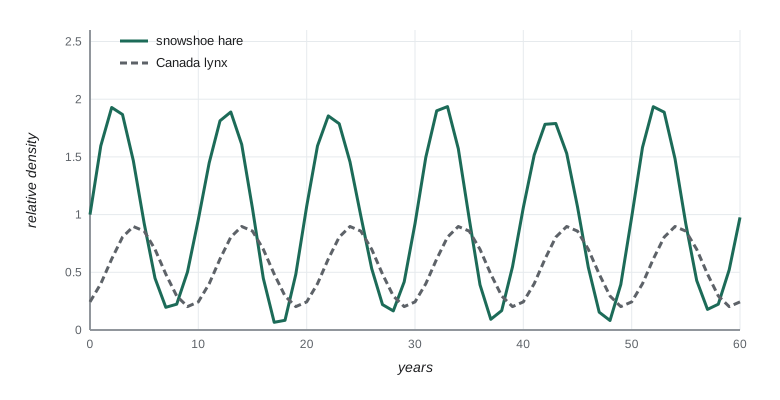
What causes the cycle? Three main hypotheses have been tested: food shortage, as hares overbrowse twigs in winter; predation, by lynx, coyotes, great horned owls, goshawks and other predators; and their interaction. The most decisive tests came from the Kluane Boreal Forest Ecosystem Project in the southwestern Yukon, led by Charles Krebs and colleagues from 1986 to 1996. Researchers fenced square-kilometer blocks to exclude mammalian predators, added food, added fertilizer and combined treatments. Excluding predators doubled hare densities, adding food tripled them, and combining predator exclusion with food addition increased densities about elevenfold, more than either alone. The conclusion was that predation is the main driver of the decline, with food acting in combination.
Later work added a twist: hares under high predation risk become chronically stressed. Rudy Boonstra, Michael Sheriff and colleagues found that females in the decline phase have high levels of stress hormones, produce fewer and smaller young, and pass the effects to their offspring, so that reproduction stays low for several years after predators decline. This maternal stress effect helps explain why hare populations do not rebound immediately after predator numbers fall, extending the low phase of the cycle.
Modeling predator–prey cycles
The Lotka–Volterra equations from BIOL-208 produce cycles, but they are neutrally stable: their amplitude depends on starting conditions, which is unrealistic. More realistic models add prey density dependence, a saturating functional response of predators, and time lags. A discrete-time model with a one-year lag in the predator's response captures the essence of the hare–lynx system and produces cycles whose period can be estimated from simulated data with a periodogram, the same tool used on the fur records.
# A discrete predator-prey model with a saturating functional response (synthetic hare-lynx system).
import numpy as np
rng = np.random.default_rng(66)
years = 200
H = np.empty(years); P = np.empty(years)
H[0], P[0] = 1.0, 0.05                       # hares and lynx per hectare-scaled units
r, K = 1.5, 1.0                              # hare growth and carrying capacity
a, h, e, m = 4.0, 0.4, 1.5, 1.0              # attack rate, handling time, conversion, lynx mortality
imm = 0.05                                   # hares arriving from refuges and unsurveyed habitat
for t in range(years - 1):
    eaten = a * H[t] / (1 + a * h * H[t])    # Holling type II, per predator
    H[t + 1] = H[t] * np.exp(r * (1 - H[t] / K) - eaten * P[t] / H[t] + rng.normal(0, 0.1)) + imm
    P[t + 1] = max(P[t] * np.exp(e * eaten - m + rng.normal(0, 0.1)), 1e-4)
h_late, p_late = H[100:], P[100:]
x = h_late - h_late.mean()
power = np.abs(np.fft.rfft(x)) ** 2
freqs = np.fft.rfftfreq(len(x), d=1.0)
period = 1 / freqs[1:][np.argmax(power[1:])]
lag = np.argmax([np.corrcoef(h_late[:len(h_late) - k], p_late[k:])[0, 1] for k in range(0, 5)])
print(f"hare peak-to-trough ratio (90th / 10th percentile): {np.percentile(h_late, 90) / np.percentile(h_late, 10):.0f}-fold")
print(f"dominant period from the periodogram: {period:.1f} years")
print(f"lynx lag behind hares that maximizes correlation: {lag} year(s)")hare peak-to-trough ratio (90th / 10th percentile): 17-fold dominant period from the periodogram: 9.1 years lynx lag behind hares that maximizes correlation: 2 year(s)
The periodogram finds a dominant period of about nine years, the lagged correlation recovers a lynx delay of about two years, and hares swing roughly seventeenfold between peaks and troughs, all close to the real system. The small immigration term matters: without a refuge that keeps a few hares in the population at the trough, this kind of model crashes to absurdly low densities. These illustrative parameters were chosen to resemble the real cycle, but parameter values can be tuned to give many periods; the value of the model is in showing that predation with a delayed numerical response and density-dependent prey growth is enough to generate stable cycles. Fitting such models to the Hudson's Bay Company records, analysts such as Nils Christian Stenseth and colleagues have shown that the lynx cycle is consistent with a predator tightly coupled to a single dominant prey.
Indigenous trappers and hunters across the boreal forest have long known the hare cycle and planned around it, shifting effort among hares, lynx, fish and other foods as abundance changed; the Hudson's Bay Company records are, after all, records of their knowledge and labor. Climate change may alter cycles. Snowshoe hares molt from brown to white in autumn and back in spring on a schedule set mainly by day length, so when snow arrives later and melts earlier, white hares stand out on brown ground. Studies in Montana and elsewhere led by Scott Mills found that such mismatched hares suffer higher predation, and that populations may adapt only slowly, a mechanism that could shift the southern edge of the hare range northward.
Small mammal and grouse cycles
Shorter cycles occur in voles and lemmings, which peak every three to five years in boreal and Arctic regions. Lemming peaks drive the breeding success of predators such as snowy owls, Arctic foxes, long-tailed jaegers and rough-legged hawks, which raise many young in peak years and few or none in crash years. Some studies suggest that lemming cycles have damped in parts of Greenland, Norway and the Canadian Arctic in recent decades, possibly because changing snow conditions reduce winter breeding under the snow. Ruffed and spruce grouse also show cycles of about ten years in parts of the boreal forest, perhaps through shared predators with hares.
Moose, wolves and long-term studies
Moose are the largest boreal herbivores and a major food for wolves, bears and people. Their populations are shaped by predation, harvest, winter severity, habitat and, increasingly, parasites and heat. Moose browse willows, birch and aspen and benefit from the young forest created by fire and logging, yet roads and young forest also increase access for hunters and predators. Winter ticks, whose numbers soar after mild autumns and short winters, have caused heavy calf mortality in parts of the southern range, and the brainworm parasite, carried harmlessly by white-tailed deer, is fatal to moose where the two species overlap.
In the United States, the world's longest continuous study of a predator–prey system has run on Isle Royale, a national park in Lake Superior, since 1958. Moose reached the island early in the twentieth century and wolves crossed an ice bridge around 1949. Researchers including Durward Allen, Rolf Peterson and John Vucetich tracked the two populations for decades, documenting how moose numbers rose and fell with wolf predation, winter severity, ticks and forage, and how the wolf population declined to two inbred animals by 2016 after genetic isolation and disease. The National Park Service then relocated wolves from Minnesota, Michigan and Ontario to the island from 2018 to 2019, and the restored wolf population has since been reducing moose numbers again. In northeastern Minnesota, moose declined by more than half from the mid-2000s, prompting research into heat stress, ticks, brainworm and wolf predation.
Apparent competition, introduced in BIOL-208, is central to northern conservation. When a shared predator such as the wolf is supported by abundant primary prey, moose or deer, it can drive a rarer secondary prey such as caribou into decline even though the two prey species do not compete for food. This mechanism links forestry, which creates young forest favored by moose and deer, to caribou declines, and it is why some recovery programs have reduced moose or wolf numbers, a controversial measure discussed in lesson 7.
| Species | Winter strategy | Population pattern | Main drivers |
|---|---|---|---|
| Snowshoe hare | Active; white coat, large feet | About 10-year cycle | Predation, food, maternal stress |
| Canada lynx | Active; large feet, thick fur | Cycle lagging hares by 1–2 years | Hare abundance |
| Voles and lemmings | Active under snow | 3–5 year cycles | Predation, snow conditions |
| Moose | Active; long legs | Fluctuating; declines in southern range | Predation, harvest, ticks, heat, habitat |
| Wolf | Active; pack hunting | Tracks prey abundance | Prey, human-caused mortality, disease |
| Canada jay | Resident; food caching | Relatively stable | Cache quality, which warm autumns can spoil |
Worked problem
Interpreting a predator exclusion experiment
In a Kluane-style experiment, hare density was 0.5 per hectare in control blocks, 1.0 in predator-exclusion blocks, 1.5 in food-addition blocks and 5.5 in blocks with both treatments. Calculate each effect as a ratio to the control and decide whether the treatments act independently.
Show solution
- Predator exclusion: 1.0 / 0.5 = 2.0 times control.
- Food addition: 1.5 / 0.5 = 3.0 times control.
- If the effects were independent and multiplicative, both together would give 2.0 x 3.0 = 6.0 times control, or 3.0 per hectare.
- Observed: 5.5 / 0.5 = 11 times control, much more than 6, so the treatments interact synergistically.
Answer: Effects of 2x and 3x alone, but 11x together: predation and food interact rather than acting independently.
Common mistakes
MistakeExplaining the hare cycle by food alone.
InsteadExperiments showed predation drives the decline, with food acting in combination and maternal stress extending the low phase.
MistakeAssuming Lotka–Volterra cycles describe real dynamics.
InsteadReal cycles need density dependence, saturating functional responses and lags; the classic model is neutrally stable.
MistakeTreating moose and caribou as competitors for food.
InsteadThey mainly interact through shared predators, a process called apparent competition.
MistakeIgnoring snow when explaining winter survival.
InsteadSnow depth, hardness and ice crusts determine movement, forage access and predation.
MistakeReading fur harvest records as direct population counts.
InsteadThey reflect trapping effort and prices too, though the cycle signal is strong.
Summary and key terms
- Boreal animals survive winter by hibernating, living beneath the snow or staying active with insulation and behavior.
- Snow depth and hardness shape movement and foraging; rain-on-snow ice crusts can cause mass starvation.
- The boreal forest is a breeding ground for one to three billion birds.
- Snowshoe hares and lynx cycle with a period of about ten years; Kluane experiments showed predation and food interact.
- Models with saturating predation and lags generate stable cycles; periodograms estimate their period.
- Moose, wolves and caribou are linked through predation, and apparent competition ties forestry to caribou declines.
- subnivean space
- The layer between snowpack and ground where small mammals live through winter.
- foot loading
- Body mass divided by foot area, which determines sinking in snow.
- population cycle
- Regular, repeated rises and falls in population density.
- functional response
- How a predator kill rate changes with prey density.
- numerical response
- How predator numbers change with prey density.
- periodogram
- A plot of the strength of periodic components in a time series, used to find cycle length.
- maternal stress effect
- Reduced reproduction in offspring caused by stress experienced by their mothers.
- apparent competition
- Negative effects between prey species mediated by a shared predator.
- rain-on-snow event
- Winter rain that freezes into an ice crust, locking away forage.
- food caching
- Storing food for later use, as Canada jays do.
Practice problems
Work each problem on paper first, then reveal the answer to check.
Who first analyzed the Hudson's Bay Company lynx records?
Show answer
Charles Elton and Mary Nicholson, in 1942.
What did predator exclusion plus food addition do to hare densities at Kluane?
Show answer
Increased them about elevenfold, more than either treatment alone.
Why might hare populations stay low after predators decline?
Show answer
Chronic maternal stress lowers reproduction for several years.
What is the typical lag between hare and lynx peaks?
Show answer
One to two years.
Why do lemming peaks matter to snowy owls?
Show answer
Owls raise many young in lemming peak years and few in crash years.
How can more moose lead to fewer caribou?
Show answer
More moose support more wolves, which also kill caribou: apparent competition.
What parasite carried by white-tailed deer is fatal to moose?
Show answer
The brainworm (meningeal worm).
Why are rain-on-snow events dangerous for caribou?
Show answer
Ice crusts prevent them from digging to lichens.
Lesson quiz · 5 questions
Score 60% or more to complete this lesson.
Create a free account to save your progress, take quizzes and earn a certificate.