
BIOL-440 · Lesson 3 of 12 · 24 min
Forest dynamics, succession and insect outbreaks
A boreal landscape is a patchwork of stands of different ages, each on its own trajectory of recovery from the last disturbance. Fire is the most important disturbance and has its own lesson next, but insects, wind and the slow replacement of trees in the absence of fire also shape the forest. This lesson looks at how stands develop after disturbance, how ecologists model those changes, and why defoliating insects such as the spruce budworm and the forest tent caterpillar erupt in outbreaks that recur over decades and cover millions of hectares.
Succession after disturbance
BIOL-208 introduced succession as the change in community composition after a disturbance. In the boreal forest, succession after fire rarely follows a simple sequence from pioneers to a single climax. Instead, what grows back depends mostly on what was there before and how severe the fire was. Black spruce stands that burn with moderate severity often return directly to black spruce from the seed released by semi-serotinous cones, a process called self-replacement or auto-succession. Jack pine regenerates jack pine on dry sands. Aspen resprouts from surviving roots. Severity matters because seedlings of spruce and pine establish best on mineral soil or thin organic layers, while a thick unburned organic layer favors resprouting broadleaf species and mosses.
Where fires are frequent, stands may burn again before they mature, and species that need decades to produce seed can fail to regenerate. Two fires in quick succession, a short-interval reburn, can convert black spruce forest to aspen, birch or open shrubland, because young black spruce does not produce enough cones until it is about 20 to 50 years old. Studies in Alaska, Yukon, Quebec and the Northwest Territories have documented such shifts, and they matter for carbon storage, wildlife habitat and future fire behavior.
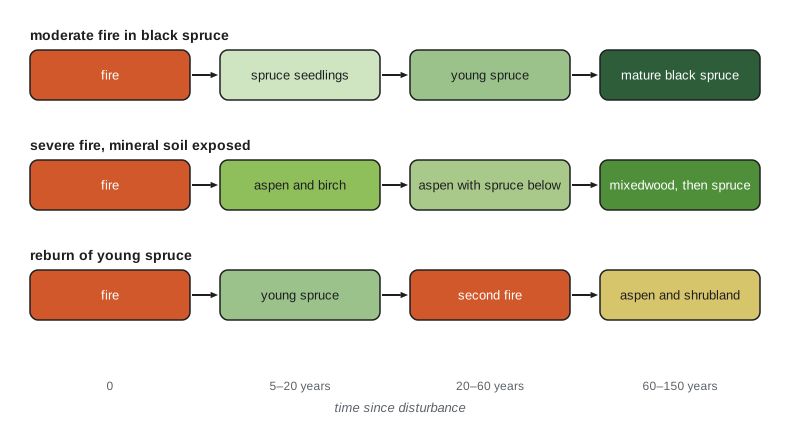
In the mixedwood forests of the southern boreal zone, a classic sequence does occur. Aspen and birch dominate the first decades after fire, while white spruce establishes more slowly beneath them, often on rotting logs. As the broadleaf trees age and die after 80 to 120 years, the spruce reaches the canopy, producing a mixedwood and eventually, in the absence of fire, a spruce–fir forest. In the long-unburned forests of eastern Quebec and Labrador, where fire cycles exceed several centuries, stands develop old-growth structure with trees of many ages, abundant dead wood and canopy gaps created by the death of individual trees. These gap dynamics, rather than stand-replacing fire, become the main way such forests renew themselves.
Modeling stand dynamics
Ecologists represent landscape-scale succession with state-and-transition or Markov chain models. The landscape is divided into stand types, and a matrix gives the probability that a stand of each type becomes each other type in a time step, for example a decade. Fire returns a stand to the young state; growth moves it to older states; reburns and severity determine which young state follows. Repeatedly multiplying the vector of current proportions by the matrix projects the landscape forward and shows the stable mix that the disturbance regime would eventually produce.
# Markov chain model of stand types on the Sable watershed (synthetic transition probabilities per decade).
import numpy as np
states = ['young conifer', 'mature black spruce', 'young broadleaf', 'mixedwood']
P = np.array([   # rows: from, columns: to (per decade)
    [0.60, 0.32, 0.08, 0.00],   # young conifer: grows up, reburns to broadleaf
    [0.12, 0.88, 0.00, 0.00],   # mature spruce: burns (back to young conifer) or persists
    [0.05, 0.00, 0.70, 0.25],   # young broadleaf: some burns, spruce grows in
    [0.06, 0.00, 0.04, 0.90],   # mixedwood: occasional fire
])
assert np.allclose(P.sum(axis=1), 1)
x = np.array([0.20, 0.60, 0.05, 0.15])
for decade in (0, 5, 10, 30):
    print(f"decade {decade:>2}: " + ", ".join(f"{s} {p:.2f}" for s, p in zip(states, x @ np.linalg.matrix_power(P, decade))))
w, v = np.linalg.eig(P.T)
stat = np.real(v[:, np.argmin(abs(w - 1))]); stat /= stat.sum()
print("stationary mix: " + ", ".join(f"{s} {p:.2f}" for s, p in zip(states, stat)))
P2 = P.copy(); P2[1] = [0.20, 0.80, 0.00, 0.00]; P2[0] = [0.55, 0.27, 0.18, 0.00]   # more fire and reburns
w, v = np.linalg.eig(P2.T); s2 = np.real(v[:, np.argmin(abs(w - 1))]); s2 /= s2.sum()
print("with more frequent fire: " + ", ".join(f"{s} {p:.2f}" for s, p in zip(states, s2)))decade 0: young conifer 0.20, mature black spruce 0.60, young broadleaf 0.05, mixedwood 0.15 decade 5: young conifer 0.20, mature black spruce 0.57, young broadleaf 0.07, mixedwood 0.15 decade 10: young conifer 0.20, mature black spruce 0.56, young broadleaf 0.07, mixedwood 0.16 decade 30: young conifer 0.20, mature black spruce 0.53, young broadleaf 0.08, mixedwood 0.19 stationary mix: young conifer 0.20, mature black spruce 0.53, young broadleaf 0.08, mixedwood 0.20 with more frequent fire: young conifer 0.18, mature black spruce 0.25, young broadleaf 0.16, mixedwood 0.41
The model is deliberately simple. Real transitions depend on stand age within a type, on weather and on spatial contagion, since fires spread to neighboring stands. Landscape models used in forest planning, such as LANDIS-II and its relatives, add spatial structure, seed dispersal and harvest. But even the simple chain shows the central result: increasing the frequency of fire and reburns cuts the share of mature black spruce by about half and moves the equilibrium landscape toward broadleaf and mixed stands, a shift already detected in parts of the western boreal forest.
Defoliating insects
Insects are the second great disturbance agent in the boreal forest. Native defoliators, insects that eat leaves or needles, have coexisted with boreal trees for millennia, and their outbreaks are a natural part of forest dynamics. The eastern spruce budworm (Choristoneura fumiferana), a moth whose larvae feed on the new shoots of balsam fir and white spruce and, less so, black spruce, is the most destructive. Larvae overwinter on the tree, emerge in spring and mine the swelling buds, then feed on the expanding needles. Several consecutive years of heavy defoliation kill many fir; spruce is more resistant.
Budworm outbreaks recur at intervals of roughly 30 to 40 years in eastern Canada and the adjacent United States, with tree-ring records showing outbreaks for centuries. The outbreak of the 1970s and 1980s defoliated more than 50 million hectares at its peak, mostly in Quebec, Ontario and the Atlantic provinces, and spread into Maine and Minnesota. A new outbreak began in Quebec's North Shore around 2006 and has since spread across several million hectares of Quebec and into New Brunswick, where an early intervention strategy of targeted spraying of rising populations has aimed to keep the outbreak from building.
Why do budworm populations cycle? Two main hypotheses have been debated. One emphasizes forest maturity: outbreaks occur when mature fir becomes abundant, then collapse when the food supply is destroyed, so the cycle tracks forest regrowth. The other, supported by long-term studies in New Brunswick, emphasizes natural enemies: parasitoid wasps and flies, birds and diseases build up during outbreaks with a delay and drive populations down, while dispersal of moths synchronizes cycles across regions. Delays in density dependence are the common thread. A population whose growth depends on its density some years earlier can overshoot and crash repeatedly, as a delayed logistic model shows.
# Delayed density dependence produces outbreak cycles (Ricker model with a lag; synthetic parameters).
import numpy as np
def run(r, tau, years=200, K=1.0):
    N = [0.05] * (tau + 1)
    for t in range(years):
        N.append(N[-1] * np.exp(r * (1 - N[-1 - tau] / K)))
    return np.array(N[tau + 1:])
for tau in (0, 4, 5):
    late = run(0.4, tau)[100:]                   # discard the first 100 years
    ratio = late.max() / late.min()
    peaks = [t for t in range(1, len(late) - 1) if late[t] > late[t - 1] and late[t] >= late[t + 1]]
    if ratio < 1.05:
        print(f"lag {tau} years: settles at carrying capacity (max/min ratio {ratio:.2f})")
    else:
print(f"lag {tau} years: cycles, max/min ratio {ratio:6.1f}, about {np.mean(np.diff(peaks)):.0f} years between peaks")lag 0 years: settles at carrying capacity (max/min ratio 1.00) lag 4 years: cycles, max/min ratio 12.3, about 19 years between peaks lag 5 years: cycles, max/min ratio 183.8, about 26 years between peaks
With no lag the population settles at its carrying capacity. With a lag of four years it cycles roughly tenfold, and a lag of five years gives swings of more than a hundredfold with a longer period: the longer the lag, the larger and slower the cycles. Real budworm cycles are longer than this toy model produces because the forest itself recovers slowly and enemies build up over many generations, but the principle that delayed feedback creates cycles applies to budworm, to forest tent caterpillar and to the snowshoe hare of lesson 6.
The forest tent caterpillar (Malacosoma disstria) defoliates aspen across the boreal plains and mixedwoods in outbreaks roughly every 10 to 12 years; aspen usually survives a few years of defoliation but grows more slowly. The western spruce budworm defoliates Douglas-fir and true firs in the western mountains, and the spruce beetle attacks white spruce in Alaska and the west. In Alaska, a spruce beetle outbreak in the 1990s killed white and Lutz spruce over more than a million hectares on the Kenai Peninsula and in south-central Alaska, and another large outbreak began in 2016 in south-central Alaska.
Insects, climate and fire
Insect outbreaks interact with fire and climate. Defoliation and beetle kill add dead fuel that can raise fire hazard for some years, although the effect depends on how quickly needles fall and dead trees decay. Warming changes insect ranges and timing. The mountain pine beetle, native to lodgepole pine forests of British Columbia and the western United States, expanded northeast across the Rocky Mountains into Alberta in the 2000s after a series of mild winters failed to kill overwintering larvae. There it reached forests where lodgepole pine hybridizes with jack pine, and studies have confirmed it can breed in pure jack pine, raising concern that it could spread east through the boreal forest, where jack pine is widespread and has no history of exposure to the beetle. Whether cold winters and boreal conditions will stop it remains an active research question.
| Insect | Main hosts | Outbreak pattern | Effects |
|---|---|---|---|
| Eastern spruce budworm | Balsam fir, white spruce | Roughly every 30–40 years, regional | Heavy fir mortality, growth loss |
| Forest tent caterpillar | Trembling aspen | Roughly every 10–12 years | Defoliation, growth loss, some dieback |
| Spruce beetle | White and Lutz spruce | Episodic after warm summers and windthrow | Large-scale spruce mortality in Alaska and the west |
| Mountain pine beetle | Lodgepole pine; jack pine at the range edge | Expanding with mild winters | Mass mortality of pine; possible eastward spread |
| Large aspen tortrix | Trembling aspen | Periodic, often with tent caterpillar | Defoliation |
Worked problem
Estimating stand mortality from consecutive defoliation
In a balsam fir stand, Jonah estimates that after each year of severe budworm defoliation, 15 percent of the surviving fir die, and the outbreak lasts five years with severe defoliation each year. What fraction of the fir survive the outbreak, and what fraction die?
Show solution
- Survival each year = 1 − 0.15 = 0.85.
- Survival over five years = 0.85^5 = 0.444.
- Mortality = 1 − 0.444 = 0.556, about 56 percent.
- In reality mortality accelerates in later years as reserves are exhausted, so this constant-rate estimate is conservative.
Answer: About 44 percent survive and about 56 percent die, more if mortality rises in later years.
Common mistakes
MistakeExpecting a single climax community everywhere in the boreal forest.
InsteadMost stands self-replace or follow pathways set by the previous stand, fire severity and fire interval.
MistakeTreating insect outbreaks as unnatural catastrophes.
InsteadNative defoliators have cycled with boreal forests for millennia; their behavior is changing with climate and forest management.
MistakeAssuming defoliation always kills trees.
InsteadAspen usually survives a few years of tent caterpillar defoliation; balsam fir is far more vulnerable to budworm.
MistakeReading a Markov chain projection as a forecast.
InsteadIt shows the consequences of fixed transition rates; real rates change with climate and management.
MistakeIgnoring the lag in density dependence when explaining cycles.
InsteadDelayed feedback from enemies or food supply is what turns regulation into oscillation.
Summary and key terms
- Post-fire succession usually depends on the previous stand and fire severity; black spruce and jack pine often self-replace.
- Short-interval reburns can convert conifer forest to broadleaf or shrubland because young spruce lacks seed.
- Mixedwoods follow a sequence from aspen to white spruce, and long-unburned forests renew through gap dynamics.
- Markov chain models project landscape composition from transition probabilities and show shifts with fire frequency.
- Spruce budworm outbreaks recur every 30 to 40 years and forest tent caterpillar every 10 to 12, driven by delayed density dependence.
- Warming lets insects such as the mountain pine beetle expand, potentially into jack pine across the boreal forest.
- self-replacement
- Post-disturbance regeneration of the same dominant species, also called auto-succession.
- short-interval reburn
- A second fire before trees have matured enough to produce seed.
- gap dynamics
- Forest renewal through the death of individual trees and regrowth in the openings they create.
- Markov chain model
- A model in which the next state depends only on the current state through fixed transition probabilities.
- defoliator
- An insect that eats leaves or needles.
- spruce budworm
- A native moth whose larvae defoliate balsam fir and spruce in recurring outbreaks.
- delayed density dependence
- Population growth that responds to density in earlier time steps, which can cause cycles.
- parasitoid
- An insect whose larvae develop inside or on a host, eventually killing it.
- mountain pine beetle
- A bark beetle of western pines that has spread into Alberta and can breed in jack pine.
- old growth
- Forest that has developed for a long time without stand-replacing disturbance, with mixed ages and abundant dead wood.
Practice problems
Work each problem on paper first, then reveal the answer to check.
Why can a reburn 15 years after a fire convert black spruce to aspen?
Show answer
Young black spruce has not yet produced enough seed, while aspen resprouts.
What determines whether spruce or aspen dominates after a severe fire?
Show answer
Seed availability and seedbed, especially exposed mineral soil, and whether aspen roots survived.
In a Markov chain, what does the stationary distribution represent?
Show answer
The long-run mix of stand types if transition probabilities stay fixed.
Name the two main hypotheses for budworm cycles.
Show answer
Forest maturity and food supply; natural enemies with delayed responses.
Which tree does the forest tent caterpillar mainly defoliate?
Show answer
Trembling aspen.
Why did mild winters matter for the mountain pine beetle?
Show answer
They failed to kill overwintering larvae, allowing range expansion into Alberta.
A stand loses 20 percent of survivors each year for three years. What fraction survives?
Show answer
0.8^3 = 0.512, about 51 percent.
What feature distinguishes old-growth boreal forest in long-unburned regions?
Show answer
Trees of many ages, abundant dead wood and renewal through canopy gaps.
Lesson quiz · 5 questions
Score 60% or more to complete this lesson.
Create a free account to save your progress, take quizzes and earn a certificate.