
BIOL-440 · Lesson 4 of 12 · 25 min
Fire ecology
Fire is the master disturbance of the North American boreal forest. Lightning has ignited boreal fires for as long as there have been boreal forests, and most boreal plants and animals are adapted to a world in which much of the landscape burns every century or so. Yet fire is also a hazard to communities, a large source of carbon emissions and smoke, and a process that is changing fast as the climate warms. This lesson describes fire regimes, how fire behaves in boreal fuels, how fire weather is rated, what fire does to forests and soils, and how fire is managed, including the revival of Indigenous cultural burning.
Fire regimes
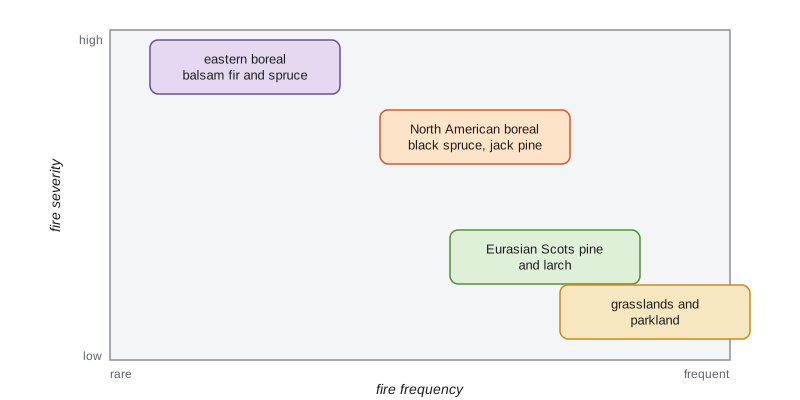
A fire regime is the pattern of fire characteristic of an area over long periods: how often fire occurs, how large fires are, when in the year they burn, how intensely they burn and how severely they affect vegetation and soil. Fire frequency is often expressed as the fire cycle, the time required to burn an area equal to the whole study area, or its reciprocal, the annual area burned as a fraction of the landscape. A landscape where 1 percent burns each year has a fire cycle of 100 years. The fire return interval at a point is the time between successive fires there; if fire strikes at random with respect to stand age, the mean return interval equals the fire cycle.
North American boreal forests are dominated by stand-replacing crown fires. Black spruce and jack pine have low branches, ladder fuels of lichens and dead twigs, and resinous needles, so fire climbs easily into the crowns and runs through the canopy, killing most trees. Most of the area burned each year comes from a small number of very large fires, often tens or hundreds of thousands of hectares, many in remote areas. In parts of Eurasia, by contrast, Scots pine and larch forests often burn in surface fires that leave thick-barked trees alive. Typical boreal fire cycles in North America range from about 50 to 150 years in the dry continental west, such as interior Alaska, the Northwest Territories and northern Saskatchewan, to several centuries in the wetter east, such as Labrador and eastern Quebec.
Time since fire
If fire strikes stands regardless of their age, the proportion of a landscape older than age \(t\) follows a negative exponential distribution, \(A(t) = e^{-t/b}\), where \(b\) is the fire cycle. Fire history studies reconstruct a time-since-fire map from tree ages, fire scars and old maps, then fit this curve, or the more flexible Weibull distribution, \(A(t) = \exp[-(t/b)^c]\), in which a shape parameter \(c\) greater than 1 means that older stands are more likely to burn. In many boreal landscapes young stands burn less readily because they lack fuel, and very old stands may burn more readily, so \(c\) is often somewhat above 1.
# Time-since-fire distribution for the Sable watershed (synthetic stand ages).
import numpy as np
from scipy import stats
rng = np.random.default_rng(404)
cycle_true = 90.0
ages = rng.weibull(1.3, 600) * cycle_true            # stand ages in years, Weibull shape 1.3
print(f"stands: {len(ages)}, mean age {ages.mean():.0f} years, oldest {ages.max():.0f} years")
b_exp = ages.mean()                                  # MLE of the negative exponential fire cycle
c, loc, b_wei = stats.weibull_min.fit(ages, floc=0)
print(f"negative exponential fit: fire cycle {b_exp:.0f} years, annual area burned {100 / b_exp:.2f}%")
print(f"Weibull fit: shape c = {c:.2f}, scale b = {b_wei:.0f} years (c > 1 means older stands burn more readily)")
for t in (50, 100, 200):
print(f"share of landscape older than {t:>3} years: exponential {np.exp(-t / b_exp):.2f}, Weibull {np.exp(-(t / b_wei) ** c):.2f}, observed {np.mean(ages > t):.2f}")stands: 600, mean age 84 years, oldest 408 years negative exponential fit: fire cycle 84 years, annual area burned 1.19% Weibull fit: shape c = 1.28, scale b = 91 years (c > 1 means older stands burn more readily) share of landscape older than 50 years: exponential 0.55, Weibull 0.63, observed 0.63 share of landscape older than 100 years: exponential 0.30, Weibull 0.32, observed 0.32 share of landscape older than 200 years: exponential 0.09, Weibull 0.06, observed 0.06
The fitted shape parameter above 1 says that the chance of burning rises with stand age here, and the Weibull curve tracks the observed share of old forest better than the exponential. Both fits put the fire cycle at roughly 85 to 90 years, meaning a little over 1 percent of the watershed burns in an average year. Such estimates underpin forest management planning: if harvest and fire together remove forest faster than it regrows to maturity, the share of old forest declines.
How boreal fires behave
Fire behavior depends on the fire triangle of fuel, weather and topography. Boreal fuels are layered: the forest floor of mosses, lichens and duff, surface fuels of shrubs and dead wood, ladder fuels of low branches, and the canopy. Fine, dry surface fuels ignite and carry fire; deep organic duff smolders for days or weeks and determines how much carbon is released and how severely the soil is heated. Crown fires can spread several kilometers per hour, throw embers ahead to start spot fires, and release energy at rates far beyond what crews on the ground can fight. Some fires overwinter as smoldering combustion deep in peat and duff, so-called zombie fires, then re-emerge in spring; these have become more common in recent hot, dry years in Alaska and northern Canada.
Weather drives the daily and seasonal course of fire. Long summer days, low humidity, wind and drought dry fuels. Lightning from summer thunderstorms causes most of the area burned in remote boreal regions even though people start many more fires near roads and communities. Large fire years are associated with persistent blocking high-pressure ridges that bring heat and drought for weeks.
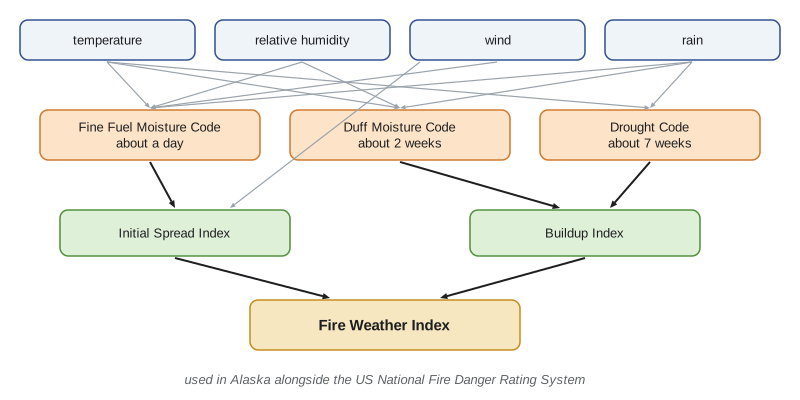
The United States rates fire danger with the National Fire Danger Rating System (NFDRS), whose current version (NFDRS2016) computes fuel moistures, an Energy Release Component, a Burning Index and a Spread Component from weather station data, and is used by federal and state agencies to set staffing and restrictions. In Alaska, however, the interagency Alaska Fire Service and the state Division of Forestry also use the Canadian Forest Fire Danger Rating System, including its Fire Weather Index and moisture codes, because it was designed for boreal fuels like Alaska's. Its Fine Fuel Moisture Code, Duff Moisture Code and Drought Code track moisture in fine fuels, upper organic layers and deep organic layers over periods of about a day, two weeks and seven weeks.
# A simplified fire weather screen for the station (illustrative thresholds, not the official FWI equations).
import numpy as np
rng = np.random.default_rng(44)
days = 92                                            # June to August
temp = 18 + 6 * rng.standard_normal(days).cumsum() / np.sqrt(np.arange(1, days + 1)) + 4 * np.sin(np.linspace(0, np.pi, days))
rh = np.clip(55 - 1.5 * (temp - 18) + rng.normal(0, 10, days), 15, 100)
rain = np.where(rng.uniform(size=days) < 0.22, rng.exponential(6, days), 0.0)
wind = np.clip(rng.normal(14, 6, days), 0, None)
dryness = 0.0
risk = []
for t, h, r, w in zip(temp, rh, rain, wind):
    dryness = max(0.0, dryness + max(0.0, t - 5) * 0.12 - r * 1.5)   # deep-fuel drying, reset by rain
    fine = (100 - h) / 100 * (1 if r < 1 else 0.3)                   # fine-fuel dryness today
    index = fine * (1 + w / 20) * (1 + dryness / 20) * 10
    risk.append('extreme' if index > 34 else 'high' if index > 24 else 'moderate' if index > 12 else 'low')
for level in ('low', 'moderate', 'high', 'extreme'):
    print(f"{level:>8}: {risk.count(level):2d} days")
print(f"longest run of high or extreme days: {max(len(s) for s in ''.join('x' if x in ('high', 'extreme') else '.' for x in risk).split('.'))}") low: 28 days
moderate: 27 days
high: 22 days
extreme: 15 days
longest run of high or extreme days: 7This screen is deliberately simplified and should not be used for operational decisions, but it captures the logic of fire danger rating: fine fuels respond to today's humidity and rain, deep fuels integrate weeks of drying, and wind multiplies spread. Long runs of high and extreme days, not single hot afternoons, set up the largest fire years.
Recent fire seasons
Alaska's largest fire seasons on record burned about 2.7 million hectares (6.6 million acres) in 2004 and about 2.1 million hectares in 2015, and recent seasons such as 2022 have again burned more than a million hectares. In the boreal forest next door, Canada's 2023 fire season burned about 15 million hectares, more than twice that country's previous record, and its smoke drove air quality alerts across the eastern and midwestern United States, from Minneapolis to New York. The 2025 Canadian season, the second largest there, again sent smoke south across the Great Lakes states. Researchers attribute the trend toward larger seasons across the North American boreal forest to hotter, drier conditions and longer fire seasons.
Fire effects
Fire severity, the degree of change to vegetation and soil, varies widely within a single fire. Ecologists measure it in the field with composite burn indices and from satellites using the differenced Normalized Burn Ratio, which compares near-infrared and shortwave-infrared reflectance before and after fire. Severity of burning of the organic layer is especially important in the boreal forest. A deep burn exposes mineral soil, which favors spruce and pine seedlings and also aspen and birch, while a shallow burn leaves a moss and duff seedbed on which conifer seedlings struggle. Deep burns also release more carbon and, where permafrost lies beneath, can trigger thaw by removing insulation, as lesson 2 showed.
Fire releases nutrients, raises soil temperature and opens the canopy, producing a flush of growth in shrubs, fireweed and young trees. It creates snags used by woodpeckers and cavity nesters; black-backed woodpeckers specialize on recently burned forests, feeding on wood-boring beetle larvae. Moose often increase on burns 10 to 30 years after fire as browse becomes abundant. Caribou, in contrast, depend on terrestrial lichens that take 50 to 100 years or more to recover after fire, so large fire years reduce winter range for decades, a point taken up in lesson 7. At the landscape scale, fire maintains the mosaic of stand ages that supports this diversity.
Carbon emissions from boreal fires are large. A severe boreal fire may release 2 to 4 kilograms of carbon per square meter, most of it from the organic soil rather than the trees. In 2023 Canadian fires released an estimated amount of carbon comparable to or larger than the country's annual fossil fuel emissions, according to several analyses, although regrowth gradually recaptures carbon over the following decades if the forest returns.
Managing fire
Fire management in the boreal forest is a matter of priorities. Agencies protect communities, infrastructure and commercial forests, and in remote areas often monitor rather than suppress fires that pose no threat, recognizing fire's ecological role and the impossibility of suppressing every fire. Alaska divides its land into full, critical, modified and limited protection zones; Canadian provinces and territories use comparable zones. FireSmart programs in Canada and Firewise and similar programs in the United States help communities reduce hazard by thinning conifers, planting fire-resistant aspen, cleaning roofs and gutters and creating fuel breaks around towns.
Indigenous peoples across the boreal forest used fire deliberately for millennia: spring burning of meadows, trails and wetland margins to improve grazing for wildlife, encourage berries and reduce the risk of summer fires near camps. Colonial fire suppression policies in the twentieth century largely ended these practices. Today Indigenous fire stewardship and cultural burning are reviving through community programs, partnerships with agencies and training of Indigenous fire crews, with research suggesting that such low-intensity spring burning can reduce hazard around communities while restoring cultural connections to the land.
Worked problem
Fire cycle from area burned
Over 40 years, fires burned a total of 18,000 hectares of the 50,000-hectare Sable watershed, some areas twice. Estimate the annual area burned, the fire cycle, and the expected share of the watershed older than 150 years if the negative exponential model holds.
Show solution
- Annual area burned = 18,000 / 40 = 450 ha per year.
- As a fraction of the watershed: 450 / 50,000 = 0.009, or 0.9 percent per year.
- Fire cycle = 1 / 0.009 = about 111 years.
- Share older than 150 years = exp(−150 / 111) = exp(−1.35) = about 0.26.
Answer: About 0.9 percent burns per year, a fire cycle of about 111 years, and roughly a quarter of the watershed older than 150 years.
Common mistakes
MistakeEquating fire frequency with fire severity.
InsteadThey are separate dimensions of a fire regime; boreal crown fires can be infrequent but severe.
MistakeAssuming fire suppression could stop boreal fires everywhere.
InsteadMost area burns in a few remote lightning fires under extreme weather; agencies set priorities instead.
MistakeFocusing only on tree mortality when assessing severity.
InsteadConsumption of the organic layer controls regeneration, carbon loss and permafrost effects.
MistakeTreating all fire as harmful to wildlife.
InsteadBurns benefit moose and black-backed woodpeckers, though they reduce lichen range for caribou for decades.
MistakeUsing a toy fire weather index for real decisions.
InsteadOperational decisions rely on the official FWI System or NFDRS equations and calibrated fuel models.
Summary and key terms
- A fire regime describes the frequency, size, season, intensity and severity of fire over long periods.
- North American boreal forests burn mainly in stand-replacing crown fires with fire cycles of about 50 to several hundred years.
- Time-since-fire distributions are modeled with negative exponential or Weibull curves.
- Fire danger is rated from weather through fuel moisture codes; the Canadian FWI System is used in Canada and Alaska.
- Recent seasons, including Canada's record 2023 season, show a trend toward larger fire years.
- Fire severity, especially organic-layer consumption, shapes regeneration, carbon loss and habitat; Indigenous cultural burning is reviving.
- fire regime
- The characteristic pattern of fire frequency, size, season, intensity and severity in an area.
- fire cycle
- The time needed to burn an area equal to the whole study area; the reciprocal of the annual fraction burned.
- crown fire
- A fire that spreads through the tree canopy, usually killing most trees.
- ladder fuels
- Low branches and vegetation that let fire climb from the ground into crowns.
- Fire Weather Index System
- The Canadian system that rates fire danger from weather through fuel moisture codes.
- Drought Code
- An FWI component tracking moisture in deep, compact organic layers over weeks.
- fire severity
- The degree of change fire causes to vegetation and soil.
- differenced Normalized Burn Ratio
- A satellite index of burn severity comparing pre- and post-fire reflectance.
- overwintering fire
- Fire that smolders underground through winter and re-emerges in spring.
- cultural burning
- Deliberate, usually low-intensity burning by Indigenous peoples to manage land and resources.
Practice problems
Work each problem on paper first, then reveal the answer to check.
If 2 percent of a landscape burns each year, what is the fire cycle?
Show answer
50 years.
Why do black spruce forests tend to burn as crown fires?
Show answer
Low branches, lichen ladder fuels and resinous needles carry fire into the canopy.
What does a Weibull shape parameter greater than 1 imply?
Show answer
The chance of burning increases with stand age.
Which FWI component responds most slowly to rain?
Show answer
The Drought Code.
Why are caribou harmed by large fire years?
Show answer
Terrestrial lichens they eat in winter take many decades to recover.
Name one way communities reduce wildfire hazard.
Show answer
For example, thinning conifers, planting aspen, clearing roofs and creating fuel breaks.
A fire cycle is 80 years. What share of the landscape is older than 160 years under the exponential model?
Show answer
exp(−2) = about 0.14.
Why is organic-layer burn depth so important?
Show answer
It controls seedbed conditions, carbon release and permafrost thaw.
Lesson quiz · 5 questions
Score 60% or more to complete this lesson.
Create a free account to save your progress, take quizzes and earn a certificate.