
BIOL-420 · Lesson 2 of 12 · 26 min
Ion channels and electrical signaling
Every electrical event in the nervous system, from a receptor potential in a hair cell to an action potential in a motor axon, is produced by ions moving through channel proteins. BIOL-350 treated channels as conductances in the Hodgkin–Huxley model and derived the action potential from them. This lesson opens the box: what channels are made of, how they select one ion over another, how they sense voltage and open, how single channels behave when recorded one at a time, and what happens when channel genes are mutated. It also introduces a simple model neuron, the integrate-and-fire model, that captures firing without the full biophysics.
Recording single channels
Hodgkin and Huxley inferred channels from macroscopic currents; nobody had seen one. In 1976 Erwin Neher and Bert Sakmann pressed a fire-polished glass pipette against a muscle cell and recorded tiny rectangular pulses of current, a few picoamperes in size, as individual channels opened and closed. After they discovered that gentle suction could form a seal with a resistance of more than a gigaohm, the gigaseal, the noise fell enough to resolve single channels routinely. They received the Nobel Prize in 1991. The patch clamp can be used in several configurations: cell-attached (the patch stays on the cell), inside-out or outside-out (a patch excised with one face exposed to the bath), and whole-cell (the patch is ruptured, so the pipette records from the entire cell and controls its interior). Whole-cell patch clamp is now the standard method for recording neurons in brain slices and even in living animals.
Single-channel records show that channels are stochastic. A channel flips between closed and open states at random, with a constant conductance when open. Membrane voltage or a ligand changes the probability of being open, not the size of the current through an open channel. The macroscopic current that Hodgkin and Huxley measured is the sum over thousands of channels:
where \(N\) is the number of channels, \(P_o\) the probability that a channel is open, \(\gamma\) the single-channel conductance (typically 5 to 50 picosiemens) and \(E_{\text{rev}}\) the reversal potential. The smooth gating variables in the Hodgkin–Huxley equations describe the average behavior of many such random channels.
# Simulate single two-state channels and show that their sum gives a smooth macroscopic current.
import numpy as np
rng = np.random.default_rng(7)
dt = 0.05                      # ms
t = np.arange(0, 40, dt)
k_open, k_close = 0.4, 0.2     # per ms, after a voltage step that favours opening
gamma, drive = 20e-12, 0.07    # 20 pS, 70 mV driving force -> 1.4 pA when open

def simulate(n):
    state = np.zeros(n, dtype=bool)          # all closed at t = 0
    current = []
    for _ in t:
        r = rng.random(n)
        opening = (~state) & (r < k_open * dt)
        closing = state & (r < k_close * dt)
        state = (state | opening) & ~closing
        current.append(state.sum() * gamma * drive)
    return np.array(current)

one = simulate(1)
many = simulate(2000)
po_theory = k_open / (k_open + k_close)
print("single channel: fraction of time open =", round((one > 0).mean(), 2))
print("single channel open current (pA):", round(one.max() * 1e12, 2))
late = many[t > 20]
print("2000 channels, steady current (pA):", round(late.mean() * 1e12, 1),
      " predicted:", round(2000 * po_theory * gamma * drive * 1e12, 1))
print("relative fluctuation with 2000 channels:", round(late.std() / late.mean(), 3))single channel: fraction of time open = 0.81 single channel open current (pA): 1.4 2000 channels, steady current (pA): 1862.2 predicted: 1866.7 relative fluctuation with 2000 channels: 0.011
A single channel looks like random telegraph noise, but two thousand channels produce a current within about one percent of the deterministic prediction. Channel noise still matters in small structures. In a thin axon or a small dendritic spine there may be only tens of channels, and random openings can trigger or block spikes, which sets a lower limit on how thin axons can usefully be, about 0.1 micrometer.
Channel families
Ion channels are encoded by hundreds of genes. The major families in neurons are voltage-gated channels (sodium, potassium, calcium and the hyperpolarization-activated HCN channels), ligand-gated channels (the receptors for glutamate, GABA, glycine, acetylcholine and serotonin covered in lessons 4 and 5), and other families including inward-rectifier and two-pore-domain potassium channels that set resting potential, and transient receptor potential (TRP) channels that sense temperature and chemicals (lesson 8).
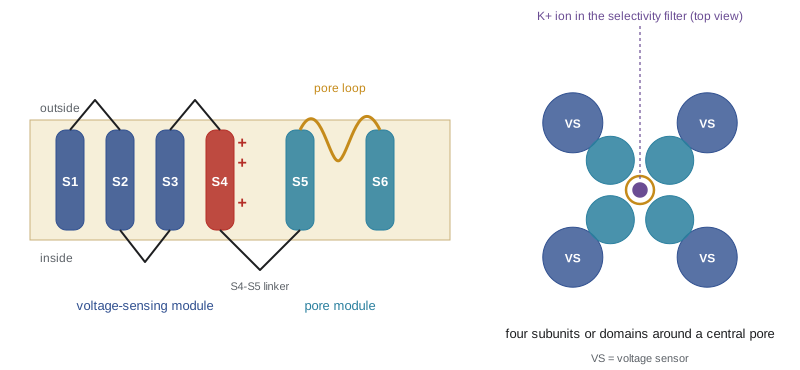
Voltage-gated potassium channels are tetramers of four separate subunits, each with six membrane-spanning helices, S1 to S6. Voltage-gated sodium and calcium channels are made of a single large protein with four homologous domains, I to IV, each resembling a potassium channel subunit, so the overall architecture is the same: four voltage-sensing modules (S1 to S4) surrounding a central pore formed by S5, S6 and the loop between them. This shared design reflects evolution by gene duplication from an ancestral potassium-channel-like gene.
Selectivity: the potassium filter
Potassium channels conduct potassium about 10,000 times better than sodium, even though sodium ions are smaller. In 1998 Roderick MacKinnon's group solved the crystal structure of a bacterial potassium channel, KcsA, and showed how. The narrowest part of the pore, the selectivity filter, is lined by backbone carbonyl oxygens from the signature sequence TVGYG in each subunit. A potassium ion entering the filter sheds its shell of water molecules, and the carbonyl oxygens are positioned exactly where the water oxygens were, so the cost of dehydration is repaid. A sodium ion is too small to contact all the oxygens at once, so it remains energetically better off in water and is excluded. Several potassium ions occupy the filter in single file, and their mutual repulsion pushes them through rapidly, at up to 100 million ions per second. MacKinnon shared the Nobel Prize in Chemistry in 2003.
Sodium channels select with a ring of charged and polar amino acids (DEKA, one from each domain) in a wider filter where sodium passes with part of its water shell; calcium channels use a ring of glutamates (EEEE) that binds calcium tightly. In calcium channels, selectivity works through competition: when calcium is present it blocks sodium flow, and when calcium is removed the channels conduct sodium well.
Gating: how voltage opens a channel
The S4 helix carries a positively charged arginine or lysine at every third position. When the membrane depolarizes, the electric field pushes S4 outward by a few nanometers, moving the equivalent of about 12 to 13 elementary charges across the field in a potassium channel. This movement can be measured directly as a tiny gating current that precedes ionic current. S4 is linked to the pore by the S4–S5 linker, and its movement pulls open the gate formed by the crossing of the S6 helices at the cytoplasmic end of the pore. Cryo-electron microscopy since about 2015 has produced structures of most major human channel families in multiple states, making it possible to see resting and activated voltage sensors.
Inactivation stops current even while the membrane stays depolarized. In sodium channels, fast inactivation is produced by a short cytoplasmic loop between domains III and IV containing three amino acids, isoleucine, phenylalanine and methionine (the IFM motif), which swings into place and blocks the open pore, like a hinged lid. In some potassium channels the N-terminus of each subunit acts as a ball on a chain that plugs the pore (N-type inactivation); cutting it off abolishes fast inactivation, and adding the peptide back restores it. Slower C-type inactivation involves rearrangement of the selectivity filter itself.
The voltage dependence of opening is described by a Boltzmann function,
where \(V_{1/2}\) is the voltage at which half the channels are open and \(z\) the effective gating charge. A larger \(z\) gives a steeper curve. With \(z\) around 6 and \(V_{1/2}\) near −30 millivolts, a sodium channel's open probability rises from almost zero to almost one over about 30 millivolts, which is why thresholds are relatively sharp.
A zoo of potassium channels
Neurons express dozens of potassium channel types, and the mix shapes each cell's firing personality. Delayed rectifiers (Kv1 and Kv2 families) repolarize the action potential. A-type channels (Kv4) activate and inactivate quickly at subthreshold voltages and delay the first spike. Kv3 channels have fast kinetics that allow very short spikes and firing at hundreds of hertz in fast-spiking interneurons. M-type channels (KCNQ2 and KCNQ3) open slowly at rest-adjacent voltages and stabilize the membrane; they are closed by acetylcholine acting through muscarinic receptors, hence the name. Calcium-activated potassium channels (BK and SK) open as calcium enters during spikes and produce afterhyperpolarizations that space spikes apart, a mechanism called spike-frequency adaptation. HCN channels, opened by hyperpolarization, carry an inward current (Ih) that drives rhythmic activity in the thalamus and heart.
| Firing pattern | Example neuron | Key channels |
|---|---|---|
| Regular spiking with adaptation | Cortical pyramidal cell | Delayed rectifier, SK and M-type potassium channels |
| Fast spiking without adaptation | Parvalbumin interneuron | Kv3 channels allow brief spikes at high rates |
| Bursting | Thalamic relay cell in sleep | T-type calcium channels and HCN channels |
| Delayed first spike | Some cortical and hippocampal cells | A-type (Kv4) potassium channels |
| Pacemaking | Dopamine neurons, sinoatrial node | HCN, calcium and leak channels |
Channelopathies
Because channels are central to excitability, mutations in channel genes cause a wide range of disorders, called channelopathies. In the nervous system they include several epilepsies: loss-of-function mutations in SCN1A, encoding the Nav1.1 sodium channel, cause Dravet syndrome, a severe childhood epilepsy. Paradoxically, losing a sodium channel causes seizures because Nav1.1 is concentrated in inhibitory interneurons, which then fire poorly, releasing excitatory cells from inhibition. Mutations in KCNQ2 cause neonatal epilepsy. In the periphery, gain-of-function mutations in SCN9A (Nav1.7) cause inherited erythromelalgia, a disorder of burning pain, while loss of Nav1.7 causes congenital insensitivity to pain, making this channel a long-sought target for painkillers (lesson 8). Heart channelopathies such as long QT syndrome, from mutations in hERG (KCNH2) or cardiac sodium channel genes, cause dangerous arrhythmias, and many drugs are screened for unintended hERG block for that reason. Episodic ataxias, familial hemiplegic migraine and some myotonias also arise from channel mutations.
Channels are also the targets of natural toxins and many drugs. Tetrodotoxin and saxitoxin block sodium channel pores; scorpion and sea anemone toxins alter gating; local anesthetics such as lidocaine block sodium channels from the inside, preferentially when channels are open or inactivated, so they act most on rapidly firing pain fibers; antiepileptic drugs such as carbamazepine and phenytoin stabilize sodium channel inactivation; and the newer pain drug suzetrigine, approved by the US Food and Drug Administration in January 2025 for acute pain, selectively blocks the peripheral sodium channel Nav1.8.
A simple model neuron: integrate-and-fire
The Hodgkin–Huxley model describes spike generation in full but is costly to simulate for large networks. The leaky integrate-and-fire neuron, introduced in simple form by Louis Lapicque in 1907, keeps only the passive membrane and a threshold. The membrane behaves as a resistor and capacitor in parallel:
where \(\tau_m = R_m C_m\) is the membrane time constant, \(E_L\) the resting (leak) potential and \(I\) the input current. When \(V\) reaches a threshold, the model records a spike and resets \(V\), optionally holding it there for a refractory period. Below a minimum current, the rheobase, the voltage settles below threshold and the neuron never fires; above it, firing rate rises with current. The relationship between input current and firing rate, the f–I curve, is a basic description of a neuron's input–output function.
# Leaky integrate-and-fire neuron: f-I curve from simulation and the exact formula.
import numpy as np
tau, R, EL = 20.0, 100.0, -70.0       # ms, megaohms, mV
Vth, Vreset, tref = -50.0, -65.0, 2.0 # mV, mV, ms
dt = 0.05

def rate_sim(I_nA, T=2000.0):
    V, spikes, hold = EL, 0, 0.0
    for _ in range(int(T / dt)):
        if hold > 0:
            hold -= dt
            continue
        V += dt / tau * (-(V - EL) + R * I_nA)
        if V >= Vth:
            spikes += 1
            V, hold = Vreset, tref
    return spikes / (T / 1000)

def rate_exact(I_nA):
    Vinf = EL + R * I_nA
    if Vinf <= Vth:
        return 0.0
    T = tref + tau * np.log((Vinf - Vreset) / (Vinf - Vth))
    return 1000.0 / T

print("rheobase =", (Vth - EL) / R, "nA")
for I in [0.15, 0.2, 0.25, 0.3, 0.4, 0.6, 1.0]:
print(f"I = {I:4.2f} nA simulated {rate_sim(I):6.1f} Hz exact {rate_exact(I):6.1f} Hz")rheobase = 0.2 nA I = 0.15 nA simulated 0.0 Hz exact 0.0 Hz I = 0.20 nA simulated 0.0 Hz exact 0.0 Hz I = 0.25 nA simulated 33.5 Hz exact 33.6 Hz I = 0.30 nA simulated 49.0 Hz exact 49.2 Hz I = 0.40 nA simulated 75.5 Hz exact 75.8 Hz I = 0.60 nA simulated 119.0 Hz exact 119.5 Hz I = 1.00 nA simulated 183.5 Hz exact 183.9 Hz
With these parameters the rheobase is 0.2 nanoamperes. Just above it the rate climbs steeply from zero, then grows more slowly and finally saturates near the limit set by the refractory period. Real neurons show this shape too, although adaptation currents reduce sustained rates. Integrate-and-fire models are the workhorse of large network simulations because they are cheap, and extensions such as the adaptive exponential model reproduce many real firing patterns with a handful of parameters (lesson 11).
Worked problem
Counting channels from a whole-cell current
In a voltage-clamp experiment on an invented neuron, a step to 0 mV evokes a peak sodium current of 4.2 nA. The sodium reversal potential is +55 mV, single-channel conductance is 15 pS and peak open probability at 0 mV is estimated as 0.6. About how many sodium channels does the cell have?
Show solution
- Use I = N Po γ (V − E). The driving force is 0 − 55 = −55 mV, so the inward current per open channel is 15 pS × 55 mV = 0.825 pA.
- Each channel contributes on average Po × 0.825 = 0.495 pA at peak.
- N = 4,200 pA / 0.495 pA ≈ 8,500 channels.
- This is an estimate: open probability is inferred, and space clamp in a branched neuron is imperfect.
Answer: About 8,500 sodium channels.
Common mistakes
MistakeThinking voltage changes the current through an open channel by changing its conductance.
InsteadVoltage mainly changes open probability; single-channel conductance is nearly constant (driving force does change with voltage).
MistakeAssuming potassium channels exclude sodium because sodium is too big.
InsteadSodium is smaller; it is excluded because the filter cannot replace its water shell energetically.
MistakeExpecting loss of a sodium channel always to reduce excitability.
InsteadIf the channel is concentrated in inhibitory neurons, as with Nav1.1, its loss can increase network excitability and cause seizures.
MistakeTreating inactivation and deactivation as the same.
InsteadDeactivation is closing when the voltage returns; inactivation is a separate block that occurs during maintained depolarization.
MistakeBelieving the integrate-and-fire model describes spike shape.
InsteadIt models only timing; the spike itself is replaced by a threshold and reset.
Summary and key terms
- Patch clamp reveals single channels that open and close stochastically with fixed conductance; macroscopic current is N Po γ (V − E).
- Voltage-gated channels share a four-fold architecture: four S1–S4 voltage-sensing modules around an S5–S6 pore.
- The potassium selectivity filter replaces water with carbonyl oxygens, excluding smaller sodium ions.
- Movement of the charged S4 helix opens the gate; inactivation occurs by an IFM lid or a ball-and-chain plug.
- Different potassium and calcium channel mixtures produce distinct firing patterns.
- Channelopathies cause epilepsies, pain disorders and arrhythmias; channels are targets of toxins and many drugs.
- The leaky integrate-and-fire neuron captures firing with a passive membrane, threshold and reset.
- patch clamp
- Recording current through a small patch of membrane, or a whole cell, sealed to a glass pipette.
- open probability
- The fraction of time, or fraction of channels, in the open state.
- single-channel conductance
- The conductance of one open channel, usually a few to tens of picosiemens.
- selectivity filter
- The narrow part of a channel pore that determines which ions pass.
- voltage sensor
- The S1–S4 module whose charged S4 helix moves with membrane voltage.
- gating current
- The small current produced by movement of voltage-sensor charges.
- inactivation
- A non-conducting state entered during maintained depolarization.
- channelopathy
- A disease caused by mutation of an ion channel gene.
- rheobase
- The minimum steady current that makes a neuron fire.
- f–I curve
- The relationship between injected current and firing rate.
Practice problems
Work each problem on paper first, then reveal the answer to check.
A channel has 25 pS conductance and the driving force is 80 mV. What current flows when it is open?
Show answer
2 pA.
Why can an excised inside-out patch be useful?
Show answer
The cytoplasmic face is exposed, so you can apply second messengers or ions directly to it.
What property of the S4 helix makes it a voltage sensor?
Show answer
Regularly spaced positive charges that move in the membrane electric field.
How does lidocaine preferentially block pain fibers?
Show answer
It binds open or inactivated sodium channels, which are more common in rapidly firing neurons.
Why does loss of Nav1.1 cause seizures?
Show answer
Nav1.1 is concentrated in inhibitory interneurons, which then fire less, disinhibiting excitatory networks.
In the integrate-and-fire model, what is the rheobase if threshold is 18 mV above rest and input resistance is 150 MΩ?
Show answer
18 mV / 150 MΩ = 0.12 nA.
Which channels produce the afterhyperpolarization that causes spike-frequency adaptation?
Show answer
Calcium-activated potassium channels, such as SK channels (with M-type channels contributing).
What advantage does a steep Boltzmann curve (large z) give a sodium channel?
Show answer
A sharp transition from closed to open over a narrow voltage range, giving a well-defined threshold.
Lesson quiz · 5 questions
Score 60% or more to complete this lesson.
Create a free account to save your progress, take quizzes and earn a certificate.