
BIOL-340 · Lesson 4 of 12 · 33 min
Photosynthesis II: carbon fixation, photorespiration, C4 and CAM
The light reactions make ATP and NADPH; the stroma spends them to turn carbon dioxide into sugar. This is the Calvin–Benson cycle, worked out by Melvin Calvin, Andrew Benson and James Bassham in the late 1940s and 1950s by feeding radioactive ¹⁴CO₂ to algae for seconds at a time and identifying which compounds became labeled first. At the center of the cycle sits rubisco, the enzyme that fixes CO₂ and probably the most abundant protein on Earth. Rubisco is also notoriously imperfect: it is slow, and it reacts with oxygen as well as with CO₂, starting a costly salvage pathway called photorespiration. Much of the diversity of photosynthesis in flowering plants, including the C4 pathway of maize and sugarcane and the CAM pathway of cacti and pineapple, can be understood as ways of coping with rubisco’s weaknesses. This lesson follows carbon from fixation to sucrose and starch, quantifies the cost of photorespiration, introduces the biochemical model that underlies most predictions of how crops respond to rising CO₂, and compares the three photosynthetic pathways.
The Calvin–Benson cycle
BIOL-107 presented the cycle in outline. Here we follow its stoichiometry. The cycle has three phases. In carboxylation, rubisco adds CO₂ to the five-carbon sugar ribulose-1,5-bisphosphate (RuBP), producing an unstable six-carbon intermediate that splits into two molecules of 3-phosphoglycerate (3-PGA). In reduction, each 3-PGA is phosphorylated by ATP and reduced by NADPH to glyceraldehyde-3-phosphate (G3P), a triose phosphate. In regeneration, a series of reactions shuffles carbon atoms among three-, four-, five-, six- and seven-carbon sugars to rebuild RuBP, consuming one more ATP per RuBP. For every three CO₂ fixed, the cycle produces six G3P, of which five are used to regenerate three RuBP and one is net product. The overall cost is nine ATP and six NADPH per triose phosphate, or three ATP and two NADPH per CO₂.
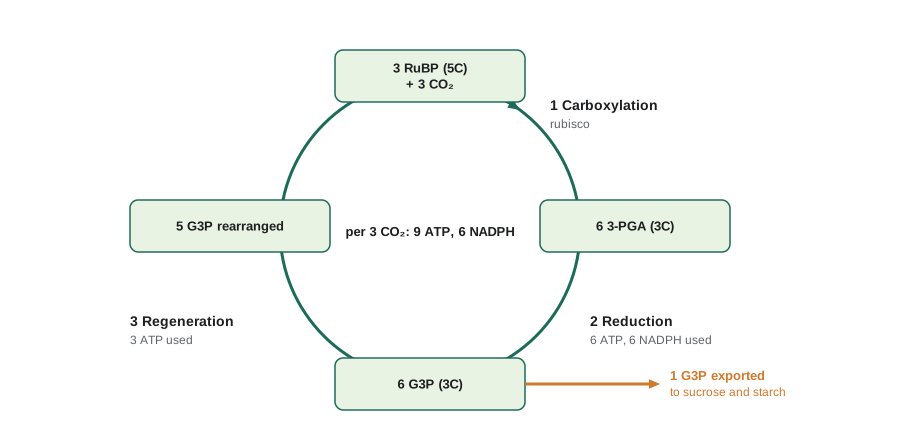
The cycle is tightly regulated so that it runs only in the light, when ATP and NADPH are available, and does not compete with the oxidative pentose phosphate pathway in the dark. Several mechanisms act together. Illumination pumps protons from the stroma into the thylakoid lumen, raising stromal pH from about 7 to 8, and magnesium ions move into the stroma; several cycle enzymes are more active at higher pH and Mg²⁺. Ferredoxin reduces thioredoxin, which in turn reduces disulfide bonds in fructose-1,6-bisphosphatase, sedoheptulose-1,7-bisphosphatase, phosphoribulokinase and other enzymes, switching them on. In darkness the bonds re-form and the enzymes switch off. A small protein called CP12 adds another layer by binding phosphoribulokinase and glyceraldehyde-3-phosphate dehydrogenase into an inactive complex in the dark.
Rubisco: the enzyme at the center
Rubisco, ribulose-1,5-bisphosphate carboxylase/oxygenase, in plants is a large complex of eight large subunits, encoded in the chloroplast genome, and eight small subunits, encoded in the nucleus. It makes up as much as half of the soluble protein in a C3 leaf and a quarter or more of leaf nitrogen. Plants need so much of it because it is slow: each active site fixes only about two to four CO₂ molecules per second, compared with thousands of reactions per second for many enzymes. Before it can work, rubisco must be activated by carbamylation, the addition of a CO₂ molecule (separate from the substrate) to a lysine in the active site, followed by binding of Mg²⁺. Sugar phosphates, including RuBP itself, can bind the uncarbamylated site and lock it shut, so plants use rubisco activase, an ATP-powered chaperone, to remove these inhibitors. Rubisco activase is heat-sensitive, which is one reason photosynthesis declines at high temperatures.
Rubisco’s second weakness is that it cannot fully distinguish CO₂ from O₂. Both gases approach the enediol form of RuBP in the active site, and oxygenation produces one 3-PGA and one 2-phosphoglycolate, a two-carbon compound that is useless to the cycle and inhibits several of its enzymes. The enzyme’s preference is measured by the specificity factor, \(S_{c/o} = (V_c K_o)/(V_o K_c)\), which compares its catalytic efficiencies for the two gases. For land plant rubisco at 25 °C, \(S_{c/o}\) is around 90 to 100, which sounds impressive until one remembers that air contains about 500 times more O₂ than CO₂. The ratio of oxygenation to carboxylation is \(v_o/v_c = (O/C)/S_{c/o}\), where O and C are the concentrations of the two gases at the active site. This ratio rises with temperature for two reasons: the specificity factor falls as temperature rises, and CO₂ becomes less soluble relative to O₂ in warm water.
Rubisco evolved more than two billion years ago, when the atmosphere held much more CO₂ and almost no O₂, so discrimination against oxygen did not matter. Comparisons across many organisms suggest a trade-off: forms of rubisco with higher specificity tend to be slower. Engineering a rubisco that is both fast and selective has proved extremely difficult, and much current research instead aims to concentrate CO₂ around the enzyme, as C4 plants, algae and cyanobacteria do.
Photorespiration
Plants cannot leave 2-phosphoglycolate to accumulate, so they recycle it through photorespiration, also called the C2 oxidative photosynthetic carbon cycle. The pathway involves three organelles. In the chloroplast, 2-phosphoglycolate is dephosphorylated to glycolate, which moves to the peroxisome and is oxidized to glyoxylate, producing hydrogen peroxide that catalase destroys. Glyoxylate is transaminated to glycine, which moves to the mitochondrion. There two glycines are converted to one serine, releasing one CO₂ and one NH₃. Serine returns to the peroxisome and is converted to glycerate, which re-enters the chloroplast and is phosphorylated to 3-PGA. The ammonia must be reassimilated in the chloroplast, at the cost of ATP and reduced ferredoxin.
The net result is that, for every two oxygenations, one carbon is lost as CO₂ and three are recovered as 3-PGA, at a substantial cost in ATP and reducing power. At 25 °C and current CO₂, oxygenation runs at roughly a quarter to a third of the rate of carboxylation in a C3 leaf, and photorespiration can reduce net photosynthesis by 20 to 30 percent; at 35 °C the loss is larger. It is often described as wasteful, and in energetic terms it is, but it is also essential: mutants unable to complete the cycle die in normal air and survive only in high CO₂. Photorespiration also helps dissipate excess energy under stress and supplies glycine and serine for other pathways. In 2019, researchers reported that tobacco plants engineered with a shorter photorespiratory bypass inside the chloroplast grew up to about 40 percent more biomass in field trials, a result that has prompted similar efforts in food crops.
Photorespiration defines an important property of C3 leaves: the CO₂ compensation point. When CO₂ around a leaf is lowered, there comes a point where CO₂ fixed by carboxylation equals CO₂ released by photorespiration. Ignoring mitochondrial respiration, this occurs at \(\Gamma^* = 0.5\,O/S_{c/o}\), with both gases expressed as dissolved concentrations, which is about 40 µmol mol⁻¹ (about 40 ppm) in C3 leaves at 25 °C. C4 plants, which suppress photorespiration, have compensation points close to zero.
import numpy as np

# Oxygenation/carboxylation ratio vs temperature in a C3 leaf (illustrative values)
T = np.array([10, 15, 20, 25, 30, 35, 40])
S = 98 * np.exp(-0.035 * (T - 25))          # rubisco specificity factor falls with temperature
# Dissolved gases in leaf water (micromolar) for 21% O2 and Ci = 280 ppm.
# Both solubilities fall with warming, CO2 faster than O2 (Henry's law, approximate).
O2 = 258 * np.exp(-0.0136 * (T - 25))
CO2 = 9.1 * np.exp(-0.0230 * (T - 25))
vo_vc = (O2 / CO2) / S
loss = 0.5 * vo_vc                          # CO2 released per CO2 fixed by carboxylation

print(" T(C)  S_c/o  O2/CO2  vo/vc  photorespiratory loss (% of gross carboxylation)")
for row in zip(T, S, O2 / CO2, vo_vc, 100 * loss):
print(" {:3d} {:5.1f} {:5.1f} {:4.2f} {:5.1f}".format(*row))T(C) S_c/o O2/CO2 vo/vc photorespiratory loss (% of gross carboxylation) 10 165.7 24.6 0.15 7.4 15 139.1 25.8 0.19 9.3 20 116.7 27.0 0.23 11.6 25 98.0 28.4 0.29 14.5 30 82.3 29.7 0.36 18.1 35 69.1 31.1 0.45 22.6 40 58.0 32.6 0.56 28.2
The table shows the ratio of oxygenation to carboxylation nearly quadrupling between 10 and 40 °C. Because each oxygenation eventually releases half a CO₂, the photorespiratory loss of carbon rises from under a tenth of gross carboxylation in cool conditions to more than a quarter in strong heat, and the energy spent on recycling rises with it. The numbers are illustrative, since real specificity factors and leaf CO₂ concentrations vary among species and conditions, but the trend is robust and explains why C4 plants dominate hot grasslands while C3 grasses dominate the cool prairies and boreal regions.
Where the carbon goes: sucrose and starch
Triose phosphate leaving the cycle has two main fates. During the day, part of it is exported from the chloroplast to the cytosol in exchange for inorganic phosphate by the triose phosphate/phosphate translocator, and converted to sucrose, the main sugar transported in the phloem (lesson 6). The rest stays in the chloroplast and is converted to starch. At night, starch is broken down and exported, mostly as maltose and glucose, to make sucrose for export and to fuel respiration. Leaves of Arabidopsis degrade their starch at a rate that runs it down almost exactly by dawn, whatever the length of the night, a remarkable feat of regulation that depends on the circadian clock (lesson 9). The exchange of triose phosphate for phosphate links the two pathways: when sucrose synthesis slows, phosphate is not released in the cytosol, triose phosphate stays in the chloroplast, and starch synthesis increases. When phosphate is in short supply, the Calvin–Benson cycle itself can become limited by phosphate, a limitation that appears at high CO₂ in some measurements.
A model of leaf photosynthesis
In 1980, Graham Farquhar, Susanne von Caemmerer and Joseph Berry published a biochemical model of C3 photosynthesis that is still used in almost every crop model and Earth system model. Its central idea is that the net assimilation rate is limited, at any moment, by the slower of two processes: the rate at which rubisco can carboxylate RuBP when RuBP is plentiful, and the rate at which RuBP can be regenerated, which depends on electron transport. A simplified form, suitable for teaching, is
where \(C_i\) is the CO₂ concentration inside the leaf, \(V_{c\max}\) is the maximum carboxylation rate, \(K_c\) and \(K_o\) are rubisco’s Michaelis constants for CO₂ and O₂, \(J\) is the rate of electron transport and \(R_d\) is respiration in the light. At low CO₂, rubisco is the limit and photosynthesis rises steeply with CO₂; at higher CO₂, the supply of RuBP limits it and the response flattens. Physiologists fit the model to curves of assimilation against internal CO₂, called A–Ci curves, to estimate \(V_{c\max}\) and \(J_{\max}\) for a leaf.
import numpy as np

# Simplified Farquhar-von Caemmerer-Berry model at 25 C (teaching version).
# Kinetic constants of the magnitude reported for tobacco rubisco in vivo.
Kc, Ko, O, gstar = 405.0, 278.0, 210.0, 42.8    # Kc umol/mol, Ko and O mmol/mol, Gamma* umol/mol
Vcmax, J, Rd = 60.0, 110.0, 1.0                  # umol m-2 s-1 for a typical C3 crop leaf

def A(Ci):
    Ac = Vcmax * (Ci - gstar) / (Ci + Kc * (1 + O / Ko))
    Aj = J * (Ci - gstar) / (4 * Ci + 8 * gstar)
    return np.minimum(Ac, Aj) - Rd, np.where(Ac < Aj, "rubisco", "RuBP regeneration")

for era, Ca in (("pre-industrial", 280), ("about 2025", 425), ("possible 2100", 700)):
    Ci = 0.7 * Ca                               # C3 leaves typically hold Ci/Ca near 0.7
    a, lim = A(Ci)
    print(f"{era:15s} Ca={Ca} ppm  Ci={Ci:.0f}  A={a:5.1f}  limited by {lim}")
gain = A(0.7*700)[0] / A(0.7*425)[0] - 1
print(f"predicted gain in net A from 425 to 700 ppm: {100*gain:.0f} % (before any acclimation)")pre-industrial Ca=280 ppm Ci=196 A= 9.1 limited by rubisco about 2025 Ca=425 ppm Ci=298 A= 14.2 limited by rubisco possible 2100 Ca=700 ppm Ci=490 A= 20.4 limited by RuBP regeneration predicted gain in net A from 425 to 700 ppm: 44 % (before any acclimation)
The model predicts that a C3 leaf fixes substantially more carbon at today’s CO₂ than before industrialization, and that it would gain further at higher concentrations, with the limitation shifting from rubisco to RuBP regeneration. This CO₂ fertilization effect is real: free-air CO₂ enrichment (FACE) experiments, in which fields of crops are exposed to elevated CO₂ in the open, have measured gains in leaf photosynthesis of roughly 30 percent at about 550 ppm. Yield gains are smaller, typically around 10 to 15 percent in C3 crops such as wheat, rice and soybean, because plants acclimate by reducing rubisco, because other factors such as nitrogen limit growth, and because higher temperatures and droughts offset some of the benefit. Grain grown at elevated CO₂ also tends to contain less protein, zinc and iron. C4 crops gain little from CO₂ in well-watered conditions, because their rubisco is already saturated.
C4 photosynthesis: a CO₂ pump
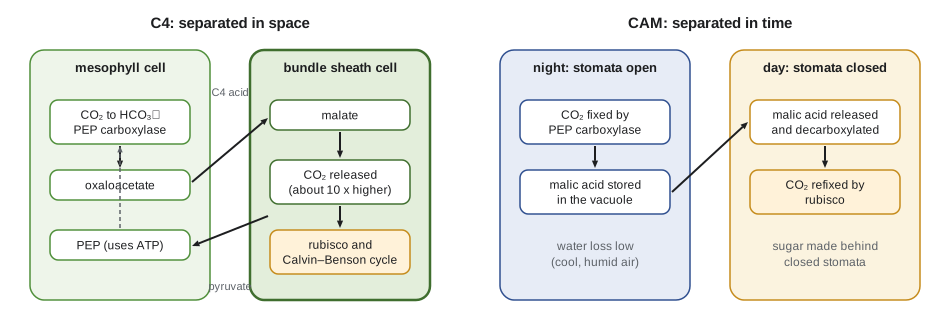
C4 plants add a biochemical pump that concentrates CO₂ around rubisco. In most C4 species the two halves of the process are separated between two cell types arranged in Kranz anatomy, a wreath of large bundle sheath cells around each vein surrounded by mesophyll cells. In the mesophyll, CO₂ is first converted to bicarbonate by carbonic anhydrase and fixed by phosphoenolpyruvate (PEP) carboxylase, an enzyme that does not react with oxygen and has a high affinity for its substrate. The product, the four-carbon acid oxaloacetate, is converted to malate or aspartate, which diffuses through plasmodesmata into the bundle sheath. There it is decarboxylated, releasing CO₂ at concentrations ten times or more above those in the mesophyll, and rubisco, confined to the bundle sheath, fixes it in an ordinary Calvin–Benson cycle. The three-carbon remainder returns to the mesophyll, where pyruvate orthophosphate dikinase regenerates PEP at the cost of two ATP equivalents.
C4 plants are grouped by the enzyme that releases CO₂ in the bundle sheath: NADP-malic enzyme (maize, sugarcane, sorghum), NAD-malic enzyme (millets, many dryland grasses, amaranths) and PEP carboxykinase (some tropical grasses), although many species use mixtures. The pump costs about two extra ATP per CO₂ fixed, five rather than three, but by nearly eliminating photorespiration it more than repays the cost in warm, bright conditions. C4 plants also use water and nitrogen more efficiently, because they can achieve high rates of photosynthesis with partly closed stomata and with less rubisco. Remarkably, C4 photosynthesis has evolved independently more than 60 times in flowering plants, mostly in the last 30 million years as atmospheric CO₂ declined. Only about 3 percent of plant species are C4, but they account for roughly a quarter of terrestrial primary production, and they include several of the world’s most productive crops. An international project, the C4 Rice Project, has been working since 2008 to engineer C4 photosynthesis into rice; it has installed parts of the pathway but, as of 2026, a fully functional C4 rice has not been reported.
CAM: separating the steps in time
Crassulacean acid metabolism, named after the stonecrop family in which it was first studied, uses the same two carboxylases as C4 but separates them in time rather than space. CAM plants open their stomata at night, when air is cool and humid, fix CO₂ with PEP carboxylase and store the resulting malic acid in their large vacuoles, which become measurably sour by dawn. During the day the stomata close, malate is released and decarboxylated, and the CO₂ is refixed by rubisco behind closed stomata. Because stomata open only when evaporation is low, CAM plants lose three to ten times less water per unit of carbon fixed than C3 plants, and some can survive months of drought. The price is slow growth, limited by the size of the vacuole’s acid store. CAM occurs in about 6 percent of plant species, including cacti, agaves, many orchids and bromeliads, pineapple and the succulent ice plant. Many species are facultative, switching from C3 to CAM when water is scarce or salt is high.
| Feature | C3 | C4 | CAM |
|---|---|---|---|
| First stable product | 3-phosphoglycerate (3 carbons) | Oxaloacetate (4 carbons) | Oxaloacetate, stored as malate |
| Initial carboxylase | Rubisco | PEP carboxylase | PEP carboxylase (night) |
| Separation of steps | None | Spatial: mesophyll and bundle sheath | Temporal: night and day |
| Photorespiration | Significant, rising with temperature | Very low | Low during the day phase |
| CO₂ compensation point | About 40–50 ppm | Near 0–10 ppm | Variable |
| ATP per CO₂ fixed | 3 | About 5 | About 5–6 |
| Water use efficiency | Low | Intermediate to high | Very high |
| Carbon isotope ratio δ¹³C | About −22 to −35 ‰ | About −10 to −16 ‰ | Intermediate to C4-like |
| Examples | Wheat, rice, canola, soybean, trees | Maize, sugarcane, sorghum, switchgrass | Pineapple, agave, cacti, orchids |
Carbon isotopes: a fingerprint of the pathway
Air contains about 1.1 percent of the heavy stable isotope ¹³C. Rubisco discriminates against ¹³CO₂, fixing the lighter isotope slightly faster, and diffusion through stomata adds a smaller discrimination. PEP carboxylase discriminates far less, and in C4 plants most CO₂ that reaches the bundle sheath is fixed rather than leaking back out. As a result, C3 plants are depleted in ¹³C by about 20 parts per thousand relative to air, while C4 plants are depleted by only about 4 to 7. Isotope ratios are reported as δ¹³C, the deviation in parts per thousand (per mil) from a reference standard; on this scale, C3 tissues are about −28 ‰ and C4 tissues about −13 ‰. The difference has many uses: detecting cane or corn syrup added to honey or maple syrup, reconstructing the spread of C4 grasslands from fossil soils and tooth enamel, tracing maize in ancient human diets, and, within C3 plants, estimating water use efficiency, because leaves with partly closed stomata discriminate less.
Worked problem
Detecting adulterated maple syrup
Pure maple syrup, from the C3 sugar maple, has a δ¹³C of about −24 ‰. Cane sugar, from C4 sugarcane, has a δ¹³C of about −11.5 ‰. A suspicious sample measures −20.5 ‰. Assuming simple mixing, what fraction of its sugar came from cane?
Show solution
- Let f be the fraction of carbon from cane; then δ(sample) = f × δ(cane) + (1 − f) × δ(maple).
- Substitute: −20.5 = f × (−11.5) + (1 − f) × (−24).
- Rearrange: −20.5 + 24 = f × (−11.5 + 24), so 3.5 = 12.5 f.
- f = 0.28.
Answer: About 28 percent of the sugar carbon came from a C4 source such as cane or corn syrup. Regulatory laboratories use this test, with refinements such as comparing the isotope ratio of the sugar with that of the syrup’s own protein, to detect adulteration of honey, maple syrup and fruit juices.
Common mistakes
MistakeCalling the Calvin–Benson cycle the dark reactions and assuming it runs at night.
InsteadIts enzymes are activated by light through thioredoxin, stromal pH and Mg²⁺; it stops in the dark.
MistakeThinking that rubisco is slow because plants make too little of it.
InsteadEach active site is intrinsically slow, which is why plants make so much of it.
MistakeDescribing photorespiration as simply a mistake with no function.
InsteadIt is costly, but it recycles carbon from 2-phosphoglycolate, removes a toxic product and is essential in air.
MistakeAssuming C4 plants use a different enzyme instead of rubisco.
InsteadC4 plants still use rubisco and the Calvin–Benson cycle; PEP carboxylase acts as a CO₂ pump in front of it.
MistakeExpecting C4 crops to benefit as much from rising CO₂ as C3 crops.
InsteadC4 rubisco is already near CO₂ saturation, so C4 crops gain little except under drought, through water savings.
MistakeReading δ¹³C values as positive numbers that increase with depletion.
Insteadδ¹³C is negative for plants; more negative values mean more depletion in ¹³C, as in C3 plants.
Summary and key terms
- The Calvin–Benson cycle fixes CO₂ with rubisco, reduces 3-PGA to triose phosphate and regenerates RuBP, costing 3 ATP and 2 NADPH per CO₂.
- Light activates cycle enzymes through stromal pH and Mg²⁺ changes, thioredoxin and release from CP12.
- Rubisco is slow, requires activation by carbamylation and rubisco activase, and also reacts with O₂.
- Photorespiration salvages 2-phosphoglycolate through chloroplast, peroxisome and mitochondrion, losing one CO₂ per two oxygenations; it rises with temperature.
- The Farquhar model treats net assimilation as the lesser of rubisco-limited and RuBP-regeneration-limited rates and predicts the CO₂ fertilization effect.
- C4 plants concentrate CO₂ in bundle sheath cells using PEP carboxylase; CAM plants fix CO₂ at night and refix it by day behind closed stomata.
- Carbon isotope discrimination distinguishes C3 (about −28 ‰) from C4 (about −13 ‰) tissues and has uses from food authentication to palaeoecology.
- Calvin–Benson cycle
- The stromal pathway that fixes CO₂ into triose phosphate and regenerates ribulose-1,5-bisphosphate.
- rubisco
- Ribulose-1,5-bisphosphate carboxylase/oxygenase, the enzyme that fixes CO₂ and also reacts with O₂.
- rubisco activase
- An ATP-dependent chaperone that removes inhibitory sugar phosphates from rubisco.
- specificity factor
- A measure of rubisco’s relative preference for CO₂ over O₂.
- photorespiration
- The pathway that recycles 2-phosphoglycolate produced by rubisco oxygenation, releasing CO₂.
- CO₂ compensation point
- The CO₂ concentration at which photosynthetic uptake equals respiratory and photorespiratory release.
- A–Ci curve
- A curve of net assimilation against intercellular CO₂, used to estimate Vcmax and Jmax.
- PEP carboxylase
- An enzyme that fixes bicarbonate into oxaloacetate without reacting with O₂.
- Kranz anatomy
- The arrangement of bundle sheath and mesophyll cells around veins in most C4 leaves.
- CAM
- Crassulacean acid metabolism, in which CO₂ is fixed at night and stored as malic acid.
- δ¹³C
- The ratio of ¹³C to ¹²C in a sample relative to a standard, in parts per thousand.
Practice problems
Work each problem on paper first, then reveal the answer to check.
How many ATP and NADPH are needed to make one molecule of glucose (two triose phosphates) by the Calvin–Benson cycle?
Show answer
18 ATP and 12 NADPH (for six CO₂).
Name three ways light activates the Calvin–Benson cycle.
Show answer
Higher stromal pH, increased stromal Mg²⁺ and reduction of enzyme disulfides by the ferredoxin–thioredoxin system (also release from CP12).
Why must rubisco be carbamylated, and what does rubisco activase do?
Show answer
Carbamylation with Mg²⁺ forms the active site; activase removes sugar phosphates that bind and block uncarbamylated or carbamylated sites.
If Sc/o = 90, O₂ at the active site is 250 µM and CO₂ is 8 µM, what is vo/vc?
Show answer
(250/8)/90 ≈ 0.35.
Why does photorespiration increase with temperature?
Show answer
Rubisco’s specificity for CO₂ falls and CO₂ solubility falls faster than O₂ solubility as temperature rises.
Which organelles take part in photorespiration, and where is CO₂ released?
Show answer
Chloroplast, peroxisome and mitochondrion; CO₂ is released in the mitochondrion when two glycines make serine.
In the Farquhar model, which process limits photosynthesis at low and at high internal CO₂?
Show answer
Rubisco carboxylation at low CO₂; RuBP regeneration (electron transport) at high CO₂.
Why do C4 plants need more ATP per CO₂ than C3 plants?
Show answer
Regenerating PEP from pyruvate costs about two ATP equivalents per CO₂ pumped into the bundle sheath.
A CAM plant’s leaf sap is acidic at dawn and neutral by late afternoon. Explain.
Show answer
Malic acid accumulates in the vacuole overnight from CO₂ fixation and is decarboxylated during the day to supply rubisco.
A honey sample has δ¹³C of −21 ‰. Pure honey from C3 flowers is −25 ‰ and corn syrup is −11 ‰. What fraction is syrup?
Show answer
(−21 + 25)/(−11 + 25) = 4/14 ≈ 0.29.
Lesson quiz · 5 questions
Score 60% or more to complete this lesson.
Create a free account to save your progress, take quizzes and earn a certificate.