
BIOL-340 · Lesson 2 of 12 · 34 min
Tissues, meristems and plant growth
An oak tree can live for centuries and keep adding new leaves, branches, roots and wood every year. A mature animal, by contrast, stops growing and simply maintains a body whose plan was fixed in the embryo. The difference lies in meristems, small populations of dividing cells that persist throughout a plant’s life and keep generating new organs. Plants are built by repetition: the shoot apex produces a node with a leaf and a bud, then another, then another, and each bud can become a new shoot with its own apex. This modular, open-ended growth lets a plant respond to its surroundings by changing its shape, a sedentary organism’s answer to the problem of finding light, water and nutrients. This lesson describes the tissues that make up the plant body, the meristems that produce them, and the two kinds of growth, primary growth in length and secondary growth in girth, that build stems, roots and wood.
Three tissue systems
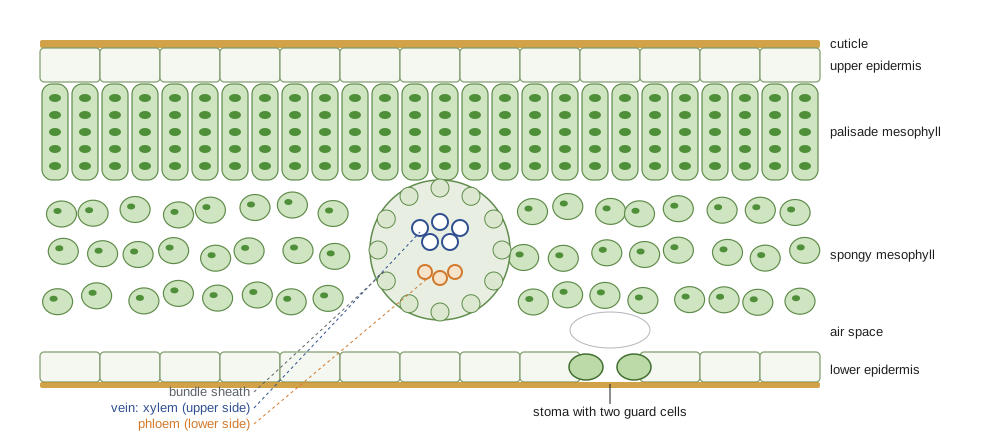
Every plant organ, whether root, stem or leaf, is built from three tissue systems that run continuously through the whole plant. The dermal tissue system is the outer covering: in young organs an epidermis one cell thick, coated on its outer surface by a waxy cuticle, and in woody stems and roots a protective periderm that replaces the epidermis. Specialized epidermal cells include guard cells that form stomata, trichomes (hairs) that reduce water loss or deter herbivores, and root hairs that increase the surface for absorption. The vascular tissue system, xylem and phloem, carries water and solutes between roots and shoots. The ground tissue system fills the rest and performs photosynthesis, storage and support.
Three basic cell types make up the ground tissue. Parenchyma cells have thin primary walls and living protoplasts; they carry out photosynthesis in leaves, store starch in roots and tubers, and retain the ability to divide, which lets them heal wounds and regenerate whole plants in tissue culture. Collenchyma cells have unevenly thickened primary walls rich in pectin and provide flexible support to growing stems and petioles; the strings in celery stalks are collenchyma. Sclerenchyma cells have thick lignified secondary walls and are usually dead at maturity. They come in two forms: long fibers, which give strength to stems and are the source of linen, hemp and jute, and short sclereids, which make the gritty texture of pear flesh and the hardness of nutshells and seed coats.
| Cell or tissue | Wall | Alive at maturity? | Main function | Example |
|---|---|---|---|---|
| Parenchyma | Thin primary wall | Yes | Photosynthesis, storage, wound repair | Leaf mesophyll, potato tuber |
| Collenchyma | Unevenly thickened primary wall | Yes | Flexible support in growing organs | Celery strings, young stems |
| Sclerenchyma fiber | Thick lignified secondary wall | Usually no | Rigid support | Flax, hemp, wood fibers |
| Sclereid | Thick lignified secondary wall | Usually no | Protection, hardness | Pear stone cells, nutshells |
| Tracheid | Lignified secondary wall with pits | No | Water conduction and support | Conifer wood |
| Vessel element | Lignified wall with perforated end walls | No | Fast water conduction | Oak and maple wood |
| Sieve element | Primary wall with sieve plates | Yes, but without a nucleus | Sugar transport in phloem | Phloem of all angiosperms |
| Companion cell | Primary wall | Yes | Loads and sustains the sieve element | Phloem of angiosperms |
The vascular tissues
Xylem conducts water and dissolved minerals upward from the roots. Its conducting cells, tracheids and vessel elements, die at maturity and leave behind hollow, lignified tubes. Tracheids are long and narrow with tapered ends, and water passes from one to the next through pits, thin areas in the secondary wall where only the primary wall and middle lamella remain. Vessel elements are shorter and wider, and their end walls are partly or wholly dissolved to form perforation plates, so that stacked elements make a continuous pipe called a vessel, which can be centimeters to meters long. Vessels conduct far more water than tracheids, because flow through a tube rises with the fourth power of its radius (lesson 5), but they are more vulnerable to air embolism. Most conifers have only tracheids; most flowering plants have both.
Phloem carries sugars, amino acids, hormones and signaling molecules from sources such as mature leaves to sinks such as roots, fruits and growing tips. Its conducting cells, sieve elements, are alive but strangely stripped down: at maturity they lose their nucleus, vacuole, ribosomes and Golgi, leaving a thin layer of cytoplasm with a few plastids and mitochondria, and their end walls become sieve plates perforated by wide pores. Each sieve element in angiosperms is paired with a companion cell, derived from the same mother cell, that is packed with organelles and keeps the sieve element alive by supplying proteins and energy through numerous branched plasmodesmata. Lesson 6 explains how sugar is loaded into this system and moved by pressure flow.
Meristems: where plants grow
Apical meristems sit at the tips of shoots and roots and produce primary growth, the increase in length that builds the primary plant body. Lateral meristems, the vascular cambium and the cork cambium, form cylinders running along stems and roots and produce secondary growth in thickness. Many grasses also have intercalary meristems at the bases of leaves and internodes, which is why a lawn keeps growing after it is mowed and why grazing does not kill grasses.
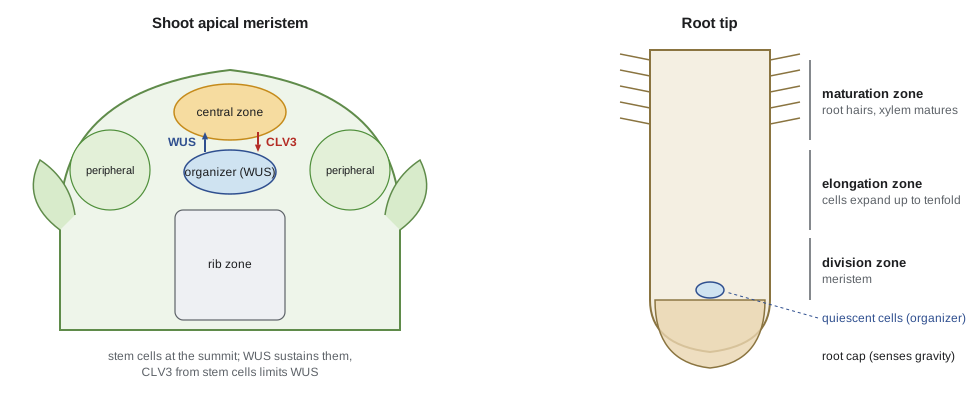
The shoot apical meristem of a flowering plant is a dome of a few hundred cells, typically 50 to 200 µm across, organized in layers and zones. In the outer layers, L1 and L2, cells divide only perpendicular to the surface, so these layers remain distinct; L1 forms the epidermis. The central zone at the summit contains slowly dividing stem cells. Their daughters are displaced into the peripheral zone, where they divide faster and form leaf primordia, and into the rib zone below, which produces the inner tissues of the stem. Stem cell number is held constant by a feedback loop discovered in Arabidopsis. Cells of the organizing center beneath the stem cells express WUSCHEL, a transcription factor that moves upward through plasmodesmata and maintains stem cell identity. The stem cells in turn secrete a small peptide, CLAVATA3, which binds the CLAVATA1 receptor and represses WUSCHEL. Too many stem cells make more CLAVATA3, which reduces WUSCHEL and shrinks the stem cell population; too few make less, which lets WUSCHEL rise. Mutations in the CLAVATA genes enlarge the meristem, and mutations in their equivalents in tomato and maize produce larger fruits and ears, a trait selected unknowingly during domestication.
The root apical meristem lies just behind the root cap, which protects it as the root pushes through soil and which senses gravity. At its center is the quiescent center, a group of cells that divide very rarely and act as an organizer, keeping the surrounding initials in a stem cell state. Behind the meristem a root shows three overlapping zones: the zone of cell division, the zone of elongation, where cells expand up to tenfold in length and push the tip forward, and the zone of maturation, where cells differentiate and root hairs appear. Root stem cell identity depends on PLETHORA transcription factors, whose concentration follows a gradient set by auxin, and on the SHORT-ROOT and SCARECROW proteins, which specify the endodermis.
Leaves, buds and phyllotaxis
Leaves arise as bulges on the flank of the shoot apical meristem, in the peripheral zone, at positions that follow strikingly regular patterns. The arrangement of leaves on a stem, phyllotaxis, may be alternate (one leaf per node, often in a spiral), opposite (two per node) or whorled (three or more). In spiral phyllotaxis, successive leaves are separated by an angle close to 137.5°, the golden angle, and the leaves line up in visible spirals, called parastichies, whose numbers are usually consecutive Fibonacci numbers: 8 and 13 in a pine cone, 34 and 55 or 55 and 89 in a sunflower head.
The mechanism is now understood in outline. A new primordium forms where auxin accumulates, and auxin is pumped toward existing maxima by PIN1 efflux carriers in the epidermis. Each young primordium therefore drains auxin from its surroundings and creates an inhibitory zone in which no new primordium can form. The next primordium appears at the point on the meristem flank farthest from the existing ones, and as the apex grows, this rule of placing each new organ in the largest available gap generates the golden angle automatically. Removing a young primordium with a laser shifts the next one into the space it vacated, as the model predicts.
import numpy as np

# Place n primordia at successive divergence angles; measure packing as the
# smallest distance between any two (Vogel's model r = sqrt(k)).
def packing(angle_deg, n=300):
    k = np.arange(1, n + 1)
    theta = np.radians(angle_deg) * k
    r = np.sqrt(k)
    xy = np.column_stack([r * np.cos(theta), r * np.sin(theta)])
    d = np.sqrt(((xy[:, None, :] - xy[None, :, :]) ** 2).sum(-1))
    d[np.diag_indices(n)] = np.inf
    return d.min(axis=1).mean()

golden = 360 * (1 - (np.sqrt(5) - 1) / 2)
print(f"golden angle = {golden:.3f} degrees")
for a in (120.0, 135.0, 137.0, golden, 138.0, 140.0, 144.0):
print(f"divergence {a:7.3f}: mean distance to nearest primordium = {packing(a):.3f}")golden angle = 137.508 degrees divergence 120.000: mean distance to nearest primordium = 0.160 divergence 135.000: mean distance to nearest primordium = 0.409 divergence 137.000: mean distance to nearest primordium = 1.174 divergence 137.508: mean distance to nearest primordium = 1.686 divergence 138.000: mean distance to nearest primordium = 1.441 divergence 140.000: mean distance to nearest primordium = 0.824 divergence 144.000: mean distance to nearest primordium = 0.262
Divergence angles that are simple fractions of a turn, such as 120° (one third) or 144° (two fifths), place organs in straight radial lines with large gaps between them, so the average distance to the nearest neighbor is poor. The golden angle, whose ratio to the full circle is the most irrational number in a precise mathematical sense, never repeats a direction, and it gives the most uniform packing. Even a change of half a degree is enough to reduce packing efficiency noticeably, which is why the regularity of sunflower heads so impressed early naturalists. The plant does not compute the golden angle; it emerges from the local rule of inhibition by existing primordia.
Each leaf has a bud in its axil, the angle between leaf and stem. Axillary buds contain their own meristems and can grow into branches, but in many plants they are held dormant while the main shoot grows, a phenomenon called apical dominance. Removing the shoot tip releases the buds, which is why pruning makes a shrub bushier. Lesson 7 explains how auxin, cytokinins and strigolactones interact to control this decision.
Primary structure of roots and stems
In a young root, the vascular tissue forms a central cylinder, the stele, surrounded by a single layer of cells called the endodermis. The radial walls of endodermal cells contain a band of suberin and lignin, the Casparian strip, that blocks movement of water and solutes through the walls. Everything entering the stele must therefore pass through the plasma membrane of an endodermal cell, which gives the plant control over what reaches the xylem (lesson 6). Inside the endodermis lies the pericycle, a layer of cells that keep the ability to divide; lateral roots originate in the pericycle and push outward through the cortex, unlike shoot branches, which arise from surface buds. In eudicot roots, xylem forms a central star with phloem between its arms; in monocot roots the xylem and phloem alternate around a central pith.
In stems, the vascular tissue is arranged in vascular bundles, each containing xylem toward the inside and phloem toward the outside. In eudicot stems the bundles form a ring separating an outer cortex from an inner pith, and a thin layer of cambium persists between xylem and phloem within each bundle. In most monocot stems, such as maize, the bundles are scattered throughout the ground tissue and there is no cambium, which is why monocots generally do not form true wood. Palms and bamboos become tall by other means: a broad primary thickening meristem near the apex, or many stems from an underground rhizome.
| Feature | Eudicots | Monocots |
|---|---|---|
| Vascular bundles in stem | In a ring around a pith | Scattered through the ground tissue |
| Root vascular pattern | Central xylem with phloem between its arms | Ring of alternating xylem and phloem around a pith |
| Vascular cambium and wood | Usually present in woody species | Absent in most species |
| Leaf venation | Branched (reticulate) | Usually parallel |
| Root system | Taproot from the radicle, often persistent | Fibrous adventitious roots replace the radicle |
| Example crops | Canola, soybean, sugar beet | Wheat, maize, rice, barley |
Secondary growth and wood
Woody eudicots and gymnosperms grow in thickness by means of two lateral meristems. The vascular cambium forms when the cambium inside each bundle joins with newly dividing parenchyma between the bundles, creating a continuous cylinder. Its cells divide parallel to the surface: daughters on the inside become secondary xylem (wood) and daughters on the outside become secondary phloem. Far more xylem is made than phloem, and the old phloem is crushed as the stem expands, so the bulk of a tree trunk is wood. The cambium contains two kinds of initials. Elongated fusiform initials produce the axial system of tracheids, vessels, fibers and sieve elements; short ray initials produce rays, radial sheets of parenchyma that carry water, sugars and signals sideways through the wood.
As the stem widens, the epidermis splits and is replaced by periderm. A cork cambium arises in the outer cortex and produces cork cells to the outside. Cork cells are dead at maturity, with walls impregnated with suberin, and they form a waterproof, insulating layer. Bark, in everyday language, means everything outside the vascular cambium: secondary phloem, cork cambium and cork. This is why girdling a tree, cutting a ring of bark all the way round, kills it slowly: the phloem is severed, and the roots starve.
In temperate climates the cambium is active in spring and summer and dormant in winter. Wood formed early in the season, earlywood, has wide cells with thin walls that conduct water efficiently; latewood formed later has narrow cells with thick walls. The abrupt change from small latewood cells to large earlywood cells at the start of each season makes the annual ring visible. Ring width records the conditions of each growing season, and dendrochronology, the matching of ring patterns among trees, has produced continuous chronologies spanning more than 10,000 years in Europe, which are used to date archaeological timber, calibrate radiocarbon dating and reconstruct past climates. In older trees, the central wood stops conducting water, its parenchyma dies, and it fills with resins, gums and phenolic compounds that darken it and resist decay. This heartwood supports the tree, while the outer, lighter sapwood conducts water.
Measuring growth
Plant growth is measured in several ways: increase in fresh or dry mass, height, leaf area, stem diameter or cell number. Because a plant’s capacity to grow depends on how much photosynthetic tissue it already has, growth in young plants is roughly exponential, and physiologists compare plants with the relative growth rate, the increase in dry mass per unit of existing mass per unit time. Between two harvests at times \(t_1\) and \(t_2\), the mean relative growth rate is \(\mathrm{RGR} = (\ln W_2 - \ln W_1)/(t_2 - t_1)\). Fast-growing annual weeds can reach relative growth rates of 0.3 per day under good conditions; slow-growing species from poor soils may manage only 0.05 per day.
For trees, which cannot be harvested and weighed, foresters estimate biomass from easily measured dimensions using allometric equations. Allometry describes how one dimension of an organism scales with another, usually as a power law of the form \(y = a x^{b}\), which becomes a straight line on log–log axes. For trees, above-ground biomass scales with stem diameter at breast height raised to a power of about 2.4 to 2.6, because taller, wider trees have disproportionately more wood. Such equations underpin national forest carbon inventories in Canada and the United States.
import numpy as np

rng = np.random.default_rng(340)
# Simulated harvest of 30 trees: diameter at breast height (cm) and dry above-ground biomass (kg)
D = rng.uniform(8, 60, 30)
a_true, b_true = 0.12, 2.45
AGB = a_true * D ** b_true * np.exp(rng.normal(0, 0.15, 30))   # log-normal scatter

# Fit ln(AGB) = ln(a) + b ln(D) by least squares
b, ln_a = np.polyfit(np.log(D), np.log(AGB), 1)
resid = np.log(AGB) - (ln_a + b * np.log(D))
s2 = resid.var(ddof=2)
cf = np.exp(s2 / 2)          # correction for back-transforming a log model
print(f"fitted exponent b = {b:.2f}, coefficient a = {np.exp(ln_a):.3f}")
print(f"back-transformation correction factor = {cf:.3f}")
for d in (10, 30, 50):
    print(f"predicted dry biomass at {d} cm DBH: {cf*np.exp(ln_a)*d**b:,.0f} kg")

# Relative growth rate of a seedling between two harvests
W1, W2, days = 0.42, 3.10, 14
print(f"mean RGR = {(np.log(W2) - np.log(W1)) / days:.3f} per day")fitted exponent b = 2.37, coefficient a = 0.158 back-transformation correction factor = 1.011 predicted dry biomass at 10 cm DBH: 37 kg predicted dry biomass at 30 cm DBH: 499 kg predicted dry biomass at 50 cm DBH: 1,670 kg mean RGR = 0.143 per day
Two details in the output deserve attention. The fitted exponent is close to the value used to simulate the data, which illustrates how well a log–log regression recovers a power law. And because the model is fitted on a log scale, simply exponentiating the prediction underestimates the mean biomass; a correction factor based on the residual variance fixes the bias. Forgetting this correction is a common error in biomass and carbon estimates. The seedling example shows a relative growth rate of about 0.14 per day, a mass increase of about 15 percent per day.
Worked problem
Interpreting a meristem mutant
An Arabidopsis mutant has a shoot apical meristem three times the normal size, flowers with extra organs and club-shaped fruits. Adding synthetic CLAVATA3 peptide to the growth medium has no effect on the mutant but shrinks the meristem of wild-type plants. Which gene is most likely mutated?
Show solution
- An enlarged meristem means too many stem cells, which suggests a failure of the negative feedback that limits WUSCHEL.
- If the mutant could not make CLAVATA3 peptide, supplying the peptide should rescue it. It does not.
- The plant therefore makes the signal but cannot respond to it, so the defect is in the receptor or its downstream pathway.
- The most likely candidate is CLAVATA1, the receptor kinase that binds CLAVATA3.
Answer: A receptor mutant such as clavata1. A clavata3 mutant would have the same appearance but would be rescued by added peptide. This logic, distinguishing signal from receptor mutants by supplying the signal, recurs throughout hormone biology.
Common mistakes
MistakeThinking that plants grow by cell division throughout the body.
InsteadDivision is concentrated in meristems; elsewhere growth is mostly cell expansion and differentiation.
MistakeCalling all bark dead tissue.
InsteadBark includes living secondary phloem and cork cambium as well as dead cork; that is why girdling kills a tree.
MistakeAssuming tree rings form because of cell division stopping at night.
InsteadRings reflect seasonal changes in cambial activity and cell size between latewood and the next year’s earlywood.
MistakeExpecting monocots such as palms to form annual rings.
InsteadMost monocots lack a vascular cambium and do not form true wood or annual rings.
MistakeSaying that xylem conducting cells are alive.
InsteadTracheids and vessel elements are dead at maturity; their lignified walls form hollow tubes. Phloem sieve elements, by contrast, are alive.
MistakeBack-transforming a log–log regression without correction.
InsteadExponentiating predictions from a log model estimates the median, not the mean; apply a correction factor based on residual variance.
Summary and key terms
- Plants grow throughout life from meristems; apical meristems produce primary growth in length, and lateral meristems produce secondary growth in thickness.
- All organs contain dermal, vascular and ground tissue systems; parenchyma, collenchyma and sclerenchyma are the basic ground cell types.
- Xylem conducts water through dead tracheids and vessels; phloem conducts sugars through living sieve elements sustained by companion cells.
- Stem cell number in the shoot apex is held constant by WUSCHEL–CLAVATA feedback; the root meristem is organized around a quiescent center.
- Spiral phyllotaxis at the golden angle emerges from auxin-based inhibition around existing primordia and packs organs most evenly.
- The endodermis with its Casparian strip controls entry to the root stele; lateral roots arise from the pericycle.
- The vascular cambium makes secondary xylem and phloem, the cork cambium makes periderm, and seasonal changes in cell size produce annual rings.
- meristem
- A region of undifferentiated cells that divide and produce new tissues throughout a plant’s life.
- primary growth
- Growth in length produced by apical meristems.
- secondary growth
- Growth in thickness produced by the vascular cambium and cork cambium.
- parenchyma
- Living cells with thin primary walls that carry out photosynthesis, storage and repair.
- sclerenchyma
- Cells with thick lignified secondary walls that provide rigid support, as fibers or sclereids.
- vessel element
- A water-conducting xylem cell with perforated end walls, joined end to end into vessels.
- sieve element
- A living phloem cell without a nucleus that conducts sugars through sieve plates.
- quiescent center
- Rarely dividing cells at the center of the root apical meristem that maintain the surrounding stem cells.
- phyllotaxis
- The arrangement of leaves or other organs around a stem.
- Casparian strip
- A band of suberin and lignin in endodermal cell walls that blocks apoplastic flow into the stele.
- vascular cambium
- The lateral meristem that produces secondary xylem and secondary phloem.
- relative growth rate
- The rate of increase in dry mass per unit of existing mass.
Practice problems
Work each problem on paper first, then reveal the answer to check.
Distinguish between primary and secondary growth and name the meristems responsible.
Show answer
Primary growth increases length and comes from apical meristems; secondary growth increases thickness and comes from the vascular cambium and cork cambium.
Why are tracheids and vessel elements dead at maturity, and how does this help their function?
Show answer
Their protoplasts die and leave hollow lignified tubes, so water flows through an open lumen without crossing membranes.
How do companion cells support sieve elements?
Show answer
They supply proteins, ATP and other molecules through plasmodesmata and help load sugars, because sieve elements lack a nucleus and most organelles.
Describe the WUSCHEL–CLAVATA feedback loop.
Show answer
WUSCHEL from the organizing center promotes stem cell identity; stem cells secrete CLAVATA3, which acts through CLAVATA1 to repress WUSCHEL, keeping stem cell number constant.
A plant’s successive leaves are separated by 137.5°. What pattern results, and why is it efficient?
Show answer
Spiral phyllotaxis with Fibonacci numbers of parastichies; the golden angle never repeats a direction, so organs are evenly packed.
Where do lateral roots originate, and how does this differ from shoot branches?
Show answer
From the pericycle deep inside the root, pushing out through the cortex; shoot branches arise from axillary buds at the surface.
What is the function of the Casparian strip?
Show answer
It blocks water and solute movement through endodermal cell walls, forcing them to cross a plasma membrane before entering the stele.
Why does the wood of a temperate tree show annual rings?
Show answer
Latewood cells formed late in the season are small and thick-walled; the next spring’s earlywood cells are large, making a visible boundary.
A seedling grows from 0.20 g to 1.60 g dry mass in 10 days. What is its mean relative growth rate?
Show answer
ln(1.60/0.20)/10 = ln 8/10 ≈ 0.208 per day.
Biomass scales as 0.1 D^2.5. How many times more biomass does a 40 cm tree have than a 20 cm tree?
Show answer
2^2.5 ≈ 5.7 times.
Lesson quiz · 5 questions
Score 60% or more to complete this lesson.
Create a free account to save your progress, take quizzes and earn a certificate.