
BIOL-340 · Lesson 12 of 12 · 31 min
Capstone: plants, crops and climate
This final lesson brings the course together around a practical question: how will the plants people depend on cope with a changing climate, and what tools do plant biologists and breeders have to help them? Answering it draws on every earlier lesson. Photosynthesis and its response to CO₂ and temperature (lessons 3 and 4), water relations and stomata (lesson 5), nutrients and symbioses (lesson 6), hormones (lessons 7 and 8), the timing of flowering (lesson 9), reproduction and seed set (lesson 10) and stress and disease (lesson 11) all determine how a crop or a forest responds to warming, drought and rising CO₂. The lesson first introduces Arabidopsis as the model that made modern plant biology possible, then surveys plant biotechnology and how Canada and the United States regulate it, then examines climate impacts on crops and forests, and ends with a worked capstone analysis of a crop season.
Arabidopsis: a weed that changed biology
Many of the discoveries in this course, from the ABC model to the auxin receptor and the ABA signaling pathway, were made in Arabidopsis thaliana, thale cress, a small weed of the mustard family with no economic value. It became the dominant model for plant biology in the 1980s because it has a short life cycle of about six to eight weeks, is small enough to grow thousands of plants in a room, self-pollinates and produces thousands of seeds per plant, and has one of the smallest genomes of any flowering plant, about 135 million base pairs with roughly 27,000 protein-coding genes. Its genome, published in 2000, was the first plant genome sequenced. Arabidopsis can be transformed simply by dipping its flowers into a suspension of Agrobacterium, which led to collections of insertion mutants covering almost every gene. The 1001 Genomes project has sequenced natural accessions from across its range, from North Africa to Scandinavia, revealing the genetic basis of local adaptation in flowering time, cold tolerance and other traits. Discoveries made in Arabidopsis are routinely transferred to crops such as canola, a close relative, and to more distant species.
Tools of plant biotechnology
Plant genetic engineering began in the early 1980s with the bacterium Agrobacterium tumefaciens, which, as lesson 7 described, naturally transfers a segment of DNA, the T-DNA, from its tumor-inducing plasmid into plant chromosomes. Scientists replaced the tumor-causing genes in the T-DNA with genes of interest and a selectable marker, turning the bacterium into a vehicle for introducing new genes. Transformed cells are selected in tissue culture and regenerated into whole plants using the auxin–cytokinin principles of lesson 7. For species that Agrobacterium transforms poorly, notably many cereals in the early years, the biolistic or gene-gun method shoots DNA-coated gold or tungsten particles into cells. A plant carrying a gene introduced from another organism is called transgenic.
Genome editing, especially with CRISPR–Cas systems since about 2013, has changed the field again. An editing reagent, a Cas nuclease guided by a short RNA, is delivered into plant cells, usually as a transgene, and cuts the genome at a chosen sequence. The cell’s own repair machinery then rejoins the cut, often with small insertions or deletions that knock out the gene; with more elaborate designs, base editors and prime editors make precise single-base changes without a double-strand break. Once the desired edit has been made, the transgene encoding the editing machinery can be removed by ordinary crossing and segregation, so the final plant may carry only a small change indistinguishable from a natural mutation. This distinction between transgenic plants and edited plants without foreign DNA has become central to how countries regulate biotechnology.
import math

# A T0 rice plant carries one copy of a Cas9 transgene (hemizygous, unlinked to the target)
# and is heterozygous for a knockout edit at the target gene. It is self-pollinated.
# Wanted in T1: homozygous for the edit AND free of the Cas9 transgene.
p_cas9_free = 1 / 4          # hemizygous transgene: 1/4 of selfed progeny lack it
p_edit_homo = 1 / 4          # heterozygous edit: 1/4 homozygous edited
p_target = p_cas9_free * p_edit_homo     # independent if unlinked
print(f"probability a T1 plant is edit-homozygous and transgene-free: {p_target:.4f} (1 in {1/p_target:.0f})")

# How many T1 seedlings must be screened to find at least one such plant?
for conf in (0.90, 0.95, 0.99):
    n = math.ceil(math.log(1 - conf) / math.log(1 - p_target))
    print(f"to be {int(conf*100)}% sure of at least one: screen {n} plants")

# If the plant is instead biallelic (two different edits) the edit is fixed in all progeny
print(f"if T0 is biallelic: transgene-free and edited = {1/4:.2f} of T1 (screen far fewer)")probability a T1 plant is edit-homozygous and transgene-free: 0.0625 (1 in 16) to be 90% sure of at least one: screen 36 plants to be 95% sure of at least one: screen 47 plants to be 99% sure of at least one: screen 72 plants if T0 is biallelic: transgene-free and edited = 0.25 of T1 (screen far fewer)
The calculation shows why editing projects plan their screens with Mendelian arithmetic. If the original plant carries one transgene copy and one edited allele, only one progeny plant in 16 has both the edit fixed and the transgene gone, so screening about 50 seedlings gives 95 percent confidence of finding at least one. If editing was efficient enough to modify both alleles in the first plant, every progeny inherits an edit and a quarter of them are transgene-free, so far fewer plants are needed. PCR screens for the transgene and sequencing of the target site identify the plants to keep.
| Trait or product | Crop | Approach | Status in outline |
|---|---|---|---|
| Insect resistance (Bt toxins) | Maize, cotton, soybean | Transgenic | Widely grown in the United States, Canada (maize, soybean) and elsewhere since the 1990s |
| Herbicide tolerance | Canola, soybean, maize, sugar beet | Transgenic and conventional mutagenesis | Most Canadian canola and US soybean are herbicide tolerant |
| Non-browning apple (Arctic apple) | Apple | Transgenic gene silencing of polyphenol oxidase | Developed in British Columbia; approved in Canada and the United States in 2015 |
| Reduced acrylamide and bruising potato | Potato | Gene silencing using potato genes | Approved in the United States and Canada in the 2010s |
| Provitamin A (Golden Rice) | Rice | Transgenic | Approved for cultivation in the Philippines in 2021; commercial propagation halted by a court ruling in 2024 that was still being contested |
| High-oleic soybean oil | Soybean | Gene editing (TALEN) | Sold in the United States from 2019 |
| Non-browning and other edited traits | Various | Gene editing (CRISPR) | Several edited products in markets in Japan, the United States and elsewhere |
How Canada and the United States regulate biotech crops
The United States regulates biotechnology under the Coordinated Framework for the Regulation of Biotechnology of 1986, which divides responsibilities among three agencies using existing laws. The US Department of Agriculture’s Animal and Plant Health Inspection Service (APHIS) regulates genetically engineered organisms that could be plant pests, under 7 CFR part 340; the Environmental Protection Agency regulates pesticidal substances produced in plants, such as Bt toxins, as plant-incorporated protectants; and the Food and Drug Administration consults with developers on food safety. In 2020 APHIS replaced its older part 340 rules with the SECURE rule, which exempted many gene-edited plants and streamlined review. On 2 December 2024 a federal district court in California vacated the SECURE rule, and APHIS announced that it was restoring its pre-2020 framework, including permits, petitions for non-regulated status and its ‘Am I Regulated’ letters, through which developers can ask whether a particular edited plant falls under the rules. In May 2026 USDA published a request for information seeking comments, due by mid-June, on a future regulatory framework for modified organisms under the Plant Protection Act. Foods containing detectable modified genetic material must be labeled under the National Bioengineered Food Disclosure Standard, mandatory since 2022. Students should check the APHIS, EPA and FDA websites for current rules, because this area changes quickly.
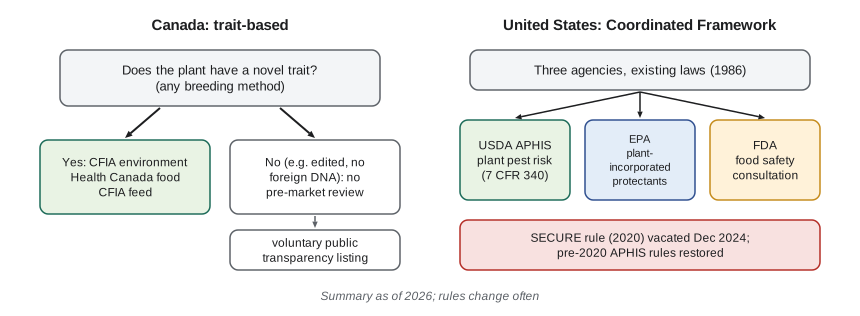
Whatever the regulatory system, scientific assessments of transgenic crops have consistently concluded that the method of breeding does not in itself make a crop more or less safe, and that each product should be judged by its traits. Major reviews, including a 2016 report of the US National Academies of Sciences, Engineering, and Medicine, found no substantiated evidence that approved transgenic crops posed greater risks to human health than conventional crops, while documenting real issues of weed and insect resistance that arise from overreliance on single traits. The weed resistance problem is a direct application of lesson 11’s arms-race logic: repeated use of one herbicide, such as glyphosate on glyphosate-tolerant crops, selected for resistant weeds such as Palmer amaranth in the United States and kochia on the Prairies.
Climate change and crops
The climate of the Canadian Prairies and the US Great Plains has warmed by more than the global average since the early twentieth century, with the greatest warming in winter and at night. Atmospheric CO₂ has risen from about 280 ppm before industrialization to more than 420 ppm. The effects on crops combine several processes covered in this course, some favorable and some harmful. Higher CO₂ increases photosynthesis and water use efficiency in C3 crops such as wheat, canola, barley and soybean (lesson 4), though by less in the field than in early chamber experiments, and it lowers grain protein and mineral content. Warmer temperatures lengthen the frost-free season and let crops and varieties move north, but they also speed development, shortening the grain-filling period, and increase the frequency of damaging heat during flowering (lesson 11). Higher temperatures raise evaporative demand, so droughts become more intense even where rainfall does not change (lesson 5). And pests and diseases expand their ranges.
Plant development is driven more by accumulated warmth than by calendar time. Agronomists track it with growing degree days (GDD), the sum over days of the amount by which the mean daily temperature exceeds a base temperature below which the crop does not develop. Base temperatures differ among crops: about 5 °C for wheat and canola, and 10 °C (50 °F) for maize and soybean, with maize calculations also capping the daily maximum at 30 °C (86 °F). Each growth stage requires a roughly constant number of degree days, so degree-day sums predict when a crop will flower or mature. In Ontario and Quebec, a related index called corn heat units is used to match maize hybrids to regions.
import numpy as np

rng = np.random.default_rng(340)
# Invented daily temperatures (F) for a corn field near Ames, Iowa, planted 1 May (day 0)
days = np.arange(0, 140)
noise_max, noise_min = rng.normal(0, 5, days.size), rng.normal(0, 4, days.size)    # same weather noise in both runs
def season(warming_F):
    mean = 60 + 18 * np.sin(np.pi * (days + 10) / 175) + warming_F
    return mean + 11 + noise_max, mean - 11 + noise_min

flower_gdd = 1350      # approximate GDD (base 50 F, cap 86 F) from planting to silking for a mid-season hybrid
for name, warm in (("baseline season", 0.0), ("season 3.6 F warmer", 3.6)):
    tmax, tmin = season(warm)
    hi = np.clip(tmax, 50, 86); lo = np.clip(tmin, 50, 86)  # standard modified GDD method
    gdd = (hi + lo) / 2 - 50
    cum = np.cumsum(gdd)
    start = int(np.argmax(cum >= flower_gdd))
    window = slice(start, start + 14)                       # about 2 weeks around silking
    hot = int((tmax[window] >= 95).sum())
    print(f"{name:20s} silking day {start:3d} after planting; "
f"days >= 95 F around silking: {hot}; season GDD: {cum[-1]:.0f}")baseline season silking day 63 after planting; days >= 95 F around silking: 1; season GDD: 3176 season 3.6 F warmer silking day 57 after planting; days >= 95 F around silking: 5; season GDD: 3549
The capstone model shows two effects of warming at once. In the warmer season, the corn crop reaches silking several days sooner after planting, because degree days accumulate faster, and silking falls in a part of the summer when very hot days are more common, so more days around silking exceed 95 °F, when pollen viability and kernel set decline and drought stress intensifies. The data are invented, but both effects have been documented across the Corn Belt, and they help explain the yield losses in hot, dry summers such as 2012, when the average US corn yield fell by about a quarter from trend. Growers respond with earlier planting, hybrids of different maturity and drought tolerance, and practices that conserve soil water.
Forests and natural vegetation
Wild plants respond too. Spring events such as leaf-out and flowering have advanced by days per decade in many temperate regions, tracking warmer springs, a shift documented in records stretching back more than a century, including Henry David Thoreau’s notes from Concord, Massachusetts, and long-running phenology networks in Canada and the United States. Mismatches can result when plants and their pollinators or herbivores respond to different cues; a plant timed by day length and an insect timed by temperature may drift apart. In the boreal forest, warming and drought stress, increased fire and insect outbreaks such as the mountain pine beetle, which killed pine across roughly 18 million hectares of British Columbia and spread east of the Rocky Mountains into Alberta in the 2000s, are reshaping a biome that stores a large fraction of the world’s terrestrial carbon. Tree species are expected to shift northward and upslope over generations, but trees migrate slowly, and assisted migration, planting seed sources from warmer regions, is being trialled by forest agencies on both sides of the border. Drought-induced hydraulic failure (lesson 5) has become a major cause of tree mortality in western North America.
Breeding for a changing climate
Breeders have several levers drawn directly from plant biology. Flowering time and maturity genes (lessons 9 and 10) can be adjusted so that crops avoid heat and drought at sensitive stages. Root architecture genes such as those controlling root angle (lesson 9) can push roots deeper. Stomatal density and ABA sensitivity (lessons 5 and 8) can be tuned for water use efficiency. Photoprotection and photorespiration (lessons 3 and 4) are targets for raising photosynthetic efficiency, with field trials showing gains in tobacco and soybean. Disease resistance can be strengthened by stacking resistance genes and using durable partial resistance (lesson 11). Wild relatives of crops, conserved in gene banks, supply alleles for heat, drought and disease tolerance that were lost during domestication. Genomic selection, which predicts breeding value from DNA markers across the whole genome, speeds selection, and genome editing allows targeted changes to known genes. No single trait will make crops climate-proof; resilience comes from combining physiology, genetics and management.
Worked problem
Interpreting a FACE experiment
In a free-air CO₂ enrichment experiment, wheat grown at 550 ppm had 30 percent higher leaf photosynthesis, 12 percent higher grain yield, 8 percent lower grain protein concentration and 15 percent lower stomatal conductance than wheat at ambient CO₂. In a drought year, the yield gain at high CO₂ was larger than in a wet year. Explain these results using the course concepts.
Show solution
- Higher CO₂ raises rubisco carboxylation and suppresses photorespiration in this C3 crop, increasing leaf photosynthesis (lesson 4).
- Yield rises less than photosynthesis because plants acclimate (reducing rubisco), because sinks and nitrogen limit growth, and because canopy-level effects dilute the leaf response.
- Grain protein falls because carbon gain outpaces nitrogen uptake, diluting nitrogen in the grain.
- Stomata partly close at high CO₂ (lesson 5), cutting transpiration; in a drought year, the water saved sustains growth longer, so the relative CO₂ benefit is larger.
Answer: These patterns, observed in FACE trials, show that rising CO₂ benefits C3 crops mainly through photosynthesis and water savings, but by less than leaf measurements suggest and with a cost in grain quality. Projections for the Prairies and the Plains must weigh these gains against heat and drought losses.
Common mistakes
MistakeAssuming that rising CO₂ will simply increase crop yields.
InsteadC3 crops gain from CO₂, but gains are smaller in the field, grain quality falls, and heat and drought can outweigh the benefit.
MistakeTreating gene-edited and transgenic plants as the same in every jurisdiction.
InsteadCanada and the United States treat edited plants without foreign DNA differently from transgenic plants, and rules continue to change.
MistakeThinking that Canada regulates crops by how they were made.
InsteadCanada regulates plants with novel traits regardless of method; even conventionally bred plants can be regulated if their traits are novel.
MistakeUsing calendar days to predict crop development.
InsteadDevelopment tracks accumulated growing degree days, which vary from year to year and place to place.
MistakeExpecting a single gene to make a crop climate-resilient.
InsteadResilience combines many traits, including phenology, roots, water use, heat tolerance and disease resistance, with good management.
MistakeAssuming forests will shift north as fast as climate changes.
InsteadTrees migrate slowly; climate is shifting faster than natural migration in many regions.
Summary and key terms
- Arabidopsis, with its short life cycle, small genome and easy transformation, made modern plant molecular biology possible.
- Agrobacterium-mediated transformation and the gene gun produce transgenic plants; CRISPR genome editing can produce small changes without foreign DNA in the final plant.
- Canada regulates plants with novel traits regardless of method; the United States regulates through USDA, EPA and FDA under the Coordinated Framework, with the SECURE rule vacated in December 2024.
- Rising CO₂ raises C3 photosynthesis and water use efficiency but lowers grain quality; warming speeds development and increases heat stress at flowering.
- Growing degree days predict crop development and show how warming shifts flowering into hotter parts of the season.
- Forests face phenological shifts, drought mortality, fire and insect outbreaks; trees migrate more slowly than climate is changing.
- Breeding for climate resilience draws on flowering time, roots, stomata, photosynthesis, disease resistance and genetic resources from wild relatives.
- model organism
- A species studied intensively because its biology makes experiments easy and results generalizable.
- T-DNA
- The segment of an Agrobacterium plasmid transferred into the plant genome.
- transgenic plant
- A plant carrying DNA introduced from another organism by genetic engineering.
- genome editing
- Targeted modification of DNA at a chosen site, for example with CRISPR–Cas nucleases.
- plant with novel traits
- In Canada, a plant with a trait new to the species that may affect the environment, regulated regardless of how it was made.
- Coordinated Framework
- The US policy of 1986 dividing biotechnology regulation among USDA, EPA and FDA.
- FACE experiment
- Free-air CO₂ enrichment, exposing field-grown plants to elevated CO₂ in the open.
- growing degree days
- Accumulated daily mean temperature above a crop-specific base temperature.
- phenology
- The timing of seasonal biological events such as leaf-out and flowering.
- assisted migration
- Deliberately moving species or seed sources to locations expected to suit them in a future climate.
- genomic selection
- Breeding that predicts the value of plants from genome-wide DNA markers.
Practice problems
Work each problem on paper first, then reveal the answer to check.
List four features that made Arabidopsis a good model organism.
Show answer
Short life cycle, small size, self-pollination with many seeds, small sequenced genome, easy Agrobacterium transformation.
How is a transgene encoding Cas9 removed from an edited plant line?
Show answer
By self-pollinating or crossing and selecting progeny that inherited the edit but not the unlinked transgene.
A T0 plant is hemizygous for Cas9 and heterozygous for an edit. What fraction of selfed progeny are edit-homozygous and Cas9-free?
Show answer
1/4 × 1/4 = 1/16.
How does Canada’s approach to regulating new crop varieties differ from a method-based approach?
Show answer
Canada assesses plants with novel traits whatever breeding method produced them, rather than triggering regulation by the use of genetic engineering.
Which three US agencies share biotech crop regulation, and what does each cover?
Show answer
USDA APHIS (plant pest risk), EPA (plant-incorporated protectants such as Bt), FDA (food safety consultation).
Calculate growing degree days (base 5 °C) for a day with maximum 24 °C and minimum 10 °C.
Show answer
(24 + 10)/2 − 5 = 12 degree days.
Why can warming increase heat stress at flowering even if summer maximum temperatures change little?
Show answer
Faster development moves flowering earlier or later into periods with more frequent hot days, and warming raises the frequency of extreme days.
Why does grain protein concentration fall at elevated CO₂?
Show answer
Carbon gain increases more than nitrogen uptake, diluting nitrogen in the grain.
Give two reasons why forests may not keep pace with climate change.
Show answer
Trees have long generations and slow seed dispersal; fragmented landscapes block migration.
Name three plant traits breeders can adjust for drought resilience and the lesson in which each was covered.
Show answer
Flowering time (lesson 9), root angle and depth (lessons 2 and 9), stomatal density and ABA sensitivity (lessons 5 and 8).
Lesson quiz · 5 questions
Score 60% or more to complete this lesson.
Create a free account to save your progress, take quizzes and earn a certificate.