
BIOL-330 · Lesson 6 of 12 · 30 min
Microbial metabolism and diversity
Animals and plants use a narrow range of metabolic strategies: animals oxidize organic food with oxygen, and plants capture light with chlorophyll and split water. Microorganisms use these strategies too, but they also make a living by oxidizing hydrogen gas, ammonia, sulfide or ferrous iron, by breathing nitrate, sulfate, ferric iron or carbon dioxide instead of oxygen, by fermenting almost any organic compound, and by capturing light with pigments other than chlorophyll a. This metabolic diversity is the reason microbes drive the planet’s chemical cycles and the reason they can live wherever there is a usable energy gradient. BIOL-107 introduced glycolysis, the citric acid cycle, oxidative phosphorylation and photosynthesis. This lesson builds on those foundations to show how microbes vary the theme, and it uses simple thermodynamics to predict which reactions can support life.
Classifying microbes by how they make a living
Every organism needs a source of energy, a source of electrons for building cell material and for energy-yielding reactions, and a source of carbon. Microbiologists combine three pairs of terms to describe the options. Phototrophs get energy from light and chemotrophs from chemical reactions. Organotrophs use organic compounds as electron donors and lithotrophs use inorganic ones (litho means rock). Autotrophs fix carbon dioxide as their carbon source and heterotrophs use organic carbon. Humans and E. coli are chemoorganoheterotrophs; plants and cyanobacteria are photolithoautotrophs, with water as the electron donor; nitrifying bacteria are chemolithoautotrophs.
| Category | Energy source | Electron donor | Carbon source | Examples |
|---|---|---|---|---|
| Photolithoautotroph | Light | H₂O, H₂S, S, Fe²⁺ | CO₂ | Cyanobacteria (H₂O), purple and green sulfur bacteria (H₂S) |
| Photoorganoheterotroph | Light | Organic compounds | Organic compounds | Purple non-sulfur bacteria such as Rhodobacter |
| Chemolithoautotroph | Chemical oxidation | H₂, NH₄⁺, NO₂⁻, H₂S, Fe²⁺ | CO₂ | Nitrosomonas, Nitrobacter, Acidithiobacillus, methanogens using H₂ |
| Chemolithoheterotroph | Chemical oxidation | Inorganic compounds | Organic compounds | Some sulfur oxidizers such as Beggiatoa |
| Chemoorganoheterotroph | Chemical oxidation | Organic compounds | Organic compounds | Most bacteria, fungi, protozoa and animals |
Redox reactions and the redox tower
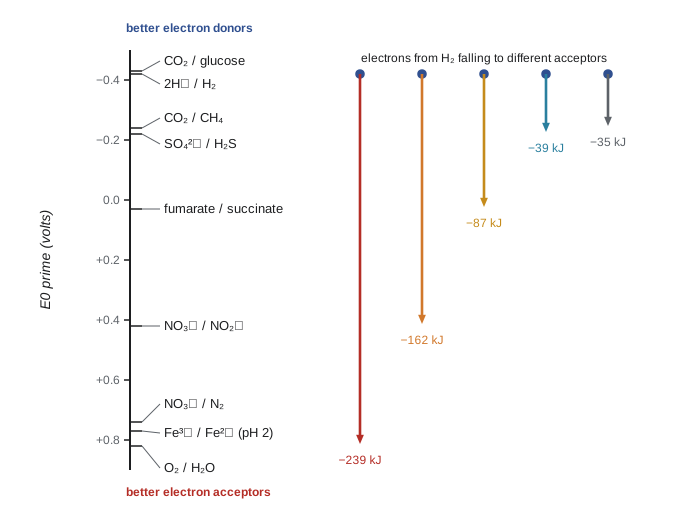
All energy-yielding metabolism is built on oxidation–reduction (redox) reactions, in which electrons pass from a donor to an acceptor. The tendency of a compound to accept electrons is measured by its standard reduction potential, E°′, in volts, at pH 7. Couples with very negative potentials, such as CO₂/glucose (−0.43 V) and 2H⁺/H₂ (−0.42 V), are good electron donors; couples with very positive potentials, such as ½O₂/H₂O (+0.82 V), are good acceptors. Listing couples from most negative to most positive gives the redox tower. Electrons ‘fall’ from a donor high on the tower to an acceptor lower down, and the larger the fall, the more energy is released. The standard free energy change is:
where n is the number of electrons transferred, F is the Faraday constant (96.485 kJ per volt per mole of electrons) and ΔE°′ is the potential of the acceptor couple minus that of the donor couple. A positive ΔE°′ gives a negative ΔG°′, meaning the reaction can release energy. Because cells need roughly 60 to 70 kJ to make one ATP under physiological conditions, but can conserve energy in smaller packets by pumping protons, reactions releasing as little as about 15 to 20 kJ per mole can support growth.
F = 96.485   # kJ per volt per mole of electrons
E = {   # standard reduction potentials at pH 7 (V)
    "CO2/glucose": -0.43, "2H+/H2": -0.42, "CO2/CH4": -0.24, "SO4--/H2S": -0.22,
    "fumarate/succinate": 0.03, "NO3-/NO2-": 0.42, "NO3-/N2": 0.74,
    "Fe3+/Fe2+ (pH 2)": 0.77, "O2/H2O": 0.82, "NO2-/NH4+": 0.34,
}
def dG(donor, acceptor, n):
    return -n * F * (E[acceptor] - E[donor])
print("H2 (2 e-) with different acceptors:")
for acc in ["O2/H2O", "NO3-/NO2-", "fumarate/succinate", "SO4--/H2S", "CO2/CH4"]:
    print(f"  {acc:20s} dG0' = {dG('2H+/H2', acc, 2):7.1f} kJ per mol H2")
print("Glucose (24 e-) with O2:", round(dG("CO2/glucose", "O2/H2O", 24)), "kJ per mol")
print("Nitrite oxidation by O2 (2 e-):", round(dG("NO3-/NO2-", "O2/H2O", 2), 1), "kJ per mol")
print("Ammonia oxidation to nitrite by O2 (6 e-):", round(dG("NO2-/NH4+", "O2/H2O", 6), 1), "kJ per mol")H2 (2 e-) with different acceptors: O2/H2O dG0' = -239.3 kJ per mol H2 NO3-/NO2- dG0' = -162.1 kJ per mol H2 fumarate/succinate dG0' = -86.8 kJ per mol H2 SO4--/H2S dG0' = -38.6 kJ per mol H2 CO2/CH4 dG0' = -34.7 kJ per mol H2 Glucose (24 e-) with O2: -2895 kJ per mol Nitrite oxidation by O2 (2 e-): -77.2 kJ per mol Ammonia oxidation to nitrite by O2 (6 e-): -277.9 kJ per mol
The output ranks the acceptors exactly as the tower predicts. Oxidizing hydrogen with oxygen releases about 240 kJ per mole, with nitrate about 160, with sulfate about 39 and with CO₂ (methanogenesis) only about 35. Complete oxidation of glucose with oxygen releases about 2,900 kJ per mole by this calculation, close to the accepted value of about 2,870. Nitrite oxidation releases only about 77 kJ per mole, which is one reason nitrite-oxidizing bacteria grow so slowly. Actual free energy changes in the environment differ from the standard values because concentrations are far from 1 molar; for instance, methanogens in sediments live on reactions whose ΔG is near the minimum that can support life because hydrogen is kept at very low concentrations.
Respiration, aerobic and anaerobic
In respiration, electrons from a donor pass along a membrane-bound electron transport chain to a terminal acceptor, and the flow drives the pumping of protons across the cytoplasmic membrane. The resulting proton motive force powers ATP synthase. Aerobic respiration of glucose in bacteria yields up to about 38 ATP per glucose in theory and probably 30 or fewer in practice, depending on the chain components; E. coli, for instance, can use several alternative oxidases and dehydrogenases with different proton-pumping efficiencies and switches among them according to oxygen levels.
Anaerobic respiration uses acceptors other than oxygen. Denitrifying bacteria, such as Pseudomonas stutzeri and Paracoccus denitrificans, reduce nitrate step by step to nitrite, nitric oxide, nitrous oxide and nitrogen gas. Denitrification removes fixed nitrogen from soils, which costs farmers fertilizer, but it is also used deliberately in wastewater treatment to remove nitrate (lesson 11), and incomplete denitrification releases nitrous oxide, a powerful greenhouse gas. Sulfate-reducing bacteria, such as Desulfovibrio, reduce sulfate to hydrogen sulfide in anoxic sediments, giving marsh mud its smell and causing corrosion of iron pipes and well casings. Iron-reducing bacteria such as Geobacter and Shewanella transfer electrons to solid iron oxide minerals outside the cell, through cytochromes in the outer membrane and conductive protein filaments; they can even pass electrons to electrodes, the basis of microbial fuel cells. Because each acceptor yields less energy than the one above it, acceptors are used in sequence in sediments and polluted aquifers: oxygen first, then nitrate, manganese, iron, sulfate and finally CO₂ by methanogens.
Fermentation
When no external electron acceptor is available, many organisms ferment. In fermentation, an organic compound is partly oxidized and the electrons removed are returned to an organic product, so the redox balance is maintained without a respiratory chain. ATP is made only by substrate-level phosphorylation, the direct transfer of a phosphate group from a high-energy intermediate to ADP. Most fermentations of glucose yield only 2 ATP per molecule, about a fifteenth of aerobic respiration, so fermenters must process far more sugar to make the same biomass, and they excrete large amounts of products. Those products are the reason fermentation matters so much to people.
| Fermentation | Main products | Organisms | Uses or consequences |
|---|---|---|---|
| Homolactic | Lactate | Lactococcus, Streptococcus, many Lactobacillus species | Yogurt, cheese, sour cream; dental caries |
| Heterolactic | Lactate, ethanol, CO₂ | Leuconostoc, some Lactobacillus species | Sauerkraut, kimchi, sourdough |
| Alcoholic | Ethanol, CO₂ | Saccharomyces cerevisiae, Zymomonas | Beer, wine, bread, fuel ethanol |
| Mixed acid | Lactate, acetate, succinate, formate, ethanol, H₂, CO₂ | E. coli, Salmonella | Basis of the methyl red identification test |
| Butanediol | 2,3-butanediol, ethanol, CO₂ | Enterobacter, Klebsiella | Basis of the Voges–Proskauer test |
| Butyrate and solvent | Butyrate, butanol, acetone | Clostridium | Acetone–butanol fermentation; rancid smells |
| Propionic | Propionate, acetate, CO₂ | Propionibacterium | Holes and flavor in Swiss-type cheese |
Because different organisms ferment sugars to different end products, fermentation tests became the backbone of classical identification (lesson 1). The products also affect health: the short-chain fatty acids acetate, propionate and butyrate, produced by fermentation of dietary fiber by gut bacteria, supply a large share of the energy used by cells lining the colon. Some fermenters cannot use glucose at all but ferment amino acids in pairs (the Stickland reaction of proteolytic clostridia) or ferment unusual substrates such as oxalate or citrate.
Chemolithotrophy
Chemolithotrophs gain energy by oxidizing inorganic compounds, a way of life discovered by Sergei Winogradsky in the 1880s when he showed that Beggiatoa oxidized hydrogen sulfide to sulfur and that nitrifying bacteria oxidized ammonia. Most chemolithotrophs are autotrophs, using the energy to fix CO₂. Nitrification is carried out in two steps by different organisms: ammonia-oxidizing bacteria such as Nitrosomonas and ammonia-oxidizing archaea such as Nitrosopumilus convert ammonia to nitrite, and nitrite-oxidizing bacteria such as Nitrobacter and Nitrospira convert nitrite to nitrate. In 2015, two groups independently discovered comammox Nitrospira, which carry out both steps in one cell, overturning a century-old assumption. Sulfur-oxidizing bacteria such as Acidithiobacillus produce sulfuric acid, which leaches metals from ores in biomining and also produces acid mine drainage. Anammox bacteria, discovered in a Dutch wastewater plant in the 1990s, oxidize ammonium with nitrite under anoxic conditions to produce nitrogen gas, inside a membrane-bound compartment called the anammoxosome; they account for a large share of nitrogen loss from the oceans and are used to remove ammonium from wastewater cheaply.
Many chemolithotrophs have a problem with reducing power. To fix CO₂ they need NADH, but electron donors such as nitrite and ferrous iron have potentials too positive to reduce NAD⁺ directly. They solve it by reverse electron transport, using the proton motive force to push electrons uphill to NAD⁺, which consumes much of the energy they gain. Combined with the small energy yields, this explains their very low growth yields and long generation times.
Phototrophy
Phototrophs capture light with pigments embedded in membranes. In oxygenic photosynthesis, carried out by cyanobacteria and by the chloroplasts of algae and plants that descended from them, two photosystems working in series extract electrons from water and release oxygen. Cyanobacteria invented this process at least 2.4 billion years ago and caused the Great Oxidation Event, which transformed Earth’s atmosphere and oceans. Anoxygenic photosynthesis, carried out by purple bacteria, green sulfur bacteria, green non-sulfur bacteria and heliobacteria, uses a single photosystem and bacteriochlorophylls that absorb near-infrared light, and takes electrons from hydrogen sulfide, hydrogen, ferrous iron or organic compounds instead of water, so no oxygen is produced. Some green sulfur bacteria are adapted to such dim light that they grow near deep-sea hydrothermal vents using geothermal radiation.
A completely different light-harvesting system uses rhodopsins. Halobacterium salinarum uses bacteriorhodopsin, a light-driven proton pump, to make ATP. Proteorhodopsin genes, discovered in marine bacterial DNA in 2000, are widespread in surface ocean microbes and may supply energy to a large fraction of marine cells, especially when organic carbon is scarce.
Fixing carbon and nitrogen
Autotrophs fix CO₂ by at least six different pathways. The Calvin–Benson cycle, using the enzyme RuBisCO, is used by cyanobacteria, many chemolithotrophs and plants; it is energetically expensive, needing 3 ATP and 2 NADPH per CO₂. The reverse citric acid cycle, found in green sulfur bacteria and some archaea, runs the familiar cycle backwards using reduced ferredoxin. The Wood–Ljungdahl (reductive acetyl-CoA) pathway of acetogens and methanogens is the most energy-efficient and is thought by many to resemble the earliest carbon fixation on Earth. Other pathways are found in particular groups of archaea and bacteria.
Nitrogen fixation, the reduction of atmospheric N₂ to ammonia, is carried out only by bacteria and archaea, using the enzyme nitrogenase:
The reaction is extremely costly, using 16 ATP for each N₂ fixed, and nitrogenase is irreversibly damaged by oxygen. Nitrogen fixers protect it in several ways. Azotobacter respires so rapidly that oxygen is consumed before it reaches the enzyme; filamentous cyanobacteria such as Anabaena fix nitrogen only in heterocysts, thick-walled cells that lack the oxygen-producing photosystem II; and Rhizobium bacteria in legume root nodules are supplied with leghemoglobin by the plant, which binds oxygen and keeps its free concentration low. Biological nitrogen fixation adds roughly 100 to 200 million metric tons of nitrogen a year to the land and oceans, comparable to industrial fertilizer production by the Haber–Bosch process. BIOL-208 places these reactions within the nitrogen and carbon cycles at the ecosystem level.
Methanogenesis and syntrophy
Methanogens are archaea that make methane as the end product of their energy metabolism. Hydrogenotrophic methanogens reduce CO₂ with H₂; acetoclastic methanogens such as Methanosarcina split acetate into methane and CO₂; and methylotrophic methanogens use methanol or methylamines. Methanogens live in wetlands, rice paddies, landfills, the rumens of cattle and the human gut, and they produce most of the biological methane entering the atmosphere. Ruminant livestock alone release roughly 100 million metric tons of methane a year, which is why feed additives that inhibit methanogenesis, such as 3-nitrooxypropanol, have been approved for cattle in Canada, the United States and elsewhere.
In anoxic environments, many organic compounds can be broken down only by partnerships. Syntrophic bacteria ferment fatty acids such as propionate and butyrate to acetate and H₂, a reaction that is thermodynamically unfavorable unless the H₂ is removed. Methanogens consume the hydrogen as fast as it is made, keeping its concentration so low that the fermentation becomes favorable; neither partner could grow alone. This interspecies hydrogen transfer is essential in anaerobic digesters, where complex organic waste is converted to biogas (lesson 11).
import numpy as np

# Syntrophic propionate oxidation: propionate- + 3 H2O -> acetate- + HCO3- + H+ + 3 H2
R, T = 8.314e-3, 298.15                     # kJ/(mol K), K
dG0 = 76.1                                  # kJ/mol at pH 7, standard conditions
prop, acet, hco3 = 1e-3, 1e-3, 20e-3        # mol/L (typical digester values)
for pH2_atm in [1.0, 1e-2, 1e-4, 1e-5, 1e-6]:
    Q = (acet * hco3 * pH2_atm ** 3) / prop
    dG = dG0 + R * T * np.log(Q)
print(f"pH2 = {pH2_atm:7.0e} atm -> dG = {dG:7.1f} kJ/mol {'favourable' if dG < -15 else ('marginal' if dG < 0 else 'unfavourable')}")pH2 = 1e+00 atm -> dG = 66.4 kJ/mol unfavorable pH2 = 1e-02 atm -> dG = 32.2 kJ/mol unfavorable pH2 = 1e-04 atm -> dG = -2.1 kJ/mol marginal pH2 = 1e-05 atm -> dG = -19.2 kJ/mol favorable pH2 = 1e-06 atm -> dG = -36.3 kJ/mol favorable
At a hydrogen partial pressure of 1 atmosphere the reaction is strongly unfavorable, at about 10⁻⁴ atmospheres it is close to zero, and when methanogens hold hydrogen at 10⁻⁵ atmospheres or below it becomes favorable enough to support growth. The window is narrow, because the methanogens themselves need enough hydrogen to gain energy, so both partners live close to the thermodynamic edge.
Worked problem
Predicting the order of electron acceptor use
A petroleum spill contaminates a shallow aquifer that initially contains dissolved O₂, nitrate, iron oxides and sulfate. In what order will these be consumed as microbes degrade the hydrocarbons, and what would you measure to show it?
Show solution
- Rank the acceptor couples by E°′: O₂/H₂O (+0.82 V) > NO₃⁻/N₂ (+0.74 V) > Fe³⁺/Fe²⁺ (positive, depending on the mineral) > SO₄²⁻/H₂S (−0.22 V) > CO₂/CH₄ (−0.24 V).
- Microbes using the acceptor with the highest yield outcompete others while it lasts, so O₂ is depleted first near the plume center, then nitrate, then iron, then sulfate, and finally methanogenesis takes over.
- Moving from the plume edge to its center, expect falling O₂ and nitrate, rising dissolved Fe²⁺, falling sulfate with sulfide appearing, and finally methane.
Answer: Oxygen, nitrate, iron, sulfate, then CO₂ (methanogenesis). These redox zones are used to demonstrate natural attenuation of hydrocarbon plumes, a theme of lesson 11.
Common mistakes
MistakeEquating anaerobic respiration with fermentation.
InsteadAnaerobic respiration uses an electron transport chain and an external acceptor such as nitrate or sulfate; fermentation has no external acceptor and makes ATP by substrate-level phosphorylation.
MistakeThinking that all photosynthesis produces oxygen.
InsteadAnoxygenic phototrophs use H₂S, H₂, Fe²⁺ or organic compounds as electron donors and release no oxygen.
MistakeGetting the sign of ΔE°′ backwards.
InsteadΔE°′ is the acceptor potential minus the donor potential; a positive value gives a negative ΔG°′.
MistakeAssuming a reaction with a positive standard ΔG°′ can never support life.
InsteadActual ΔG depends on concentrations; syntrophs grow on such reactions when partners keep products very low.
MistakeBelieving that only plants fix nitrogen.
InsteadOnly bacteria and archaea have nitrogenase; legumes host nitrogen-fixing Rhizobium in root nodules.
MistakeTreating methanogens as bacteria.
InsteadAll known methanogens are archaea.
Summary and key terms
- Microbes are classified by energy source (photo- or chemo-), electron donor (organo- or litho-) and carbon source (auto- or hetero-).
- ΔG°′ = −nFΔE°′: the farther electrons fall down the redox tower, the more energy is available.
- Aerobic respiration yields the most ATP; anaerobic respiration with nitrate, iron, sulfate or CO₂ yields progressively less, and acceptors are used in that order.
- Fermentation balances redox internally, yields about 2 ATP per glucose and produces the acids, alcohols and gases used in foods and identification tests.
- Chemolithotrophs oxidize ammonia, nitrite, sulfur, iron or hydrogen; phototrophs use chlorophyll, bacteriochlorophyll or rhodopsins.
- Nitrogenase uses 16 ATP per N₂ and must be protected from oxygen; methanogenesis and syntrophic partnerships complete anaerobic decomposition.
- chemolithotroph
- An organism that gains energy by oxidizing inorganic compounds.
- autotroph
- An organism that uses CO₂ as its main carbon source.
- reduction potential
- The tendency of a redox couple to accept electrons, measured in volts.
- anaerobic respiration
- Respiration that uses a terminal electron acceptor other than oxygen.
- fermentation
- Energy metabolism in which an organic compound is both electron donor and, via its products, acceptor, with ATP made by substrate-level phosphorylation.
- denitrification
- Anaerobic respiration that reduces nitrate to nitrogen gas.
- anammox
- Anaerobic ammonium oxidation with nitrite to produce nitrogen gas.
- nitrogenase
- The oxygen-sensitive enzyme complex that reduces N₂ to ammonia.
- methanogen
- An archaeon that produces methane as the end product of energy metabolism.
- syntrophy
- A partnership in which two organisms together carry out a reaction neither can perform alone.
Practice problems
Work each problem on paper first, then reveal the answer to check.
Classify a bacterium that uses light for energy, H₂S as electron donor and CO₂ as carbon source.
Show answer
Photolithoautotroph.
Calculate ΔG°′ for oxidizing H₂ with nitrate to nitrite (E°′ = −0.42 and +0.42 V; n = 2).
Show answer
−2 × 96.485 × 0.84 ≈ −162 kJ per mol.
Why do sulfate reducers outcompete methanogens for hydrogen when sulfate is present?
Show answer
Sulfate reduction yields more energy and lets sulfate reducers grow on lower hydrogen concentrations.
How many ATP per glucose does homolactic fermentation yield?
Show answer
Two.
What test distinguishes mixed-acid from butanediol fermenters?
Show answer
Methyl red (positive for mixed acid) and Voges–Proskauer (positive for butanediol).
Why must nitrite oxidizers use reverse electron transport?
Show answer
Nitrite’s reduction potential is too positive to reduce NAD⁺ directly.
What do heterocysts lack that protects nitrogenase?
Show answer
Oxygen-producing photosystem II.
What did the discovery of comammox overturn?
Show answer
The assumption that nitrification always requires two different organisms.
Name the carbon fixation pathway used by acetogens.
Show answer
The Wood–Ljungdahl (reductive acetyl-CoA) pathway.
Why do syntrophic propionate oxidizers depend on methanogens?
Show answer
Methanogens keep hydrogen low enough to make propionate oxidation thermodynamically favorable.
Lesson quiz · 5 questions
Score 60% or more to complete this lesson.
Create a free account to save your progress, take quizzes and earn a certificate.