
BIOL-330 · Lesson 11 of 12 · 32 min
Applied, industrial and food microbiology
People were using microbes long before anyone knew they existed. Beer was brewed in Mesopotamia more than five thousand years ago, wine was made in the Caucasus earlier still, and cheese, yogurt, leavened bread, soy sauce and fermented vegetables were staples across the ancient world. Today microbes produce antibiotics, enzymes, amino acids, vitamins, organic acids, vaccines and therapeutic proteins worth hundreds of billions of dollars a year; they treat the sewage of every city; and they are used to clean up pollution. At the same time, microbial growth in food causes spoilage and foodborne illness. This lesson applies the principles of the earlier lessons, growth kinetics, environmental control, metabolism and genetics, to these practical problems.
Fermented foods
Fermented foods are made by allowing or encouraging the growth of particular microbes, usually lactic acid bacteria or yeasts, whose products preserve the food and give it flavor and texture. The fermentation lowers pH, produces antimicrobial compounds such as organic acids, ethanol, hydrogen peroxide and bacteriocins, and consumes sugars that spoilage organisms would otherwise use. In this sense fermentation is one of the oldest forms of food preservation, a controlled spoilage that excludes worse ones.
| Food | Main organisms | Key microbial activity |
|---|---|---|
| Yogurt | Streptococcus thermophilus and Lactobacillus delbrueckii subsp. bulgaricus | Homolactic fermentation of lactose lowers pH to about 4.5 and coagulates milk proteins; acetaldehyde gives flavor |
| Cheese | Lactococcus lactis starters; ripening molds and bacteria (Penicillium roqueforti, P. camemberti, Propionibacterium) | Acidification, then curdling with rennet (now mostly produced by recombinant microbes); ripening by proteolysis and lipolysis |
| Sauerkraut and kimchi | Leuconostoc mesenteroides, then Lactobacillus and related species | Heterolactic then homolactic fermentation of salted vegetables in succession |
| Bread | Saccharomyces cerevisiae; lactic acid bacteria in sourdough | CO₂ leavens dough; sourdough acids add flavor and inhibit mold |
| Beer and wine | S. cerevisiae (ale), S. pastorianus (lager); wine yeasts; Oenococcus for malolactic fermentation | Alcoholic fermentation of malt sugars or grape juice |
| Soy sauce, miso, tempeh | Aspergillus oryzae, then lactic acid bacteria and yeasts; Rhizopus for tempeh | Fungal enzymes break down starch and protein before further fermentation |
| Vinegar | Acetobacter and Komagataeibacter | Aerobic oxidation of ethanol to acetic acid |
Modern dairy and brewing industries use defined starter cultures rather than relying on chance, because a consistent product requires a consistent fermentation. Starter cultures are vulnerable to phage attack, which can halt a cheese vat within hours, and as lesson 7 described, the study of phage-resistant Streptococcus thermophilus led to the discovery of CRISPR as an immune system. Dairy companies now select starter strains whose CRISPR arrays carry spacers against the phages found in their plants.
Industrial microbiology
Industrial microbiology uses microbes to make products on a large scale. Primary metabolites are made during active growth and are essential to the cell, such as ethanol, citric acid, lactic acid, amino acids and vitamins. Corynebacterium glutamicum produces over three million metric tons of glutamate a year for flavoring and large amounts of lysine for animal feed; Aspergillus niger produces citric acid for foods and beverages. Secondary metabolites are made mainly in stationary phase and are not needed for growth; they include most antibiotics, many of which come from Streptomyces and other actinomycetes, and compounds such as the immunosuppressant cyclosporine, the cholesterol-lowering statins and the antiparasitic drug avermectin.
Production strains are improved by classical mutation and selection and by metabolic engineering, in which pathways are redesigned by adding, deleting or rebalancing genes. The penicillin-producing Penicillium chrysogenum strains used today make thousands of times more penicillin than Fleming’s original isolate after decades of mutagenesis and selection. Synthetic biology has extended metabolic engineering to complex molecules: yeast engineered with more than a dozen plant, bacterial and fungal genes produces artemisinic acid, a precursor of the antimalarial drug artemisinin.
Fermentation is carried out in bioreactors, stirred, aerated steel tanks that may hold hundreds of cubic meters. Growth must be scaled up from flasks through seed tanks to production vessels while keeping conditions uniform, which is harder than it sounds: oxygen dissolves poorly in water, and a large, dense culture can consume oxygen faster than stirring and aeration can supply it. Oxygen transfer, mixing, heat removal and sterility all become harder as the vessel grows. Many production processes are fed-batch: nutrients are added gradually so that the culture grows at a controlled rate, avoiding the accumulation of inhibitory by-products such as acetate in E. coli or ethanol in aerobic yeast cultures, and the oxygen and cooling demands stay within what the equipment can deliver. Downstream processing, the recovery and purification of the product, often accounts for most of the cost.
Recombinant proteins: the insulin story
Insulin links Canadian medical history to modern biotechnology. Frederick Banting, Charles Best, James Collip and John Macleod at the University of Toronto isolated insulin and first used it to treat a person with diabetes in January 1922, and the university’s Connaught Laboratories then produced insulin extracted from the pancreases of cattle and pigs. Animal insulin served patients for sixty years, but supplies depended on slaughterhouses and some people reacted to the slight differences from human insulin. In 1978 researchers at Genentech and City of Hope expressed synthetic genes for the two chains of human insulin in E. coli, and in 1982 recombinant human insulin, marketed by Eli Lilly as Humulin, became the first drug made by genetic engineering to be approved for human use. Today insulin and its engineered analogues are made in E. coli and in the yeasts Saccharomyces cerevisiae and Komagataella (Pichia) pastoris, along with hepatitis B and HPV vaccines, growth hormone, blood-clotting factors and many enzymes. Proteins that need complex modifications, such as monoclonal antibodies, are usually made in mammalian cell cultures instead, because bacteria cannot add the right sugar chains.
Environmental microbiology at work: wastewater treatment
Municipal wastewater treatment is the largest application of microbiology by volume. Its main goals are to remove organic matter, which would otherwise be degraded by microbes in the receiving river, using up its oxygen and killing fish; to remove nutrients such as nitrogen and phosphorus that cause algal blooms; and to reduce pathogens. The organic load is measured as biochemical oxygen demand (BOD), the oxygen consumed by microbes degrading the organic matter in a sample, conventionally over five days at 20 °C (BOD₅). Raw domestic sewage typically has a BOD₅ of 200 to 300 mg per liter; treated effluent should be below about 25 mg per liter.
Treatment proceeds in stages. Primary treatment removes solids by screening and settling. Secondary treatment is microbial: in the activated sludge process, wastewater is aerated in tanks with a dense suspension of microbes that oxidize organic matter to CO₂ and new biomass. The microbes form flocs, clumps bound by extracellular polymers, which settle in a clarifier; most of the settled sludge is returned to the aeration tank to keep the microbial population high, and the excess is removed for further treatment. Filamentous bacteria that grow too abundantly cause bulking sludge that will not settle, a common operating problem. Nitrogen is removed by nitrification in aerated zones followed by denitrification in anoxic zones (lesson 6), and phosphorus by polyphosphate-accumulating bacteria that take up phosphate in excess when cycled between anaerobic and aerobic conditions. Anammox bacteria are increasingly used to remove ammonium from concentrated side streams with less aeration. Tertiary treatment may add filtration and disinfection by chlorination or ultraviolet light before discharge.
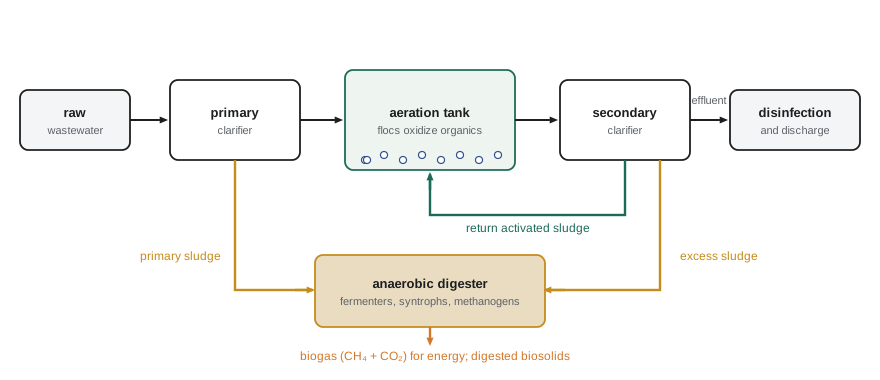
Sludge is commonly stabilized in anaerobic digesters, where a consortium of fermenters, syntrophs and methanogens (lesson 6) converts much of the organic matter to biogas, typically 55 to 70 percent methane, which can fuel the plant’s boilers and generators. The digested solids, called biosolids when treated to meet regulatory standards, may be applied to farmland. Wastewater plants have also become sentinels for public health, as the wastewater surveillance described in lesson 9 shows.
import numpy as np

# First-order BOD exertion: BOD_t = L0 * (1 - exp(-k t)); L0 = ultimate BOD
rng = np.random.default_rng(330)
days = np.array([1, 2, 3, 4, 5, 7, 10, 15, 20])
L0_true, k_true = 290.0, 0.23            # mg/L, per day at 20 C
bod = L0_true * (1 - np.exp(-k_true * days)) * np.exp(rng.normal(0, 0.03, days.size))
# fit L0 and k by a simple grid search on squared error
best = None
for k in np.linspace(0.05, 0.6, 551):
    x = 1 - np.exp(-k * days)
    L0 = np.sum(x * bod) / np.sum(x * x)      # least squares for L0 given k
    sse = np.sum((bod - L0 * x) ** 2)
    if best is None or sse < best[0]:
        best = (sse, k, L0)
_, k, L0 = best
print(f"fitted k = {k:.3f} per day, ultimate BOD L0 = {L0:.0f} mg/L")
print(f"BOD5 = {L0*(1-np.exp(-5*k)):.0f} mg/L ({100*(1-np.exp(-5*k)):.0f}% of ultimate)")
# temperature correction k_T = k_20 * theta^(T-20), theta about 1.047
for T in [10, 20, 30]:
print(f" k at {T} C = {k*1.047**(T-20):.3f} per day")fitted k = 0.232 per day, ultimate BOD L0 = 293 mg/L BOD5 = 201 mg/L (69% of ultimate) k at 10 C = 0.147 per day k at 20 C = 0.232 per day k at 30 C = 0.367 per day
The fit shows why BOD₅ is a convention rather than a complete measure: at a typical rate constant, only about two-thirds of the ultimate oxygen demand is exerted in five days, and the fraction depends on temperature and on how easily the waste is degraded. Nitrifying bacteria can add a second, later oxygen demand, which is often suppressed with an inhibitor when only carbonaceous BOD is wanted.
Bioremediation
Bioremediation uses microbes to remove pollutants. Many organic pollutants, including petroleum hydrocarbons, solvents, pesticides and explosives, can be degraded by some microbe, but natural degradation is often limited by a missing nutrient or electron acceptor rather than by the absence of capable organisms. Biostimulation adds what is missing, such as nitrogen and phosphorus fertilizers or oxygen; bioaugmentation adds organisms known to degrade the pollutant. After the Exxon Valdez spilled about 41 million liters of crude oil in Alaska in 1989, fertilizer applied to oiled beaches roughly doubled degradation rates. After the Deepwater Horizon blowout in the Gulf of Mexico in 2010, natural populations of hydrocarbon-degrading bacteria bloomed in the deep plume and consumed much of the methane and lighter hydrocarbons, although heavier components persisted in sediments for years.
Not every pollutant is destroyed. Metals cannot be degraded, but microbes can change their form: sulfate reducers precipitate metals as insoluble sulfides, and some bacteria reduce soluble uranium(VI) to insoluble uranium(IV), immobilizing it in groundwater. Chlorinated solvents such as trichloroethene, common groundwater contaminants from dry cleaning and degreasing, are dechlorinated step by step under anoxic conditions by Dehalococcoides, which uses them as electron acceptors in a process called organohalide respiration; mixed cultures containing Dehalococcoides are now sold for bioaugmentation and have been used at many contaminated sites in Canada and the United States. In northern Alberta, the oil sands tailings ponds host methanogenic communities that degrade residual solvents and produce methane, which affects both greenhouse gas emissions and the settling of the fine tailings. Monitored natural attenuation relies on documented, ongoing microbial degradation, verified by the kind of redox zonation described in lesson 6, rather than active intervention.
Food spoilage and food safety
Foods are rich media, and the same factors described in lesson 4, temperature, pH, water activity, oxygen and preservatives, determine which microbes grow in them. Food microbiologists group these factors into intrinsic properties of the food (pH, water activity, nutrients, natural antimicrobials) and extrinsic properties of its storage (temperature, humidity, gas atmosphere). Spoilage is the growth of organisms that make food unacceptable through off-odors, slime, gas or visible growth: Pseudomonas on chilled meat and fish, lactic acid bacteria in vacuum-packed meats, yeasts in fruit juices and molds on bread and cheese. Spoilage is a large economic problem, but it is at least visible. Foodborne pathogens are often not, and a contaminated food may look, smell and taste normal.
| Pathogen | Typical sources | Notable features |
|---|---|---|
| Norovirus | Infected food handlers, shellfish, produce | Leading cause of foodborne illness overall; very low infectious dose; resists alcohol |
| Campylobacter jejuni | Undercooked poultry, raw milk | Leading bacterial cause of gastroenteritis in many countries; microaerophile |
| Non-typhoidal Salmonella | Poultry, eggs, produce, nut butters | Major cause of hospitalization; many serotypes |
| Shiga toxin-producing E. coli (e.g. O157:H7) | Undercooked ground beef, leafy greens, raw milk, contaminated water | Phage-encoded Shiga toxins; hemolytic uremic syndrome in children |
| Listeria monocytogenes | Ready-to-eat deli meats, soft cheeses, smoked fish, cantaloupe | Psychrotroph; high fatality rate; dangerous in pregnancy and for older or immunocompromised people |
| Clostridium botulinum | Improperly home-canned low-acid foods, fermented fish and marine mammal products | Neurotoxin formed in food under anaerobic, low-acid conditions |
| Staphylococcus aureus | Food handled by carriers and left warm | Heat-stable enterotoxin; rapid onset of vomiting |
| Bacillus cereus | Cooked rice and starchy foods held warm | Spore former; emetic toxin is heat-stable |
Preventing foodborne illness relies on hurdle technology and on systematic hazard control. The hurdle concept recognizes that several mild preservation factors combined, such as modest acidity, reduced water activity, refrigeration and a preservative, can stop microbial growth where any one alone would not, while preserving food quality. Hazard Analysis and Critical Control Points (HACCP), developed in the 1960s by Pillsbury with NASA to produce safe food for astronauts, is now the basis of food safety regulation in both countries. It requires processors to identify hazards, set critical control points where they can be controlled (such as a cooking temperature or a pH limit), set critical limits, monitor them, take corrective action when limits are not met, verify that the system works and keep records.
Listeria deserves special mention because its ability to grow at refrigeration temperatures defeats the usual hurdles. It persists in biofilms on drains, slicers and conveyors in food plants for years, and it contaminates ready-to-eat foods after cooking, which are then eaten without further heating. Lesson 4 introduced the Ratkowsky square-root model; food safety agencies use it and related models to estimate how fast Listeria can grow during refrigerated storage, which underpins shelf-life limits and the requirement that foods supporting growth be tested more strictly.
import numpy as np

# Square-root model for L. monocytogenes growth rate below the optimum (illustrative parameters)
b, Tmin = 0.0235, -1.7          # sqrt(per h) per degree C, notional minimum (degrees C)
def mu(T):
    return (b * max(T - Tmin, 0)) ** 2          # specific growth rate, per h (ln units)
start, limit = 10.0, 100.0 * 1000              # 10 CFU/g at packing; concern if > 100,000 CFU/g (illustrative)
for T in [2, 4, 7, 10]:
    m = mu(T)
    g = np.log(2) / m
    days = np.log(limit / start) / m / 24
print(f"{T:2d} C: mu = {m:.4f} per h, doubling time = {g:5.1f} h, days from 10 to 1e5 CFU/g = {days:5.1f}")2 C: mu = 0.0076 per h, doubling time = 91.7 h, days from 10 to 1e5 CFU/g = 50.8 4 C: mu = 0.0179 per h, doubling time = 38.6 h, days from 10 to 1e5 CFU/g = 21.4 7 C: mu = 0.0418 per h, doubling time = 16.6 h, days from 10 to 1e5 CFU/g = 9.2 10 C: mu = 0.0756 per h, doubling time = 9.2 h, days from 10 to 1e5 CFU/g = 5.1
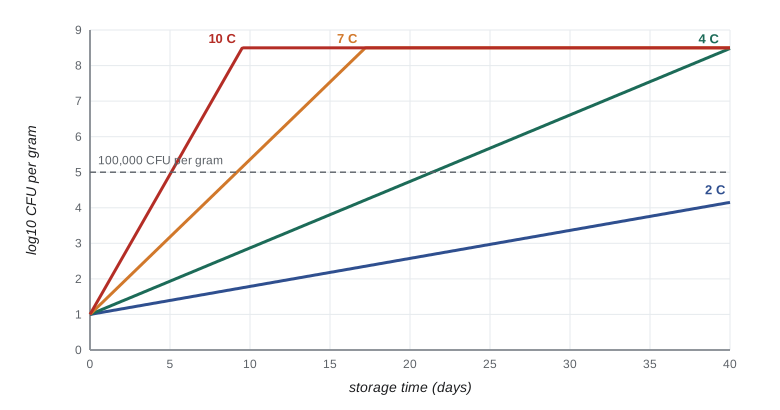
The calculation shows how sensitive Listeria growth is to small temperature differences. Raising storage from 4 °C to 7 °C more than halves the time for a population to increase ten-thousand-fold, which is why domestic refrigerators running warm and long shelf lives are significant risk factors, and why the guidance in both countries is to keep refrigerators at or below 4 °C. Real predictions include a lag phase and are validated with challenge studies, in which products are deliberately inoculated with a cocktail of strains under controlled laboratory conditions and stored at specified temperatures.
Food safety crises have shaped US regulation. In 1993, undercooked hamburgers contaminated with E. coli O157:H7 from the Jack in the Box restaurant chain sickened more than 700 people in western states and killed four children, prompting USDA to declare O157:H7 an adulterant in ground beef. In 2024, Listeria monocytogenes in deli meats from a Boar’s Head plant in Virginia caused 61 illnesses, 60 hospitalizations and 10 deaths across 19 states, one of the largest US listeriosis outbreaks in a decade, and inspection reports describing mold, insects and residue in the plant led to scrutiny of USDA oversight. Today US food safety is divided between the FDA, which regulates most foods under the Food Safety Modernization Act of 2011 and its preventive controls rules, and the USDA Food Safety and Inspection Service (FSIS), which inspects meat, poultry and processed egg products and requires HACCP plans; the CDC leads investigations of multistate outbreaks with state health departments. For comparison, Canada’s Walkerton water disaster of 2000 and the 2008 Maple Leaf Foods Listeria outbreak, which killed 22 people, led to sweeping reforms there, and the Canadian Food Inspection Agency now enforces the Safe Food for Canadians Regulations.
Worked problem
Applying hurdles to a new product
A company plans a refrigerated, ready-to-eat bean dip with pH 5.8 and water activity 0.98, with a 60-day shelf life. Which hazards concern you most, and which hurdles could make the product safe?
Show solution
- At pH 5.8 and a_w 0.98, the dip supports growth of Listeria monocytogenes, which also grows at refrigeration temperatures; a 60-day shelf life gives it ample time (see the model above).
- If the dip is packed with little oxygen, non-proteolytic C. botulinum, which can grow and make toxin at 3 °C, is a further concern.
- Possible hurdles: acidify to pH 4.6 or below (which stops C. botulinum and slows Listeria), add a preservative such as sorbate or a cultured fermentate, apply high-pressure processing after packing to kill vegetative cells, or shorten the shelf life.
- Whichever combination is chosen must be validated by challenge studies and controlled through a HACCP plan with critical limits on pH and processing.
Answer: Listeria (and possibly non-proteolytic C. botulinum) is the key hazard. Acidification below pH 4.6 combined with high-pressure processing, or a much shorter shelf life, are typical solutions, verified by challenge testing.
Common mistakes
MistakeAssuming that food which looks and smells normal is safe.
InsteadPathogens such as Listeria, Salmonella and norovirus rarely change the appearance or smell of food.
MistakeBelieving refrigeration makes ready-to-eat foods safe indefinitely.
InsteadPsychrotrophs such as Listeria grow at 4 °C, so shelf life must be limited or growth prevented by other hurdles.
MistakeTreating BOD₅ as the total oxygen demand of a waste.
InsteadBOD₅ is typically about two-thirds of the ultimate BOD and depends on the waste and temperature.
MistakeExpecting bioremediation to destroy heavy metals.
InsteadMetals cannot be degraded; microbes can only change their chemical form and mobility.
MistakeScaling up a fermentation by simply making the flask bigger.
InsteadOxygen transfer, mixing, heat removal and sterility all become limiting at large scale.
MistakeThinking all recombinant proteins can be made in E. coli.
InsteadProteins needing complex glycosylation, such as antibodies, are usually made in mammalian cells.
Summary and key terms
- Fermented foods rely on lactic acid bacteria, yeasts and molds whose acids, alcohol and other products preserve and flavor food.
- Industrial microbiology makes primary and secondary metabolites and recombinant proteins in bioreactors, often using fed-batch processes.
- Recombinant human insulin (1982) was the first genetically engineered drug, following Toronto’s discovery of insulin in 1921 and 1922.
- Activated sludge treatment, nitrification and denitrification, phosphorus removal and anaerobic digestion clean wastewater; BOD follows first-order kinetics.
- Bioremediation uses biostimulation, bioaugmentation and natural attenuation; organohalide respiration by Dehalococcoides removes chlorinated solvents.
- Food safety rests on hurdle technology and HACCP; Listeria grows in the cold and persists in plant biofilms, making shelf-life control essential.
- Regulators differ between countries: CFIA, Health Canada and PHAC in Canada; FDA, USDA FSIS and CDC in the United States.
- starter culture
- A defined microbial culture added to start a food fermentation.
- secondary metabolite
- A compound made mainly in stationary phase that is not needed for growth, such as an antibiotic.
- fed-batch culture
- A batch culture to which nutrients are added gradually to control growth.
- biochemical oxygen demand
- The oxygen consumed by microbes degrading the organic matter in water.
- activated sludge
- An aerated suspension of microbial flocs used to treat wastewater.
- anaerobic digestion
- Microbial conversion of organic matter to biogas in the absence of oxygen.
- bioremediation
- The use of microorganisms to remove or detoxify pollutants.
- organohalide respiration
- Anaerobic respiration that uses chlorinated organic compounds as electron acceptors.
- hurdle technology
- Combining several mild preservation factors to prevent microbial growth.
- HACCP
- Hazard Analysis and Critical Control Points, a preventive system for controlling food safety hazards.
Practice problems
Work each problem on paper first, then reveal the answer to check.
Why does fermentation preserve food?
Show answer
Microbial products such as acids and ethanol lower pH and inhibit spoilage organisms and pathogens, and sugars are consumed.
Why is phage contamination a serious problem in dairy plants?
Show answer
Phages can destroy starter cultures and halt fermentations within hours.
Distinguish primary from secondary metabolites, with an example of each.
Show answer
Primary metabolites are made during growth and are essential (glutamate, ethanol); secondary are made in stationary phase and are not needed for growth (penicillin).
Why is oxygen transfer a problem in large bioreactors?
Show answer
Oxygen dissolves poorly, and dense cultures can consume it faster than it can be supplied.
Why was recombinant insulin an improvement over animal insulin?
Show answer
It is identical to human insulin and its supply does not depend on slaughterhouses.
What is the purpose of returning sludge to the aeration tank?
Show answer
To maintain a high concentration of active microbes.
If k = 0.23 per day, what fraction of ultimate BOD is exerted in 5 days?
Show answer
1 − e^{−1.15} ≈ 0.68.
How does Dehalococcoides gain energy from trichloroethene?
Show answer
It uses it as a terminal electron acceptor in organohalide respiration, replacing chlorine atoms with hydrogen.
Why is Listeria a particular hazard in ready-to-eat deli meats?
Show answer
It contaminates them after cooking, grows during refrigerated storage, and they are eaten without reheating.
Name the seven principles of HACCP.
Show answer
Hazard analysis, critical control points, critical limits, monitoring, corrective actions, verification, and record keeping.
Lesson quiz · 5 questions
Score 60% or more to complete this lesson.
Create a free account to save your progress, take quizzes and earn a certificate.