
BIOL-330 · Lesson 4 of 12 · 32 min
Environmental influences and the control of growth
Every microorganism has a range of conditions in which it can grow, a narrower range in which it grows well, and limits beyond which it dies. Temperature, acidity, the availability of water, oxygen and pressure are the most important factors, and together they explain where microbes live, how food spoils and which organisms survive treatments meant to kill them. The second half of this lesson turns those facts around: if we know what limits growth, we can design processes that stop it or kill cells, from refrigeration and pickling to pasteurization, autoclaving and chemical disinfection. HSE-245 treated disinfection as a workplace practice; here the emphasis is on the biology and the kinetics that make those practices work.
Temperature
Temperature affects microbes through its effects on enzymes and membranes. As temperature rises, reactions speed up and growth accelerates, until proteins begin to unfold, membranes become too fluid and growth falls steeply. Below the optimum, membranes stiffen, transport slows and growth eventually stops, although cells usually survive. Each organism therefore has three cardinal temperatures: a minimum, an optimum and a maximum. The optimum is always much closer to the maximum than to the minimum, because the destruction of proteins above the optimum is rapid and cooperative while the slowing of reactions below it is gradual.
| Group | Typical optimum | Typical range | Examples and habitats |
|---|---|---|---|
| Psychrophile | 15 °C or below | About −15 to 20 °C | Polaromonas and Psychromonas in sea ice and polar oceans |
| Psychrotroph (psychrotolerant) | 20–30 °C | About 0 to 35 °C | Listeria monocytogenes and Pseudomonas fluorescens, which grow slowly in refrigerators |
| Mesophile | 25–40 °C | About 10 to 45 °C | E. coli, most human pathogens, most soil bacteria |
| Thermophile | 50–65 °C | About 40 to 75 °C | Geobacillus stearothermophilus, compost and hot-spring bacteria |
| Hyperthermophile | 80 °C or above | About 65 to over 110 °C | Pyrolobus fumarii, Methanopyrus kandleri (growth reported at 122 °C) |
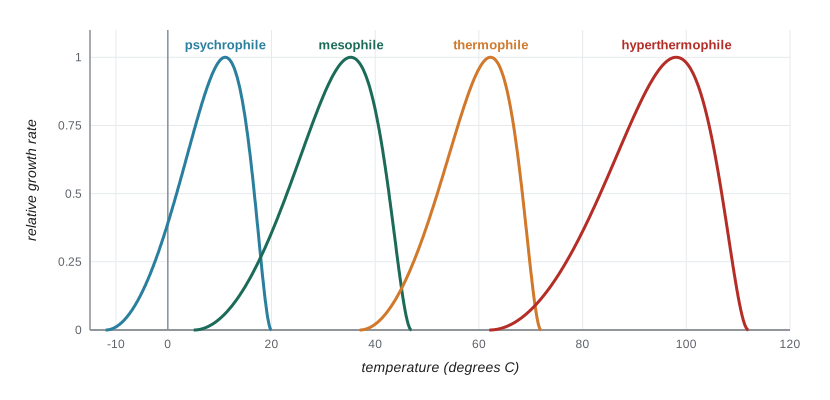
Adaptations to extreme temperatures are found at every level of the cell. Psychrophiles have membranes rich in unsaturated and short-chain fatty acids that stay fluid in the cold, enzymes with flexible active sites that work at low temperature, and cold-shock proteins and antifreeze proteins. Hyperthermophiles have enzymes stabilized by more ionic bonds and tightly packed hydrophobic cores, tetraether lipid monolayers in archaea (lesson 2), reverse gyrase, which adds positive supercoils to DNA, and high concentrations of compatible solutes that stabilize proteins. Their enzymes have practical uses: Taq polymerase, from the thermophile Thermus aquaticus isolated from Yellowstone hot springs, made the polymerase chain reaction practical (BIOL-207).
Microbiologists who need to predict growth at different temperatures, for example to estimate how quickly a food will spoil, often use the Ratkowsky square-root model. Below the optimum, the square root of the growth rate rises in a straight line with temperature:
where T_min is a notional minimum temperature found by extrapolating the line to zero growth. An extended form adds a term for the fall above the optimum. Lesson 11 uses the square-root model to estimate how fast Listeria grows in a refrigerator, which is the basis of shelf-life rules for ready-to-eat foods.
Acidity, water and salt
Most bacteria are neutrophiles that grow best between pH 6 and 8. Acidophiles grow below pH 5, and some extreme acidophiles, such as Picrophilus and the iron-oxidizing bacteria of acid mine drainage, grow at pH 1 or below. Alkaliphiles grow above pH 9 in soda lakes and are a source of enzymes for laundry detergents. Fungi generally tolerate more acid than bacteria, which is why molds rather than bacteria spoil fruit. Whatever the external pH, the internal pH of the cell stays close to neutral, maintained by pumping protons and by the low permeability of the membrane. Weak organic acids such as acetic, lactic, benzoic and sorbic acids preserve foods because their uncharged forms cross the membrane, dissociate in the neutral cytoplasm and release protons, forcing the cell to spend energy pumping them out.
Microbes also need available water. The relevant measure is water activity (a_w), the ratio of the vapor pressure of water above a solution to that above pure water. Pure water has a_w = 1.00, and adding salt or sugar lowers it. Most bacteria need a_w above about 0.91; Staphylococcus aureus tolerates down to about 0.86; most molds grow down to about 0.80, and xerophilic molds and osmophilic yeasts to about 0.61. That is why salting, drying, curing and making jam preserve food. Halophiles need salt: moderate halophiles such as many marine bacteria grow best at 1 to 15 percent NaCl, and extreme halophiles such as the archaeon Halobacterium need 15 to 30 percent. Organisms that live in salty or dry habitats balance the osmotic pressure by accumulating compatible solutes, such as glycine betaine, proline and trehalose, which raise internal osmolarity without disturbing enzymes; Halobacterium instead accumulates potassium chloride to molar concentrations and has acidic proteins that need it.
| Water activity | Example foods or environments | Organisms that can still grow |
|---|---|---|
| 0.98–1.00 | Fresh meat, fish, milk, vegetables | Almost all microbes |
| 0.93–0.98 | Bread, cooked sausages, cheeses | Most bacteria, yeasts and molds |
| 0.85–0.93 | Dry sausages, aged cheeses | Staphylococcus aureus, many yeasts and molds |
| 0.60–0.85 | Jams, flour, dried fruit, salted fish | Xerophilic molds, osmophilic yeasts, extreme halophiles |
| Below 0.60 | Dried pasta, crackers, milk powder | No growth, though spores and some cells survive |
Oxygen
Oxygen divides microbes into groups that every microbiologist must know, because they determine how specimens are collected, how organisms are cultured and where they cause disease. Obligate aerobes need O₂ for respiration. Obligate anaerobes are killed or inhibited by it. Facultative anaerobes, such as E. coli and yeast, respire with O₂ when it is present and switch to fermentation or anaerobic respiration when it is not, growing better with oxygen. Aerotolerant anaerobes, such as the lactic acid bacteria, never use O₂ but tolerate it. Microaerophiles, such as Campylobacter and Helicobacter, need oxygen but only at reduced concentrations, typically 2 to 10 percent.
The reason oxygen is toxic is chemical. When O₂ accepts electrons one at a time, as it does in side reactions of flavoproteins and other enzymes, it forms reactive oxygen species: superoxide (O₂⁻), hydrogen peroxide (H₂O₂) and, in the presence of iron, the hydroxyl radical, which damages DNA, proteins and lipids. Aerobes defend themselves with enzymes. Superoxide dismutase converts superoxide to hydrogen peroxide and oxygen, and catalase converts hydrogen peroxide to water and oxygen; some organisms use peroxidases instead of catalase. Obligate anaerobes typically lack these enzymes or have too little of them. The catalase test, in which a drop of hydrogen peroxide bubbles vigorously on catalase-positive colonies such as staphylococci but not on streptococci, is a standard identification step. The same chemistry is used against microbes: phagocytes kill bacteria partly by producing bursts of superoxide and hypochlorite (BIOL-380).
Anaerobes are cultured by excluding oxygen: in anaerobic jars or chambers filled with a hydrogen–carbon dioxide–nitrogen mixture and a catalyst that removes residual O₂, or in reducing media containing thioglycollate or cysteine. In a tube of thioglycollate broth, oxygen diffuses only into the top layer, so the position of growth reveals an organism’s oxygen class: obligate aerobes at the surface, obligate anaerobes at the bottom, facultative anaerobes throughout but densest at the top, aerotolerant anaerobes evenly throughout, and microaerophiles in a band just below the surface.
Pressure and radiation
Most of the ocean is deep and cold, and the organisms living there are adapted to high hydrostatic pressure. Piezotolerant organisms grow at high pressure but better at atmospheric pressure; piezophiles grow best at high pressure, and obligate piezophiles from the Mariana Trench, at over 1,000 atmospheres, will not grow at the surface at all. Radiation is a hazard rather than a habitat factor for most microbes. Ultraviolet light damages DNA by forming pyrimidine dimers, and ionizing radiation breaks DNA strands. Deinococcus radiodurans survives gamma doses thousands of times higher than a lethal human dose because it protects its proteins from oxidation with manganese complexes and reassembles its shattered chromosomes efficiently.
The language of microbial control
Precise terms matter in microbial control, because a process described with the wrong word may not do what people expect.
| Term | Meaning | Example |
|---|---|---|
| Sterilization | Destruction or removal of all microorganisms, including endospores and viruses | Autoclaving, dry heat, ethylene oxide, filtration of liquids through 0.22 µm filters |
| Disinfection | Destruction of most pathogens on inanimate objects, not necessarily spores | Bleach on bench tops; high-level disinfectants for some medical devices |
| Antisepsis | Reduction of microbes on living tissue | Chlorhexidine or alcohol on skin before an injection |
| Sanitization | Reduction of microbes to levels judged safe by public health standards | Dishwashing in restaurants |
| -cidal agent | Kills the target organism | Bactericide, fungicide, virucide, sporicide |
| -static agent | Inhibits growth without killing; growth resumes when the agent is removed | Refrigeration; bacteriostatic antibiotics |
Death is exponential: D-values
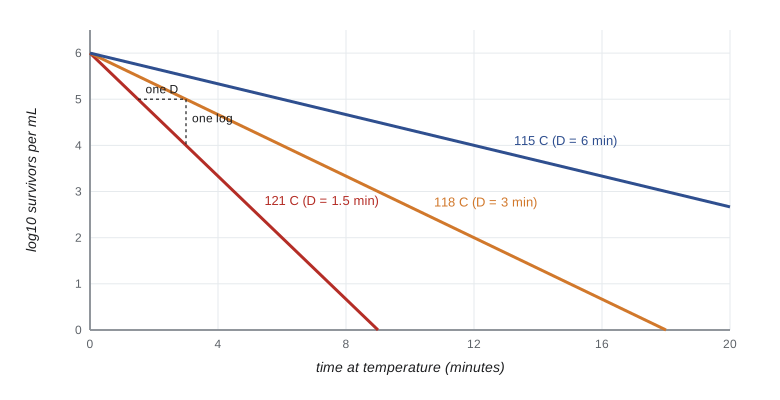
When a population of cells is exposed to a lethal agent such as moist heat, the cells do not all die at once. Under constant conditions, a constant fraction dies in each unit of time, so the number of survivors falls exponentially and a plot of log survivors against time is a straight line. The decimal reduction time, or D-value, is the time needed to kill 90 percent of the population, a one-log reduction, at a stated temperature:
D-values depend on the organism, its physiological state, the temperature and the medium; fat, protein and low water activity all protect cells. Vegetative bacteria typically have D-values of seconds to minutes at 65 to 70 °C. Spores are far more resistant: Clostridium botulinum type A spores have a D₁₂₁ (the D-value at 121 °C) of about 0.2 minutes, and Geobacillus stearothermophilus spores, used as biological indicators to test autoclaves, have a D₁₂₁ of about 1.5 to 2 minutes.
The exponential model has an important consequence: a heat treatment never reduces the expected number of survivors to exactly zero. It reduces it to a very small probability. Low-acid canned foods are processed to achieve a 12D reduction of C. botulinum spores, the botulinum cook, which would reduce a population of 10¹² spores per can to an expected one survivor, or one can in a billion containing a single spore if each starts with a thousand. Sterilization is likewise defined probabilistically for medical devices: a sterility assurance level of 10⁻⁶ means no more than a one-in-a-million chance that a single viable organism remains on a sterilized item.
import numpy as np

rng = np.random.default_rng(330)
# survivor data for spores held at constant temperature (invented, illustrative)
times = np.array([0, 2, 4, 6, 8, 10])                    # minutes
temps = {115: 6.0, 118: 3.0, 121: 1.5}                    # true D-values (min)
logN0 = 6.0
Dfit = {}
for T, Dtrue in temps.items():
    tt = times * (Dtrue / 3.0)                            # sample more often at higher T
    logN = logN0 - tt / Dtrue + rng.normal(0, 0.08, tt.size)
    slope, icept = np.polyfit(tt, logN, 1)
    Dfit[T] = -1 / slope
    print(f"T = {T} C: fitted D = {Dfit[T]:.2f} min  (log reduction after 15 min = {15/Dfit[T]:.1f})")
# z-value: temperature change for a ten-fold change in D
T = np.array(list(Dfit)); logD = np.log10(list(Dfit.values()))
s, b = np.polyfit(T, logD, 1)
print(f"z-value = {-1/s:.1f} C")T = 115 C: fitted D = 5.91 min (log reduction after 15 min = 2.5) T = 118 C: fitted D = 3.01 min (log reduction after 15 min = 5.0) T = 121 C: fitted D = 1.46 min (log reduction after 15 min = 10.3) z-value = 9.9 C
Plotting the logarithm of D against temperature also gives a straight line. Its slope defines the z-value, the temperature increase that reduces the D-value ten-fold. For bacterial spores in moist heat, z is typically about 10 °C; for vegetative cells it is usually 4 to 8 °C. The z-value lets processes at different temperatures be compared. The lethality of a process is expressed as an F-value, the equivalent number of minutes at a reference temperature; for canning, F₀ refers to 121.1 °C with z = 10 °C, so one minute at 111.1 °C contributes only 0.1 minutes of F₀. Because a can heats slowly from the outside in, food engineers integrate lethality over the measured temperature history at the slowest-heating point.
import numpy as np

# Temperature history at the cold spot of a can during processing (illustrative)
t = np.arange(0, 61, 1.0)                                # minutes
T = np.where(t < 30, 40 + (121 - 40) * (1 - np.exp(-t / 9)),   # heating
             121 - (121 - 40) * (1 - np.exp(-(t - 30) / 7)))   # cooling
T = np.minimum(T, 121.0)
z, Tref = 10.0, 121.1
L = 10 ** ((T - Tref) / z)                               # lethal rate, min at Tref per min
F0 = np.trapezoid(L, t) if hasattr(np, "trapezoid") else np.trapz(L, t)
print(f"peak cold-spot temperature = {T.max():.1f} C")
print(f"F0 = {F0:.1f} min")
print(f"log reduction of C. botulinum spores (D121 = 0.21 min) = {F0/0.21:.0f}")peak cold-spot temperature = 121.0 C F0 = 4.3 min log reduction of C. botulinum spores (D121 = 0.21 min) = 21
An F₀ of about 3 minutes is the conventional minimum for low-acid canned foods because it delivers roughly 12D for C. botulinum spores. Commercial processes usually exceed this to control heat-resistant spoilage organisms as well.
Heat in practice
Moist heat is the most widely used and reliable method of killing microbes, because water conducts heat efficiently and helps denature proteins. Boiling at 100 °C for a few minutes kills vegetative cells and most viruses but not spores. The autoclave, a pressure vessel filled with saturated steam, reaches 121 °C at about 1 atmosphere above atmospheric pressure, and a typical cycle holds that temperature for at least 15 minutes for small loads, longer for large or dense ones, which kills spores. Steam must reach every surface, so air must be removed from the chamber and the load. Autoclave performance is checked with chemical indicators, which change color when exposed to the right temperature, and with biological indicators containing G. stearothermophilus spores, which should fail to grow after a successful cycle. Dry heat is less efficient and needs higher temperatures, such as 160 to 170 °C for two hours, but suits glassware and materials that steam would damage.
Pasteurization uses milder heat to kill pathogens and reduce spoilage organisms without changing the taste and texture of a food much. It does not sterilize. For milk, the high-temperature short-time (HTST) process in the Pasteurized Milk Ordinance used across the United States heats milk to at least 161 °F (72 °C) for at least 15 seconds, followed by rapid cooling; ultra-high temperature (UHT) processing at about 135 to 150 °C for a few seconds, with aseptic packaging, gives shelf-stable milk. Pasteurization was designed around the most heat-resistant milk-borne pathogens of its time, Mycobacterium tuberculosis and Coxiella burnetii. The FDA bans interstate sale of raw milk for drinking, but states set their own rules for sales within their borders, and many allow them.
Low temperature, filtration and radiation
Refrigeration at 4 °C or below slows the growth of most pathogens and spoilage organisms but does not stop psychrotrophs such as Listeria, Yersinia enterocolitica and non-proteolytic C. botulinum. Freezing stops growth, and ice crystals kill some cells, but many survive for years, which is why microbiologists store cultures in freezers at −80 °C and in liquid nitrogen. Filtration through membranes with 0.22 µm or 0.2 µm pores removes bacteria from heat-sensitive liquids such as antibiotic solutions and tissue culture media; viruses pass through such filters and need much finer ones. High-efficiency particulate air (HEPA) filters remove at least 99.97 percent of 0.3 µm particles from air in biological safety cabinets and operating rooms. Ultraviolet light at about 260 nm, where DNA absorbs strongly, disinfects surfaces, air and water but penetrates poorly. Ionizing radiation from cobalt-60 or electron beams sterilizes disposable medical supplies, and food irradiation is permitted for specified foods in both Canada and the United States.
Chemical agents
Chemical disinfectants and antiseptics differ in their targets and in what they can kill. Alcohols (60 to 90 percent ethanol or isopropanol) denature proteins and dissolve membranes; they are rapid and effective against vegetative bacteria and enveloped viruses but not spores. Halogens such as chlorine (as hypochlorite) and iodine oxidize cell components; chlorine is the main disinfectant for drinking water, and at high concentrations bleach is sporicidal. Hydrogen peroxide and peracetic acid are oxidizers that become sporicidal at higher concentrations or as vapor. Quaternary ammonium compounds, cationic detergents that disrupt membranes, are common in hospital surface disinfectants but are weak against non-enveloped viruses, mycobacteria and spores. Glutaraldehyde and ortho-phthalaldehyde cross-link proteins and are used for high-level disinfection of heat-sensitive instruments such as endoscopes. Phenolics and chlorhexidine are used in antiseptics and hand washes.
Microbes differ in their resistance to chemical agents in a consistent order. From most to least resistant, the usual ranking is prions, bacterial endospores, mycobacteria, non-enveloped (hydrophilic) viruses such as norovirus, fungi, vegetative bacteria and enveloped viruses such as influenza and coronaviruses. Product labels state which organisms a disinfectant is approved against, and the required contact time; in a hospital, a product chosen for C. difficile or norovirus must be sporicidal or effective against non-enveloped viruses. The kinetics are the same as for heat: disinfection is expressed as a log reduction, and HSE-245 explains how log-reduction claims are read on product labels and how the regulators in each country approve them.
Worked problem
Designing a heat process
A liquid product contains up to 10³ spores per mL of a spoilage organism with D₁₂₁ = 1.0 minute and z = 10 °C. The product is filled in 100 mL bottles. The target is no more than one spoiled bottle in 10⁶. How long must it be held at 121 °C, and how long at 116 °C?
Show solution
- Each bottle starts with 10³ × 100 = 10⁵ spores.
- The target is an expected 10⁻⁶ survivors per bottle, so the process needs log(10⁵) − log(10⁻⁶) = 11 log reductions.
- At 121 °C, 11 × D₁₂₁ = 11 minutes.
- At 116 °C, 5 °C lower, D = 1.0 × 10^{5/10} ≈ 3.16 minutes, so the hold time is 11 × 3.16 ≈ 35 minutes.
Answer: About 11 minutes at 121 °C or 35 minutes at 116 °C, assuming the whole product is at that temperature. Real processes add time for heating and cooling and include a safety margin.
Common mistakes
MistakeThinking that refrigeration kills bacteria.
InsteadCold slows or stops growth but rarely kills, and psychrotrophs such as Listeria keep growing at 4 °C.
MistakeUsing sterilization and disinfection interchangeably.
InsteadSterilization removes all life including spores; disinfection kills most pathogens on objects but not necessarily spores.
MistakeAssuming a heat treatment either kills everything or nothing.
InsteadDeath is exponential; processes are designed to reach a target probability of survival, such as 12D or a sterility assurance level of 10⁻⁶.
MistakeComparing D-values measured at different temperatures directly.
InsteadConvert them to a common temperature with the z-value first.
MistakeRelying on alcohol to disinfect surfaces contaminated with spores or norovirus.
InsteadAlcohol is weak against spores and non-enveloped viruses; use a sporicidal or appropriately approved product with the labeled contact time.
MistakeAssuming all anaerobes are killed instantly by air.
InsteadTolerance varies widely; aerotolerant anaerobes are unaffected, and many obligate anaerobes survive brief exposure.
Summary and key terms
- Each organism has cardinal temperatures; the optimum lies near the maximum, and groups range from psychrophiles to hyperthermophiles growing above 100 °C.
- Most bacteria are neutrophiles; weak acids preserve foods by acidifying the cytoplasm, and low water activity from salt, sugar or drying stops growth.
- Oxygen classes reflect respiration and defenses against reactive oxygen species, such as superoxide dismutase and catalase.
- Thermal death is exponential: the D-value is the time for a one-log reduction, and the z-value is the temperature change for a ten-fold change in D.
- Low-acid canning targets 12D for C. botulinum (about F₀ = 3 minutes); autoclaving holds 121 °C for at least 15 minutes; pasteurization reduces but does not eliminate microbes.
- Filtration, radiation and chemical agents complete the toolkit; chemical resistance runs from prions and spores down to enveloped viruses.
- cardinal temperatures
- The minimum, optimum and maximum temperatures for an organism’s growth.
- psychrotroph
- An organism able to grow at refrigeration temperatures with an optimum above 20 °C.
- water activity
- The ratio of the vapor pressure of water over a substance to that over pure water.
- facultative anaerobe
- An organism that grows with or without oxygen, usually better with it.
- superoxide dismutase
- An enzyme that converts superoxide to hydrogen peroxide and oxygen.
- D-value
- The time at a given temperature needed to kill 90 percent of a population.
- z-value
- The temperature increase needed to reduce the D-value ten-fold.
- F-value
- The lethality of a process expressed as equivalent minutes at a reference temperature.
- sterility assurance level
- The probability that a single viable organism survives on a sterilized item, typically 10⁻⁶.
- pasteurization
- Mild heat treatment that kills pathogens and reduces spoilage organisms without sterilizing.
Practice problems
Work each problem on paper first, then reveal the answer to check.
Why is an organism’s optimum temperature closer to its maximum than its minimum?
Show answer
Protein denaturation above the optimum is rapid and cooperative, while reactions slow only gradually below it.
Name two adaptations of psychrophiles.
Show answer
Unsaturated, short-chain membrane fatty acids; flexible enzymes; cold-shock or antifreeze proteins.
Why does sorbic acid preserve food better at pH 4 than pH 7?
Show answer
More of it is in the uncharged form that crosses membranes and then releases protons inside the cell.
What enzymes give a positive catalase test, and what is seen?
Show answer
Catalase breaks down hydrogen peroxide, producing visible bubbles of oxygen.
A spore population falls from 10⁶ to 10² in 8 minutes at 121 °C. What is D₁₂₁?
Show answer
Four logs in 8 minutes, so D = 2 minutes.
If z = 10 °C and D₁₂₁ = 2 minutes, what is D₁₁₁?
Show answer
20 minutes.
How many minutes at 121 °C give a 12D process for spores with D₁₂₁ = 0.21 minutes?
Show answer
About 2.5 minutes.
What does a sterility assurance level of 10⁻⁶ mean?
Show answer
No more than a one-in-a-million chance that a viable organism survives on an item.
Why are 0.22 µm filters not used to remove viruses?
Show answer
Most viruses are much smaller than 0.22 µm and pass through.
Rank from most to least resistant to disinfectants: enveloped virus, endospore, mycobacterium.
Show answer
Endospore, mycobacterium, enveloped virus.
Lesson quiz · 5 questions
Score 60% or more to complete this lesson.
Create a free account to save your progress, take quizzes and earn a certificate.