
BAS-420 · Lesson 11 of 12 · 21 min
Service calls, reports and customer communication
▶ Video coming soon A video version of this lesson is on the way.
On Friday, November 13, after Prakash had re-clamped the coupling on room 108's reheat valve before 9:00, Callie wrote her first full service report. She sent the draft to Prakash at lunchtime. It came back with three pencil notes. Beside her paragraph about the trend analysis: "Gus will not read this. Put it in one sentence and attach the chart." Beside the list of what was checked: "Good. Keep." And at the bottom, where she had ended with the fix: "What does the college need to do next? Say it." The finished report was a page and a half, with one chart and two photographs. "Most people judge a service company by the report," Prakash said, "because the report is the only part of the work they see."
This lesson covers the parts of a service call that are not technical: taking the call, communicating on site, writing a report that the customer can use, explaining findings that are bad news or not your fault, and following up. It uses the room 108 report as a model.
The service call from start to finish
A service call has a shape, and each stage has its own communication.
| Stage | What happens | Communication |
|---|---|---|
| Intake | The call or work order arrives; urgency is judged | Get the symptom, location, contact, access and urgency; confirm when someone will come |
| Remote check | Trends, alarms, overrides and audit trail are read before travel | Tell the customer what you have already seen; ask about anything that changed |
| Arrival | Check in with the operator or contact; site rules and permits | Say what you plan to do and what it may affect |
| Diagnosis | The method from lesson 1 | Give updates if it takes longer than expected; ask before commanding or shutting down |
| Fix or temporary measure | Repair, adjust, or make safe pending parts or another trade | Agree any extra cost or shutdown before doing it |
| Verification | Prove the symptom is gone under the right conditions | Say how and when it will be confirmed |
| Report and close-out | Written report, change log, backups, overrides released | Explain findings, actions and recommendations; ask the customer to confirm |
| Follow-up | Check the trend after the next cold morning or busy day; quote further work | Tell the customer the result; send any quotation separately |
Intake sets up everything else. A good intake gets enough information to decide how urgent the call is and who should go. A boiler lockout in January, a freezestat trip or a server room overheating is urgent. A slightly warm office in spring is not. At Quillon, the service coordinator asks the same questions as lesson 1: what exactly is wrong, where, when, since when, and who noticed. The coordinator also asks about access (keys, escort, permits, roof access), safety (is anything leaking, smoking or tripping?) and who will be the contact on site.
Remote access makes the remote check possible on most of Quillon's sites. It is often the most valuable half hour of the call. Callie's room 108 investigation started on the front end before she left the shop. What she saw there, discharge air far above supply air with reheat at zero, told Prakash which tools and parts to take.
Communicating on site
On arrival, find the person responsible for the building, usually the chief operator or the facilities contact. At Harcastle that is often Nell Nakagawa; at Ninefield it is Ilona Vescovi's office or her building staff. Tell them what you plan to do, what it may affect, and how long you expect to take. If you need to shut anything down, command anything, or enter a tenant's space, ask first.
Keep the customer informed while you work, especially if the job grows. A call that was expected to take an hour and is still going after three needs an update, even if there is no answer yet. Updates should say what you have ruled out, what you are testing next, and when you expect to know more. "I have ruled out the sensor and the program; I am checking the valve itself next, and I should know within an hour" is more reassuring than silence, and it gives the customer the chance to say that the occupant has a meeting at 11:00.
Be careful with first impressions. In the first ten minutes of a call, it is tempting to say what you think the problem is. If you are wrong, you have to take it back, and the customer remembers the first answer. Say what you see and what you will test: "The box is heating air that it has not been asked to heat; I am going to look at the valve." Save the diagnosis for when you have proved it.
Talk to occupants with respect, even when the complaint turns out to have a simple cause. Someone who has been too hot for a week is not being difficult. Explain what you found in plain words, avoid jargon, and do not blame anyone in front of them, including the previous contractor, the operator or the occupant who taped a sheet of cardboard over a diffuser. Adaptations like that are evidence of the problem, not offenses.
Writing the service report
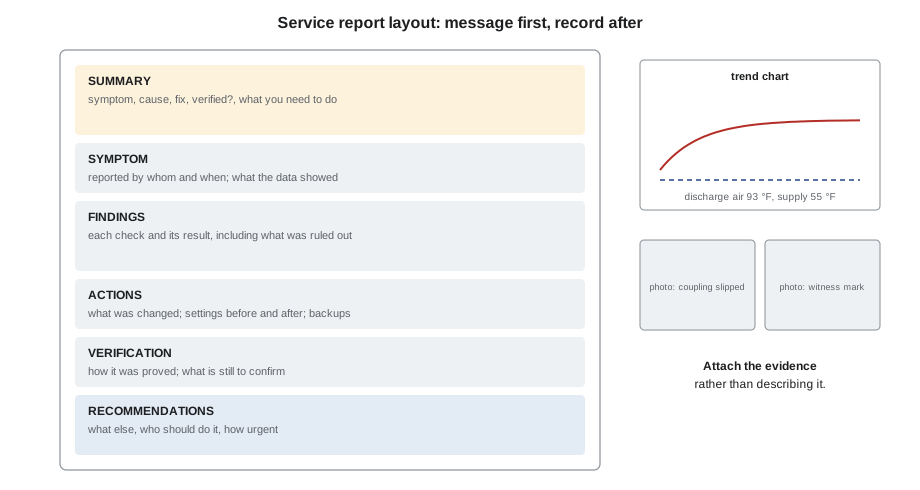
A service report is a record and a message. As a record, it tells the next technician exactly what was found and done. As a message, it tells the customer what happened to their building and what they need to do. The two readers want different things, so a good report puts the message first and the record after.
- Summary: two to four sentences in plain language. The symptom, the cause, the fix, whether it is verified, and anything the customer needs to do.
- Symptom: what was reported, by whom, and when, and what the data showed.
- Findings: what was checked and the result of each check, including what was ruled out. Readings with their times and conditions.
- Actions: what was changed, repaired or replaced, with part numbers, settings before and after, and backups taken.
- Verification: how the fix was proved, and what remains to be confirmed.
- Recommendations and open items: what else was noticed, what should be done, by whom, and how urgent it is.
- Attachments: one or two charts and photographs that show the problem and the fix.
SERVICE REPORT  Quillon Building Controls
Site: Harcastle College, Tilden Hall     Area: Room 108 (VAV-1-08)
Reported: Thu Nov 12, work order from facilities     Technicians: C. Rintoul, P. Deshmukh

SUMMARY
Room 108 was overheating because the reheat valve was stuck open: the
coupling between the actuator and the valve stem had slipped, so the valve
stayed open while the controls commanded it closed. The coupling was
re-clamped and marked on Fri Nov 13 before 9:00. The box maximum airflow,
which had been raised on Nov 11, was returned to design. Please see
recommendations 1 to 3.

FINDINGS
- Trend since Mon Nov 9: box at maximum cooling airflow, reheat command 0,
  discharge air about 93 F while AHU-1 supply air was 55 F.
- Zone sensor checked against reference thermometer: within tolerance.
- Program and priority array: no override; reheat command 0 at priority 16.
- Actuator traveled fully on command; valve stem did not move with it.
- Box maximum changed from 320 to 425 cfm on Wed Nov 11 (audit trail,
  operator account); reason not recorded.

ACTIONS
- Coupling re-clamped on the stem flat; witness mark added.
- Box maximum returned to design 320 cfm. Backup taken after change.

VERIFICATION
- Fri Nov 13: with reheat commanded 0, discharge air followed supply air.
- Trend left running; to be reviewed after next cold morning.

RECOMMENDATIONS
1. Fault rule VAV-REHEAT-LEAK (drafted Nov 12) to alarm on any box heating
   air with its valve closed. Proposal to follow.
2. Ask who raised the box maximum on Nov 11, so changes are recorded.
3. AHU-1 final filters are close to their alarm point; plan a change.
Look at what the report does and does not say. It does not explain how a thermistor works or describe the trend analysis in detail; it attaches the chart. It does say what was ruled out, because that saves the next technician from repeating the checks. It gives settings before and after. And it ends with what the college should do, which is the part Gus will act on.
Quantify where you can. A customer who reads that a valve was stuck open learns that something was wrong. A customer who reads how much energy it was wasting learns whether it mattered.
Worked problem
Putting a fault in the customer's terms
Callie's fault rule note estimated that a reheat valve stuck open at room 108's design airflow wastes about 6,000 kWh of heat a year. How much is that per day and per week, and how could the report use it?
Show solution
- Per day: 6,000 ÷ 365 = 16.4 kWh.
- Per week: 16.4 × 7 = 115 kWh.
- The fault had been present for at least the week before it was found, so roughly 115 kWh of heat had been added to a room that was already too hot, and then removed again by the cooling air.
Answer: About 16 kWh a day or 115 kWh a week for one box. The report can use the yearly figure to justify the fault rule: one leaking valve found in its first week instead of after a winter is worth far more than the rule costs to set up.
Explaining bad news and other people's problems
Many troubleshooting calls end with findings that the customer does not want to hear: the equipment is worn out, the fault is in somebody else's work, the fix needs a shutdown, or the real solution costs money. The way the news is delivered matters as much as the news.
- Lead with the facts and the evidence, not with blame. "The freezestat on AHU-2 is wired only to a BAS input, with a 15-minute delay, so it cannot stop the fan quickly enough to protect the coil" is a finding. "Whoever wired this did a terrible job" is not.
- Separate what is urgent from what is not. A safety problem gets fixed or made safe now, and the customer is told immediately and in person, as AHU-2's freezestat was rewired the same day in October. An energy problem can go in a proposal.
- Say clearly when the problem belongs to someone else, and give them what they need: "The chilled water temperature difference is low mainly because of three-way valves on the oldest air handlers; this is a mechanical change, and the trends are attached for your engineer."
- Offer options with their consequences, not just a single recommendation. The customer decides, and some will choose a cheaper or slower path for good reasons of their own.
- Do not hide a problem to keep the customer happy. A temporary setpoint change or override can be fine if it is agreed and recorded, but a hidden one becomes the next call, or one of the 14 overrides found at Tilden.
Some news is about your own company's work. If a fault traces back to something Quillon installed or programmed, say so plainly and fix it. The Marlow Lane commissioning file in BAS-410 is full of Quillon's own deficiencies found and fixed. Customers trust contractors who own their mistakes far more than contractors who never seem to make any.
Different customers, different reports
The same findings may need to reach several people in different forms.
| Reader | What they want | How to give it |
|---|---|---|
| Facilities manager (Gus) | What happened, whether it is fixed, what it costs, what they need to decide | The summary and recommendations; a quotation separately for extra work |
| Chief operator (Nell) | Exactly what was changed, how the system now behaves, what to watch for | Findings, settings before and after, and a walk-through on site |
| Property manager (Ilona) | Tenant impact, cost, schedule, any recovery from tenants or contractors | The summary, tenant-facing wording, and invoices that match the report |
| Occupant | Is it fixed, and what to do if it comes back | A short conversation or a note through the facilities contact |
| Next technician | Everything that was checked and changed, and the backups | The full report, change log and job folder |
Write the summary for the least technical reader who will act on it, and put the detail where the technical reader can find it. When the same call involves a tenant and a landlord, as many calls at Ninefield do, be careful with wording about cost and blame: a phrase such as "tenant contractor replaced a box controller with factory settings" is a fact that may decide who pays, so make sure it is correct and supported by evidence.
Closing the call and following up
Before leaving site, release every override you applied, put back every cover, take a backup if you changed anything in a controller, and check with the contact. Tell them what was done and what to watch for. If verification needs a cold morning or a full occupied day, say when you will check the trend and do it.
Follow-up is where repeat calls are prevented. Check the trend you left running. If the fix held, tell the customer and close the work order. If it did not, call before they do. Turn recommendations that need money into a proper quotation through the project manager, as Declan does for Quillon, rather than leaving them as a line in a report. Room 108's fault rule is now part of the proposal to Gus planned for early December.
Finally, feed what you learned back into the company. A fault that might exist on other sites, such as a replacement sensor with the wrong curve or an actuator coupling that slips, deserves a note to the rest of the service team. Quillon's practice of marking couplings, recording firmware with every backup, and testing every safety with the controller off all came from service calls like these.
Common mistakes
MistakeWriting the report as a story of everything you did, in order.
InsteadPut a plain summary first, then findings, actions, verification and recommendations; attach charts rather than describing them.
MistakeTelling the customer your first guess at the cause.
InsteadSay what you see and what you will test; give the diagnosis when you have proved it.
MistakeLeaving a recommendation that costs money as a line in the report.
InsteadTurn it into a quotation, and say in the report that one will follow.
MistakeBlaming a previous contractor or an occupant.
InsteadState the facts and evidence neutrally; the customer can draw their own conclusions.
Summary and key terms
- A service call runs from intake and remote check through arrival, diagnosis, fix, verification, report and follow-up, each with its own communication.
- Good intake gets the symptom, location, urgency, access, safety and contact; the remote check often points to the cause before travel.
- On site, say what you plan, ask before shutting down or commanding, update the customer if the job grows, and hold back the diagnosis until it is proved.
- A service report puts a plain summary first, then symptom, findings including what was ruled out, actions with before and after settings, verification and recommendations.
- Quantify faults in the customer's terms, such as energy wasted.
- Deliver bad news with facts, urgency, ownership and options; own your company's mistakes.
- Match the form of the report to each reader, release overrides before leaving, and follow up on verification and recommendations.
- Service report
- A written record of a service call, with a plain summary for the customer and detail for the next technician.
- Intake
- Taking the first details of a service call to judge urgency and plan the visit.
- Remote check
- Reading trends, alarms, overrides and the audit trail before traveling to site.
- Temporary measure
- An agreed, recorded action that makes a system safe or usable until the real fix is done.
- Follow-up
- Checking after the call that the fix held, and turning recommendations into quotations.
Practice problems
Work each problem on paper first, then reveal the answer to check.
What should the first paragraph of a service report contain?
Show answer
A plain summary of the symptom, the cause, the fix, whether it is verified, and anything the customer needs to do.
You find a safety problem, such as a freezestat that cannot stop its fan. How should you communicate it?
Show answer
Tell the responsible person immediately and in person, make it safe or fix it with their agreement, and record it in the report as urgent.
Why list what was ruled out in the findings?
Show answer
So the next technician does not repeat the checks, and so the customer can see the diagnosis was thorough.
Lesson quiz · 5 questions
Score 60% or more to complete this lesson.
Create a free account to save your progress, take quizzes and earn a certificate.