
BAS-210 · Lesson 2 of 12 · 21 min
Unitary, application-specific and programmable controllers
▶ Video coming soon A video version of this lesson is on the way.
On Monday, September 21, Prakash took Callie to Ninefield Tower to show her a whole controls system from top to bottom. Ilona Vescovi, the property manager, met them in the lobby with a ring of keys and a warning that the seventh floor tenants were in a mood about temperatures again. They started in the building operator's office with the front-end workstation, went up to the penthouse mechanical room where the central air handlers lived, opened a ceiling tile on the fourth floor to look at a variable air volume box, and ended on the podium roof beside the four rooftop units. At each stop Prakash asked Callie the same question: what kind of controller is this, and why was it chosen?
Building controllers come in a range of sizes and abilities. At one end is a small controller sold to run one kind of equipment, with its program fixed at the factory and only a few settings to adjust. At the other is a fully programmable controller that can run any sequence the controls contractor writes, with dozens of inputs and outputs and the power to coordinate other controllers. Most buildings use several kinds together. This lesson explains the categories, the names manufacturers and BACnet give them, and how a technician recognizes and works with each.
A typical system architecture
A building automation system is usually arranged in layers. At the top is the operator interface: a workstation, a web server or a cloud service where people view graphics, acknowledge alarms and change schedules. Below that are supervisory controllers, sometimes called network controllers, building controllers or engines, which collect data from the controllers below them, store trends and alarms, run building-wide schedules and pass information between networks. Below those are the field-level controllers that actually read sensors and drive equipment: plant controllers for chillers, boilers and air handlers, and smaller controllers on terminal units such as variable air volume boxes, fan coils and heat pumps.
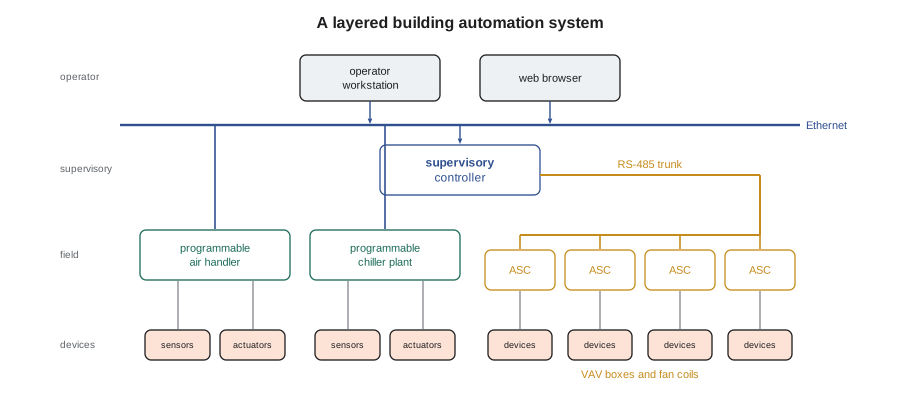
At Ninefield, the layers were easy to see. The front end was a server in the operator's office, reached through a web browser. A supervisory controller in the penthouse connected to the building Ethernet network and to three RS-485 trunks. Two programmable controllers in the penthouse ran the chilled water plant and the four central air handlers. The roughly 140 variable air volume boxes on the office floors each had a small controller on an RS-485 trunk. The podium rooftop units had their own controllers, of different ages, and that was the subject of Callie's last stop.
Unitary controllers
A unitary controller is a controller made to run one unit of equipment, such as a rooftop unit, a heat pump or a fan coil. The word comes from the equipment industry, where a packaged unit is called unitary equipment. Many unitary controllers are supplied by the equipment manufacturer and fitted at the factory; others are sold by controls manufacturers to fit standard units in the field. They have just enough inputs and outputs for the unit: for a rooftop unit, typically a discharge air sensor, a space or return sensor, fan and compressor and heat stage outputs, an economizer damper output and a few status inputs.
Some unitary controllers are little more than a networked thermostat with a few extra inputs. Others are full controllers with a fixed program. Either way, their main limitation is that the sequence is what the manufacturer wrote. A technician can change setpoints, delays and options from a list, but cannot add a new feature that the program does not have. For standard equipment that is usually a strength: the program has been tested on thousands of units, and every unit in a building behaves the same way.
Application-specific controllers
An application-specific controller, often shortened to ASC, is a controller with a fixed or selectable program written for one application: a pressure-independent variable air volume box with hot water reheat, a two-pipe fan coil, a unit ventilator, a water source heat pump. The term is used for controls-manufacturer products as well as factory-fitted ones, and it overlaps with unitary. The key idea is the same: the controller arrives knowing how to run that kind of equipment. The technician selects the application, sets the box size, airflow limits, setpoints and network address, and the controller is ready.
On the fourth floor, Prakash lifted a ceiling tile next to the elevator lobby and showed Callie a variable air volume box with a controller mounted on its side. The controller had a built-in damper actuator that clamped onto the damper shaft, a built-in airflow sensor with two tubes running to the flow pickup in the inlet, a few inputs for the room sensor and discharge air sensor, and an output for the reheat valve. Its whole program was selected from a menu: cooling only, cooling with reheat, fan-powered series or parallel. "There are a hundred and forty of these in the building," Prakash said. "Imagine writing a custom program for each one." ASCs keep terminal units cheap, consistent and quick to commission.
| Kind | Program | Typical use | Strength | Limitation |
|---|---|---|---|---|
| Unitary or factory-fitted | Fixed by the equipment or controls maker | Rooftop units, heat pumps, fan coils | Tested, cheap, consistent | Only the features the maker wrote |
| Application-specific (ASC) | Selected from a library of applications | VAV boxes, fan coils, unit ventilators | Fast to set up, many identical units | Limited inputs and outputs, fixed logic |
| Programmable field controller | Written by the controls contractor | Air handlers, plants, special equipment | Any sequence can be written | Needs programming, documentation and backups |
| Supervisory controller | Coordination, trends, alarms, schedules | Building or network level | Ties the system together | Usually controls little directly |
Programmable controllers
A programmable controller, sometimes called a general-purpose or custom application controller, can run any sequence the controls programmer writes. It has more inputs and outputs, often expandable with modules, and is programmed with the manufacturer's tool in a graphical block language, a line language or both, as BAS-220 will cover. Programmable controllers run air handlers, chilled water and heating plants, and anything unusual: a laboratory exhaust system, a snow-melt system, a process cooling loop. Their strength is flexibility. Their cost is that every program is a one-off that must be written, tested, documented and backed up, and the next technician must be able to read it.
In the penthouse, the air handler controller was a programmable controller with a base unit and two expansion modules clipped beside it on the rail. Sophie Aubertin had written its program in 2022 when Quillon took over the building, replacing a sequence nobody could explain. Prakash opened the program on his laptop for a moment to show Callie the scale of it: forty-one inputs and outputs, eighteen control loops and several pages of start-up, shutdown and alarm logic. "An ASC is a form you fill in," he said. "This is a book somebody wrote. Treat it with respect, and never change it without a backup."
Supervisory controllers
Supervisory controllers sit above the field controllers. They may control a few points of their own, but their main jobs are to collect and store trends, route alarms, run building-wide schedules and calculations such as outdoor air temperature sharing, host graphics or pass data to a front-end server, and route messages between networks, for example from Ethernet to RS-485 trunks. Different manufacturers give them different names: network controller, building controller, engine, router, gateway or automation server. On many current systems, the supervisory controller is itself a small server with a web interface.
Callie noticed that the Ninefield supervisory controller was from a different manufacturer than the air handler controllers. Prakash explained that this was common and possible because both spoke BACnet, the open communication protocol covered in BAS-310. Open protocols allow a building owner to mix controllers from several manufacturers, or change contractors, without replacing everything. They do not guarantee that every feature of one product can be used from another, which is why integration takes care.
BACnet device profiles
BACnet, the protocol used by most new building controllers in North America, sorts devices into standard profiles that describe what each kind of device is able to do. The names appear on data sheets and in specifications, so a technician needs to recognize them. The profiles are defined in the BACnet standard and its testing programs, and they are updated from time to time, so the current list is worth checking when reading a specification.
| Profile | Name | What it is |
|---|---|---|
| B-OWS | BACnet Operator Workstation | The operator's software for graphics, alarms and changes |
| B-BC | BACnet Building Controller | A general-purpose, often supervisory, controller with scheduling, trending and alarming |
| B-AAC | BACnet Advanced Application Controller | A programmable or flexible field controller |
| B-ASC | BACnet Application Specific Controller | A controller with a limited, mostly fixed application |
| B-SA and B-SS | Smart actuator and smart sensor | A single actuator or sensor that talks BACnet itself |
A specification might say, for example, that air handler controllers shall be B-AAC or better and that terminal unit controllers may be B-ASC. That tells the contractor how capable each controller must be. Testing laboratories run conformance testing against these profiles, and a listing shows that a product has been tested. BAS-310 explains the objects and services that make up each profile.
Choosing the right kind
Choosing a controller is usually the controls designer's job, but a technician who understands the choices installs and services them better. The questions are practical. How many inputs and outputs does the equipment need, with spares for changes? Is the sequence standard, or does it need custom logic? Will there be many identical units, where an ASC saves time, or one important piece of equipment, where a programmable controller is worth the effort? Does the specification require a particular profile, protocol or manufacturer? Will the building's operators and future contractors be able to support it?
Worked problem
Counting points for a controller
A rooftop unit retrofit needs these points: discharge air temperature, return air temperature, mixed air temperature, outdoor air temperature from the network, space temperature from a wall sensor, supply fan status, filter status, smoke detector shutdown status, supply fan start, two compressor stages, two heat stages and an economizer damper output. The designer wants at least 20 in 100 spare physical points. How many physical inputs and outputs are needed?
Show solution
- Physical inputs: discharge, return, mixed and space temperature (4), fan status, filter status and smoke status (3), so 7 inputs. Outdoor air comes over the network and needs no input.
- Physical outputs: fan start, two compressor stages and two heat stages (5 binary) plus the economizer (1 analog), so 6 outputs.
- Total physical points: 7 + 6 = 13.
- With 20 in 100 spare: 13 × 1.2 = 15.6, so at least 16 points.
Answer: At least 16 physical points, for example a controller with 10 universal inputs and 6 or more outputs. Lesson 12 uses a controller of this size on Ninefield RTU-1.
The rooftop units
The last stop was the podium roof. The four rooftop units, RTU-1 to RTU-4, served the shops and the lobby. Each had a unitary controller fitted when the units were replaced in 2004, connected to the supervisory controller through a protocol converter that translated their old proprietary protocol into BACnet. RTU-1's controller had failed in August, and the unit was running on a temporary thermostat that Quillon's service technician had wired in so the shops would have heat and cooling. The other three still worked, but spare parts were no longer made.
Declan Kilbride had quoted replacing all four with programmable controllers on a BACnet MS/TP trunk, which would remove the protocol converter and let Sophie write one tested program for all four units. Ilona had approved RTU-1 at once, because it had failed, and the other three to be done in December alongside the damper actuator work Callie had seen booked. "This is your project to follow," Prakash said. "By the end of this course, you'll have built the panel, wired it and checked it out." That work is the thread through the lessons that follow.
Reading a controller data sheet
Whatever kind of controller is chosen, its data sheet is the technician's first reference. A typical data sheet lists the number and kind of inputs and outputs and what each can be configured for, the power supply voltage and consumption in volt-amperes, the communication ports and protocols, the BACnet profile and any testing listing, the operating temperature and humidity ranges, the dimensions and mounting method, and the agency listings for safety. Callie started a habit of printing the data sheet for every controller she worked on and highlighting the three numbers she was most likely to need on site: the power draw, the output ratings and the operating temperature range.
Common mistakes
MistakeTreating every controller as programmable.
InsteadMany terminal unit controllers have fixed applications; adjust them through their settings, not by trying to write logic.
MistakeAssuming two BACnet devices can share every feature.
InsteadOpen protocols make data exchange possible; check what each device supports before relying on a feature.
MistakeChoosing a controller with no spare points.
InsteadAllow spares, commonly around 20 in 100, for changes and added sensors.
MistakeChanging a custom program without a backup.
InsteadProgrammable controllers hold one-off programs; back up before every change.
MistakeIgnoring the profile in a specification.
InsteadA required profile such as B-AAC sets the minimum capability of the controller to be supplied.
Summary and key terms
- Building automation systems are layered: operator interface, supervisory controllers, field controllers and field devices.
- Unitary controllers run one unit of packaged equipment, often with a fixed program.
- Application-specific controllers run a selected standard application, such as a VAV box, and are quick to set up in large numbers.
- Programmable controllers run custom sequences for air handlers, plants and special equipment, and need careful documentation and backups.
- Supervisory controllers collect data, store trends and alarms, run schedules and connect networks.
- BACnet device profiles such as B-BC, B-AAC and B-ASC describe a device's capability and appear in specifications.
- Controller choice depends on points, sequence, number of units, specification and long-term support.
- Unitary controller
- A controller made to run one unit of packaged equipment.
- Application-specific controller
- A controller that runs a fixed or selectable standard application.
- Programmable controller
- A controller that runs a sequence written by the controls contractor.
- Supervisory controller
- A controller that coordinates others, stores trends and alarms and connects networks.
- Expansion module
- An add-on that gives a controller more inputs and outputs.
- Protocol converter
- A device that translates one communication protocol into another.
- Device profile
- A standard description of what a class of BACnet device can do.
- Open protocol
- A published communication standard that products from many manufacturers can use.
Practice problems
Work each problem on paper first, then reveal the answer to check.
What kind of controller is usually fitted to a VAV box?
Show answer
An application-specific controller with a selectable VAV application.
What does B-AAC stand for?
Show answer
BACnet Advanced Application Controller.
Name three jobs of a supervisory controller.
Show answer
Any three of: storing trends, routing alarms, running schedules, sharing values, hosting graphics, routing between networks.
A unit needs 9 inputs and 6 outputs. How many points with 20 in 100 spare?
Show answer
15 × 1.2 = 18 points.
Why did Declan propose programmable controllers for all four Ninefield rooftop units?
Show answer
To remove the protocol converter, replace unsupported controllers and run one tested program on all four.
Lesson quiz · 5 questions
Score 60% or more to complete this lesson.
Create a free account to save your progress, take quizzes and earn a certificate.