
BAS-210 · Lesson 10 of 12 · 24 min
Controller networks: trunks, addressing and termination
▶ Video coming soon A video version of this lesson is on the way.
In the afternoon of Monday, September 21, after the morning tour that lesson 2 described, Ilona Vescovi caught Prakash and Callie at the elevator. The seventh-floor tenants were complaining again: some offices too warm, some too cold, and the front end showing two or three of the floor's variable air volume box controllers offline at different times each day. It had started in July, after a tenant fit-out contractor had moved some walls and replaced one box controller. Prakash looked at Callie. "This one's yours," he said. "Networks. Let's go and find it." This lesson covers how controllers are connected into networks, with most of it on the RS-485 trunks that still connect most terminal unit controllers, and a shorter look at Ethernet.
Why controllers are networked
A controller can run its own equipment alone, but a building system needs controllers to share information. Terminal unit controllers need the air handler's status and the outdoor air temperature. The air handler needs to know how many zones are calling for cooling, to reset its supply air temperature. The supervisory controller needs every controller's alarms and trends, and operators need to change setpoints and schedules from one place. The network carries all of this. When it fails, controllers usually carry on with their last values and default settings, but the building loses coordination, and the front end shows controllers offline, as Ninefield's seventh floor did.
BACnet, the protocol most new systems use, can run over several kinds of network. The two a technician meets most are BACnet MS/TP over an RS-485 trunk, used for terminal unit and smaller controllers, and BACnet/IP over Ethernet, used for supervisory controllers, plant controllers and increasingly for everything. Many systems also include Modbus RTU on RS-485 for meters and drives, and some older systems use other protocols. BAS-310 covers the protocols themselves. This lesson is about the wiring and settings that let them work.
RS-485 basics
RS-485 is an electrical standard for sending data over a twisted pair of wires. The two wires, often marked plus and minus or A and B, carry the signal as a difference in voltage between them, which is why RS-485 is called differential. Interference picked up along the cable affects both wires almost equally and cancels out at the receiver, so RS-485 works over long distances in noisy buildings. Many devices also have a reference or common terminal, connected through a third conductor so that all devices share a reference voltage. The cable is usually shielded twisted pair with a characteristic impedance of around 100 to 130 ohms, as the controller makers specify.
Many devices share one pair of wires. Only one device talks at a time; the others listen. In BACnet MS/TP, the devices take turns by passing a token from one master device to the next: the device holding the token may send messages, then passes the token on. In Modbus RTU, one master polls each slave device in turn. Either way, every device on the trunk must use the same baud rate, the same wiring polarity and a unique address.
Daisy chain topology
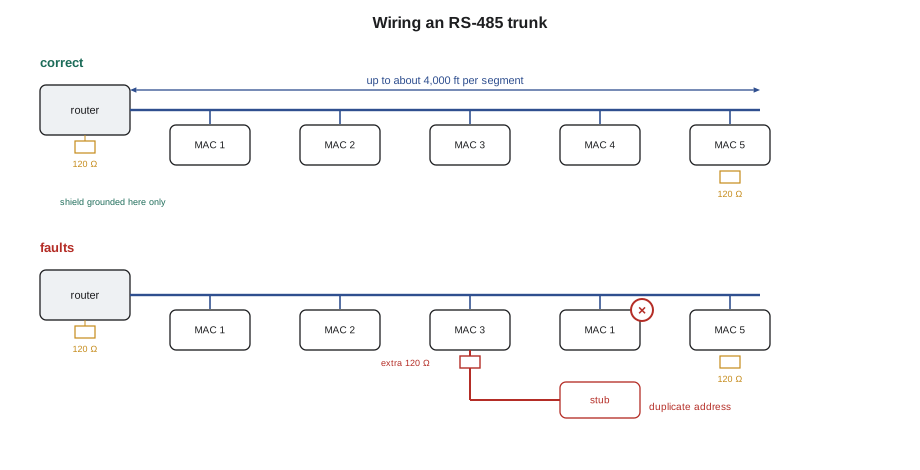
An RS-485 trunk must be wired as a daisy chain: a single line that runs from the first device to the second, from the second to the third and so on, ending at the last device. Each device has the trunk coming in and going out on the same terminals, or on a pair of linked terminals. Stars, where several cables run out from one point, and long stubs, where a cable branches off the trunk to reach one device, are not allowed, because each branch reflects part of the signal back along the cable and corrupts the data. Short connections from the trunk to a device's terminals are fine; the rule is that the trunk itself must not branch.
Termination and bias
At high data rates, a signal reaching the end of a cable reflects back unless the cable is terminated with a resistor equal to its characteristic impedance. On RS-485 trunks, a terminating resistor of about 120 ohms is fitted across the pair at each of the two physical ends of the trunk, and only there. Many controllers and routers have a built-in terminator switched on by a jumper, a DIP switch or software. A terminator in the middle of the trunk, or a missing one at an end, distorts the signal. On short, slow trunks a mistake may go unnoticed; on long or fast trunks it causes intermittent errors.
Bias resistors hold the pair at a known idle state when no device is talking, so that receivers do not read noise as data. Bias is applied at one point on the trunk, usually at the router or a designated master device, as the system design states. Too little bias causes errors on idle trunks; bias applied at many devices can load the trunk. A technician needs to know where the bias and terminators are on every trunk, which is why they belong on the as-built riser diagram.
Worked problem
Finding terminators with a meter
With the trunk powered down and all devices connected, the resistance between the plus and minus wires is measured. Each terminator is 120 ohms. What reading is expected with two terminators, and what would three give?
Show solution
- Two 120 ohm resistors in parallel: 120 ÷ 2 = 60 ohms.
- Three in parallel: 120 ÷ 3 = 40 ohms.
- One alone: 120 ohms; none: a high reading, set by the devices' input circuits.
Answer: About 60 ohms is correct. About 40 ohms means a third terminator is switched on somewhere, and about 120 ohms means one end is unterminated.
Unit loads and length
Each device on an RS-485 trunk loads the line a little. The standard describes this in unit loads: a standard RS-485 driver can handle 32 unit loads. Older transceivers count as one unit load each, so a trunk was limited to 32 devices. Many current controllers use transceivers rated as a half, a quarter or an eighth of a unit load, so more devices can be connected electrically. In practice, manufacturers and designers usually limit the number of devices on one MS/TP trunk well below the electrical limit, often to a few dozen, because every device adds to the time taken to pass the token around, and a crowded trunk is slow. Repeaters can extend a trunk or add a segment, and a router can split a busy floor into two networks.
Length is limited too. The BACnet standard recommends a maximum segment length of about 4,000 ft on suitable 18 AWG shielded twisted pair, and manufacturers give their own limits for each baud rate. Faster baud rates generally need shorter runs. Common MS/TP baud rates are 9,600, 19,200, 38,400 and 76,800 bits per second, and every device on a trunk must be set to the same one.
Worked problem
Checking a trunk's load and length
Ninefield's seventh-floor trunk has a router counting as one unit load and 22 VAV controllers at a quarter of a unit load each. Its measured length is about 1,250 ft. Is it within the 32 unit load limit and the recommended segment length?
Show solution
- Load: 1 + 22 × 0.25 = 6.5 unit loads, well under 32.
- Length: 1,250 ft against a recommended maximum of about 4,000 ft.
Answer: Both well within limits. The seventh-floor problem was not the trunk's size.
Addresses
Every device on an MS/TP trunk has a MAC address, a number from 0 to 254 that identifies it on that trunk. Addresses 0 to 127 are for master devices, which take part in token passing; 128 to 254 are for slave devices, which only answer when asked; 255 is reserved for broadcasts. Most controllers are masters. Each master has a Max Master setting, the highest master address it will look for when passing the token. Setting Max Master just above the highest address actually used saves the time otherwise spent polling for masters that do not exist. Addresses are usually set with DIP switches, rotary switches or software. Two devices with the same address on one trunk is a classic fault: both answer, the messages collide, and both, and often their neighbors, drop offline intermittently.
The MAC address only identifies a device on its own trunk. Every BACnet device also has a device instance, a number unique across the whole building network, by which the supervisory controller and front end know it. The two must not be confused: a controller can be MAC address 12 on the seventh-floor trunk and device instance 107012, following the site's numbering plan. Lesson 12 and BAS-310 return to numbering plans. Quillon's plan for Ninefield gave each floor's trunk a network number and each device an instance of 100,000, plus 1,000 times the floor, plus the MAC address, so that the instance told a technician where to find the device.
| Setting | Scope | Typical range | Must be |
|---|---|---|---|
| MAC address | One MS/TP trunk | 0 to 127 masters, 128 to 254 slaves | Unique on the trunk |
| Max Master | Each master device | Up to 127 | At or above the highest master address in use |
| Baud rate | Whole trunk | 9,600 to 76,800, sometimes higher | The same on every device |
| Device instance | Whole BACnet internetwork | 0 to about 4.19 million | Unique in the building, following the plan |
| Network number | Each trunk or IP network | Set by the router configuration | Unique, following the plan |
Shields and reference
The cable shield drains interference to ground. It should be continuous along the trunk, joined through at each device, and grounded at one point only, usually at the router or the end where the trunk starts, for the reasons lesson 3 explained. Grounding the shield at every device creates ground loops that inject noise. Where the devices use a reference terminal, the third conductor connects the reference of every device so that their signal levels agree. Some makers use the shield as the reference; most specify a separate conductor. The installation guide for the controllers is the authority.
Finding the seventh-floor fault
Callie started at the front end. The trend of each controller's online status showed that three controllers near the east end of the floor dropped out most often, always within a few minutes of one another. She printed the trunk's riser diagram from the job archive, which showed a daisy chain of 22 controllers with the router in the floor's electrical room at one end and controller VAV-7-22 at the far end with its terminator switched on. Then she went up into the ceiling with a ladder and a flashlight.
She found three problems. The box controller the fit-out contractor had replaced, VAV-7-14, had come out of its box with its MAC address at the factory default of 3, which was already used by VAV-7-03 at the other end of the floor. Its built-in terminator was switched on, so the trunk had three terminators. And to reach a new office, the contractor had added a new box and wired its controller as a stub, a branch about 40 ft long from VAV-7-15, instead of running the trunk through it. With the trunk powered down, her meter read 41 ohms between plus and minus, which matched three terminators in parallel.
With Prakash watching, Callie set VAV-7-14 to its correct address of 14 from the riser diagram, switched off its terminator and set its Max Master to match the others. Then she rewired the new box into the chain, so that the trunk ran from VAV-7-15 to the new box and back toward VAV-7-16, removing the stub, and gave the new controller the next free address, 23, and a device instance from the plan. The meter now read 61 ohms. Back at the front end, all 23 controllers were online, and they stayed online through the next week. Ilona's seventh-floor complaints dropped away as the boxes went back to working with fresh information from the air handler.
Callie updated the riser diagram to show the new controller, its address and the final terminator positions, took backups of the two controllers she had changed as lesson 9 required, and wrote a note to Declan suggesting that Ninefield's lease rules should require fit-out contractors to coordinate with Quillon before touching the controls. "Three faults, one cause," Prakash said. "Nobody gave the fit-out contractor the riser diagram."
Ethernet and BACnet/IP
Supervisory controllers, plant controllers and many newer field controllers connect over Ethernet using BACnet/IP or another IP protocol. Ethernet differs from RS-485 in almost every way that matters to the installer. It is wired as a star from network switches, each device on its own cable, with copper runs limited to about 328 ft from the switch. Each device needs an IP address, a subnet mask and usually a gateway, set statically or assigned by the network, and BACnet/IP normally uses UDP port 47808. Building controls Ethernet is often a separate network or a segregated virtual network on the owner's infrastructure, managed with the owner's IT department, which controls addressing, switches and security policy. BAS-310 covers routers and BBMDs, the devices that carry BACnet between IP subnets, and the program's cybersecurity course covers how to protect these networks.
| Feature | RS-485 trunk (MS/TP) | Ethernet (BACnet/IP) |
|---|---|---|
| Topology | Daisy chain, no stubs | Star from switches |
| Length | About 4,000 ft per segment, less at high baud | About 328 ft per copper run |
| Speed | 9,600 to 76,800 bits per second typical | 10 to 1,000 million bits per second |
| Addressing | MAC 0 to 254 set at each device | IP address, mask and gateway |
| Termination | 120 ohm resistors at both ends | Not needed |
| Who manages it | Controls contractor | Controls contractor with the owner's IT department |
Common mistakes
MistakeWiring an RS-485 trunk as a star or with stubs.
InsteadRun a single daisy chain from end to end; take the trunk through each device.
MistakeLeaving terminators switched on at middle devices.
InsteadTerminate only at the two physical ends; measure about 60 ohms with power off.
MistakeInstalling a replacement controller at its default address.
InsteadSet the address from the riser diagram before connecting it to the trunk.
MistakeGrounding the shield at every device.
InsteadKeep the shield continuous and ground it at one point only.
MistakeConfusing the MAC address with the device instance.
InsteadThe MAC is unique on the trunk; the device instance is unique in the whole building.
Summary and key terms
- Controllers share data over networks: MS/TP on RS-485 trunks for smaller controllers and BACnet/IP on Ethernet for larger ones.
- RS-485 is a differential twisted-pair signal that many devices share, taking turns to talk.
- Trunks must be daisy chains with no stars or stubs.
- Terminate with about 120 ohms at both ends only; bias at one point; check with a resistance reading of about 60 ohms.
- Unit loads, length and baud rate limit a trunk; designers keep device counts well below the electrical limit.
- Each MS/TP device needs a unique MAC address on its trunk, a suitable Max Master setting and a unique device instance in the building.
- Ethernet runs in a star from switches, with IP addressing managed with the owner's IT department.
- RS-485
- A differential, multi-drop electrical standard for data over twisted pair.
- MS/TP
- Master-slave/token-passing, the BACnet data link used on RS-485 trunks.
- Daisy chain
- A wiring arrangement running from one device to the next in a single line.
- Stub
- A branch off a trunk to a device, which reflects signals on RS-485.
- Terminating resistor
- A resistor of about 120 ohms across the pair at each end of a trunk.
- Bias
- Resistors that hold an idle RS-485 trunk at a known state.
- Unit load
- The RS-485 measure of how much a device loads the line.
- MAC address
- The address that identifies a device on its own MS/TP trunk.
- Max Master
- The highest master address a device will poll for when passing the token.
- Baud rate
- The signaling speed of a trunk in bits per second.
Practice problems
Work each problem on paper first, then reveal the answer to check.
With power off, a trunk measures 120 ohms between plus and minus. What is wrong?
Show answer
Only one terminator is in place; one end is unterminated.
A trunk has a router at 1 unit load and 30 controllers at an eighth of a unit load. What is the total?
Show answer
1 + 30 × 0.125 = 4.75 unit loads.
What MAC address range is for MS/TP masters?
Show answer
0 to 127.
Why set Max Master just above the highest address in use?
Show answer
To avoid wasting time polling for masters that do not exist.
What three faults did Callie find on the seventh floor?
Show answer
A duplicate address, an extra terminator in the middle and a stub to a new controller.
Lesson quiz · 5 questions
Score 60% or more to complete this lesson.
Create a free account to save your progress, take quizzes and earn a certificate.