
BAR-250 · Lesson 7 of 12 · 21 min
Wisconsin courts and civil procedure
▶ Video coming soon A video version of this lesson is on the way.
Priscilla Heidemann handed Selby a file on her first Monday in September: a rear-end collision on Highway 53, a client with a neck injury, and an insurer that had stopped returning calls. 'Draft the summons and complaint,' Priscilla said. 'Then tell me when we have to serve them, when the answer is due and where we are likely to end up if this goes to appeal.' Selby, fresh from a Minnesota law school, realized she knew the federal rules well and the Wisconsin rules barely at all.
Hollis used the file to frame the seventh session. 'The UBE tests federal civil procedure,' she said. 'Your clients will mostly be in circuit court. The structure of the courts and a handful of Wisconsin procedure rules are what you need on day one of practice.'
This lesson surveys the Wisconsin court system and the civil procedure rules a new Wisconsin lawyer meets first. It is a preview, not a treatise. The Wisconsin Statutes, chapters 801 to 847, contain the rules of civil procedure, and the circuit courts' local rules add details.
The courts
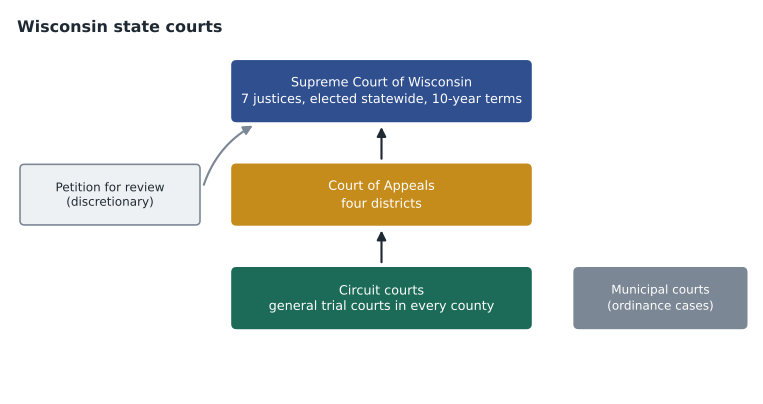
Wisconsin has a unified court system with three levels of general courts. At the bottom are the circuit courts, the general trial courts, which sit in every county. Circuit courts hear civil, criminal, family, probate, juvenile and small claims matters. Circuit judges are elected in nonpartisan elections for six-year terms. Alongside them, many cities, villages and towns have municipal courts, which hear ordinance violations such as traffic and local code cases.
The middle level is the Court of Appeals. It is a single court organized in four districts, with offices in Milwaukee, Waukesha, Wausau and Madison. Its judges are elected by district for six-year terms. Most appeals are decided by three-judge panels, though certain categories, such as small claims and many misdemeanor appeals, are heard by a single judge. The Court of Appeals is an error-correcting court: it hears appeals as of right from final judgments of the circuit courts. Its published opinions bind circuit courts throughout the state, and the Supreme Court of Wisconsin has held that the Court of Appeals may not overrule or modify its own published decisions; only the Supreme Court can do that.
At the top is the Supreme Court of Wisconsin. It has seven justices, elected statewide in nonpartisan April elections for ten-year terms. Since a 2015 constitutional amendment, the justices choose the chief justice from among themselves. The court's jurisdiction is mostly discretionary: a party who loses in the Court of Appeals files a petition for review, which the court may grant or deny. The court also accepts certifications from the Court of Appeals and takes some cases directly, and it has original jurisdiction in a limited set of matters of great public importance. Beyond deciding cases, it is the court that writes the Supreme Court Rules governing lawyers, which is why this course keeps returning to it.
Federal practice in Wisconsin takes place in two districts. The Eastern District of Wisconsin sits in Milwaukee and Green Bay, and the Western District sits in Madison. Both are in the Seventh Circuit. Eau Claire, where Selby works, is in the Western District.
Starting a lawsuit
A civil action in Wisconsin is commenced by filing a summons and complaint with the court, under section 801.02. Filing is what commences the action for most purposes, including the statute of limitations, but the plaintiff must then serve the summons and complaint on the defendant within 90 days after filing. If service is not made within that time, the action is in trouble: the 90-day requirement is strictly applied, and a plaintiff who files at the end of the limitations period and then fails to serve in time may find the claim time-barred. Most circuit courts require electronic filing for represented parties.
Wisconsin uses its own summons form, which tells the defendant how long it has to answer. In most cases the answer is due 20 days after service, under section 802.06, with longer periods in some situations, for example where the state or certain insured defendants are involved. A new lawyer should read the statute and the summons together for each case rather than assume the federal 21 days.
Pleading
Wisconsin's pleading rule, section 802.02, requires a short and plain statement of the claim showing that the pleader is entitled to relief, language modeled on the federal rule. In Data Key Partners v. Permira Advisers LLC, decided in 2014, the Supreme Court of Wisconsin held that a complaint must allege facts that plausibly suggest the plaintiff is entitled to relief, and that bare legal conclusions are not enough. The standard resembles the federal plausibility standard of Twombly and Iqbal, and Wisconsin practitioners draft complaints accordingly.
Motions to dismiss for failure to state a claim, motions for judgment on the pleadings and motions for summary judgment under section 802.08 work much as their federal counterparts do, with Wisconsin timing rules and local practices. Summary judgment is granted when there is no genuine issue of material fact and the moving party is entitled to judgment as a matter of law.
| Step | Wisconsin rule | What to remember |
|---|---|---|
| Commencement | Wis. Stat. 801.02 | File summons and complaint; serve within 90 days of filing |
| Answer | Wis. Stat. 802.06 | Usually 20 days after service; longer in some cases |
| Pleading standard | Wis. Stat. 802.02; Data Key (2014) | Facts that plausibly suggest entitlement to relief |
| Summary judgment | Wis. Stat. 802.08 | No genuine issue of material fact |
| Small claims | Wis. Stat. ch. 799 | Simplified procedure for smaller money claims and evictions |
| Claims against local governments | Wis. Stat. 893.80 | Written notice of injury within 120 days |
| Appeal | Wis. Stat. 808.04 | Short, strict deadlines after entry of judgment |
Discovery and evidence
Discovery in Wisconsin, in chapter 804, follows the familiar pattern of interrogatories, requests for production, requests for admission and depositions. The Supreme Court amended the discovery rules in the late 2010s to emphasize proportionality and to limit the default number of some discovery requests, bringing Wisconsin closer to the 2015 federal amendments. A new lawyer should check the current limits in the statutes and in any scheduling order before serving discovery.
Wisconsin's rules of evidence are in chapters 901 to 911 of the statutes. They track the Federal Rules of Evidence in organization and in much of their substance, but there are differences, and the Wisconsin component includes evidence for that reason. One notable change came in 2011, when the legislature amended the expert testimony statute, section 907.02, to adopt the Daubert reliability standard used in federal court. Before then, Wisconsin had applied a more permissive relevancy test to expert evidence.
Limitations periods and notice requirements
Statutes of limitations are found mainly in chapter 893. Many personal injury claims must be brought within three years. Medical malpractice claims have their own rules in section 893.55, combining a basic period with a discovery rule and an outer limit. Contract claims generally have longer periods. Because the periods have been amended several times in recent years, a new lawyer should check the current statute for every claim and never rely on memory or on an older outline.
Claims against local governments carry a separate requirement. Under section 893.80, a claimant must serve written notice of the circumstances of the claim on the governmental body and the officer or employee involved within 120 days after the event, and must also present an itemized claim to the appropriate clerk. Failure to give the 120-day notice does not bar the action if the body had actual notice and the court finds that the delay caused no prejudice, but no lawyer should rely on that exception. The body then has 120 days to disallow the claim; silence counts as disallowance. Once the claim is disallowed, the claimant has six months to sue. Lesson 8 covers the damage cap that comes with these claims. Claims against state officers and employees have their own notice rule, under section 893.82, which requires notice to the attorney general within a short period.
Small claims
Chapter 799 provides a simplified small claims procedure for money claims up to a statutory limit, evictions and certain replevin actions. Small claims cases are common in general practice and are a frequent first courtroom experience for new lawyers. Many parties appear without lawyers, and court commissioners hear many of the cases.
Appeals
Appeals from circuit court judgments go to the Court of Appeals by notice of appeal under section 808.04. The deadline is short and depends on whether written notice of entry of the judgment was given: if it was, the deadline is 45 days after entry; if not, it is 90 days. The deadlines are jurisdictional in practice, and a missed deadline usually ends the appeal. Wisconsin also has detailed rules of appellate procedure in chapter 809, covering briefs, records and petitions for review.
Selby's file
Selby drafted the complaint in the Highway 53 case with specific facts about the collision, the injury and the medical treatment, mindful of Data Key. She calendared 90 days from filing for service, though she planned to serve within a week. She noted the answer date from the summons. She checked the limitations period for the injury and found the claim well within it. And she flagged a question for Priscilla: the collision happened at an intersection where a county snowplow had left a ridge of snow that obscured the stop sign. If the county might be a defendant, the 120-day notice under section 893.80 was already running. Priscilla sent the notice the next day.
Worked problem
A late service
A hypothetical plaintiff's lawyer, Dov Brueggen, files a summons and complaint for a slip-and-fall claim two weeks before the limitations period expires. He hands the papers to a process server but does not follow up, and service is not made until 100 days after filing.
Show solution
- Filing commenced the action, but section 801.02 requires service within 90 days after filing.
- Service on day 100 is late, and Wisconsin courts apply the 90-day requirement strictly.
- If the action is dismissed, the limitations period has now expired, so refiling may be impossible.
- The lesson for practice: calendar the 90-day service deadline at filing and confirm service well before it.
Answer: The client's claim is at serious risk. Late service can cost the entire claim when filing was close to the limitations deadline.
Common mistakes
MistakeA Wisconsin action is commenced by service, as in some states.
InsteadIt is commenced by filing the summons and complaint; service must follow within 90 days.
MistakeThe Court of Appeals can overrule its own published decisions.
InsteadOnly the Supreme Court can overrule or modify published Court of Appeals decisions.
MistakeAppeals to the Supreme Court are as of right.
InsteadReview by the Supreme Court is mostly discretionary, by petition for review.
MistakeWisconsin still uses a relevancy test for experts.
InsteadSince 2011, section 907.02 follows the Daubert reliability standard.
MistakeThe 120-day notice to a city is optional if you sue quickly.
InsteadSection 893.80 requires the notice; the actual-notice exception is narrow.
Practice problems
Work each problem on paper first, then reveal the answer to check.
How many justices sit on the Supreme Court of Wisconsin?
Show answer
Seven, elected statewide for ten-year terms.
How long does a plaintiff have to serve after filing?
Show answer
90 days.
What case set Wisconsin's plausibility pleading standard?
Show answer
Data Key Partners v. Permira Advisers LLC (2014).
What notice is required for a claim against a city?
Show answer
Written notice within 120 days of the event, plus an itemized claim.
In which federal district is Eau Claire?
Show answer
The Western District of Wisconsin.
Working with circuit court practice
Beyond the statutes, day-to-day practice in a Wisconsin circuit court depends on local rules and practices. Each judicial administrative district and many individual counties have local rules on scheduling, motion practice and the format of filings, and individual judges issue scheduling orders that set deadlines for amending pleadings, naming experts, completing discovery and filing dispositive motions. A new lawyer should read the scheduling order in every case as carefully as the statutes, because it often controls the deadlines that matter most.
Wisconsin's circuit court records are publicly searchable online through the Wisconsin Circuit Court Access system, often called CCAP after its origins. Lawyers use it to check case histories, find prior cases involving a party and confirm hearing dates. Electronic filing is mandatory for attorneys in most case types, and filings must comply with the formatting and redaction rules for protected information such as Social Security numbers and financial account numbers.
Two procedural tools deserve early attention because they affect settlement. Wisconsin allows a party to serve a formal offer of settlement under section 807.01, and if the other side does not accept and then fails to obtain a better result at trial, cost and interest consequences follow. Lawyers on both sides should calculate the effect of an offer before rejecting it. Wisconsin courts also commonly order mediation or other alternative dispute resolution before trial in civil cases, and most cases settle.
Finally, a new lawyer should know where to look for answers. The Wisconsin Statutes and the Supreme Court Rules are published online by the Legislative Reference Bureau and the court system. The State Bar of Wisconsin publishes practice guides and form books used throughout the state, and its ethics and practice management resources are available to members. When a procedural question is unusual, Priscilla's advice to Selby was simple: read the statute, read the local rule, read the scheduling order, and then call the clerk's office to ask how the court actually handles it.
Summary and key terms
- Circuit courts are the trial courts; the Court of Appeals has four districts; the Supreme Court has seven elected justices and mostly discretionary review.
- An action begins by filing the summons and complaint; service must follow within 90 days.
- The answer is usually due in 20 days; read the summons and section 802.06.
- Data Key (2014) requires facts that plausibly suggest entitlement to relief.
- Section 893.80 requires 120-day notice for claims against local governments; disallowed claims must be sued on within six months.
- Appeal deadlines under section 808.04 are short and strict.
- circuit court
- Wisconsin's general trial court, sitting in every county.
- petition for review
- A request asking the Supreme Court of Wisconsin to hear a case decided by the Court of Appeals.
- notice of claim
- The written notice and itemized claim required before suing a Wisconsin local government.
- Data Key standard
- Wisconsin's requirement that a complaint plead facts plausibly suggesting entitlement to relief.
- small claims
- Simplified procedure under chapter 799 for smaller money claims and evictions.
Lesson quiz · 5 questions
Score 60% or more to complete this lesson.
Create a free account to save your progress, take quizzes and earn a certificate.