
BAR-250 · Lesson 5 of 12 · 20 min
Exam changes: from the Wisconsin exam to the UBE in 2026 and NextGen in July 2028
▶ Video coming soon A video version of this lesson is on the way.
Selby's supervising lawyer, Priscilla Heidemann, joined the fifth session for ten minutes. She was admitted on diploma privilege in the 1990s and had never thought much about the Wisconsin exam. 'When I started, the only people who took the bar here were the ones who went to school out of state,' she said. 'Now Selby tells me she is taking a national exam, that it changes again in 2028, and that her score could get her into Minnesota. That is a lot of change for one state in three years.'
'It is,' Hollis said. 'And for a candidate the important thing is knowing which exam you are actually taking, and what happens if you have to take it again.'
This lesson explains the move from the Wisconsin-drafted exam to the UBE in 2026, why the court made the change, and the next transition, to the NextGen bar exam in July 2028. It ends with planning advice for candidates who may sit more than once during the transition.
The exam before 2026
Until 2026 Wisconsin gave its own bar exam. It used NCBE's Multistate Bar Examination together with written components assembled for Wisconsin, and it tested Wisconsin law. Because it was not the UBE, the result was not portable in either direction. A candidate who passed in Wisconsin earned a Wisconsin license; a candidate with a strong UBE score from Minnesota or Illinois had no way to use that score in Wisconsin and had to sit the Wisconsin exam or wait to qualify on proof of practice.
The number of people taking the Wisconsin exam was always small compared with other states, because the diploma privilege handled most new lawyers. That small size is part of why the change made sense: a jurisdiction-drafted exam takes real effort to write and grade, and for a small group of examinees the benefits of a national, portable exam are large.
The 2026 petition and order
The Board of Bar Examiners filed rule petition 25-04 on December 17, 2025, asking the Supreme Court to amend SCR 40.04 and 40.14 relating to the Wisconsin bar examination. The court wrote to the petitioner and interested persons in January 2026 and received comments, including from the State Bar of Wisconsin, the State Public Defender and the office of a state representative. It held a public hearing on March 12, 2026. The next day it wrote to the deans of the Marquette and University of Wisconsin law schools, and both deans responded on March 20.
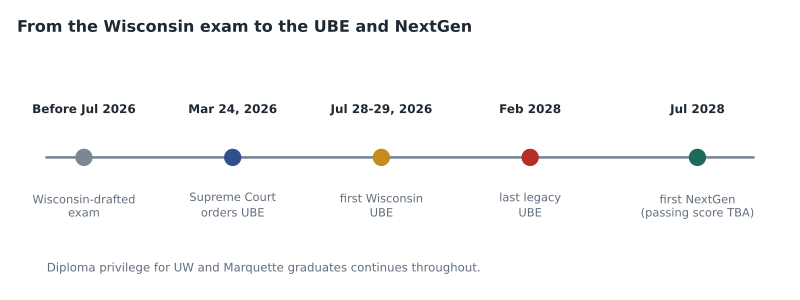
On March 24, 2026, the court ordered that Wisconsin would administer the legacy Uniform Bar Examination, replacing the Wisconsin exam, beginning with the July 2026 administration. The amended rules took effect immediately. The court's announcement and NCBE's release together set out the main terms: Wisconsin accepts transferred UBE scores of 260 or higher, applicants with transferred scores must apply within 36 months of earning them, every exam and transfer applicant must complete 21 hours of Wisconsin-specific law components within 12 months, and the diploma privilege is unchanged. The fee to take the exam or to transfer a qualifying score was announced as 450 dollars.
The online application for the first UBE opened on March 26, 2026, two days after the order. The July 2026 filing deadlines were May 1 and June 1, which gave candidates only weeks to adjust. The first Wisconsin UBE was given on July 28 and 29, 2026, in Middleton, with 122 applicants registered.
Why the court made the change
Chief Justice Jill Karofsky described the change as a response to an access problem. Wisconsin has had difficulty recruiting and retaining lawyers, particularly in rural counties, and the court described the UBE as a practical step to connect more attorneys with the people who need them. After the first exam, the court's newsletter quoted her saying that without attorneys the courthouse doors are closed for too many Wisconsinites.
Geography is the other part of the reason. Wisconsin borders Illinois, Iowa, Michigan and Minnesota, all UBE jurisdictions, and many Wisconsin lawyers practice near those borders. Before 2026, a Minnesota lawyer who wanted to open an office in Hudson or River Falls had to qualify separately in Wisconsin. Now a UBE score of 260 or more from any of those states can be used in Wisconsin within its 36-month life, along with the 21-hour component.
What the change means for candidates
For candidates like Selby, the practical consequences are straightforward. The exam tests national law, not Wisconsin law, so a commercial UBE course prepares her for the whole exam. The essays are MEE questions graded in Wisconsin using NCBE materials. The score is portable. Wisconsin law is learned afterward, through the 21-hour component, not tested on the exam. And because Wisconsin's passing score of 260 is at the low end of the UBE range, a score that passes in Wisconsin may not be enough for a jurisdiction that requires 266 or 270.
For Wisconsin lawyers who never take an exam, nothing changes. Diploma-privilege graduates are admitted as before. Experienced lawyers moving in can still use proof of practice under SCR 40.05.
The next change: NextGen
The UBE that Wisconsin adopted is the legacy UBE, the version given since 2011. NCBE is replacing it with the NextGen bar exam, which was first given in July 2026 in ten jurisdictions. NCBE's Wisconsin chart lists February 2028 as Wisconsin's final legacy UBE and July 2028 as its first NextGen administration. When NCBE announced Wisconsin's adoption of the UBE in April 2026, it noted that the legacy UBE sunsets in 2028 and that Wisconsin planned to move to NextGen for July 2028.
NextGen is a different exam. It is given over a day and a half in three three-hour sessions. Each session contains multiple-choice questions, integrated question sets built around a common fact pattern, and a performance task. Instead of separate MBE, MEE and MPT scores, NextGen produces a single scaled score on a scale from 500 to 750. It tests foundational legal concepts together with lawyering skills such as legal research, writing, issue spotting, investigation, client counseling and negotiation. NCBE's materials for the exam include rules of professional conduct within the skills, and family law becomes a foundational concept from July 2028, the date of Wisconsin's first NextGen exam.
| Feature | Legacy UBE (Wisconsin, July 2026 to February 2028) | NextGen (Wisconsin from July 2028) |
|---|---|---|
| Length | Two days | A day and a half, three sessions |
| Parts | MBE, MEE and MPT | Multiple choice, integrated sets and performance tasks in each session |
| Score | 400-point scale; Wisconsin passes at 260 | 500 to 750 scale; Wisconsin passing score to be announced |
| Transfer into Wisconsin | 260 or more within 36 months | To be announced |
| Wisconsin requirement | 21-hour component | To be announced |
Wisconsin's NextGen details were not settled as of November 2026. NCBE's chart listed Wisconsin's NextGen passing score, its acceptance of transferred NextGen scores and any jurisdiction-specific requirement under NextGen as to be announced. Among the jurisdictions that had set NextGen passing scores, most chose figures between 610 and 620, consistent with NCBE's guidance. NCBE also warns that legacy and NextGen scores should not be compared numerically.
Planning for a possible retake
Hollis always asks candidates to plan for the possibility of a second attempt, not because she expects it but because the transition makes the timing important. If Selby passes in February 2027, none of this matters to her Wisconsin admission. If she does not, her next chances on the legacy UBE are July 2027, February 2028 and nothing after that. A candidate who has not passed by February 2028 will take NextGen in July 2028, with a different format and a different preparation.
That makes the legacy window shorter than it looks. A February 2027 candidate has three legacy attempts at most. A July 2027 first-timer has two. Hollis's advice is to treat the first legacy attempt as the one that counts, and to avoid study materials written for NextGen unless the candidate expects to take NextGen. NextGen practice questions may test formats or skills that the legacy exam does not, and older MEE practice sets may include the four subjects removed in July 2026.
There is also a question about transferred scores during the transition. Wisconsin accepts legacy UBE scores of 260 or more for 36 months. A candidate who earns a legacy score elsewhere in 2027 can use it in Wisconsin through its 36-month life, even after Wisconsin moves to NextGen, unless the rules change. A NextGen score earned elsewhere is a different matter: whether and at what level Wisconsin will accept it was still to be announced in late 2026. Candidates relying on a transfer should watch the Board's notices.
Watching for news
Rule changes in Wisconsin come through the Supreme Court's rule petition process. Pending petitions are listed on the court's website, with the petition, comments, hearing information and the eventual order. The Board's admissions pages and the filing instructions for each exam carry the practical details. NCBE's Wisconsin chart is a useful summary but notes that rules change and that the Board is the authority. Selby set a reminder to check the Board's page and the pending petitions list on the first of each month until her exam.
Worked problem
Which exam will he take?
A hypothetical graduate of an Illinois law school, Osric Schoenecker, plans to work in Kenosha. He finishes school in May 2027 and wants to sit in Wisconsin in July 2027. If he fails, he plans to retake once and, if necessary, a third time.
Show solution
- July 2027 is a legacy UBE in Wisconsin.
- His first retake would be February 2028, the final legacy UBE.
- A third attempt would be July 2028, Wisconsin's first NextGen exam, with a different format and a passing score still to be announced.
- He should prepare to pass in July 2027 and, if he must retake, put everything into February 2028.
Answer: He has two legacy attempts. Any third attempt would be on NextGen.
Common mistakes
MistakeWisconsin will give the legacy UBE indefinitely.
InsteadNCBE lists February 2028 as Wisconsin's last legacy UBE and July 2028 as its first NextGen exam.
MistakeWisconsin has set its NextGen passing score at 610.
InsteadAs of November 2026 Wisconsin's NextGen passing score was to be announced.
MistakeThe UBE in Wisconsin tests Wisconsin law.
InsteadIt tests national law; Wisconsin law is covered by the 21-hour component.
MistakeThe 2026 order also ended the diploma privilege.
InsteadThe diploma privilege continues unchanged.
MistakeA NextGen score of 620 can be compared directly with a legacy score of 260.
InsteadNCBE warns that legacy and NextGen scores should not be compared numerically.
Practice problems
Work each problem on paper first, then reveal the answer to check.
When did the Supreme Court order the UBE?
Show answer
March 24, 2026, on petition 25-04.
When was the first Wisconsin UBE?
Show answer
July 28-29, 2026.
When is Wisconsin's last legacy UBE?
Show answer
February 2028.
What is the NextGen score scale?
Show answer
500 to 750.
Name two reasons the court gave for adopting the UBE.
Show answer
Lawyer shortages, especially in rural areas, and practice near borders with UBE states.
How candidates should read the transition
Hollis gave Selby three rules for living through an exam transition. The first is to read the source, not the summary. Commercial courses, law school bar support offices and online forums all publish summaries of Wisconsin's changes, and many of them were written in the spring of 2026, before details such as the July 2026 site and the instructions for later exams were available. The Board's filing instructions for the specific exam and the court's orders are the authorities. NCBE's chart is a useful cross-check but says itself that rules change.
The second rule is to separate what is settled from what is announced as coming. As of November 2026, the legacy UBE in Wisconsin, the 260 passing score, the 36-month transfer window and the 21-hour component were settled. The move to NextGen in July 2028 was announced. The NextGen passing score, NextGen transfer rules and any Wisconsin requirement under NextGen were still to be decided. Candidates should plan around what is settled and watch what is still open.
The third rule is to choose study materials that match the exam. A February 2027 Wisconsin candidate is taking the legacy UBE: an MBE of 200 questions, six MEE essays and two MPTs. Materials designed for NextGen, with integrated question sets and a single 500-to-750 score, are the wrong preparation. So are older MEE outlines that still treat family law, trusts and estates, conflict of laws and secured transactions as essay subjects; those four subjects left the MEE in July 2026. Selby kept her old family law flashcards only for the Wisconsin component and for practice.
Priscilla Heidemann, listening in, added a practitioner's view. 'For thirty years the lawyers who came here from other states had to start from scratch,' she said. 'Now a lawyer from Minneapolis or Rockford can bring a score with her. That will change who applies for jobs in a place like Eau Claire. It may be the most practical thing the court has done for rural practice in a long time.'
Selby asked whether Wisconsin might change its mind and go back to its own exam. Hollis said that nothing in the 2026 materials suggested that, and that the court had tied its decision to the needs of rural communities and border practice, which were unlikely to change. 'Plan for the system you have,' she said. 'If the rules change again, the court will publish a petition, take comments and hold a hearing, and you will have warning.'
Summary and key terms
- Wisconsin gave its own exam until 2026; scores were not portable.
- On petition 25-04, the court ordered the legacy UBE on March 24, 2026, effective with July 2026.
- Reasons: attorney shortages, especially in rural areas, and practice near four UBE neighbors.
- The legacy UBE ends in Wisconsin in February 2028; NextGen starts in July 2028.
- Wisconsin's NextGen passing score, transfer rules and local requirement were to be announced as of November 2026.
- February 2027 candidates have at most three legacy attempts; plan the first as the one that counts.
- legacy UBE
- The Uniform Bar Examination given since 2011, made up of the MBE, MEE and MPT.
- NextGen bar exam
- NCBE's new exam, first given in July 2026, scored on a 500 to 750 scale.
- rule petition
- A request to the Supreme Court of Wisconsin to amend its rules, followed by comment, hearing and order.
- integrated question set
- A NextGen item type with several questions built around one fact pattern.
- transition window
- The period in which a candidate can still take the legacy UBE before NextGen begins.
Lesson quiz · 5 questions
Score 60% or more to complete this lesson.
Create a free account to save your progress, take quizzes and earn a certificate.