
BAR-250 · Lesson 3 of 12 · 21 min
Character and fitness, and why Wisconsin does not require the MPRE
▶ Video coming soon A video version of this lesson is on the way.
Selby arrived at the third session with a question she had been carrying for weeks. 'I took the MPRE in August and scored 94,' she said. 'I was proud of it. Then I read the Wisconsin chart and it says the MPRE is not required. Did I waste a Saturday?'
'You did not waste it,' Hollis said. 'You will want a Minnesota license, and Minnesota requires 85. But you are right that Wisconsin does not ask for it. Wisconsin tests ethics in other ways, and it puts a great deal of weight on the character and fitness file. That file is where Wisconsin applicants actually get into trouble.'
This lesson covers the character and fitness standard, what the Board looks at, how candor and rehabilitation work, what happens if the Board has concerns, and how Wisconsin covers professional responsibility without the MPRE.
The standard
Every route of admission in Wisconsin requires the Board of Bar Examiners to certify that the applicant has the character and fitness to practice law. The idea behind the requirement is the same in every jurisdiction: clients, courts and the public rely on lawyers to be honest, to keep promises, to handle money and confidences carefully and to follow the rules even when nobody is watching. A lawyer's record of conduct should justify that trust.
The applicant carries the burden. It is not the Board's job to prove that an applicant is unfit; it is the applicant's job to show, through a complete and candid file, that he or she meets the standard. In practice this means the Board looks for a pattern of reliable, honest conduct over time, and treats gaps, evasions and unexplained problems as reasons for further inquiry.
The Board's own rules set out the kinds of conduct it considers relevant and the factors it weighs. Relevant conduct typically includes unlawful conduct, academic misconduct, false statements including omissions on the application, misconduct in employment, acts involving dishonesty or fraud, neglect of financial responsibilities, neglect of professional obligations, violation of court orders, and conduct suggesting a mental or emotional condition or substance use that currently impairs the ability to practice. The factors include the applicant's age at the time, how recent the conduct was, how reliable the information is, how serious the conduct was, the circumstances, the cumulative effect, evidence of rehabilitation, positive social contributions since, candor in the admission process and the materiality of any omissions.
What the Board looks at
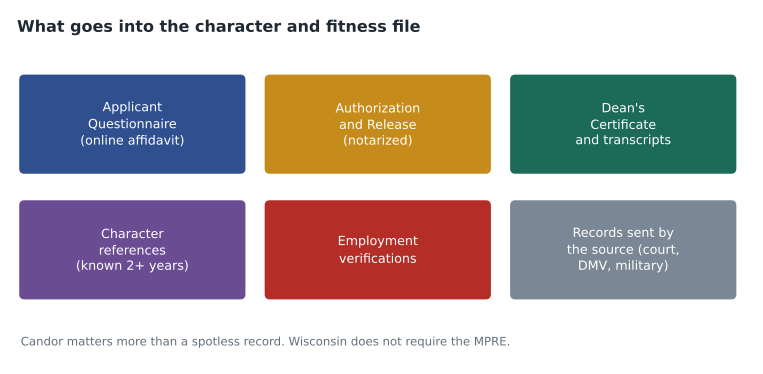
The Applicant Questionnaire asks about every place the applicant has lived and worked, every school attended, every bar admission or application elsewhere, every criminal charge and many traffic matters, every civil lawsuit, financial delinquencies and defaults, military discharge, academic discipline and other topics. The Board then checks the answers. It contacts employers, reads references, obtains records directly from courts and agencies when needed, and compares the application with what the law school reported. For an applicant already admitted elsewhere, the instructions require original certificates of good standing and letters on disciplinary history, dated no earlier than the first filing deadline.
References must be people who have known the applicant for at least two years, and they may not be family members or partners. The Board contacts them by email, so the applicant must supply valid addresses. Employers are contacted the same way; if an employer cannot be reached, the instructions ask the applicant to enter a placeholder address and explain.
Military service requires the discharge record. Court records, driving abstracts and similar documents, when needed, must be sent directly by the agency that keeps them, not forwarded by the applicant.
Candor is the whole game
Experienced admissions lawyers say the same thing in every state: the Board forgives a great deal, but it rarely forgives a lie. A speeding ticket from college, a disorderly conduct citation at nineteen or a credit card that went to collection during a hard year will seldom keep anyone out of the profession if it is disclosed fully and explained honestly. The same matter left off the application, and discovered later, becomes a question about honesty in the admission process itself, which is exactly the trait the Board is testing.
The rule of thumb is to disclose when in doubt. If a question could reasonably be read to include a matter, include it and explain. If the record has been expunged or sealed, read the question carefully, because admission questionnaires in many states ask about such matters expressly, and answer exactly what is asked. If the applicant does not remember the details, obtain the record.
Selby had two items to disclose. In 2019, at nineteen, she received a municipal citation in Eau Claire for underage possession of alcohol at a party, and paid a forfeiture. In 2024 she let a medical bill go to collection while she was waiting for an insurance appeal; it was paid in full when the appeal was resolved. She listed both, attached the municipal court printout and the paid-in-full letter, and wrote two short paragraphs explaining each. 'That is what the Board wants,' Hollis said. 'Facts, documents, no excuses and no drama.'
Rehabilitation and conditions
When the record does contain serious conduct, the question becomes rehabilitation. The Board looks for time without further problems, acceptance of responsibility, restitution where owed, completion of any sentence or treatment, a stable record of work or school, and references who know about the conduct and can speak to the person the applicant has become. An applicant with a serious matter should gather that evidence before filing, not after the Board asks.
Questions about mental health and substance use are a sensitive area. Admission authorities across the country have narrowed such questions over the past decade to focus on current conduct and current impairment, rather than on diagnosis or treatment as such. Seeking treatment is not misconduct. An applicant with concerns about how a question applies should read the current questionnaire carefully and consider getting advice from a lawyer who handles admissions matters.
When the Board has concerns
Most files are certified without any contact beyond routine requests. When the Board needs more, it writes to the applicant asking for documents or an explanation. If concerns remain, the Board may ask the applicant to appear for an interview or a hearing. If the Board decides not to certify character and fitness, chapter 40 provides for written notice, an opportunity for a hearing before the Board and review by the Supreme Court. An applicant in that position should treat it as a legal proceeding and get counsel.
Two timing points matter for exam takers. First, the Board may allow an applicant to sit the exam while the character investigation continues; passing the exam does not guarantee admission. Second, the July 2026 instructions said that files not completed within six months after passing are closed. A candidate who passes but leaves documents outstanding risks losing momentum just when admission should be close.
Why there is no MPRE
Almost every US jurisdiction requires the MPRE, NCBE's 60-question multiple-choice exam on the rules of professional conduct. NCBE's Wisconsin chart lists the MPRE as not required for admission by exam, for transferred UBE scores and for proof of practice, and the diploma privilege rules have never required it. Wisconsin has long been one of very few US jurisdictions without an MPRE requirement.
That does not mean Wisconsin ignores professional responsibility. It covers the subject in three other ways. Diploma-privilege graduates must complete professional responsibility coursework as one of the required subjects under SCR 40.03. Exam and transfer applicants must complete the 21-hour Wisconsin component, and two of its twelve core hours are in ethics and professional responsibility. And every Wisconsin lawyer must complete at least three hours of ethics in each two-year continuing legal education period under SCR chapter 31. Lesson 10 covers the Wisconsin conduct rules themselves.
| Where ethics is covered | Who | What is required |
|---|---|---|
| SCR 40.03 required coursework | Diploma-privilege graduates | Professional responsibility among the required subjects |
| Wisconsin law and practice component | UBE and transfer applicants | 2 core hours in ethics and professional responsibility |
| Continuing legal education, SCR 31 | All active lawyers | At least 3 ethics hours in each two-year period |
| MPRE | Nobody, for Wisconsin | Not required for any route |
When the MPRE still matters
The MPRE still matters for many Wisconsin applicants because of other states. A Wisconsin lawyer who later seeks admission in another jurisdiction, by transferred UBE score or by motion, will usually face that jurisdiction's MPRE requirement, and some jurisdictions accept only scores earned within a set period. Selby's 94 will satisfy Minnesota's 85 if she uses it within Minnesota's time limits. A diploma-privilege lawyer from Madison who moves to Illinois after a few years will probably need the MPRE then, even though Wisconsin never asked for it.
Hollis's advice for Wisconsin exam takers who may want a second license is to take the MPRE while the subject is fresh, typically during or just after law school, and to check the score-age rules of the second state. For candidates sure they will practice only in Wisconsin, the MPRE is optional.
Worked problem
Disclose or not?
A hypothetical applicant, Leontine Kluck, was charged with retail theft at eighteen. The charge was dismissed under a deferred prosecution agreement after she completed community service, and the court record was later expunged. The Wisconsin questionnaire asks about charges, including those that were dismissed or expunged. She is tempted to answer no because the record is gone.
Show solution
- Answer the question that is asked. If it covers dismissed or expunged charges, the matter must be disclosed.
- Disclose the charge, the deferred agreement, the community service and the dismissal, with whatever documents are available.
- Explain briefly and factually: age, what happened, what she learned and her record since.
- An omission discovered later would raise a candor problem far more serious than the original charge.
Answer: She should disclose it fully. The underlying matter is minor and old; failing to disclose it would itself be a character issue.
Common mistakes
MistakeWisconsin requires an MPRE score of 85.
InsteadWisconsin does not require the MPRE for any route of admission.
MistakeThe Board must prove that an applicant is unfit.
InsteadThe applicant has the burden of showing character and fitness.
MistakeAn expunged matter never needs to be disclosed.
InsteadAnswer exactly what the question asks; many admission questions reach expunged or dismissed matters.
MistakePassing the exam means admission is assured.
InsteadAdmission also requires character and fitness certification and, for exam takers, the 21-hour component.
MistakeA family member can serve as a character reference.
InsteadReferences must have known the applicant at least two years and may not be family members or partners.
Practice problems
Work each problem on paper first, then reveal the answer to check.
Who has the burden on character and fitness?
Show answer
The applicant.
Does Wisconsin require the MPRE?
Show answer
No.
How do exam takers cover Wisconsin ethics?
Show answer
Two core hours of ethics in the 21-hour component.
How long must a reference have known the applicant?
Show answer
At least two years.
Who must send court records when the Board needs them?
Show answer
The court or agency itself, directly to the Board.
Building the file, step by step
Hollis gave Selby a practical routine for the character and fitness file that she uses with every candidate, whatever the jurisdiction. The first step is to assemble the raw material before opening the questionnaire: a list of every address since age eighteen, every job including summer and part-time work, every school, every traffic citation and court matter, and any debt that went more than a few months past due. Credit reports from the three national bureaus, which are free, are a good way to find forgotten accounts. Old court matters can usually be found through Wisconsin's online circuit court records or the records of the county where they happened.
The second step is to answer each question in the order asked, using the question's own words, and to keep a note of where each answer came from. If a date is uncertain, say so and give the best estimate rather than inventing precision. The third step is to write short, factual explanations for anything adverse: what happened, when, how it was resolved and what has happened since. Explanations should avoid blaming others and should not argue with the Board. The fourth step is to read the whole application once more as if you were the Board's investigator, looking for inconsistencies between answers, for example a job that appears in the employment section but overlaps oddly with a stated address.
Selby followed the routine and found two things she would otherwise have missed. Her credit report showed a store card she had opened at nineteen and forgotten, closed with a zero balance; it needed no explanation but confirmed that her financial answers were complete. And her address list reminded her that she had spent one summer of law school in a sublet in St. Paul, which she had left off her first draft of the residence history. 'Neither was a problem,' Hollis said. 'But an investigator who finds an address you did not list starts to wonder what else you did not list.'
Applicants already admitted in another jurisdiction have extra steps. They must obtain original certificates of good standing and letters stating their disciplinary history from each jurisdiction, dated no earlier than the first filing deadline for the exam, and they must disclose any bar complaints, even those dismissed. Lawyers often underestimate how long those letters take to arrive.
Summary and key terms
- The Board of Bar Examiners certifies character and fitness for every route, including diploma privilege.
- The applicant bears the burden; the Board weighs relevant conduct with factors such as age, recency, seriousness and rehabilitation.
- Candor is critical: a disclosed minor matter is rarely a problem, while an omission becomes a question of honesty.
- Adverse determinations carry notice, a hearing before the Board and Supreme Court review.
- Wisconsin does not require the MPRE; ethics is covered by SCR 40.03 coursework, the component and CLE.
- Applicants who want another license should check that state's MPRE rules.
- character and fitness
- The qualities of honesty, reliability and diligence an applicant must show for admission.
- candor
- Complete and truthful disclosure in the admission process.
- rehabilitation
- Evidence that an applicant has overcome past misconduct, such as time, responsibility and restitution.
- MPRE
- NCBE's professional responsibility exam, required by most jurisdictions but not by Wisconsin.
- relevant conduct
- Conduct the Board treats as bearing on fitness, such as dishonesty, unlawful acts or financial neglect.
Lesson quiz · 5 questions
Score 60% or more to complete this lesson.
Create a free account to save your progress, take quizzes and earn a certificate.