
BAR-250 · Lesson 6 of 12 · 21 min
The Wisconsin law and practice component and diploma privilege
▶ Video coming soon A video version of this lesson is on the way.
Selby's question at the start of the sixth session was practical. 'Everyone keeps telling me the exam does not test Wisconsin law. But I am going to practice in Eau Claire. When do I actually learn the difference between Wisconsin and everywhere else?'
'After the exam,' Hollis said. 'That is the deal Wisconsin made when it adopted the UBE. The exam tests national law. Then, before you are admitted, you complete a 21-hour Wisconsin law and practice component. It is built from the same subjects that Wisconsin requires of its own graduates under the diploma privilege. So to understand the component, you need to understand the privilege.'
This lesson explains the diploma privilege under SCR 40.03, the 21-hour component that exam and transfer applicants must complete, how the two relate, and how a candidate should plan the component around the exam and admission.
The diploma privilege
Wisconsin has admitted graduates of its law schools on their diplomas since the nineteenth century, first for the University of Wisconsin and later also for Marquette University. Many states had similar privileges in the past and gave them up. Wisconsin kept its privilege, which survived a federal court challenge in the 2000s, and it is today the only state with a permanent diploma privilege of this kind.
The privilege is not automatic for every graduate. SCR 40.03 requires a graduate to have completed a prescribed course of study, and the law school certifies to the Board that the graduate has done so. The University of Wisconsin Law School's published guidance shows how this works in practice. A UW JD requires 90 credits, and 60 of those must come from courses that qualify under SCR 40.03, meaning courses on substantive and procedural law as it arises in courts and administrative agencies. Some kinds of credit count only up to a cap, such as clinics and externships. The graduate must take courses in a list of mandatory subjects, which at UW includes contracts, civil procedure, criminal law and procedure, torts, property, constitutional law, professional responsibility, evidence and trusts and estates. The graduate must also maintain at least a C average in the mandatory courses and in the courses counted toward the 60 credits. Marquette publishes its own guidance on the same rule.
The point of the requirement is that the coursework does what the exam does elsewhere: it gives the court a basis for saying the graduate is competent in the core subjects. The Board still certifies character and fitness separately, and the graduate still takes the oath and joins the State Bar.
A graduate who misses a required course or the grade requirement is not eligible for the privilege and must qualify another way, usually by the exam. A graduate of either school may also choose to sit the UBE, for example to earn a portable score, but most use the privilege.
Why the component exists
When the court adopted the UBE, it faced a question that every UBE jurisdiction faces: how will a lawyer admitted on a national exam learn local law? Some jurisdictions answer with a short online course and test; New York, for example, uses a course and a 50-question exam. Wisconsin answered by building a component around the subjects that its own diploma-privilege graduates must study. The Board's admission page describes the component as based on the diploma privilege requirements in SCR 40.03, as approved by the Board.
That design has a logic. A diploma-privilege graduate has studied Wisconsin's approach to criminal law, evidence, family law, torts and trusts and estates in law school. An exam taker who studied in Minnesota has not. The component fills part of that gap, focusing on the areas where Wisconsin law differs most from the national rules tested on the UBE.
What the component requires
The component is 21 hours. Twelve are core hours: two hours each in six categories, namely criminal law, ethics and professional responsibility, evidence, family law, torts, and trusts and estates. The remaining nine hours may be chosen from the core or the optional curriculum.
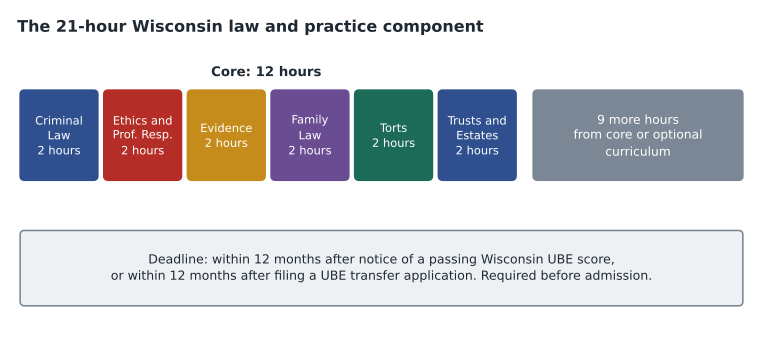
The component applies to two groups. Applicants who pass the UBE in Wisconsin must complete it within 12 months after notice that they passed. Applicants who transfer a UBE score from another jurisdiction must complete it within 12 months after filing the transfer application. In both cases the component must be completed before admission. The Board's admission page links to a purchase guide that explains how to register for and complete the component, and applicants should follow that guide rather than any secondhand description.
| Core category | Hours | Why it matters in Wisconsin |
|---|---|---|
| Criminal law | 2 | Wisconsin statutes and procedure differ from the national criminal law tested on the MBE |
| Ethics and professional responsibility | 2 | Wisconsin has its own version of the conduct rules and does not require the MPRE |
| Evidence | 2 | Wisconsin has its own evidence code in the statutes |
| Family law | 2 | Wisconsin is a marital property state with an equal-division presumption at divorce |
| Torts | 2 | Comparative negligence, the safe-place statute and statutory caps are distinctive |
| Trusts and estates | 2 | Probate and marital property rules at death are distinctive |
| Optional or additional core | 9 | Chosen by the applicant from the curriculum |
Several of these subjects are also tested on the UBE, but in their national form. Evidence on the MBE follows the Federal Rules of Evidence; Wisconsin's evidence code is similar in many places but not identical. Torts on the MBE assumes a general common-law framework; Wisconsin has its own comparative negligence statute and important statutory limits. Family law and trusts and estates are no longer tested on the MEE at all since July 2026, so for an exam taker the component may be the first serious exposure to Wisconsin's marital property system. Lessons 7 through 10 of this course preview the Wisconsin law that the component and early practice will demand.
Planning the component
The 12-month window starts at different times for different applicants, and that affects planning. For Selby, it starts when she is notified that she passed the February 2027 exam. If she passes, she will want to be admitted as soon as possible, because her firm needs her to appear in court. That means finishing the component quickly after results, not waiting until month eleven. Hollis suggested a plan: do nothing on the component before the exam, because every hour before February should go to the UBE; buy the component the day results arrive; finish the twelve core hours within two weeks; finish the optional hours within a month; and make sure the character and fitness file is complete in the same period.
Selby asked whether she could start the component before the exam to save time. 'Read the purchase guide and ask the Board,' Hollis said. 'The rule ties the deadline to the notice of passing, which suggests the component is meant to follow the exam. Even if you could start early, I would not. The UBE is a two-day test of national law; the component is twenty-one hours of Wisconsin law. Mixing them before February is a good way to remember the wrong rule on the MBE.'
For a transfer applicant, the clock starts at filing. A Minnesota lawyer who files a transfer application in March has until the following March to finish. In practice, transfer applicants also want to finish quickly, because nothing else stands between them and admission once the character file is complete.
What the component is not
The component is not a test of the kind New York uses. The Board's description refers to hours of education in prescribed categories, not to a scored exam. It is also not continuing legal education in the ordinary sense: it is a condition of admission, completed before the applicant becomes a lawyer. Whether any of its hours also count toward the new lawyer's first CLE reporting period is a question to ask the Board, not to assume.
It is also not a requirement for diploma-privilege graduates or for lawyers admitted on proof of practice. NCBE's Wisconsin chart describes the jurisdiction-specific component as required before admission by examination or by transferred UBE score.
Comparing the routes
Putting it together, a Wisconsin lawyer admitted on diploma privilege has taken a set of required law school courses, including Wisconsin-focused instruction, and was certified by the school and the Board. A Wisconsin lawyer admitted on the UBE has passed the national exam and completed 21 hours in the same core subjects. A lawyer admitted on proof of practice has practiced elsewhere for three of the last five years. Each route answers the competence question in its own way, and each requires the same character and fitness certification.
Worked problem
Meeting the 12-month deadline
A hypothetical candidate, Lise Kroening, passes the July 2027 Wisconsin UBE and receives notice of her passing score on a date in the fall of 2027. She starts a demanding job in Chicago and does not begin the component until the following summer.
Show solution
- Her 12-month window runs from the notice of her passing score.
- If she has not completed all 21 hours, including the 12 core hours, within that window, she has not met the requirement for admission by examination.
- The rule does not say she can extend the deadline by asking; she would need to ask the Board what options exist, if any.
- She should have scheduled the component within weeks of results, as Hollis advises.
Answer: She risks missing the 12-month deadline. The component is a condition of admission with a fixed window, and the safe course is to finish it soon after results.
Common mistakes
MistakeThe component is a 50-question test like New York's.
InsteadWisconsin's component is 21 hours of education in prescribed categories.
MistakeDiploma-privilege graduates must complete the component.
InsteadThe component applies to admission by exam and by transferred UBE score.
MistakeThe 12-month window always starts on the exam date.
InsteadIt starts at notice of a passing score for exam takers and at filing for transfer applicants.
MistakeAny graduate of UW or Marquette is admitted automatically.
InsteadThe graduate must complete the coursework required by SCR 40.03 and pass character and fitness.
MistakeFamily law and trusts are tested on the MEE, so the component repeats them.
InsteadThey left the MEE in July 2026; the component may be an exam taker's main exposure to them.
Practice problems
Work each problem on paper first, then reveal the answer to check.
How many hours is the Wisconsin component?
Show answer
21.
How many core hours, and in what pattern?
Show answer
12: two hours each in six categories.
Name the six core categories.
Show answer
Criminal law, ethics and professional responsibility, evidence, family law, torts, trusts and estates.
When does the window start for a transfer applicant?
Show answer
When the transfer application is filed.
What is the component based on?
Show answer
The diploma privilege requirements in SCR 40.03.
A closer look at the core subjects
Hollis previewed what each core category of the component is likely to emphasize, based on where Wisconsin law departs from what the UBE tests. Criminal law in Wisconsin is statutory, found in chapters 939 to 951 of the statutes, with Wisconsin's own definitions of offenses, degrees of homicide and defenses, and criminal procedure is governed by chapters 967 to 980 along with state constitutional decisions. An exam taker who studied the common-law and Model Penal Code framework for the MBE will find that Wisconsin uses its own vocabulary, such as first-degree and second-degree intentional homicide.
Evidence in Wisconsin is codified in chapters 901 to 911. Its structure follows the Federal Rules of Evidence closely enough that the MBE is good preparation, but the component will point out the differences that matter in Wisconsin courtrooms, including the state's own rules on character evidence in some cases, privileges and hearsay exceptions.
Family law and trusts and estates are where the component does the most work for exam takers. Wisconsin's marital property system has no equivalent in the national law tested on the UBE, and since July 2026 neither subject has been tested on the MEE at all. Lesson 9 of this course previews that material.
Torts in Wisconsin turn on statutes as much as on common law: comparative negligence under section 895.045, the safe-place statute, the governmental claim rules of section 893.80 and the damages limits discussed in lesson 8. Ethics and professional responsibility covers the Wisconsin version of the conduct rules in SCR chapter 20, including the fee and trust account provisions that lesson 10 explains. Because Wisconsin does not require the MPRE, these two core hours are the only formal ethics instruction required of an exam taker before admission, which is a good reason to take them seriously.
The nine optional hours give candidates a chance to tailor the component to their practice. Hollis's advice is to choose subjects tied to the work the candidate will actually do first. A candidate joining a general practice in a small city, like Selby, might add Wisconsin civil procedure, real estate practice and probate. A candidate joining a criminal defense office might add more criminal procedure and sentencing. The component is short; it should be used.
Selby wrote her own plan into her calendar: results day, buy the component; first week, the six core subjects; second week, optional hours in civil procedure, real estate and probate; third week, confirm completion with the Board and check that the character and fitness file is complete.
Summary and key terms
- The diploma privilege under SCR 40.03 admits UW and Marquette graduates who complete prescribed coursework, certified by the school.
- At UW, 60 of the 90 JD credits must qualify under SCR 40.03, with mandatory subjects and a C average.
- Exam and transfer applicants must complete a 21-hour Wisconsin component before admission.
- Core: 12 hours, two each in criminal law, ethics, evidence, family law, torts, and trusts and estates; nine more hours of choice.
- Deadline: 12 months from notice of passing, or from filing a transfer application.
- Plan the component after the exam and finish it quickly to be admitted promptly.
- Wisconsin component
- The 21-hour Wisconsin law and practice education required of UBE and transfer applicants before admission.
- core hours
- The 12 required hours of the component, two in each of six categories.
- SCR 40.03
- The rule setting the diploma privilege and its coursework requirements.
- law school certification
- The school's statement to the Board that a graduate met the diploma privilege coursework.
- transfer application
- An application for admission based on a UBE score earned in another jurisdiction.
Lesson quiz · 5 questions
Score 60% or more to complete this lesson.
Create a free account to save your progress, take quizzes and earn a certificate.