
BAR-250 · Lesson 10 of 12 · 20 min
The Wisconsin Rules of Professional Conduct (SCR 20) and lawyer regulation
▶ Video coming soon A video version of this lesson is on the way.
A new client walked into Priscilla Heidemann's office in November wanting help with a dispute over a farm equipment lease. He offered to pay 2,500 dollars up front. Priscilla asked Selby to prepare the engagement letter and handle the deposit. 'In Minnesota I would put it in the trust account and bill against it,' Selby said. 'Is that right here?' 'It is one right answer,' Priscilla said. 'Wisconsin gives you two, and it has rules about what you have to put in writing that are stricter than the Model Rules. Look at SCR 20:1.5.'
Hollis built the tenth session around that question. Wisconsin does not require the MPRE, but every Wisconsin lawyer is bound by the Wisconsin Rules of Professional Conduct for Attorneys, chapter 20 of the Supreme Court Rules. They follow the ABA Model Rules in structure and much of their content, with important Wisconsin variations. This lesson covers the most practical of those variations, especially fees and trust accounts, then the confidentiality rule and the discipline system.
The structure of SCR 20
The Wisconsin rules are numbered to match the Model Rules, with a prefix: SCR 20:1.1 is competence, SCR 20:1.7 is conflicts of interest, SCR 20:8.4 is misconduct, and so on. Many rules carry Wisconsin comments explaining how the Wisconsin text differs from the Model Rule. When a Wisconsin rule tracks the Model Rule, national ethics authorities are persuasive; when it differs, the Wisconsin text controls. The State Bar of Wisconsin's Professional Ethics Committee issues formal ethics opinions interpreting the rules, and the State Bar provides ethics guidance to members who call with questions.
Fees: what must be in writing
SCR 20:1.5 starts like the Model Rule: a lawyer may not charge an unreasonable fee, and the factors for reasonableness are familiar. But Wisconsin goes further on communication. Under SCR 20:1.5(b)(1), the scope of the representation, the basis or rate of the fee and the expenses for which the client will be responsible must be communicated to the client in writing, before or within a reasonable time after the representation begins. The writing requirement does not apply where the lawyer regularly represents the client and will charge on the same basis as before. And where the total cost of the representation, including attorney fees, is reasonably foreseeable to be 1,000 dollars or less, the communication may be oral or in writing. Any later change in the basis or rate of the fee or expenses must also be communicated in writing.
The Model Rule only says the basis or rate should be communicated, preferably in writing. Wisconsin makes writing mandatory above the 1,000 dollar threshold. For a general practice like Priscilla's, that means almost every new matter needs a written fee communication.
Contingent fees follow the familiar rule in SCR 20:1.5(c): the agreement must be in a writing signed by the client, stating the method by which the fee is determined, including the percentages that apply in the event of settlement, trial or appeal, the expenses that will be deducted from the recovery and whether they are deducted before or after the contingent fee is calculated. Under SCR 20:1.5(d), contingent fees are prohibited in certain family law matters and in criminal defense.
Advanced fees: two options
The Wisconsin rule on advanced fees is the provision that most surprises lawyers from other states. SCR 20:1.5(f) states the default: unearned advanced fees and funds paid by the client or a third party for fees must be held in trust until earned by the lawyer, and funds advanced for costs must be held in trust until the costs are incurred.
SCR 20:1.5(g) offers an alternative for advanced fees, not for costs. A lawyer may deposit advanced fees in the lawyer's business account instead of trust if the lawyer complies with a set of notice and dispute-resolution requirements. At the outset, the lawyer must give the client written notice that covers the amount of the advanced fee, the basis or rate of the fee, any expenses the client must pay, the lawyer's obligation to refund any unearned advanced fee with an accounting at the end of the representation, the availability of binding arbitration to resolve fee disputes, and the client's right to file a claim with the Wisconsin Lawyers' Fund for Client Protection if the lawyer fails to refund. When the representation ends, the lawyer must provide a final accounting, refund any unearned fees and costs, and give notice of the dispute and arbitration process and its deadlines. A fee that is subject to court review in the proceeding also satisfies the rule.
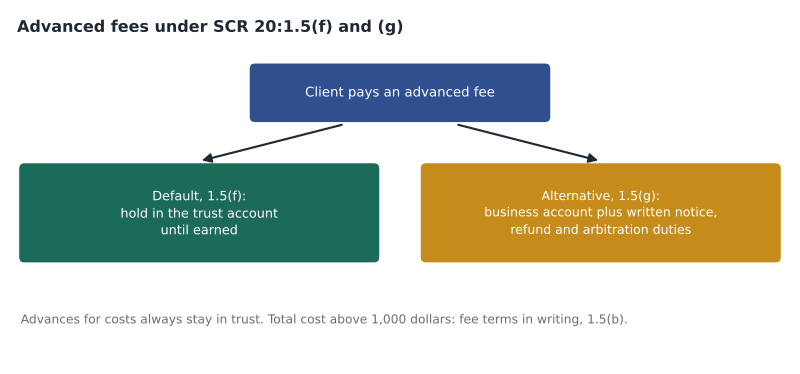
The alternative exists because many lawyers, especially in criminal defense and small practices, take advanced fees and earn them quickly, and the court decided that strong notice and refund obligations could protect clients without requiring every advance to pass through trust. But it is an alternative with strict conditions. A lawyer who puts an advanced fee in the business account without the required notice has violated the rule, and a lawyer who uses the alternative and then fails to refund unearned fees faces discipline and a claim against the client protection fund.
For the farm equipment client, Selby drafted an engagement letter covering scope, hourly rates and expenses, as SCR 20:1.5(b) required because the matter would plainly cost more than 1,000 dollars. Priscilla's firm uses the trust account for advanced fees as a matter of policy, so Selby deposited the 2,500 dollars in trust and noted that fees would be transferred to the operating account only as earned and billed. 'The 1.5(g) route is lawful,' Priscilla said, 'but we find it easier to do one thing every time.'
| Rule | Model Rule approach | Wisconsin approach |
|---|---|---|
| Fee communication | Preferably in writing | In writing unless total cost is foreseeably 1,000 dollars or less, or same basis for a regular client (SCR 20:1.5(b)) |
| Contingent fees | Signed writing | Signed writing with percentages and expense treatment (SCR 20:1.5(c)) |
| Advanced fees | Held in trust until earned | Trust (1.5(f)) or business account with notice, refund and arbitration duties (1.5(g)) |
| Advanced costs | Held in trust | Always held in trust |
| Trust accounts | Safekeeping rule | Detailed SCR 20:1.15 requirements on accounts, records and reconciliation |
Trust accounts
SCR 20:1.15 is one of the most detailed rules in chapter 20. It requires that funds of clients and third persons paid to a lawyer in connection with a representation be deposited in identifiable trust accounts, kept separate from the lawyer's own property. Funds that belong in trust include advanced fees unless the lawyer uses SCR 20:1.5(g), advances for costs, filing fees, settlement proceeds and funds held for probate or guardianship matters. The rule also sets requirements for the kinds of banks that may hold trust accounts, for the records a lawyer must keep, for regular reconciliation of the accounts and for how disputed funds are handled. Pooled interest-bearing trust accounts for small or short-term deposits support the state's interest on lawyers' trust accounts program, which funds civil legal services.
Wisconsin also asks lawyers to confirm their trust account compliance regularly, as part of the annual State Bar dues and reporting process. Trust account problems are among the most common sources of serious discipline in every state, and Wisconsin's Office of Lawyer Regulation offers trust account resources for exactly that reason. Hollis told Selby to read SCR 20:1.15 in full before touching any client money.
Confidentiality: a mandatory disclosure rule
Wisconsin's confidentiality rule, SCR 20:1.6, contains a feature that sets it apart from the Model Rule and from most states. Under the Model Rule, every exception to confidentiality is permissive: a lawyer may reveal information to prevent certain harms but is not required to. Wisconsin's rule includes a mandatory exception. A Wisconsin lawyer shall reveal information relating to the representation to the extent the lawyer reasonably believes necessary to prevent the client from committing a criminal or fraudulent act that the lawyer reasonably believes is likely to result in death or substantial bodily harm, or in substantial injury to the financial interest or property of another. Other exceptions in the Wisconsin rule are permissive, as under the Model Rule.
Mandatory disclosure is rare in American ethics rules, and a lawyer coming from another state may assume that the Model Rule's permissive approach applies. In Wisconsin it does not, for the harms the mandatory provision covers. The rule is narrow in that it concerns the client's own future criminal or fraudulent acts and turns on the lawyer's reasonable belief, but where it applies it imposes a duty, not a choice.
The discipline system
Lawyer discipline in Wisconsin belongs to the Supreme Court, which has created the Office of Lawyer Regulation to carry out the work. Grievances against lawyers go to the OLR, which screens them, investigates those that warrant it, and may resolve minor matters by diversion or by agreement. If the OLR believes misconduct warrants discipline, it may file a complaint, and a referee appointed by the court hears the case and makes findings and recommendations. The Supreme Court decides the outcome. Discipline in Wisconsin ranges from a private reprimand, through a public reprimand and suspension, to revocation of the license, which is Wisconsin's term for what other states call disbarment. The court may also order restitution, conditions on practice and payment of the costs of the proceeding.
Wisconsin also maintains the Wisconsin Lawyers' Fund for Client Protection, which compensates clients who lose money because of a lawyer's dishonest conduct, and a fee arbitration program for fee disputes. Both appear in the notice that SCR 20:1.5(g) requires.
Why this matters before admission
Selby asked why she needed this before she was admitted. Hollis gave three reasons. First, the Wisconsin component includes two core hours on ethics and professional responsibility, and this material is what those hours cover. Second, she was already working in a law office, and nonlawyer staff, including law clerks, act under the supervision of lawyers who are responsible for their conduct under the rules. Third, the first trust account mistake a new lawyer makes is often in the first month of practice.
Worked problem
Using the 1.5(g) alternative
A hypothetical criminal defense lawyer in Milwaukee, Isolde Ruehl, accepts a 5,000 dollar advanced fee for a misdemeanor case and deposits it in her business account. She gives the client a written fee agreement stating her hourly rate but saying nothing about refunds, arbitration or the client protection fund. The case is dismissed after she has earned 1,800 dollars.
Show solution
- Advanced fees must go into trust under SCR 20:1.5(f) unless the lawyer complies with SCR 20:1.5(g).
- SCR 20:1.5(g) requires written notice of the refund obligation, binding arbitration for fee disputes and the right to claim against the Lawyers' Fund for Client Protection.
- Her notice omitted those required terms, so the business-account deposit did not comply with the alternative.
- At the end of the representation she must account for the fee and refund the 3,200 dollars unearned, with the required notice.
Answer: She violated SCR 20:1.5 by depositing the advance in her business account without the required notice, and she must refund the unearned 3,200 dollars with an accounting.
Common mistakes
MistakeWisconsin, like the Model Rule, only prefers written fee communications.
InsteadSCR 20:1.5(b) requires writing unless the total cost is foreseeably 1,000 dollars or less or the client is a regular client billed on the same basis.
MistakeAdvanced fees must always go into trust in Wisconsin.
InsteadSCR 20:1.5(g) allows a business-account alternative with strict notice and refund requirements.
MistakeAdvances for costs may also use the business-account alternative.
InsteadCost advances must stay in trust until the costs are incurred.
MistakeAll confidentiality exceptions in Wisconsin are permissive.
InsteadSCR 20:1.6 includes a mandatory disclosure duty for certain client crimes or frauds.
MistakeWisconsin disbars lawyers.
InsteadWisconsin calls the most serious sanction revocation of the license.
Practice problems
Work each problem on paper first, then reveal the answer to check.
Above what foreseeable total cost must fee terms be in writing?
Show answer
More than 1,000 dollars.
What must a lawyer do to use the 1.5(g) alternative?
Show answer
Give written notice of the fee, the refund obligation, binding arbitration and the client protection fund, and follow the end-of-representation steps.
Which office investigates lawyer grievances?
Show answer
The Office of Lawyer Regulation.
What is Wisconsin's term for disbarment?
Show answer
Revocation.
How does Wisconsin's confidentiality rule differ from the Model Rule?
Show answer
It includes a mandatory disclosure duty for certain client crimes or frauds.
Supervision and staff
The Wisconsin rules, like the Model Rules, make lawyers responsible for the conduct of the nonlawyers they supervise. Law clerks, paralegals and assistants who handle client funds, send fee letters or talk with clients do so under the supervising lawyer's responsibility. That is why Priscilla reviewed Selby's engagement letter and deposit before the client signed, and why firms build fee and trust procedures into their office routines rather than leaving them to memory.
Summary and key terms
- SCR 20 follows the Model Rules in numbering and much content, with Wisconsin variations.
- SCR 20:1.5(b) requires written fee communication unless total cost is foreseeably 1,000 dollars or less or the client is regular and billed on the same basis.
- Advanced fees go into trust (1.5(f)) or the business account with notice, refund and arbitration duties (1.5(g)); cost advances stay in trust.
- SCR 20:1.15 imposes detailed trust account requirements.
- SCR 20:1.6 includes a mandatory disclosure duty for certain client crimes or frauds.
- The OLR investigates; referees hear cases; the Supreme Court imposes discipline from private reprimand to revocation.
- advanced fee
- A fee paid before it is earned, governed in Wisconsin by SCR 20:1.5(f) and (g).
- trust account
- A separate account holding client and third-party funds, governed by SCR 20:1.15.
- Office of Lawyer Regulation
- The Supreme Court office that investigates and prosecutes lawyer misconduct.
- revocation
- Wisconsin's most serious discipline, ending the lawyer's license.
- Lawyers' Fund for Client Protection
- A fund that compensates clients for losses caused by a lawyer's dishonest conduct.
Lesson quiz · 5 questions
Score 60% or more to complete this lesson.
Create a free account to save your progress, take quizzes and earn a certificate.