
BAR-249 · Lesson 9 of 12 · 22 min
Claims against local governments and health care providers
▶ Video coming soon A video version of this lesson is on the way.
Two new files landed on Lonnie's desk in the same week. In the first, a county ambulance authority's vehicle ran a red light in Bridgeport and struck a client's car. In the second, a client's mother died after a hospital discharged her with an infection that her family says should have been caught. Verna told him that both files had something in common: before anyone thinks about the merits, a West Virginia lawyer must check special statutes that change the usual rules of tort law. For the ambulance case, that statute is the Governmental Tort Claims and Insurance Reform Act. For the hospital case, it is the Medical Professional Liability Act. This lesson introduces both, along with the rules for claims against the State itself.
Three kinds of public defendants
West Virginia law treats public defendants in three groups. The State itself and its agencies are protected by constitutional immunity, with a route to compensation through the State's insurance and the Legislature's claims process. Political subdivisions, such as counties, municipalities, county boards of education and many local authorities, are governed by the Governmental Tort Claims and Insurance Reform Act in chapter 29, article 12A of the Code. Public employees have their own protections under the same Act. Identifying which group a defendant belongs to is the first step in any claim against a public body.
The State
Article VI, section 35 of the West Virginia Constitution provides that the State shall never be made a defendant in any court of law or equity. The Supreme Court of Appeals has long held that this immunity does not bar a suit seeking recovery up to the limits of the State's liability insurance coverage, an approach associated with Pittsburgh Elevator Co. v. West Virginia Board of Regents (1983). Claims against the State that fall outside insurance coverage may be presented through the Legislature's claims process, now the Legislative Claims Commission, which recommends awards that the Legislature may then fund. A lawyer with a claim against a state agency should identify the agency, check whether the claim is covered by the State's insurance program and consider both routes.
Political subdivisions: the structure of the Act
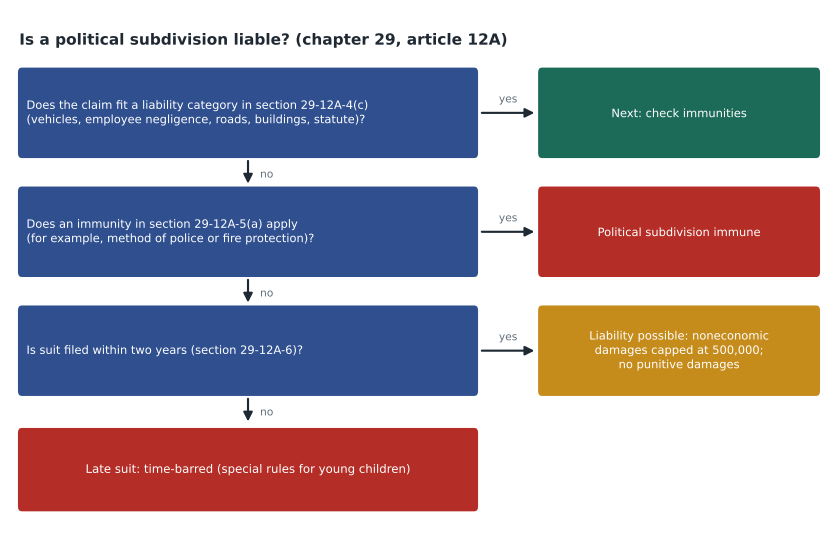
The Governmental Tort Claims and Insurance Reform Act sets up a three-step analysis for claims against political subdivisions. First, the claim must fit one of the categories of liability the Act recognizes. Second, none of the Act's immunities may apply. Third, the plaintiff must meet the Act's procedural and damages rules, including its limitations period and damages cap.
Under section 29-12A-4(c), political subdivisions are liable for injury, death or loss caused by the negligent operation of a vehicle by their employees within the scope of employment; by the negligent performance of acts by employees while acting within the scope of employment; by their negligent failure to keep public roads, highways, streets and similar public ways open, in repair or free from nuisance; by the negligence of employees occurring within or on the grounds of buildings used in connection with governmental functions; and where liability is expressly imposed by another statute. These categories are broad, but they are subject to the immunities in the next section.
Section 29-12A-5(a) lists many specific immunities. Among them, a political subdivision is immune for claims arising from legislative or quasi-legislative functions and judicial or quasi-judicial functions; from the method of providing police, law enforcement or fire protection; from snow or ice on public ways, except when caused by the subdivision's own negligent conduct; from natural conditions of unimproved property; from inspections and the issuance or denial of licenses and permits; and from a number of other functions listed in the section. If an immunity applies, the subdivision is not liable even if the claim fits a liability category.
Employees of political subdivisions
Section 29-12A-5(b) protects employees of political subdivisions personally. An employee is immune from liability unless the employee's acts or omissions were manifestly outside the scope of employment, were done with malicious purpose, in bad faith or in a wanton or reckless manner, or liability is expressly imposed on the employee by another statute. In most negligence cases, therefore, the claim runs against the subdivision, not the individual employee.
The limitations period
Section 29-12A-6 sets the limitations period. An action against a political subdivision for injury, death or loss must be brought within two years after the cause of action arose, or within two years after the injury was discovered or reasonably should have been discovered, whichever is later, unless another statute sets a shorter period. For a minor who was under ten years old when injured, the action may be brought within the two-year period or before the minor's twelfth birthday, whichever gives more time. The periods are tolled if the subdivision or its representative concealed or misrepresented material facts through fraud or collusion.
Damages limits
Section 29-12A-7 limits damages against political subdivisions. Noneconomic loss, such as pain and suffering, is capped at 500,000 dollars per person for the same cause, transaction or occurrence; economic loss, such as medical expenses and lost wages, is not capped by this section. Interest on a judgment and court costs awarded to the plaintiff are not counted against the cap. Punitive or exemplary damages may not be awarded against a political subdivision at all.
| Issue | Rule | Code section |
|---|---|---|
| Liability categories | Vehicles, employee negligence, roads, buildings, statutes | 29-12A-4(c) |
| Immunities | A long list, including the method of police and fire protection and snow and ice | 29-12A-5(a) |
| Employee immunity | Unless outside scope, malicious, bad faith, wanton or reckless, or statutory | 29-12A-5(b) |
| Limitations | Two years or discovery; special rule for children under ten | 29-12A-6 |
| Damages | Noneconomic capped at 500,000 dollars per person; no punitive damages | 29-12A-7 |
The Medical Professional Liability Act
Claims against health care providers for medical professional liability are governed by the Medical Professional Liability Act in chapter 55, article 7B. The Act applies to claims based on health care services rendered, or that should have been rendered, by a health care provider or facility, and it imposes pre-suit requirements, special proof rules and damages caps. Whether a particular claim falls within the Act, rather than ordinary negligence, is itself a frequent question, because a claim that is really about health care cannot avoid the Act by being labeled something else.
Pre-suit notice and the certificate of merit
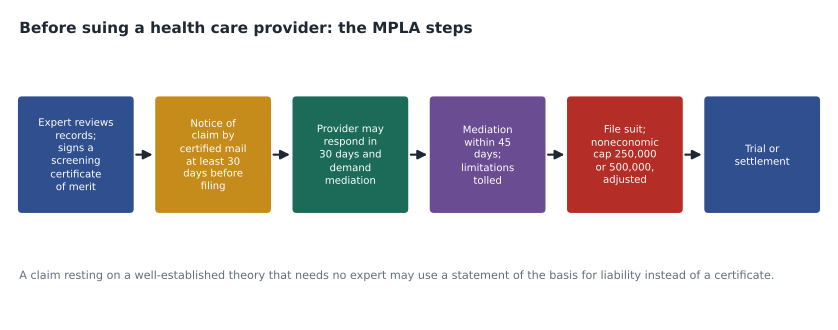
Section 55-7B-6 requires that, at least 30 days before filing a medical professional liability action, the claimant serve each health care provider to be joined with a notice of claim by certified mail, return receipt requested. The notice must state the theories of liability and list all providers and facilities being notified, and it must include a screening certificate of merit. The certificate must be executed under oath by a health care provider qualified as an expert under the rules of evidence who meets the Act's requirements, including spending at least 60 percent of professional time annually in clinical practice or teaching in the relevant field at the time of the injury. It must state with particularity the expert's familiarity with the standard of care, the expert's qualifications, the expert's opinion on how the standard was breached and how the breach caused the injury or death, and a list of the records reviewed. A separate certificate is needed for each provider.
Two variations matter. If the claim rests on a well-established legal theory that does not require expert testimony on the standard of care, the claimant may serve a statement of the basis for liability instead of a certificate. If there is not enough time to obtain a certificate before the limitations period expires, the claimant may serve the notice with a statement of intent to provide a certificate within 60 days of the provider's receipt of the notice, or 120 days for nursing homes, assisted living facilities and certain related providers.
Response, mediation and tolling
A provider may respond in writing within 30 days of receiving the notice, or of receiving the certificate if it came later, stating any bona fide defense and naming its lawyer. A provider may also demand pre-litigation mediation, which must be concluded within 45 days of the demand. The limitations period is tolled from the mailing of the notice until 30 days after the claimant receives a response, 30 days after a response was due, or 30 days after the claimant receives the mediator's notice that mediation ended without settlement, whichever is latest. The notice, certificate, response and mediation results are confidential and generally inadmissible.
The noneconomic damages cap
Section 55-7B-8 caps noneconomic damages in medical professional liability actions. The base cap is 250,000 dollars per occurrence, regardless of the number of plaintiffs or defendants. The cap rises to 500,000 dollars per occurrence for wrongful death; for permanent and substantial physical deformity, loss of use of a limb or loss of a bodily organ system; and for permanent physical or mental injury that permanently prevents the injured person from independently caring for himself or herself and performing life-sustaining activities. Both caps have been adjusted each year since January 1, 2004 by the Consumer Price Index, but total increases may not exceed 150 percent of the original amounts, which sets maximums of 375,000 and 750,000 dollars. A defendant may claim the caps only if it has at least one million dollars per occurrence of medical professional liability insurance covering the injury. The Supreme Court of Appeals upheld the caps against constitutional challenge in MacDonald v. City Hospital (2011).
Applying the Acts together
Sometimes both Acts apply. A claim against a county-owned hospital or a public ambulance authority for negligent medical care may involve both the Governmental Tort Claims Act and the Medical Professional Liability Act. In such a case, a lawyer must satisfy the procedural requirements of both and work out how their damages provisions interact. Verna's advice was to research that interaction carefully for each case, because the answer depends on the defendant, the claim and the current case law.
Worked problem
The ambulance case
A county ambulance authority's ambulance, driven by an employee responding to a call, ran a red light in Bridgeport on September 9, 2026 and struck the client's car. The client has 60,000 dollars in medical bills and lost wages and significant pain.
Show solution
- The authority is likely a political subdivision, so the Governmental Tort Claims Act applies.
- Negligent operation of a vehicle by an employee within the scope of employment is a liability category under section 29-12A-4(c).
- The firm must check the immunities in section 29-12A-5(a) carefully, including any that might relate to emergency response, and any other statute governing emergency vehicles.
- Suit must be filed within two years, by September 9, 2028; noneconomic damages are capped at 500,000 dollars, economic damages are not capped, and no punitive damages are available.
Answer: The claim fits a liability category; the key questions are immunity, the two-year deadline and the damages limits.
Worked problem
The hospital case
The client's mother died after discharge from a private hospital with an infection. The family first consulted the firm 20 months after her death.
Show solution
- A wrongful death claim based on health care services falls under the Medical Professional Liability Act.
- Before filing, the firm must serve a notice of claim with a screening certificate of merit by certified mail at least 30 days before suit.
- Because time is short, the firm may serve the notice with a statement of intent to provide the certificate within 60 days, which starts tolling.
- If liability is proved, noneconomic damages fall under the higher wrongful death cap, as adjusted for inflation, provided the hospital has the required insurance.
Answer: The firm must move at once to serve a compliant notice and secure an expert, then plan around the wrongful death cap.
Common mistakes
MistakeA county ambulance authority can be sued like any private company.
InsteadPolitical subdivisions are governed by the Governmental Tort Claims and Insurance Reform Act.
MistakePunitive damages are available against political subdivisions if conduct is reckless.
InsteadSection 29-12A-7 prohibits them.
MistakeThe noneconomic cap against political subdivisions also limits medical bills.
InsteadOnly noneconomic loss is capped at 500,000 dollars; economic loss is not.
MistakeA medical malpractice suit can be filed first and the certificate supplied later.
InsteadA notice with a certificate, or a statement of intent where allowed, must be served at least 30 days before filing.
MistakeThe MPLA caps are fixed at 250,000 and 500,000 dollars.
InsteadThey are adjusted for inflation, up to maximums of 375,000 and 750,000 dollars.
Practice problems
Work each problem on paper first, then reveal the answer to check.
Which constitutional provision makes the State immune from suit?
Show answer
Article VI, section 35 of the West Virginia Constitution.
What is the limitations period for claims against political subdivisions?
Show answer
Two years after the claim arose or was discovered, whichever is later.
What is the noneconomic damages cap against a political subdivision?
Show answer
500,000 dollars per person.
How many days before filing must an MPLA notice of claim be served?
Show answer
At least 30 days.
Which case upheld the MPLA caps?
Show answer
MacDonald v. City Hospital (2011).
Summary and key terms
- The State has constitutional immunity, but recovery up to insurance limits and the legislative claims process are available.
- Political subdivision claims must fit a section 29-12A-4(c) category and avoid the section 29-12A-5(a) immunities.
- Employees are personally immune unless outside scope, malicious, in bad faith, wanton or reckless, or statutory liability applies.
- Two-year limitations period; noneconomic damages capped at 500,000 dollars; no punitive damages against political subdivisions.
- MPLA claims need a notice of claim with a screening certificate of merit at least 30 days before suit.
- MPLA noneconomic caps of 250,000 and 500,000 dollars are inflation-adjusted up to 375,000 and 750,000 dollars and require one million dollars of insurance.
- political subdivision
- A local public body, such as a county, municipality or county board of education.
- Governmental Tort Claims and Insurance Reform Act
- Chapter 29, article 12A, governing tort claims against political subdivisions.
- Medical Professional Liability Act
- Chapter 55, article 7B, governing claims against health care providers.
- screening certificate of merit
- An expert's sworn statement supporting an MPLA claim, served before suit.
- Legislative Claims Commission
- The body that hears claims against the State and recommends awards to the Legislature.
Lesson quiz · 5 questions
Score 60% or more to complete this lesson.
Create a free account to save your progress, take quizzes and earn a certificate.