
BAR-249 · Lesson 6 of 12 · 22 min
What the exam tests and how West Virginia law appears
▶ Video coming soon A video version of this lesson is on the way.
Lonnie came to the fourth session with a question that had been bothering him at work. Verna Dotson, the senior partner at his firm, had asked him to research a fall at a Clarksburg hardware store, and he had found a West Virginia statute on open and obvious dangers that seemed to settle the case. 'On the MBE,' he said, 'would that statute be the answer?' Hollis said no, and that the reason was one of the most important things a West Virginia candidate can understand. The bar exam West Virginia gives is uniform. It tests the law of no particular state, and West Virginia adds no state-specific test of its own. West Virginia law matters enormously to a West Virginia lawyer, but it is learned in practice, not tested on the exam.
No West Virginia component
Some UBE jurisdictions require applicants to complete a course or test on local law, such as a short online course with a quiz or a separate local exam. NCBE's chart shows that West Virginia has no jurisdiction-specific component for the legacy UBE or for NextGen. The exam is not drafted by the jurisdiction, and West Virginia requires the MBE, the MEE, the MPT and the MPRE. A candidate who passes those, clears character and fitness and meets the other requirements is admitted without any separate test of West Virginia law.
That does not mean West Virginia expects new lawyers to know nothing about its law. It means the state has chosen other tools: the State Bar's mandatory Bridge the Gap program for new admittees, continuing legal education, and the ordinary duty of competence in the Rules of Professional Conduct, which requires every lawyer to learn the law that applies to a client's matter.
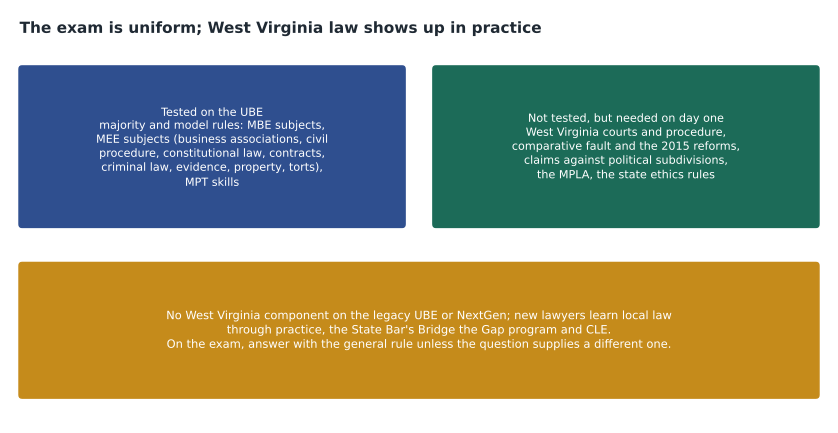
What law the exam uses
The MBE tests generally accepted rules of law. NCBE's subject matter outlines and instructions describe the law to be applied: in most areas, the majority rule or the rule stated in a Restatement or uniform act; for federal subjects, federal law; for evidence, the Federal Rules of Evidence; for civil procedure, the Federal Rules of Civil Procedure and federal statutes. The MEE follows the same approach unless the question tells the candidate otherwise. The MPT supplies its own law in the Library, usually from the fictional State of Franklin and the fictional Fifteenth Circuit.
So the exam answer and the West Virginia answer can differ. Where they do, the exam answer is the general rule, and the candidate should not import West Virginia law into an exam answer unless the question directs it. Hollis put it bluntly: 'On February 23 and 24, you are a lawyer from nowhere in particular.'
Where West Virginia law differs: examples
The differences are easiest to see with examples drawn from the substantive lessons later in this course.
Comparative fault is one. MBE questions on contributory or comparative negligence usually ask about the general approaches: pure comparative negligence, modified comparative negligence with a 50 or 51 percent bar, or traditional contributory negligence, and they tell the candidate which approach applies or test the majority approach. West Virginia's own rule, codified in 2015 at section 55-7-13c of the West Virginia Code, bars a plaintiff only when the plaintiff's fault is greater than the combined fault of all others, and it makes most defendants liable only for their own share. A candidate who answered an MBE question using West Virginia's several-liability rule, when the question assumed traditional joint and several liability, would get it wrong.
Pleading is another. On the MBE and MEE, civil procedure means federal procedure, so a motion to dismiss for failure to state a claim is judged by the plausibility standard of Bell Atlantic v. Twombly and Ashcroft v. Iqbal. West Virginia's own courts have declined to adopt that standard for the state's Rule 12(b)(6): in Mountaineer Fire & Rescue Equipment v. City National Bank (2020), the Supreme Court of Appeals kept its traditional, more lenient notice pleading approach. On the exam, federal plausibility; in a West Virginia circuit court, state notice pleading.
Premises liability is a third, and it answers Lonnie's question. The general common law asks whether a possessor of land owes a duty to protect entrants from dangers that are open and obvious, and many jurisdictions now treat obviousness as a factor in comparative fault rather than as an absolute bar. West Virginia's Legislature enacted section 55-7-28 in 2015, providing that a possessor of real property owes no duty to protect others from dangers that are open, obvious, reasonably apparent or as well known to the injured person as to the possessor, and expressing its intent to restore the doctrine to its status before the 2013 decision in Hersh v. E-T Enterprises. That statute is vital in a West Virginia case and irrelevant on the MBE unless a question supplies it.
| Topic | Exam answer | West Virginia practice |
|---|---|---|
| Comparative fault | The approach the question states, or the majority approach | Plaintiff barred only if fault exceeds all others combined; mostly several liability |
| Pleading standard | Federal plausibility (Twombly and Iqbal) | State notice pleading (Mountaineer Fire & Rescue, 2020) |
| Open and obvious dangers | General common law; often a comparative fault factor | Statutory no-duty rule, section 55-7-28 |
| Punitive damages | Due process limits from the Supreme Court | Also a statutory cap: the greater of four times compensatory or 500,000 dollars |
| Ethics | ABA Model Rules (MPRE) | West Virginia Rules of Professional Conduct, with some differences |
Punitive damages and ethics
Punitive damages show the same pattern. The MBE and MEE may test the federal constitutional limits on punitive awards. West Virginia adds a statutory cap, enacted in 2015 at section 55-7-29: punitive damages may not exceed the greater of four times compensatory damages or 500,000 dollars, and the plaintiff must prove the required misconduct by clear and convincing evidence. On the exam, the constitutional analysis; in a West Virginia case, both.
Ethics differs too, though less. The MPRE tests the ABA Model Rules, and an MEE or MPT question touching ethics would use general principles. West Virginia's Rules of Professional Conduct follow the Model Rules closely, but they contain differences, such as additional requirements for contingent fee agreements and a provision allowing a lawyer to reveal client information to obtain informal ethics advice from the Office of Disciplinary Counsel. Lesson 10 covers them.
When the exam supplies a rule
Sometimes an exam question tells the candidate which rule applies: 'The jurisdiction has adopted a modified comparative negligence statute under which a plaintiff may not recover if the plaintiff's negligence exceeds that of the defendant.' When it does, the candidate applies the stated rule, even if it is not the majority rule and even if it is not West Virginia's rule. The skill tested is applying a given rule to facts. Hollis said that candidates sometimes lose points by ignoring a supplied rule in favor of the one they memorized.
A grader's view
Hollis graded essays for a UBE jurisdiction for several years, and she described what happens when a candidate writes local law into an MEE answer. The grader works from NCBE's analysis and a grading guide that identify the issues and the generally accepted rules. An answer that states a local statute instead of the general rule does not match the guide, so it earns little or no credit for that issue, even if the local rule is perfectly accurate. An answer that states the general rule and then adds a sentence about a local variation does no harm, but the extra sentence earns nothing and costs time.
The same is true of the MPT, where the Library contains all the law the candidate may use. A candidate who cites a real West Virginia case in an MPT answer is not following the instructions. Graders look for the Library's authorities, applied carefully to the File's facts, and an outside authority is at best ignored.
For West Virginia candidates who work in law offices before the exam, as Lonnie does, Hollis suggested a simple habit: when studying a topic, note the general rule in the outline and, separately, note any West Virginia difference encountered at work. On exam day, only the first column matters. After admission, the second column becomes a head start.
Learning West Virginia law after the exam
Hollis suggested that the West Virginia members of the group set aside the local law until after the exam, then learn it deliberately. The tools are good. The West Virginia Code is available free on the Legislature's website. The Supreme Court of Appeals and the Intermediate Court of Appeals publish their opinions on the court system's website. The West Virginia Rules of Civil Procedure, Rules of Evidence, Rules of Appellate Procedure and Trial Court Rules are published by the Court. The State Bar's Bridge the Gap program introduces new lawyers to local practice, and CLE programs cover recent developments.
For a new lawyer like Lonnie, the most important local subjects depend on the practice. In an injury and municipal defense practice, the essentials are the court system and procedure, the 2015 comparative fault and punitive damages statutes, the open and obvious statute, the Governmental Tort Claims and Insurance Reform Act and the Medical Professional Liability Act. Lessons 7 through 10 introduce those subjects, so that Lonnie and other West Virginia candidates have a map of the law they will meet in their first months of practice.
Why this course teaches local law anyway
Lonnie asked why the course covered West Virginia law at all if the exam does not test it. Hollis gave three reasons. First, admission is not the end of the process: the first weeks of practice bring West Virginia questions immediately, and a new lawyer who already has a map learns faster. Second, knowing where West Virginia differs helps on the exam itself, because it tells the candidate exactly which local rules to set aside on exam day. Third, the material is useful for character and fitness interviews and for conversations with employers, who want to know that a new hire understands the state they practice in.
She also pointed out that West Virginia's local law is not exotic. Most of it follows the general common law and the federal rules closely. The differences are concentrated in a few areas, most of them created by statute in recent years, and a new lawyer can learn them quickly with a good map.
Worked problem
Exam answer or West Virginia answer?
An MBE question describes a shopper who slipped on a clearly visible spill in a store, asks whether the store owed a duty and says nothing about any jurisdiction's statute. A month later, Lonnie's firm receives a similar case from a store in Clarksburg.
Show solution
- On the MBE, the candidate applies the general common law on duties to invitees and the role of obviousness, as the question frames it.
- The West Virginia statute is not mentioned and should not be used on the exam.
- In the Clarksburg case, section 55-7-28 is central: if the danger was open and obvious, the possessor owed no duty under the statute.
- Lonnie should also research how West Virginia courts have applied the statute since 2015.
Answer: The same facts produce an exam answer under the general rule and a practice answer under the West Virginia statute.
Worked problem
A supplied rule
An MEE question states that the jurisdiction follows a rule barring a plaintiff whose negligence equals or exceeds the defendant's, and gives facts showing the plaintiff 50 percent at fault.
Show solution
- The question supplies the rule, so the candidate applies it.
- Under the stated rule, a plaintiff at exactly 50 percent is barred.
- Under West Virginia's statute, a plaintiff whose fault equals the others' combined fault is not barred, but that is irrelevant here.
- The answer should state the supplied rule, apply it and conclude that the plaintiff recovers nothing.
Answer: Apply the supplied rule, not the memorized majority rule and not West Virginia's rule.
Common mistakes
MistakeWest Virginia applicants must pass a West Virginia law test.
InsteadNCBE's chart shows no jurisdiction-specific component.
MistakeWest Virginia statutes are the right answer on the MBE for West Virginia takers.
InsteadThe MBE tests generally accepted rules; local statutes apply only if a question supplies them.
MistakeFederal plausibility pleading governs West Virginia circuit courts.
InsteadWest Virginia kept notice pleading in Mountaineer Fire & Rescue (2020).
MistakeA supplied rule can be ignored if it is not the majority rule.
InsteadApply the rule the question gives.
MistakeLocal law can wait until after admission forever.
InsteadCompetence requires learning the law that applies to each matter; start with Bridge the Gap.
Practice problems
Work each problem on paper first, then reveal the answer to check.
Does West Virginia have a jurisdiction-specific component?
Show answer
No.
What law does the MBE apply to civil procedure?
Show answer
Federal law, including the Federal Rules of Civil Procedure.
What did Mountaineer Fire & Rescue (2020) decide?
Show answer
West Virginia declined to adopt the federal plausibility pleading standard.
What does section 55-7-28 provide?
Show answer
A possessor of real property owes no duty to protect against open and obvious dangers.
Where does the MPT get its law?
Show answer
From the Library supplied with the task, often from the fictional State of Franklin.
Summary and key terms
- West Virginia has no state-specific component; it requires the MBE, MEE, MPT and MPRE.
- The exam tests generally accepted rules, federal law for federal subjects and supplied law on the MPT.
- West Virginia differs on comparative fault, pleading, open and obvious dangers, punitive damages and some ethics rules.
- Apply any rule the question supplies; otherwise use the general rule, not West Virginia law.
- Local law is learned through practice, Bridge the Gap and CLE, and the competence duty requires it.
- Lessons 7 to 10 map the West Virginia law a new lawyer meets first.
- jurisdiction-specific component
- A local course or test some UBE jurisdictions require.
- generally accepted rule
- The majority or Restatement rule the MBE and MEE apply.
- notice pleading
- A pleading standard that requires fair notice of the claim rather than plausibility.
- State of Franklin
- The fictional jurisdiction used in many MPT tasks.
- supplied rule
- A rule stated in an exam question that the candidate must apply.
Lesson quiz · 5 questions
Score 60% or more to complete this lesson.
Create a free account to save your progress, take quizzes and earn a certificate.