
BAR-249 · Lesson 7 of 12 · 23 min
West Virginia courts, the Intermediate Court of Appeals and civil procedure
▶ Video coming soon A video version of this lesson is on the way.
In his first month at Varner & Dotson, Lonnie drafted a notice of appeal in a dispute over a commercial lease that the firm had lost in the Circuit Court of Harrison County. He addressed it to the Supreme Court of Appeals, because that was where every West Virginia civil appeal had gone when his professors went to law school. Verna Dotson caught it. 'Not anymore,' she said. 'Since 2022, that goes to the Intermediate Court of Appeals.' Lonnie told the group the story against himself, and Hollis said it was a perfect example of why West Virginia's court structure deserves a lesson of its own. This lesson maps the courts, explains the Intermediate Court of Appeals and introduces the civil procedure rules a new lawyer uses first.
The Supreme Court of Appeals
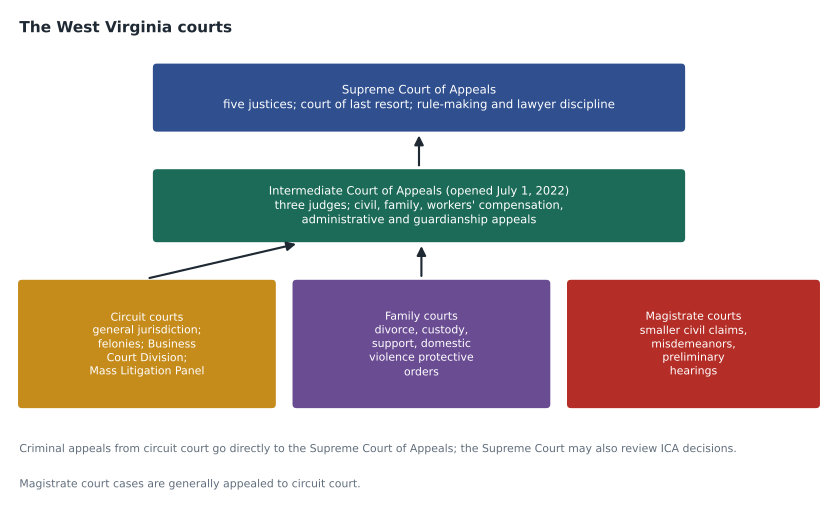
The Supreme Court of Appeals of West Virginia is the state's court of last resort. It has five justices, elected statewide in nonpartisan elections to twelve-year terms, and the justices choose a chief justice who serves for a year at a time. The Court sits in Charleston. Beyond deciding appeals, it has administrative authority over the whole court system, adopts the rules of practice and procedure, regulates admission to the bar and decides lawyer discipline cases, as Lessons 1 and 10 explain.
For decades West Virginia was one of the few states without an intermediate appellate court, so the Supreme Court of Appeals heard appeals from the circuit courts directly. Under rules of appellate procedure adopted in 2010, it moved to deciding every properly filed appeal on the merits with a written decision, rather than refusing review in many cases. That workload was one of the reasons the Legislature created an intermediate court.
The Intermediate Court of Appeals
The Legislature created the Intermediate Court of Appeals in 2021, and the court opened on July 1, 2022. It has three judges. The first three were appointed by the Governor to staggered terms; after that, judges are elected in nonpartisan elections to ten-year terms. A judge must have practiced law for at least ten years, and the judges choose a chief judge for a one-year term. In 2024, Judge Ryan White was elected to a ten-year term beginning January 1, 2025, succeeding Judge Thomas E. Scarr, who retired at the end of 2024.
Under section 51-11-4 of the West Virginia Code, the Intermediate Court of Appeals hears appeals from final orders and judgments in civil cases, family cases, including certain interlocutory appeals concerning 50-50 custody, decisions of the Workers' Compensation Board of Review, administrative matters, and guardianship and conservatorship matters. Criminal appeals and several other categories continue to go directly to the Supreme Court of Appeals. The court's primary location is Charleston, and when it grants oral argument, the argument may be held in person in Charleston or virtually from satellite courtrooms around the state, such as in Beckley, Petersburg, Weston, Berkeley Springs and New Martinsville. Like the Supreme Court, it issues a written decision on the merits in each properly filed appeal within its jurisdiction.
The court's published decisions are binding precedent on the circuit courts, family courts, magistrate courts and state administrative agencies unless the Supreme Court of Appeals overrules or modifies them. A party who loses in the Intermediate Court of Appeals may ask the Supreme Court of Appeals to review the decision, and the higher court decides which cases to take. For a new lawyer, the practical effects are three: civil appeals usually go to the Intermediate Court of Appeals first, its decisions must be researched along with Supreme Court decisions, and a case may pass through two levels of review before it is final.
The trial courts
The circuit courts are West Virginia's trial courts of general jurisdiction. Each county is part of a judicial circuit, and circuit judges are elected in nonpartisan elections. Circuit courts hear civil cases of any size, felony criminal cases and appeals from magistrate courts, among other matters. Within the circuit court system, the Business Court Division handles complex commercial litigation referred to it under the Trial Court Rules, and the Mass Litigation Panel manages mass tort and other mass litigation that involves many plaintiffs and common questions.
The family courts, created after a constitutional amendment approved by voters in 2000, hear divorce, custody, child support, spousal support and domestic violence protective order cases. Family court judges are elected. Appeals from final family court orders now go to the Intermediate Court of Appeals. Magistrate courts in each county hear smaller civil claims, misdemeanors, landlord-tenant matters and preliminary matters in felony cases, such as initial appearances and bail. Magistrates need not be lawyers. Cases from magistrate court are generally appealed to the circuit court.
| Court | Main work | Appeals go to |
|---|---|---|
| Magistrate court | Smaller civil claims, misdemeanors, preliminary hearings | Circuit court |
| Family court | Divorce, custody, support, protective orders | Intermediate Court of Appeals |
| Circuit court (civil) | General civil jurisdiction; Business Court Division | Intermediate Court of Appeals |
| Circuit court (criminal) | Felonies | Supreme Court of Appeals |
| Intermediate Court of Appeals | Civil, family, workers' compensation, administrative, guardianship appeals | Supreme Court of Appeals, on review |
| Supreme Court of Appeals | Court of last resort; rules; discipline | Final in state court |
The rules of procedure
West Virginia's Rules of Civil Procedure are modeled on the Federal Rules of Civil Procedure, and their numbering mostly matches, so a lawyer who learned federal procedure in law school will find much of the state system familiar. The Supreme Court of Appeals adopts and amends them, along with the West Virginia Rules of Evidence, the Rules of Appellate Procedure and the Trial Court Rules, which govern matters such as case management, the Business Court Division and the Mass Litigation Panel. A new lawyer should keep the current versions at hand and check the local practices of the circuit where the case is filed.
Pleading
The most important procedural difference from federal practice concerns pleading. In federal court, a complaint must state a plausible claim under Bell Atlantic v. Twombly (2007) and Ashcroft v. Iqbal (2009). West Virginia has not followed that change. In Mountaineer Fire & Rescue Equipment v. City National Bank (2020), the Supreme Court of Appeals declined to adopt the federal plausibility standard for motions to dismiss under West Virginia Rule 12(b)(6) and kept its traditional approach, under which a complaint survives if it gives fair notice of the claim and the plaintiff could prove facts in support of it. Motions to dismiss therefore succeed less often in West Virginia circuit courts than in federal court, and more cases move on to discovery and summary judgment.
Discovery and summary judgment
Because fewer cases end on a motion to dismiss, discovery and summary judgment carry more of the load in West Virginia circuit courts. The discovery rules track the federal rules in structure, with interrogatories, requests for production, requests for admission and depositions, and the circuit court sets a schedule through a scheduling order. Summary judgment under West Virginia Rule 56 is available when there is no genuine issue of material fact and the moving party is entitled to judgment as a matter of law. A new lawyer should learn the circuit judge's scheduling practices early, because deadlines for expert disclosures and dispositive motions shape the whole case.
Limitations periods
West Virginia's general limitations statutes are in chapter 55, article 2 of the Code. Personal injury claims generally must be brought within two years. Claims on written contracts generally have ten years and claims on oral contracts five. West Virginia applies a discovery rule in many tort cases, under which the period begins when the plaintiff knows, or reasonably should know, of the injury, its cause and the identity of the party responsible. Special periods and notice requirements apply in particular areas, such as claims against political subdivisions and medical professional liability claims, covered in Lesson 9. A new lawyer should calendar the limitations date for every new matter on the first day and should never rely on memory for a period.
Appeals
A civil appeal begins with a notice of appeal filed within the time set by the Rules of Appellate Procedure, generally 30 days after entry of the judgment, with the record and briefs following on a schedule. The appellate courts require a final judgment, with limited exceptions, such as a Rule 54(b) certification of a final judgment as to fewer than all claims or parties, and certain interlocutory matters that statutes or rules allow. In civil cases, the notice of appeal now goes to the Intermediate Court of Appeals unless the case falls outside its jurisdiction. Getting the court wrong, as Lonnie nearly did, can cost time; getting the deadline wrong can cost the appeal.
Reading West Virginia opinions
West Virginia appellate opinions have a feature that surprises lawyers from other states: syllabus points. The West Virginia Constitution requires the Supreme Court of Appeals to prepare a syllabus of the points adjudicated in each case, and the Court states its holdings in numbered syllabus points at the head of a signed opinion. New points of law are announced in the syllabus, and West Virginia lawyers cite syllabus points by number when they rely on a holding. A new lawyer researching an issue should read the syllabus points first, then the opinion for the reasoning behind them.
The Court also decides many appeals by memorandum decision, a shorter written decision used when a case does not call for a new point of law. Memorandum decisions resolve the appeal and can be persuasive, but they carry less weight as precedent than signed opinions with new syllabus points. The Intermediate Court of Appeals issues both published opinions and memorandum decisions as well. When citing West Virginia authority, a lawyer should note which kind of decision it is.
Federal courts in West Virginia
West Virginia has two federal districts, the Northern District and the Southern District, with appeals to the United States Court of Appeals for the Fourth Circuit in Richmond. Federal courts in West Virginia apply the federal plausibility standard and the Federal Rules of Civil Procedure, while applying West Virginia substantive law in diversity cases. A case that can be filed in either system may be pleaded differently depending on the choice, which is one reason defendants sometimes remove cases to federal court.
Practical habits
Verna Dotson gave Lonnie three habits that Hollis repeated to the group. Check the court's jurisdiction before drafting anything, because the 2022 change moved most civil appeals. Calendar every deadline twice, once in the firm's system and once on paper. Read the most recent version of each rule, because the Court amends its rules regularly, and an old practice manual may predate the Intermediate Court of Appeals entirely.
Worked problem
Where does the appeal go?
Varner & Dotson lost a commercial lease case in the Circuit Court of Harrison County. The circuit court entered final judgment on October 15, 2026.
Show solution
- The case is a civil case with a final judgment from a circuit court.
- Under section 51-11-4, appeals from final civil judgments go to the Intermediate Court of Appeals.
- The notice of appeal is generally due within 30 days of entry of the judgment, so by mid-November 2026.
- After the Intermediate Court of Appeals decides, the losing party may ask the Supreme Court of Appeals to review the decision.
Answer: The firm files its notice of appeal in the Intermediate Court of Appeals on time, with possible further review in the Supreme Court of Appeals.
Worked problem
A motion to dismiss
A hypothetical client, Laurelwood Supply, is sued in circuit court by a former distributor whose complaint alleges breach of contract in a few general sentences. Laurelwood's president asks whether the complaint can be dismissed quickly, as he heard happens in federal court.
Show solution
- In federal court, the complaint would be tested under the plausibility standard.
- In a West Virginia circuit court, Mountaineer Fire & Rescue (2020) keeps the more lenient notice pleading approach.
- A complaint that gives fair notice of the contract claim is likely to survive a Rule 12(b)(6) motion.
- The better strategy may be early discovery and a summary judgment motion if the facts favor Laurelwood.
Answer: A quick dismissal is less likely in state court; the firm should plan for discovery and summary judgment.
Common mistakes
MistakeAll civil appeals go directly to the Supreme Court of Appeals.
InsteadSince July 1, 2022, most civil appeals go first to the Intermediate Court of Appeals.
MistakeThe Intermediate Court of Appeals hears criminal appeals.
InsteadCriminal appeals go directly to the Supreme Court of Appeals.
MistakeWest Virginia follows federal plausibility pleading.
InsteadMountaineer Fire & Rescue (2020) declined to adopt it.
MistakeFamily court decisions are appealed to circuit court.
InsteadFinal family court orders are now appealed to the Intermediate Court of Appeals.
MistakePersonal injury claims have a three-year period.
InsteadThe general period for personal injury is two years.
Practice problems
Work each problem on paper first, then reveal the answer to check.
When did the Intermediate Court of Appeals open?
Show answer
July 1, 2022.
How many justices sit on the Supreme Court of Appeals?
Show answer
Five.
Name three kinds of appeals the Intermediate Court of Appeals hears.
Show answer
Civil, family and workers' compensation appeals; also administrative and guardianship matters.
What is the general limitations period for personal injury in West Virginia?
Show answer
Two years.
Which federal court of appeals covers West Virginia?
Show answer
The Fourth Circuit.
Summary and key terms
- The Supreme Court of Appeals has five justices and is the court of last resort, with rule-making and discipline powers.
- The Intermediate Court of Appeals opened July 1, 2022 with three judges and hears civil, family, workers' compensation, administrative and guardianship appeals.
- Criminal appeals go directly to the Supreme Court of Appeals; ICA decisions bind lower courts unless modified.
- Circuit courts are general jurisdiction trial courts; family and magistrate courts handle specific matters.
- West Virginia kept notice pleading in Mountaineer Fire & Rescue (2020).
- Personal injury: two years; written contracts: ten years; oral contracts: five years; notices of appeal generally within 30 days.
- Intermediate Court of Appeals
- West Virginia's appellate court between the circuit courts and the Supreme Court of Appeals, opened in 2022.
- circuit court
- West Virginia's trial court of general jurisdiction.
- Business Court Division
- The part of the circuit court system that handles complex commercial cases.
- Mass Litigation Panel
- The panel of judges that manages mass litigation in West Virginia.
- discovery rule
- The rule that a limitations period begins when the injury and its cause are, or should be, known.
Lesson quiz · 5 questions
Score 60% or more to complete this lesson.
Create a free account to save your progress, take quizzes and earn a certificate.