
BAR-249 · Lesson 11 of 12 · 22 min
Score transfer, admission on motion and practice after admission
▶ Video coming soon A video version of this lesson is on the way.
Verna Dotson was admitted in West Virginia in the 1990s and later also in Ohio and Pennsylvania, because Clarksburg clients do business across state lines. When Lonnie asked how she had done it, she laughed and said the rules had changed several times since then. Hollis offered to walk the group through the current routes. 'Some of you will want a second license someday,' she said, 'and some of you will meet lawyers moving the other way, into West Virginia.' This lesson covers admission by transferred UBE score, admission without examination, the limited admission routes and the duties that begin the day a new lawyer takes the oath.
Admission by transferred UBE score
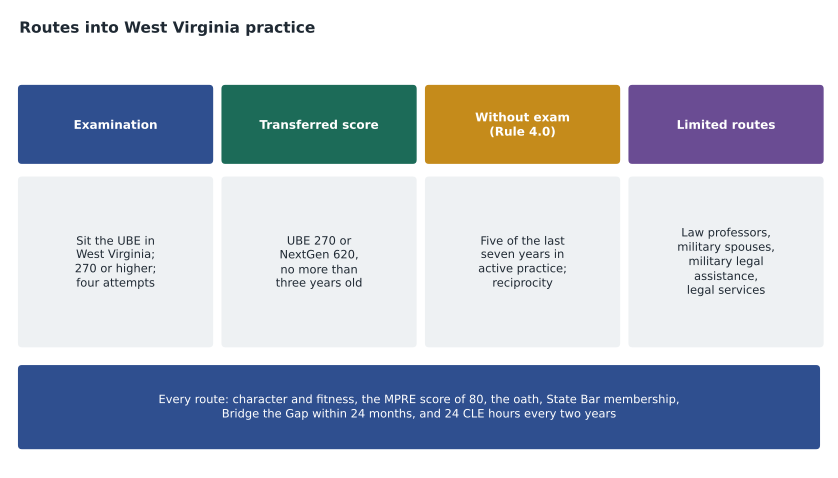
Rule 3.5 allows an applicant who took the UBE in another jurisdiction to seek admission in West Virginia by transferring the score, without sitting the exam again. West Virginia has accepted transferred UBE scores for applications on or after July 1, 2017. The applicant needs a combined scaled UBE score of at least 270, earned on an administration within the three years before the application. Only scores certified by NCBE are accepted, and NCBE's chart notes that a concurrent application for admission by transferred score is not allowed, so an applicant must have the score in hand before applying by this route.
The transfer applicant must also meet the MPRE requirement, a scaled score of 80 earned within the time the rules allow, and must clear character and fitness in the same way as an applicant by examination. The rule has also limited how long a transferred score may be used once an application is filed, so an applicant should complete the process promptly. NCBE's 2026 chart lists the fee for admission by transferred UBE score as 750 dollars, plus the character and fitness fee.
During the NextGen transition, the Court has also approved transfers of NextGen scores. As Lesson 5 explained, a NextGen score of 620 or higher is treated as equivalent to a legacy UBE score of 270, and West Virginia began accepting NextGen transfer scores starting with the July 2026 exam. NCBE's chart also reports that West Virginia accepts transferred MBE scores from other jurisdictions; an applicant who wants to rely on an MBE score earned elsewhere should check with the Board how that works for the West Virginia exam.
| Requirement | Admission by transferred score (Rule 3.5) |
|---|---|
| Score | Legacy UBE 270 or higher, or NextGen 620 or higher |
| Age of score | From an exam within three years before the application |
| Certification | Only NCBE-certified scores |
| MPRE | Scaled 80 within the rules' time window |
| Character | Full character and fitness review |
| Fee (NCBE chart) | 750 dollars plus the character fee |
Admission without examination
Rule 4.0 allows an experienced lawyer licensed elsewhere to be admitted without taking an exam in West Virginia. The applicant must show the Board an intention to practice law in West Virginia on at least a minimal basis. The applicant must have been lawfully and actively engaged in the practice of law for five of the seven years before applying, and must have held a valid license from some state throughout that five-year period. And at least one state in which the applicant was admitted must have had admission standards that were, both when the applicant was admitted and now, substantially equivalent to West Virginia's standards. That last requirement is the reciprocity condition, and the Board publishes a list of jurisdictions that qualify.
The rule defines active practice carefully. Practice must be substantial, motivated by earning a livelihood, and active and continuous. Work as a lawyer for the military or a government agency counts while the lawyer's primary duties are legal. Service as a judge or hearing officer in a position open only to lawyers counts, as does full-time teaching at a law school. NCBE's chart adds that lawyers initially admitted by diploma privilege elsewhere are eligible, that an ABA-approved JD is not required for this route and that an MPRE time limit applies. Under Rule 4.4, as amended in June 2026, the Board may accept an MPRE score from another jurisdiction or from a prior exam taken within 36 months of the application, if the applicant asks. NCBE's chart lists the fee for admission on motion as 2,000 dollars.
Limited routes
The Court's rules also provide narrower forms of admission. Resident professors of law at a West Virginia law school may be admitted under Rule 4.6. Rule 4.7 provides temporary admission for military spouse attorneys who are in West Virginia because of a service member's assignment. Rule 4.8 addresses lawyers providing military legal assistance. Rule 9.0 allows limited permission to practice for lawyers working for indigent legal services or public defender programs. Each has its own conditions and limits, and none is a substitute for full admission for a lawyer who intends to practice generally in the state.
Lawyers licensed elsewhere who need to appear in a single West Virginia case may seek permission to appear pro hac vice under the court rules, usually with local counsel. That is permission for one case, not admission.
The oath and the State Bar
Once the Board certifies an applicant to the Clerk of the Supreme Court of Appeals, the applicant takes the oath, often at a ceremony arranged by the Board's staff, and is admitted. The new lawyer must then be an active member of the West Virginia State Bar, which is an integrated bar, and pay annual dues. Lawyers who are not practicing may choose inactive status under the State Bar's rules, with different obligations.
Continuing legal education
West Virginia lawyers must complete 24 hours of continuing legal education in each two-year reporting period. At least 3 of those hours must be in legal ethics, office management, substance abuse or elimination of bias, a category that recent descriptions also extend to attorney well-being. The period ends on June 30 of each even-numbered year, and the lawyer then reports the hours to the State Bar by its reporting deadline. Up to 6 general hours, but not ethics hours, may be carried over to the next period. Courses may be taken live or on demand, subject to the State Bar's limits on certain formats.
Bridge the Gap
New admittees must complete the State Bar's Bridge the Gap program. Under the CLE rules, as amended effective July 1, 2018, the program must be completed within six months before admission or within twenty-four months after admission; before that amendment, the post-admission window was twelve months. The State Bar sponsors the program, offers it free to new admittees, presents it at least twice a year, including at the State Bar's annual meeting, and records it at least once a year. New lawyers receive CLE credit for completing it. Lawyers who have been admitted elsewhere for at least five years, or who completed another state's mandatory new-lawyer program of at least seven credits, may seek an exemption.
| Duty after admission | Rule |
|---|---|
| State Bar membership and dues | Active membership in the integrated bar |
| CLE | 24 hours every two years, at least 3 in ethics, office management, substance abuse or elimination of bias |
| Reporting period | Ends June 30 of even-numbered years |
| Carryover | Up to 6 general hours |
| Bridge the Gap | Within 6 months before or 24 months after admission; free |
Planning a second license
Lonnie asked how he could add another state later. Hollis explained the options. Within three years of his February 2027 exam, he could transfer his UBE score to another UBE jurisdiction, if his score meets that jurisdiction's passing score and the jurisdiction accepts legacy scores at the time; with a passing West Virginia score, the first condition is satisfied everywhere, since no UBE jurisdiction requires more than 270. After five years of practice, admission on motion becomes available in many jurisdictions, subject to each jurisdiction's own reciprocity rules. Some neighboring states may not use the UBE in the same way, so he should check each state's rules before relying on a transfer.
The mechanics of a transfer are simple once the decision is made. The candidate asks NCBE to send a score transcript to the receiving jurisdiction, files that jurisdiction's application and pays its fees. The receiving jurisdiction runs its own character and fitness review, and may require its own local law course or test. Hollis suggested keeping a copy of the official West Virginia score notice with the admission file for exactly this reason.
Working across state lines without a second license
A second license is not always necessary. Rule 5.5 of the Rules of Professional Conduct, in West Virginia as elsewhere, allows lawyers admitted in one jurisdiction to provide some legal services in another on a temporary basis in limited circumstances, such as work associated with local counsel, work reasonably related to a pending or anticipated proceeding in which the lawyer is authorized to appear, and some matters arising out of the lawyer's practice at home. Those exceptions are narrow and fact-specific. A lawyer who regularly represents clients in another state, or who holds out as practicing there, needs a license there.
For a Clarksburg firm, the issue arises often. A client with a business dispute in Ohio may need Ohio counsel for litigation even if Verna can advise on the West Virginia aspects. Federal courts have their own admission rules, so admission to practice in the federal courts of West Virginia is a separate application, usually straightforward for a lawyer admitted in the state.
Keeping a license in good standing
Admission is the start of a career-long relationship with the Court and the State Bar. A lawyer keeps a license in good standing by paying dues on time, completing and reporting CLE, keeping contact information current with the State Bar, complying with the Rules of Professional Conduct and responding to any inquiry from the Office of Disciplinary Counsel. Missed dues and unreported CLE can lead to administrative suspension, which is not discipline but still bars practice until the lawyer is reinstated. Hollis told the group to set reminders for every recurring deadline on the day they are sworn in.
Moving to West Virginia
The same rules work in reverse for lawyers who move to West Virginia. A recent graduate who passed the UBE elsewhere with 270 or more within the last three years can transfer the score. An experienced lawyer with five of the last seven years in practice can seek admission without examination if the reciprocity condition is met. A lawyer who meets neither condition must sit the West Virginia exam. In every case, the applicant must clear character and fitness and meet the MPRE requirement.
Worked problem
Transferring a score in
A hypothetical lawyer, Etta Nester, sat the UBE in another state in July 2025 and scored 274. She moves to Morgantown in November 2026 and wants to be admitted in West Virginia. Her MPRE score of 88 was earned in March 2025.
Show solution
- Her score of 274 exceeds West Virginia's 270.
- July 2025 is within three years of a November 2026 application.
- Her MPRE of 88 exceeds 80, and its date falls well within the current timing rules.
- She applies under Rule 3.5 with the 750-dollar fee and the character fee, and must clear character and fitness.
Answer: Etta can seek admission by transferred UBE score without sitting the exam again.
Worked problem
Admission without examination
A hypothetical lawyer, Bonnie Sizemore, has practiced full time in a neighboring state since 2017 and plans to open an office in Parkersburg in 2027. She took that state's bar exam in 2017.
Show solution
- She has practiced actively for more than five of the last seven years and has been licensed throughout.
- She must show an intention to practice in West Virginia on at least a minimal basis.
- Her admitting state's standards must be substantially equivalent to West Virginia's; she checks the Board's reciprocity list.
- She needs a qualifying MPRE score under Rule 4.4 and must clear character and fitness; the fee is 2,000 dollars.
Answer: If her state is on the reciprocity list, Bonnie can seek admission under Rule 4.0 without an exam.
Common mistakes
MistakeA transferred UBE score never expires.
InsteadIt must be from an exam within three years before the application.
MistakeAny lawyer with five years of practice can be admitted without examination.
InsteadRule 4.0 also requires reciprocity, intent to practice and a valid license throughout.
MistakeBridge the Gap must be completed within twelve months of admission.
InsteadSince July 1, 2018, the window is twenty-four months after admission, or six months before.
MistakeWest Virginia lawyers need 12 CLE hours a year reported annually.
InsteadThe requirement is 24 hours per two-year period ending June 30 of even years.
MistakePro hac vice is a form of full admission.
InsteadIt is permission for a single case.
Practice problems
Work each problem on paper first, then reveal the answer to check.
What UBE score is needed to transfer into West Virginia?
Show answer
A combined scaled score of 270 or higher.
How old may a transferred UBE score be?
Show answer
From an exam within the three years before the application.
What practice requirement applies under Rule 4.0?
Show answer
Active practice for five of the seven years before applying.
How many CLE hours must a West Virginia lawyer complete, and how often?
Show answer
24 hours every two years.
When must Bridge the Gap be completed?
Show answer
Within six months before or twenty-four months after admission.
Summary and key terms
- Rule 3.5: transfer a UBE score of 270 or more (or NextGen 620 or more) from an exam within three years, with NCBE certification.
- Transfer applicants still need the MPRE score of 80 and character clearance; the fee is 750 dollars.
- Rule 4.0: five of the last seven years in active practice, a license throughout, intent to practice and reciprocity; the fee is 2,000 dollars.
- Limited routes cover law professors, military spouses, military legal assistance and legal services lawyers.
- After admission: State Bar membership, 24 CLE hours every two years with 3 in ethics-related subjects, June 30 of even years.
- Bridge the Gap: within six months before or twenty-four months after admission, free of charge.
- transferred UBE score
- A UBE score earned in one jurisdiction and used for admission in another.
- admission without examination
- Admission under Rule 4.0 based on experience and reciprocity.
- reciprocity
- Admission conditioned on the other jurisdiction's substantially equivalent standards.
- pro hac vice
- Permission to appear in a single case without full admission.
- Bridge the Gap
- The State Bar's mandatory program for new admittees.
Lesson quiz · 5 questions
Score 60% or more to complete this lesson.
Create a free account to save your progress, take quizzes and earn a certificate.