
BAR-249 · Lesson 10 of 12 · 23 min
The West Virginia Rules of Professional Conduct and lawyer discipline
▶ Video coming soon A video version of this lesson is on the way.
Lonnie scored 96 on the MPRE, so he expected the ethics rules to be the easy part of practice. Then Verna asked him to draft a contingent fee agreement for a new injury client and to make sure it complied with West Virginia's version of Rule 1.5. He pulled up the ABA Model Rule he had studied and was about to copy its requirements when Verna stopped him. 'Our rule is close to the Model Rule,' she said, 'but close is not the same.' This lesson explains where the West Virginia Rules of Professional Conduct come from, the kinds of differences from the Model Rules a new lawyer should check, how client money is handled and how the discipline system works.
Where the rules come from
The Supreme Court of Appeals adopts the West Virginia Rules of Professional Conduct under its authority to regulate the practice of law. Like most states, West Virginia based its rules on the ABA Model Rules of Professional Conduct, and it has revised them over time to reflect later Model Rule amendments. In 2014, the Court undertook a comprehensive revision. It published proposed revisions for public comment by order of April 14, 2014, with comments due in June 2014, and it later entered a final order on September 29, 2014, followed by a list of formal and typographical corrections. The current rules are published on the court system's website, with comments.
The structure is the Model Rules' structure: a preamble and scope section, definitions in Rule 1.0, and rules grouped under the client-lawyer relationship, counselor, advocate, transactions with persons other than clients, law firms, public service, information about legal services and maintaining the integrity of the profession. A lawyer who knows the Model Rules can navigate the West Virginia rules immediately. The work lies in checking the specific text when a question matters.
Kinds of differences to check
West Virginia's rules depart from the Model Rules in places, and the 2014 revision as proposed for comment shows the kinds of changes the Court considered. A new lawyer should check the current text of each of the following areas rather than assuming the Model Rule applies.
Fees are the first area. The 2014 proposal would have required that changes in the basis or rate of a fee be communicated to the client in writing; would have required a contingent fee agreement to notify the client clearly of any expenses for which the client will be liable whether or not the client prevails; and would have added a provision on fee division between lawyers in contingent fee referrals, addressing when the requirements of services performed and joint responsibility are satisfied. Those subjects are exactly where a West Virginia fee agreement should be checked line by line against the current Rule 1.5.
Confidentiality is the second. The 2014 proposal would have allowed a lawyer to reveal client information to the extent reasonably necessary to obtain informal ethics advice from the Office of Disciplinary Counsel, an addition specific to West Virginia's system, in addition to the Model Rule's exception for securing legal advice about compliance with the rules. A lawyer who calls the Office of Disciplinary Counsel for informal guidance should know where the authority to share client information for that purpose comes from.
The comments are the third. The proposal changed 'should' to 'must' in several comments, including the comment on keeping abreast of changes in the law and the comment on controlling a lawyer's workload. Comments do not themselves add obligations under the rules' scope section, but the stronger wording signals how seriously West Virginia treats competence and diligence.
| Area | What to check in West Virginia | Why it matters |
|---|---|---|
| Rule 1.5 (fees) | Writing requirements; notice of expenses in contingent fee agreements; referral fee division | Fee agreements are a common source of complaints |
| Rule 1.6 (confidentiality) | Disclosure to obtain informal ethics advice from the Office of Disciplinary Counsel | Seeking advice should not itself breach confidentiality |
| Comments to Rules 1.1 and 1.3 | Stronger wording on competence and workload | Signals expectations in discipline cases |
| Rule 1.15 and State Bar rules | Trust account and IOLTA requirements | Mishandling client money leads to the most serious sanctions |
| Advertising rules | The current West Virginia text | Advertising rules vary widely by state |
The MPRE and the West Virginia rules
Lonnie asked whether he had wasted his time learning the Model Rules for the MPRE. Hollis said no. The MPRE tests the Model Rules, and on that exam the Model Rule answer is the right one. In practice, the Model Rules give a West Virginia lawyer about 95 percent of the answer; the last five percent is reading the West Virginia text and the Court's decisions applying it. 'The danger is not ignorance,' she said. 'The danger is confidence.'
Client money
Rule 1.15 requires a lawyer to hold property of clients and third persons that is in the lawyer's possession in connection with a representation separate from the lawyer's own property. Client funds go into a trust account, the lawyer keeps complete records, and the lawyer must promptly deliver funds the client is entitled to receive and promptly account for them. When the lawyer and client both claim an interest in funds, the disputed amount stays in trust until the dispute is resolved.
In West Virginia, the State Bar's administrative rules, including the rule governing interest on lawyers' trust accounts, add requirements for how trust accounts are set up and maintained. Funds that are nominal in amount or held for a short time go into a pooled interest-bearing account, with the interest supporting legal services for people who cannot afford a lawyer; larger or longer-held funds may go into separate interest-bearing accounts for the client's benefit. A new lawyer opening a practice or handling client funds for the first time should read the current State Bar rule and set up the accounts correctly from the start.
Hollis was blunt about why this matters. Across the country, misappropriation of client funds is the conduct most likely to end a lawyer's career, and courts treat it with great severity even when the lawyer intended to repay. Commingling, sloppy records and borrowing from the trust account 'just until Friday' are the beginnings of the cases that end in loss of a license.
The discipline system
Lawyer discipline in West Virginia is governed by the Rules of Lawyer Disciplinary Procedure, adopted by the Supreme Court of Appeals. The Office of Disciplinary Counsel receives complaints, investigates them and prosecutes formal charges. The Lawyer Disciplinary Board, made up of lawyers and members of the public, acts through panels: an Investigative Panel reviews the results of investigations and decides whether formal charges should be brought, and a Hearing Panel Subcommittee hears contested cases and makes recommendations. The Supreme Court of Appeals makes the final decision on discipline.
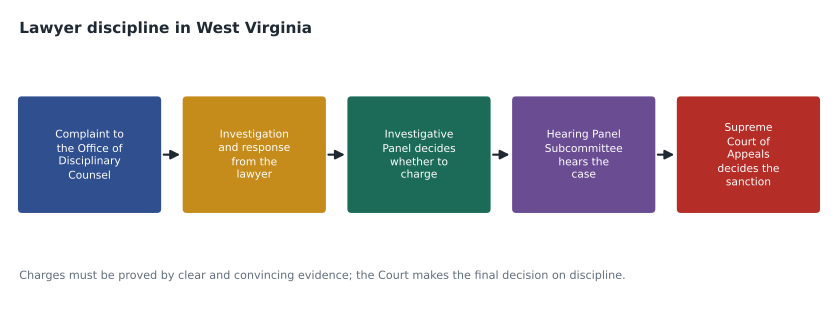
Formal charges must be proved by clear and convincing evidence. The available sanctions range from admonishment and reprimand through probation, restitution, supervised practice and suspension to annulment of the lawyer's license, which is West Virginia's term for what other states call disbarment. In choosing a sanction, the Court considers the duty violated, the lawyer's mental state, the actual or potential injury caused and any aggravating or mitigating factors, such as prior discipline, cooperation and remorse.
Most complaints never reach a hearing. Many are dismissed because they do not allege a violation, such as a client's disagreement with the outcome of a case. Others end with an informal resolution. The complaints that lead to serious sanctions usually involve dishonesty, neglect of client matters over time, or client money.
Practical habits for a new lawyer
Verna gave Lonnie a short list. Use written engagement letters for every matter, stating the scope of the representation and the fee. For contingent fees, use a form checked against the current West Virginia Rule 1.5, and give the client a written statement at the end of the case showing the outcome and the calculation. Run a conflict check before accepting any new client or new matter. Answer client calls and letters promptly, and keep clients informed. Never put client money in the operating account, and reconcile the trust account every month. When an ethics question arises, read the rule, then ask: West Virginia lawyers can seek informal guidance, and asking early is far better than explaining later.
Before admission: working as a law clerk
Lonnie's own position raised an ethics question the group found useful. Until he is admitted, he is not a lawyer, and he may not practice law. He can research, draft documents and attend meetings under the supervision of the firm's lawyers, but he may not give legal advice to clients on his own, sign pleadings, appear in court as counsel or set fees. The responsibility runs to the firm too: under Rule 5.3, lawyers with supervisory authority must make reasonable efforts to ensure that a nonlawyer assistant's conduct is compatible with the lawyers' professional obligations, and under Rule 5.5 a lawyer may not assist another person in the unauthorized practice of law.
In practice, that means Lonnie introduces himself to clients as a law clerk, not as an attorney, and routes every question calling for legal judgment to Verna or another lawyer. Hollis said candidates in his position should be careful in casual settings as well. A friend who asks what to do about a dispute should be pointed to a lawyer, not given advice over dinner, until the oath is taken.
Conflicts of interest
Conflicts deserve special attention from new lawyers, because they arise in ordinary work. Rule 1.7 prohibits representing a client whose interests are directly adverse to another current client, or where there is a significant risk that the representation will be materially limited by duties to others or by the lawyer's own interests, unless the conditions for informed consent are met. Rule 1.9 protects former clients. Rule 1.10 generally imputes one lawyer's conflict to the whole firm. A firm that handles both injury claims and municipal defense, like Varner & Dotson, must check carefully before suing a county or city that it represents in other matters.
Help for lawyers
Many discipline cases begin with problems outside the law, such as substance use, depression or overwhelming stress, that lead to missed deadlines and unreturned calls. West Virginia, like other states, offers confidential assistance to lawyers and judges dealing with such problems, and the State Bar's continuing legal education requirement includes credit for programs on substance abuse and well-being. Hollis told the group that seeking help is a sign of responsibility, not weakness, and that it protects both the lawyer and the clients.
Worked problem
Drafting the contingent fee agreement
A new client, a hypothetical Glenna Hedrick, retains Varner & Dotson on a one-third contingent fee to pursue an injury claim. Lonnie drafts the agreement.
Show solution
- A contingent fee agreement must be in writing, signed by the client, and state the method of calculating the fee, including the percentages at each stage.
- It must state the litigation expenses to be deducted and whether they come out before or after the fee is calculated.
- Lonnie checks the current West Virginia Rule 1.5 for any added requirements, such as clear notice of expenses the client will owe whether or not she wins.
- At the end of the matter, the firm gives Glenna a written statement of the outcome and the calculation of her recovery.
Answer: Lonnie starts from the Model Rule structure but finalizes the agreement against the current West Virginia text.
Worked problem
A trust account temptation
A hypothetical lawyer, Orval Burdette, receives a 30,000-dollar settlement for a client and deposits it in his trust account. His operating account is short on payroll day, and he moves 4,000 dollars from trust to operating, planning to replace it when a fee arrives next week.
Show solution
- The 4,000 dollars belongs to the client, not to Orval.
- Moving it to the operating account is conversion of client funds, whatever his intention to repay.
- Rule 1.15 requires client property to be kept separate and safeguarded.
- Misappropriation of client funds is among the most serious violations and can lead to suspension or annulment of the license.
Answer: Orval has violated Rule 1.15 and faces severe discipline; intent to repay does not cure misappropriation.
Common mistakes
MistakeWest Virginia's rules are identical to the Model Rules.
InsteadThey follow the Model Rules closely but differ in places; read the current state text.
MistakeThe Board of Law Examiners handles lawyer discipline.
InsteadThe Office of Disciplinary Counsel, the Lawyer Disciplinary Board and the Supreme Court of Appeals do.
MistakeDisbarment is the most serious sanction in West Virginia.
InsteadWest Virginia calls it annulment of the license.
MistakeBorrowing from trust is acceptable if repaid quickly.
InsteadIt is misappropriation of client funds regardless of intent to repay.
MistakeDiscipline charges are proved by a preponderance of evidence.
InsteadThey must be proved by clear and convincing evidence.
Practice problems
Work each problem on paper first, then reveal the answer to check.
Who adopts the West Virginia Rules of Professional Conduct?
Show answer
The Supreme Court of Appeals.
Which office investigates and prosecutes lawyer discipline cases?
Show answer
The Office of Disciplinary Counsel.
What standard of proof applies to formal charges?
Show answer
Clear and convincing evidence.
What is West Virginia's term for disbarment?
Show answer
Annulment of the license.
What does Rule 1.15 require for client funds?
Show answer
That they be kept separate in a trust account, with complete records, and promptly delivered and accounted for.
Summary and key terms
- The Supreme Court of Appeals adopts the rules, based on the ABA Model Rules and comprehensively revised in 2014.
- Check the West Virginia text on fees, confidentiality and other areas where it may differ from the Model Rules.
- The MPRE tests the Model Rules; practice requires the West Virginia rules.
- Client funds go into trust accounts under Rule 1.15 and the State Bar's trust account rules; misappropriation brings the harshest sanctions.
- Discipline: the Office of Disciplinary Counsel, an Investigative Panel, a Hearing Panel Subcommittee and the Supreme Court of Appeals.
- Charges require clear and convincing evidence; sanctions range from admonishment to annulment.
- Office of Disciplinary Counsel
- The office that investigates complaints and prosecutes discipline cases.
- Lawyer Disciplinary Board
- The board that acts through investigative and hearing panels in discipline cases.
- annulment
- West Virginia's term for revoking a lawyer's license, similar to disbarment.
- trust account
- A bank account holding client and third-party funds separate from the lawyer's own.
- misappropriation
- Using client funds for an unauthorized purpose.
Lesson quiz · 5 questions
Score 60% or more to complete this lesson.
Create a free account to save your progress, take quizzes and earn a certificate.