
BAR-248 · Lesson 8 of 12 · 20 min
Washington torts: pure comparative fault, several liability, no punitive damages and claims against government
▶ Video coming soon A video version of this lesson is on the way.
Tessa's diagnostic practice sets kept producing the same kind of error. On a torts question about a plaintiff who was 60 percent at fault, she chose the answer that let the plaintiff recover 40 percent of her damages. The answer key, applying the modified comparative negligence rule most states use and the exam tests by default, said the plaintiff recovered nothing. 'That's Washington,' she told Marchetti. 'In Washington she'd get 40 percent.'
'You're right about Washington and wrong about the exam,' Marchetti said. 'Washington's tort law is different from the majority rule in at least four ways that matter every day in practice, and every one of them is a trap on the national exam. Learn them as Washington rules, so you can switch them off on February 23.'
This lesson covers the four Washington tort rules a new lawyer uses most: pure comparative fault, several liability with its exceptions, the rule against punitive damages, and the waiver of sovereign immunity with its claim-filing requirements. It also covers the Consumer Protection Act, which often travels with tort claims, and the constitutional limit on damages caps.
Pure comparative fault
Washington abolished contributory negligence as a complete bar in 1973 and now applies pure comparative fault under RCW 4.22.005. Any contributory fault chargeable to the claimant diminishes the claimant's damages in proportion to the claimant's percentage of fault, but does not bar recovery. A plaintiff found 90 percent at fault still recovers 10 percent of her damages. The statute applies to fault in any form, including negligence, recklessness and strict liability, and to assumption of risk in most of its forms, which is treated as a form of fault rather than a separate defense, except for express assumption of risk by agreement.
Pure comparative fault is the minority rule in the United States. Most states use modified comparative fault, in which a plaintiff who is more at fault than the defendants (or, in some states, equally at fault) recovers nothing. The national exam generally tests the majority approaches and states which rule applies when it matters. A Washington candidate who instinctively applies pure comparative fault will get some exam questions wrong.
Several liability, with exceptions
The second Washington rule concerns how liability is shared among several defendants. Under RCW 4.22.070, the trier of fact determines the percentage of total fault attributable to every entity that caused the claimant's damages, including the claimant, defendants, third-party defendants, entities released by the claimant, and entities with individual defenses against the claimant. The only entities left out of the allocation are those immune from liability to the claimant under Title 51 RCW, the industrial insurance (workers' compensation) statute. The percentages must total 100. Judgment is entered against each defendant only for its own share, and the statute states that the liability of each defendant shall be several only and shall not be joint, subject to exceptions.
The exceptions are where Washington cases are won and lost. First, a party is responsible for the fault of another person or for the share of another party if they were acting in concert or if the other person was the party's agent or servant. Second, if the claimant was not at fault, the defendants against whom judgment is entered are jointly and severally liable for the sum of their proportionate shares of the claimant's total damages. Third, the statute does not apply to certain claims, including claims relating to hazardous wastes or substances and solid waste disposal sites, claims for tortious interference with contracts or business relations, and claims arising from the manufacture or marketing of a fungible product in a generic form without a clearly identifiable shape, color or marking.
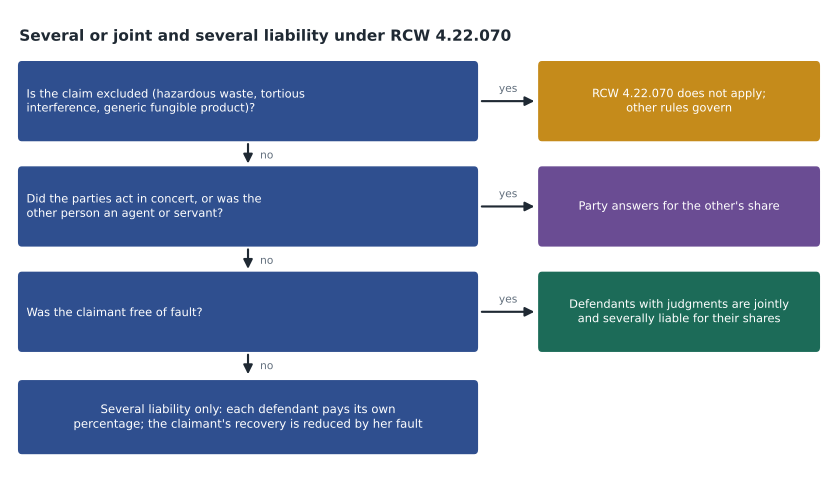
The fault-free plaintiff exception is the one new lawyers meet most often. A passenger injured in a two-car collision is usually without fault. If the jury finds Driver A 70 percent at fault and Driver B 30 percent, both drivers are jointly and severally liable for the whole of the passenger's damages, so the passenger can collect everything from Driver A if Driver B is uninsured. A driver who was 10 percent at fault does not get the benefit of that exception; she recovers from each defendant only that defendant's share.
No punitive damages without a statute
The third Washington rule surprises lawyers from almost every other state. Washington does not allow punitive damages unless a statute expressly authorizes them. The rule dates to the state's earliest decisions, including Spokane Truck & Dray Co. v. Hoefer in 1891, and the Supreme Court has repeatedly reaffirmed it. In Dailey v. North Coast Life Insurance Co., decided in 1996, the Court applied the rule to the Washington Law Against Discrimination, holding that the statute's reference to remedies under federal civil rights law was not the express legislative authorization needed for punitive damages.
Some Washington statutes do authorize enhanced or exemplary damages, often as multiples of actual damages. The Consumer Protection Act allows a court to increase damages up to three times the actual damages, subject to a dollar cap, for injury to business or property. The Insurance Fair Conduct Act allows a court to increase damages up to three times actual damages when an insurer unreasonably denies a claim for coverage or payment of benefits. Other statutes, such as some employment and landlord-tenant provisions, provide double damages or statutory penalties. But in an ordinary negligence or intentional tort case under Washington law, there are no punitive damages, however egregious the conduct. A Washington plaintiff's lawyer builds the damages case on compensatory damages, including noneconomic damages.
Choice of law can change the result. When the conduct and the parties have connections to another state that allows punitive damages, a Washington court applying the most significant relationship test may apply the other state's law on that issue. That analysis is case-specific and beyond this lesson.
No cap on noneconomic damages
The fourth difference concerns limits on damages. In Sofie v. Fiberboard Corp., decided in 1989, the Supreme Court of Washington held that a statute capping noneconomic damages violated the right to trial by jury in the Washington Constitution, because determining the amount of damages is part of the jury's constitutional role. Washington therefore has no general cap on noneconomic damages, including in medical negligence cases, unlike many states that cap pain and suffering in malpractice actions.
| Issue | Common national rule | Washington rule |
|---|---|---|
| Plaintiff's own fault | Modified comparative fault (barred above 50 percent in many states) | Pure comparative fault, RCW 4.22.005 |
| Several defendants | Varies; joint and several common | Several only, with exceptions, RCW 4.22.070 |
| Punitive damages | Available for malice or reckless indifference | Not available unless a statute authorizes them |
| Noneconomic damages cap | Common in malpractice | Struck down in Sofie v. Fiberboard (1989) |
The Consumer Protection Act
The Washington Consumer Protection Act, chapter 19.86 RCW, prohibits unfair or deceptive acts or practices in trade or commerce. A private plaintiff must prove the five elements set out in Hangman Ridge Training Stables, Inc. v. Safeco Title Insurance Co., decided in 1986: an unfair or deceptive act or practice, occurring in trade or commerce, that affects the public interest, injury to the plaintiff's business or property, and causation. A prevailing plaintiff recovers actual damages, costs and reasonable attorney fees, and the court may increase the damages up to three times, subject to a statutory dollar cap on the increase. Personal injury damages are not injury to business or property, so a CPA claim does not replace a tort claim for bodily harm. The fee-shifting provision is the reason CPA claims appear in so many Washington complaints involving consumer transactions, insurance and real estate.
Claims against the state and local governments
Washington waived sovereign immunity by statute in the 1960s. RCW 4.92.090 makes the state liable for damages arising out of its tortious conduct to the same extent as if it were a private person or corporation, and RCW 4.96.010 makes local governmental entities, such as counties, cities and school districts, liable in the same way. The waiver is broad, but it comes with procedural requirements and with judge-made doctrines that limit liability in certain kinds of cases.
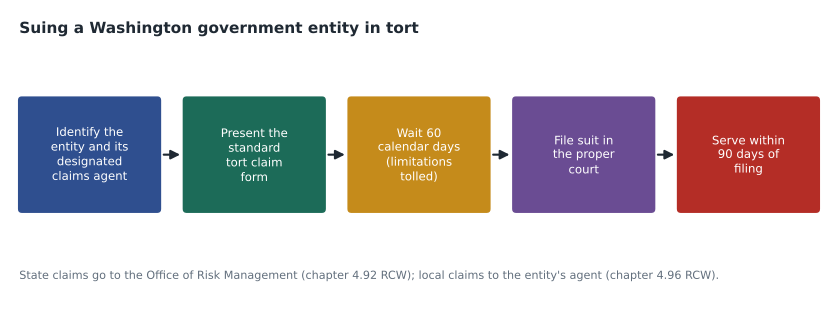
The procedural requirement is a pre-suit claim. Before suing the state, a claimant must present a claim on the standard tort claim form to the state's Office of Risk Management. Before suing a local government, a claimant must present a claim to the agent the entity has designated to receive claims. The claim must contain the information the statute requires, such as the time and place of the incident, the nature of the injury and the amount of damages claimed. No action may be filed until 60 calendar days have passed after the claim is presented, and the statute of limitations is tolled during that 60-day period. A lawyer who files suit on day 59 has filed too early, and a lawyer who waits until the last week of the limitations period to present the claim has no margin for error.
The judge-made limit is the public duty doctrine. When a government owes a duty only to the public at large, such as a general duty to enforce building codes or to respond to emergencies, a single injured person usually cannot sue for breach of that duty unless an exception applies, such as a special relationship, legislative intent to protect a particular class, failure to enforce after actual knowledge of a violation, or the rescue doctrine. Washington courts have narrowed and debated the doctrine over the years, and it does not apply where the government acts as an ordinary actor, such as a city bus driver who causes a collision.
Worked problem
Allocating fault in a Yakima intersection crash
A city of Yakima maintenance truck ran a red light and struck a car driven by Petra Brightman, whose passenger, Mirela Voskuijl, was injured. Petra was speeding. A jury finds the city 75 percent at fault and Petra 25 percent. Mirela's damages are 400,000 dollars; Petra's own damages are 200,000 dollars. What can each recover, and from whom?
Show solution
- Mirela was not at fault, so under RCW 4.22.070(1)(b) the city and Petra are jointly and severally liable for the sum of their shares, which is her full 400,000 dollars. She may collect it all from the city.
- Petra was 25 percent at fault, so under pure comparative fault her damages are reduced by 25 percent, to 150,000 dollars, recoverable from the city as the only other at-fault party.
- Neither plaintiff may recover punitive damages, because no statute authorizes them for negligent driving.
- Before filing suit, each plaintiff must present a claim to the city's designated agent and wait 60 days, with the limitations period tolled during the wait.
Answer: Mirela recovers 400,000 dollars, collectible in full from the city; Petra recovers 150,000 dollars; no punitive damages; both must use the claim process first.
Common mistakes
MistakeA Washington plaintiff more than 50 percent at fault recovers nothing.
InsteadWashington uses pure comparative fault; her recovery is reduced, not barred.
MistakeEvery defendant is jointly and severally liable.
InsteadLiability is several only under RCW 4.22.070, unless an exception applies, such as a fault-free plaintiff.
MistakePunitive damages are available for egregious conduct.
InsteadWashington allows them only when a statute expressly authorizes them.
MistakeWashington caps pain and suffering in malpractice cases.
InsteadSofie v. Fiberboard (1989) struck the cap under the state jury right.
MistakeA claimant can sue a city the day after presenting the claim.
InsteadThe claimant must wait 60 calendar days; the limitations period is tolled meanwhile.
MistakeA CPA claim covers bodily injury.
InsteadThe CPA requires injury to business or property.
Putting the rules together
Washington's tort rules work as a set. A plaintiff's lawyer evaluating a case asks, in order: who was at fault and in what shares, including the client and any immune or released entities; whether the client was free of fault, which decides whether joint and several liability is available; whether any defendant is a government entity, which triggers the claim process; and what damages are available, which excludes punitive damages unless a statute applies. A defense lawyer asks the same questions from the other side, often focusing on allocating fault to other entities, including those not sued, to reduce the client's share.
That last point is distinctive. Because RCW 4.22.070 requires the jury to allocate fault to every entity that caused the damages, other than Title 51 immune employers, a defendant may argue that an absent or settling party bears much of the fault. A plaintiff who settles with one defendant must therefore think carefully about how that party's share will be allocated at trial.
Workers' compensation and employers
When a worker is injured on the job, Washington's industrial insurance statute in Title 51 RCW generally provides the exclusive remedy against the employer, with a narrow exception for injuries the employer deliberately intended. The worker may still sue third parties, such as the manufacturer of a defective machine or a driver from another company, and the employer's immunity is why RCW 4.22.070 leaves Title 51 immune employers out of the fault allocation.
Summary and key terms
- Washington applies pure comparative fault under RCW 4.22.005.
- Under RCW 4.22.070 liability is several only, with joint and several liability for a fault-free plaintiff and for concert or agency, and exclusions for certain claims.
- Punitive damages are unavailable unless a statute authorizes them (Dailey, 1996); some statutes allow treble or double damages.
- Sofie v. Fiberboard (1989) bars caps on noneconomic damages under the state jury right.
- The state and local governments are liable like private parties, but a claim must be presented and 60 days must pass before suit.
- 0
- pure comparative fault
- 1
- several liability
- 2
- fault-free plaintiff
- 3
- punitive damages
- 4
- Consumer Protection Act
- 5
- Hangman Ridge elements
- 6
- sovereign immunity waiver
- 7
- claim filing
- 8
- public duty doctrine
Practice problems
Work each problem on paper first, then reveal the answer to check.
What does a Washington plaintiff who is 70 percent at fault recover?
Show answer
Thirty percent of her damages, under pure comparative fault.
When are Washington defendants jointly and severally liable under RCW 4.22.070?
Show answer
When the claimant was not at fault, when they acted in concert or as agent or servant, and in the excluded categories of claims.
Can a Washington jury award punitive damages in a drunk driving case?
Show answer
Not unless a statute authorizes them; Washington's general rule bars punitive damages.
How long must a claimant wait after presenting a claim to a local government before suing?
Show answer
Sixty calendar days.
Lesson quiz · 5 questions
Score 60% or more to complete this lesson.
Create a free account to save your progress, take quizzes and earn a certificate.