
BAR-248 · Lesson 11 of 12 · 19 min
Score transfer, admission by motion, the APR 6 Law Clerk Program and practice after admission
▶ Video coming soon A video version of this lesson is on the way.
Gerrit's reason for sitting a February 2027 courtesy seat was simple. Ferro & Quintanilla has clients on both sides of the Columbia River, and he would like eventually to be admitted in Oregon. His Washington license, obtained by court order under the August 2026 waiver, does not come with a NextGen score that Oregon can evaluate. Tessa had the opposite question: if she passes in Washington in February, what could she do with her score elsewhere, and how soon could she move to another state on motion if her career took her there? Marchetti used both questions to walk through the routes in and out of Washington.
This lesson covers admission to Washington by transferred UBE score and by motion, how a Washington score travels, the APR 6 Law Clerk Program in more depth, and the duties that begin at admission: licensing, MCLE and the rest of a Washington lawyer's annual obligations.
Coming in: admission by transferred UBE score
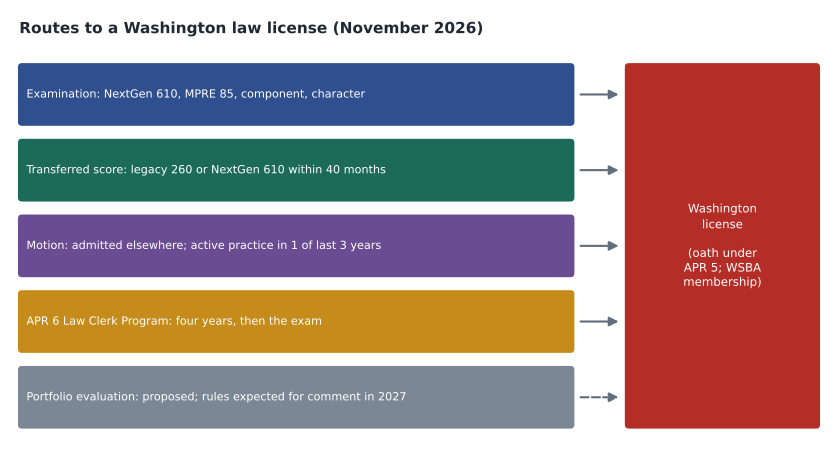
Washington accepts transferred UBE scores. According to NCBE's guide, an applicant may transfer a legacy UBE score of at least 260 or a NextGen score of at least 610, earned in another jurisdiction within the preceding 40 months. Washington accepts NextGen transfers from July 2026. It does not accept a transferred MBE score alone. Concurrent applications are allowed, so a candidate may apply in Washington on a score while also applying elsewhere. A transfer applicant must still meet Washington's education requirements, pass character and fitness review and pass the Washington Law Component within one year of filing.
The 40-month window runs from the exam at which the score was earned. A candidate who scored 265 on the Oregon UBE in July 2024 has until roughly November 2027 to apply in Washington on that score. Washington also does not require an applicant on a transferred score to have practiced law.
Coming in: admission by motion
APR 3(c)(1) allows admission without examination for a lawyer admitted in another state, territory or the District of Columbia who provides satisfactory proof of admission and current good standing and of active legal experience for at least one of the three years immediately preceding the filing of the application. NCBE's guide describes the qualifying experience broadly, including law teaching, work for a government agency, military service, in-house corporate work and judicial service in a court of record. Washington's motion rule does not require graduation from an ABA-approved law school and is not limited by reciprocity: a lawyer from a state that would not admit a Washington lawyer on motion can still be admitted on motion in Washington. Lawyers first admitted elsewhere by diploma privilege are eligible.
A motion applicant files the application with supporting documents, including certificates of admission and good standing from every jurisdiction where the applicant has been admitted, good moral character certificates and an authorization and release, with documents dated within six months before the application. NCBE conducts a character and fitness investigation. The applicant must pass the Washington Law Component and complete the other preadmission requirements within one year from filing under APR 5(b); otherwise the applicant must file a new application and pay a new fee. APR 3(c)(2) provides a separate route for military spouses.
| Route | Key Washington requirements |
|---|---|
| Transferred UBE score | Legacy 260 or NextGen 610, earned within 40 months; Washington Law Component within one year of filing |
| Admission by motion | Admitted and in good standing elsewhere in the United States; active legal experience in at least one of the three years before filing; no reciprocity requirement |
| Military spouse | Separate provision in APR 3(c)(2) |
| Exam after APR 6 | Four-year Law Clerk Program qualifies the clerk to sit |
Going out: how a Washington score travels
A Washington NextGen score is portable to other jurisdictions that accept NextGen transfers, subject to each jurisdiction's minimum score and time limit. Most NextGen jurisdictions set passing scores between 610 and 620. A candidate who passes in Washington with a score near 610 may meet the minimum in a few states but not in others. A candidate who wants options should aim higher than the Washington passing score.
Gerrit's courtesy seat illustrates the point from the other direction. Because he was admitted without a score, he has nothing to transfer. A February 2027 score of 620 or more would let him apply in Oregon on a transferred score within Oregon's time limit, subject to Oregon's other requirements. Admission by motion in Oregon would be another option later, once he has the practice experience Oregon's own rule requires. Each state's rules, not Washington's, decide whether his Washington license or score is enough.
Some jurisdictions accept NextGen transfers only from a later date, and some do not accept them at all. A Washington candidate planning to practice in another state should check that state's rules before choosing where to sit, not after.
The APR 6 Law Clerk Program in practice
Lesson 2 introduced the APR 6 Law Clerk Program. Its structure deserves a closer look because Washington is one of very few states that offers it, and because the proposed pathways project includes a route for clerks. A clerk must hold a bachelor's degree, find a primary tutor who is a lawyer or judge with at least ten years of active experience, and enroll with the WSBA. The program lasts four years and requires at least 32 hours a week of work and study, with at least three hours a week of personal supervision by the tutor. The clerk follows a course of study set by the program, with periodic examinations and tutor reports, and pays an annual fee, currently listed at 2,000 dollars. Advanced standing may be granted for some law school courses, but not for undergraduate study, paralegal work or employment experience. A clerk who completes the program may sit the Washington bar exam. The Court amended APR 6 effective September 1, 2026.
A clerk's path has advantages and limits. The clerk earns while learning and avoids law school debt, and many clerks find employment with their tutors. But a clerk who passes the Washington exam may find that other states do not admit lawyers who did not attend law school, by exam or on motion, so a clerk's license is often a Washington license only unless another state's rules say otherwise.
Practice after admission: licensing and MCLE
Admission begins a set of annual duties. A Washington lawyer must complete the annual licensing process with the WSBA, pay the license fee and Client Protection Fund assessment, disclose trust account and professional liability insurance information, and keep contact information current.
The MCLE requirement under APR 11 is 45 credits every three years for active lawyers. At least 15 credits must be in law and legal procedure, and at least six must be in ethics and professional responsibility, including at least one equity credit, a requirement that took effect beginning with the 2023-2025 reporting period. A lawyer may carry forward up to 15 excess credits, including up to two ethics credits, to the next period, and may not earn more than eight credits in a single day. Credits must be earned by December 31 of the third year of the reporting period and certified by February 1 of the following year. Late compliance triggers late fees that start at 150 dollars and increase for each consecutive late period, and continued noncompliance leads to suspension. The rules assign each newly admitted lawyer to a reporting period and provide how the first period works; a new lawyer should check the assignment on the WSBA's MCLE page soon after admission.
| MCLE item | Washington requirement |
|---|---|
| Total | 45 credits every three years |
| Law and legal procedure | At least 15 credits |
| Ethics | At least 6 credits, including at least 1 equity credit |
| Carryover | Up to 15 credits, including up to 2 ethics credits |
| Daily limit | No more than 8 credits a day |
| Deadlines | Earn by December 31 of year three; certify by February 1 |
Worked problem
Three questions about mobility
Marchetti puts three short questions to Tessa. (1) Margit Delacorte, a Montana lawyer admitted in 2019, practiced full time until 2023, stopped to care for a parent, and returned to practice in January 2026. Can she seek admission by motion in Washington if she files in December 2026? (2) Emil Ostergaard scored 612 on the Washington NextGen exam in September 2026. Can he use that score in a state requiring 620? (3) A clerk who completes APR 6 and passes the Washington exam asks whether she can be admitted on motion in another state five years later.
Show solution
- Margit: she needs active legal experience for at least one of the three years immediately before filing. Practice from January to December 2026 gives her close to one year; she should count carefully and confirm with the WSBA, but her earlier years are outside the window and do not help. She also needs good standing, the documents and the Washington Law Component.
- Emil: no. A state requiring 620 applies its own minimum; 612 passes in Washington only.
- The clerk: it depends on the other state's motion rule. Many states require graduation from an ABA-approved law school for admission on motion, so she must read that state's rule.
Answer: Washington's motion rule is generous but strict about the look-back window; scores and licenses travel only as far as the receiving state's rules allow.
Common mistakes
MistakeWashington admits on motion only lawyers from reciprocal states.
InsteadWashington's motion rule is not limited by reciprocity.
MistakeA motion applicant needs five years of practice.
InsteadAPR 3(c)(1) requires active legal experience in at least one of the three years before filing.
MistakeA Washington passing score works anywhere.
InsteadEach receiving state applies its own minimum and time limit; many require 616 or 620.
MistakeWashington accepts a transferred MBE score.
InsteadIt does not; it accepts UBE scores only.
MistakeMCLE is 15 credits a year with no special categories.
InsteadIt is 45 credits every three years, with at least 15 in law and legal procedure and 6 in ethics, including 1 equity credit.
Choosing where to sit
Candidates who expect to practice in more than one state often ask where to sit first. The answer depends on each state's rules on transfer and motion, on its passing score and on its timing. A candidate who sits in a state with a 610 passing score and scores 612 is admitted there but cannot transfer to a state requiring 620. A candidate who sits in a state requiring 620 and passes has a score that meets the minimum almost everywhere that accepts transfers. Washington candidates who plan to practice in Oregon, Idaho or Alaska, the most common second states for lawyers in the Pacific Northwest, should check each state's current rules before the first exam.
Motion is the other route. Washington's own motion rule is generous, but other states' rules are often stricter, commonly requiring several years of practice and sometimes reciprocity. A Washington lawyer planning a move should read the receiving state's motion rule early in her career, so that she knows how many years of practice she will need and whether her Washington license will count.
The annual rhythm of a Washington license
Marchetti gave Tessa a one-page calendar for her first years of practice. Each year: the license fee and licensing form by the WSBA's deadline, with trust account and insurance disclosures; a check that the address and email on file are current; monthly trust account reconciliation if she holds client money. Each reporting period: track MCLE credits as she earns them, including the ethics and equity credits, earn them by December 31 of the third year, and certify by February 1. Ongoing: report any change that the WSBA's rules require, and respond promptly to any communication from the WSBA.
Gerrit's next steps
Gerrit's own plan for 2027 combines the threads of this lesson. He will sit the February 2027 courtesy seat and aim above 620. If he reaches that score, he will look at applying in Oregon on the transferred score within Oregon's time limit, which would let him appear for clients across the river. If he does not, he will consider Oregon's motion rule later, once he has the years of practice it requires. In the meantime he is a Washington lawyer with a full set of duties: licensing, MCLE and a trust account he reconciles every month.
Keeping a career record
A lawyer who may one day seek admission on motion elsewhere should keep a simple record from the start: dates of each job, the nature of the practice, hours if a receiving state measures them, and the names of supervisors who can confirm the work. Receiving states often ask for detailed proof of practice years later, and reconstructing it is much harder than recording it as it happens. Gerrit started his record in his first week at the firm.
Summary and key terms
- Transferred scores: legacy 260 or NextGen 610, within 40 months; no MBE-only transfers.
- Motion: admission and good standing elsewhere plus active experience in one of the last three years; no reciprocity requirement.
- Every transfer and motion applicant must pass the Washington Law Component within one year of filing.
- The APR 6 Law Clerk Program is four years under a ten-year tutor; other states may not admit clerks later.
- MCLE: 45 credits every three years, 15 law and legal procedure, 6 ethics including 1 equity; certify by February 1.
- 0
- transferred UBE score
- 1
- admission by motion
- 2
- APR 3(c)(1)
- 3
- good standing
- 4
- portability
- 5
- courtesy seat
- 6
- MCLE
- 7
- reporting period
- 8
- equity credit
Practice problems
Work each problem on paper first, then reveal the answer to check.
What practice does Washington's motion rule require?
Show answer
Active legal experience for at least one of the three years immediately before filing.
How old may a transferred UBE score be?
Show answer
No more than 40 months.
How many MCLE credits must a Washington lawyer earn, and how often?
Show answer
Forty-five credits every three years.
Why might an APR 6 clerk's license not travel?
Show answer
Many states require an ABA-approved law degree for admission, including on motion.
Lesson quiz · 5 questions
Score 60% or more to complete this lesson.
Create a free account to save your progress, take quizzes and earn a certificate.