
BAR-248 · Lesson 5 of 12 · 19 min
Exam changes: the 2024-2026 reforms, the Yakima cancellation and licensure pathways
▶ Video coming soon A video version of this lesson is on the way.
No state's bar admission rules changed as much between 2024 and 2026 as Washington's. Tessa had followed the news in pieces: a headline saying the bar exam was no longer required, a classmate's post about a lower passing score, the July 2026 exam failing in Yakima, and friends admitted without testing. Marchetti spent a full session putting the pieces in order, with Gerrit filling in the July part from personal experience.
'Every change has an order behind it,' Marchetti said. 'If you read the orders in sequence, the story is less confusing than the headlines. And the headlines got the most important point wrong. Washington has not stopped requiring the bar exam. It has said it will build other paths, and it has not finished building them.'
This lesson walks through the reforms in order, explains the July 2026 disruption and the Court's response, and sets out where the alternative pathways stand.
Before 2024: the UBE and the 270 score
Washington began giving the Uniform Bar Examination in July 2013. For most of the period that followed, its passing score was 270 on the 400-point UBE scale, among the higher passing scores in the country. During the COVID-19 pandemic, the Court temporarily lowered the passing score to 266 and, for a time, offered a diploma privilege to some graduates. The score returned to 270 for exams beginning in February 2023.
March 2024: a lower score and alternatives in concept
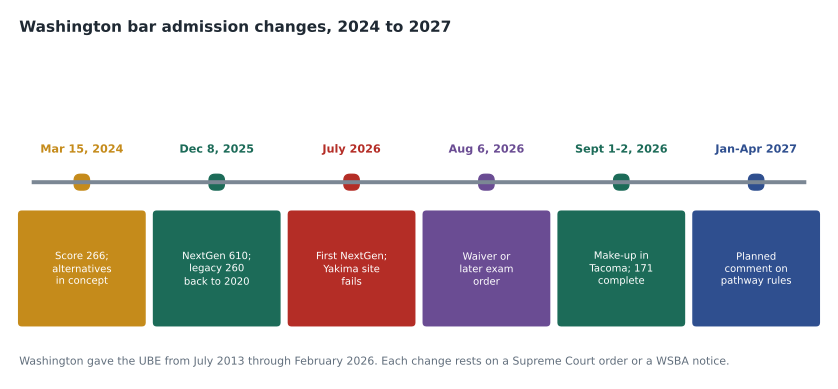
On March 15, 2024, the Court issued two orders. The first lowered the UBE passing score from 270 back to 266 and applied the change retroactively to the February 2023 exam, so that candidates who had scored 266 to 269 since then could be admitted on those scores. The second adopted, in concept, the recommendations of the Washington Bar Licensure Task Force for alternatives to the bar exam. The Court's announcement criticized the traditional exam as disproportionately and unnecessarily blocking marginalized groups from the profession and as at best minimally effective at ensuring competence. Those orders produced the headlines that said Washington no longer required a bar exam.
The 2024 concept described three alternatives, each built on supervised practice rather than a test. As reported at the time, law graduates would complete a six-month apprenticeship under a qualified lawyer plus standardized coursework; law students would complete 500 hours as licensed legal interns, 12 qualifying skills credits and a portfolio of work; and APR 6 law clerks would complete 500 hours as licensed legal interns plus additional standardized materials and benchmarks under their tutors. The Court directed the WSBA to work out an implementation plan and rules. Nothing in the March 2024 orders made those routes available immediately.
December 2025: NextGen and the 260 and 610 scores
In Order No. 25700-B-747, dated December 8, 2025, the Court took three further steps. It confirmed that the final legacy UBE in Washington would be the February 2026 exam and that the NextGen exam would begin in July 2026. It set the passing score for NextGen at 610. And it set the passing score for the February 2026 legacy exam at 260, which it described as equivalent to 610, and applied 260 retroactively to every Washington UBE from July 2020 through July 2025. Candidates who scored 260 to 265 during that period could apply for admission on that score within one year of the order, under instructions from the WSBA. That window closes in December 2026.
July 2026: the Yakima cancellation
The first NextGen exam was given in late July 2026 in ten jurisdictions. Washington had scheduled about 700 candidates, most of them at the Yakima Convention Center. NCBE later described a venue-specific infrastructure issue at Yakima that prevented the jurisdiction from completing testing. The WSBA canceled the administration for affected candidates because it could not be confident that the site's problems were fully resolved. NCBE reported that its platform performed as designed elsewhere, with delays at sites in two other states, and that it would review each site's problems before describing their causes. The WSBA announced that it would pursue a full, independent review with NCBE.
Gerrit was in the Yakima room. He described the morning to Tessa without drama: a long wait, announcements that the start would be delayed, and then the instruction that the session would not go ahead. 'The worst part was not knowing what came next,' he said. 'Nobody in the room could tell us whether we'd be sitting in a week or in February.'
The August 6, 2026 order
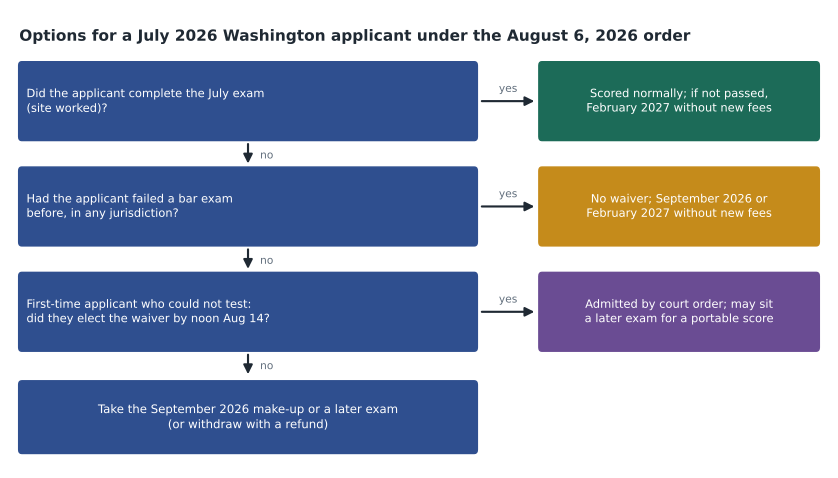
On August 6, 2026, by a majority vote, the Court adopted a resolution. First-time applicants who could not take the July exam because of the technology failure were given a choice: take a Washington NextGen exam in September 2026 or later, or accept a waiver of the bar exam requirement and be admitted by court order. The election had to reach the WSBA by noon on August 14, 2026, and it was binding. An applicant who made no election would not be admitted by court order. An applicant who chose the waiver could not sit the September exam, but could later sit a future exam at their own expense to earn a portable NextGen score.
Applicants who had previously failed a bar exam in any jurisdiction were not eligible for the waiver. They could register for the September 2026 or February 2027 exam without paying another WSBA application fee or NCBE exam fee. Applicants who completed the July exam, because their site worked, were not eligible for the waiver or the September exam; their exams were scored normally, and those who did not pass could sit in February 2027 without the additional fees. The Court directed that admission by court order take effect on the same date as admission for the July and September exam takers, and that the WSBA's admission list, published on or after October 12, 2026, not show how anyone had been admitted. All other licensing requirements remained in effect.
The Court's statement explained that it had considered other options, including conditional admission through January 31, 2028, a diploma privilege with added continuing legal education, and requiring every affected applicant to retake the exam without extra fees, and that no option fully satisfied everyone. When the WSBA asked the Court to reconsider for applicants who were not eligible for the waiver, the Court announced on August 14 that its order would stand.
Other relief and the September make-up
The WSBA added practical relief. Affected applicants could choose a fee-waived make-up exam on September 1 and 2, 2026, at the University of Washington Tacoma, a fee-waived transfer to the February 2027 exam, or withdrawal with a full refund. Under Order No. 25700-B-754, certain applicants could ask for an extension of, or a new, Rule 9 legal intern license through July 31, 2027. The WSBA also opened a process to reimburse eligible exam-related expenses, such as nonrefundable travel, lodging and change fees. NCBE reported that the September make-up went smoothly: 172 candidates sat and 171 completed all required sections and received official, portable NextGen scores, released on the same day and on the same scale as the July scores.
Applicants admitted by waiver, or who chose that option, may sit the 2027 Washington exam as a courtesy seat to earn a portable NextGen score, paying a registration fee and a technology fee. Registration for those seats opened on October 9, 2026. Gerrit took one.
The pathways: where things stand in November 2026
The alternatives adopted in concept in March 2024 are still being built. The WSBA convened a Licensure Pathways Implementation Steering Committee, with subcommittees working on the law-graduate apprenticeship, the law-school experiential pathway, the APR 6 law clerk pathway and alternative assessments. The WSBA now describes the result as admission by portfolio evaluation. On April 1, 2026, the steering committee approved suggested amendments to the APR. The WSBA's page states that the pathway and the amendments have not yet been adopted by the Court, that the Court plans to publish proposed rules for comment beginning in January 2027, and that comments are due April 30, 2027.
For a candidate, that means three things. No one can be admitted through a portfolio pathway on the date of this course. The final requirements may differ from the 2024 concept, so a student planning to use a pathway should not rely on the hours or credits reported in 2024. And the comment period is public: students, lawyers and law schools can comment on the proposed rules.
| Date | Action | Effect |
|---|---|---|
| March 15, 2024 | Orders 25700-B-710 and 711 | UBE score 270 to 266 (back to February 2023); alternatives adopted in concept |
| December 8, 2025 | Order 25700-B-747 | NextGen from July 2026 at 610; legacy 260 back to July 2020 |
| Late July 2026 | First NextGen exam | Canceled for most Yakima candidates |
| August 6, 2026 | Court order | Waiver or later exam for first-time affected applicants |
| September 1-2, 2026 | Make-up exam in Tacoma | 171 candidates complete |
| January to April 2027 | Planned comment period | Proposed portfolio pathway rules |
Worked problem
Which rule applies?
Three people ask Marchetti for advice in November 2026. Siobhan Lachaise scored 263 on the Washington UBE in July 2022 and was not admitted. Emil Ostergaard, who failed the Oregon exam in 2025, was scheduled at Yakima in July 2026 and could not test. A second-year law student wants to know whether she can skip the bar exam through the portfolio pathway when she graduates in 2028.
Show solution
- Siobhan: under Order 25700-B-747, a 260 or higher on a Washington UBE from July 2020 through July 2025 is a passing score. She may apply for admission on her 263, but she must apply within one year of the December 8, 2025 order, under the WSBA's instructions, and complete the other requirements.
- Emil: because he had failed a bar exam before, he was not eligible for the waiver. He could sit in September 2026 or February 2027 without paying the WSBA application fee or NCBE exam fee again.
- The law student: the pathway has not been adopted. She should follow the 2027 comment period and the final rules, and plan to sit the NextGen exam unless and until a pathway is adopted that fits her.
Answer: Each answer depends on a specific order and its dates. Siobhan has a real but closing opportunity; Emil had fee relief but not the waiver; the student has only a proposal.
Common mistakes
MistakeWashington abolished the bar exam in 2024.
InsteadThe Court adopted alternatives in concept in 2024; the bar exam remains required until a pathway is adopted.
MistakeEveryone affected in July 2026 was admitted without an exam.
InsteadOnly first-time applicants who could not test and who elected the waiver by the August 14 deadline were admitted by court order.
MistakeAdmission by waiver gives a portable score.
InsteadIt gives a Washington license only; a waiver admittee who wants a portable score must sit a later exam.
MistakeThe 260 retroactive score has no deadline.
InsteadApplications based on 260 to 265 scores were due within one year of the December 8, 2025 order.
MistakeThe pathway requirements are settled at 500 hours and a portfolio.
InsteadThose were 2024 concepts; proposed rules are expected in 2027 and may differ.
Lessons for a February 2027 candidate
Marchetti drew three practical lessons from the July disruption for Tessa. First, read every notice from the WSBA as soon as it arrives, because the notices for the February exam will reflect what the WSBA learned in July and September. Second, prepare for delays and changes, not just for the exam: know what to do if the start is late, keep food and water with you, and keep the phone number and email for admissions handy. Third, keep your own records, including registration confirmations, payment receipts and travel bookings, because relief such as the expense reimbursement process required documentation.
She also reminded Tessa that the disruption was a site failure, not a failure of the exam itself. NCBE reported that the platform worked at most sites, and the make-up exam in Tacoma ran without administration-level problems. The best response to July is careful preparation for February, not anxiety about it.
Following the comment period
When the Court publishes the proposed pathway rules, the text will appear on the Court's website with instructions for submitting comments. Law students who might use a pathway, lawyers who might supervise apprentices and law schools that would offer experiential programs all have a stake in the details: the number of supervised hours, who may supervise, how portfolios are evaluated and how a pathway license would be treated in other states. Reading the proposed rules, rather than secondhand summaries, is the only way to know what they say.
Summary and key terms
- March 2024: the score went from 270 to 266, retroactive to February 2023, and alternatives were adopted in concept.
- December 2025: NextGen from July 2026 at 610; the final legacy exam (February 2026) at 260, retroactive to July 2020.
- July 2026: the exam failed at the Yakima Convention Center; the August 6 order gave first-time affected applicants a waiver or a later exam.
- A September 1-2 make-up in Tacoma went smoothly; waiver admittees can sit a 2027 courtesy seat for a portable score.
- Admission by portfolio evaluation is not yet adopted; proposed rules are expected for comment in early 2027.
- 0
- retroactive score
- 1
- Bar Licensure Task Force
- 2
- adopted in concept
- 3
- exam waiver
- 4
- admission by court order
- 5
- make-up exam
- 6
- courtesy seat
- 7
- portfolio evaluation
Practice problems
Work each problem on paper first, then reveal the answer to check.
What did the March 15, 2024 orders do?
Show answer
Lowered the UBE passing score to 266, retroactive to February 2023, and adopted alternatives to the bar exam in concept.
Who was eligible for the August 2026 waiver?
Show answer
First-time applicants who could not take the July 2026 exam because of the technology failure and who elected the waiver by noon on August 14.
When are proposed pathway rules expected to be published for comment?
Show answer
Beginning in January 2027, with comments due April 30, 2027.
What can a waiver admittee do to get a portable score?
Show answer
Sit a later Washington exam, such as a 2027 courtesy seat, at their own expense.
Lesson quiz · 5 questions
Score 60% or more to complete this lesson.
Create a free account to save your progress, take quizzes and earn a certificate.