
BAR-248 · Lesson 2 of 12 · 20 min
Eligibility, education, deadlines and fees
▶ Video coming soon A video version of this lesson is on the way.
Tessa's second call with Marchetti was about paperwork. She had filed her February 2027 application in early October, but a classmate graduating at the same time had not filed yet, and Tessa wanted to know what would happen to him. Gerrit joined part of the call to describe what his own file had needed before July, and Marchetti brought along an example from her files: a candidate she called Maelle Adair, who had studied law in France and wanted to know whether Washington would let her sit.
'The eligibility rules decide whether you may sit,' Marchetti said. 'The deadlines and fees decide whether you will. Most problems in this part of the process are self-inflicted. People file late, or they assume that a rule from another state applies, or they treat the application as a form instead of a sworn statement.'
This lesson covers who may apply under APR 3, the education routes Washington accepts, the filing deadlines for the February and July exams, the fees, accommodations and the practical habits that keep an application on track.
Who may apply: the basic qualifications
APR 3 sets out who may apply for admission as a lawyer. An applicant for admission by examination must have the required legal education and must show good moral character and fitness to practice. The education requirement is the one that most often raises questions, because Washington accepts more routes than many states do.
The ordinary route is a J.D. from a law school approved by the American Bar Association. Washington is not, however, limited to ABA graduates. NCBE's comprehensive guide lists several other routes Washington accepts for exam eligibility: graduation from some non-ABA law schools, in state or out of state, with additional study at an ABA-approved school; completion of the APR 6 Law Clerk Program, which is law office study under a tutor; and, for graduates of foreign law schools, a combination of additional education at an ABA-approved law school and, in some cases, practice in the foreign jurisdiction. An LL.M. or other graduate law degree from an ABA-approved school can also play a role for some foreign-trained applicants. Each route has specific conditions in APR 3, and the WSBA's admissions staff decide whether an applicant meets them. An applicant on any route other than the ABA J.D. should get that answer in writing before relying on it.
| Education route | How it works in Washington |
|---|---|
| ABA-approved J.D. | The standard route; the law school certifies the degree |
| APR 6 Law Clerk Program | Four years of supervised study and work under a qualified tutor; completing it qualifies the clerk to sit the exam |
| Non-ABA law school | Accepted in some cases with additional study at an ABA-approved school; check APR 3 and confirm with admissions staff |
| Foreign law degree | May qualify with additional ABA-approved study and, in some cases, foreign practice; confirm before filing |
The APR 6 Law Clerk Program in brief
Washington is one of a small number of states that allow a person to qualify for the bar exam without law school. Under APR 6, an applicant who holds a bachelor's degree can enroll in a four-year Law Clerk Program. The clerk works and studies under a primary tutor, who must be a lawyer or judge with at least ten years of active experience. The program requires at least 32 hours a week of work and study as a law clerk, and the tutor must provide at least three hours a week of personal supervision. The WSBA lists an annual fee, currently 2,000 dollars a year, payable after enrollment. A clerk who completes the program may sit the Washington bar exam under APR 3. The Court amended APR 6 effective September 1, 2026; a clerk already in the program should read the amended rule and the WSBA's program materials rather than older guides.
The program is demanding, and it produces a different kind of candidate. A clerk spends four years doing real legal work under a single tutor and taking the program's own examinations, but has not taken the broad sweep of law school courses that the NextGen exam assumes. Marchetti's advice to clerks is to treat the NextGen content scope as a curriculum and check it off subject by subject. Lesson 11 returns to the program and to the proposed licensure pathway for clerks.
Deadlines for the February and July exams
Washington sets a first filing deadline and a later late filing deadline for each exam. According to NCBE's guide, the deadlines for the February 2027 exam were October 5, 2026 (first filing) and November 5, 2026 (late filing). For the July 2026 exam they were March 5 and April 5. The July 2027 deadlines should follow the same general pattern, but a candidate should take the dates from the WSBA's current notice, not from this course.
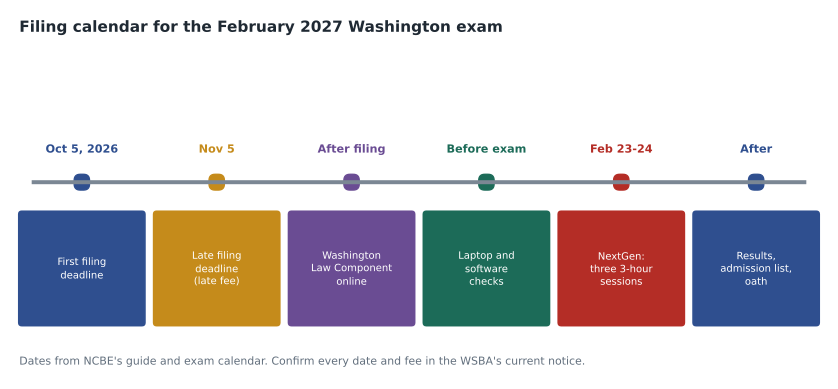
Tessa filed on October 2, three days before the first deadline. Her classmate, whom Marchetti called Cassius Ruthven, filed on November 3, inside the late period, and paid the late fee. 'Cassius is fine,' Marchetti said. 'He paid more and he lost a month of slack, but he is in. Someone who misses the late deadline is not in, and there is no third deadline.'
Fees
NCBE's chart lists the main Washington fees. The examination fee is 595 dollars for a first-time applicant who is not an attorney and 645 dollars for an attorney applicant, who must also pay the character and fitness investigation fee charged for NCBE's report. Repeat takers pay the same amounts as first-time takers. An applicant for admission by transferred UBE score pays the same 595 or 645 dollars, plus the investigation fee for attorneys. Admission by motion costs 970 dollars plus the investigation fee. A candidate who uses a laptop also pays NCBE's technology fee, and late filers pay a late fee. A withdrawing applicant may face a nonrefundable administrative fee, which the WSBA's motion page lists at 400 dollars. The WSBA's fee schedule is the controlling source, and fees change.
| Applicant | Fee listed by NCBE (dollars) |
|---|---|
| Exam, first-time, non-attorney | 595 |
| Exam, attorney | 645 plus character and fitness investigation fee |
| Exam, repeat taker | Same as first-time (595 or 645) |
| Transferred UBE score | 595 or 645, plus investigation fee for attorneys |
| Admission by motion | 970 plus investigation fee |
No limit on attempts
Washington does not limit the number of times a candidate may take the exam. That is unusual; many states cap attempts at four or five. It does not mean a candidate should plan to take the exam more than once. Each attempt costs months, money and, for a candidate already working at a firm, goodwill. But it does mean that a candidate who has failed elsewhere several times is not shut out of Washington for that reason, although the earlier results remain part of the character and fitness file and, after the July 2026 disruption, determined who could use the waiver.
Accommodations
A candidate with a disability may request testing accommodations, such as extra time, a separate room or assistive technology. The request goes to the WSBA with supporting documentation, and it has its own deadline, which falls earlier than many candidates expect. NextGen is given on the candidate's own laptop in a proctored room, and some accommodations, such as screen readers or a paper format, require advance coordination with NCBE. A candidate who needs accommodations should start the request at the same time as the application.
The application is a sworn statement
Washington's application asks for detailed information about education, employment, residence, finances, court involvement and conduct. The applicant signs it under penalty of perjury, and the duty to update it continues until admission. Lesson 3 covers how the character and fitness review uses that information. For now, the point is practical: complete answers save time, and incomplete or inconsistent answers cost time. Gerrit learned that in May 2026, when admissions staff asked why his application listed two addresses for the same month. One was his apartment and one was his parents' house, where he received mail during finals. He explained in two sentences and the file moved on, but he would have saved a week by explaining it the first time.
Worked problem
Can Maelle sit in Washington?
Maelle Adair earned a law degree in France, practiced for four years in Lyon and completed an LL.M. at an ABA-approved law school in the United States in May 2026. She asks whether she can sit the July 2027 Washington exam.
Show solution
- Start with APR 3: Washington permits some graduates of foreign law schools to sit, with additional education at an ABA-approved school and, in some cases, foreign practice.
- Her LL.M. from an ABA-approved school and four years of French practice are the kinds of facts the rule asks about, but the rule's specific conditions control, including which courses or credits are required.
- She should ask the WSBA's admissions staff for a written eligibility determination well before the first filing deadline for July 2027.
- If she is eligible, she files by the first filing deadline, takes the MPRE and the Washington Law Component, and sits the NextGen exam.
Answer: Maelle may well qualify, but only an eligibility decision under APR 3 settles it. Her first step is the written determination, not the application.
A filing checklist
Marchetti gave Tessa the checklist she uses with every Washington candidate. Before filing: confirm the education route and gather the law school certification or program records; collect the residence, employment and address history for the period the application covers; gather court records for any case in which the applicant was a party; and request references early. When filing: file by the first deadline, pay the correct fee and keep the confirmation. After filing: watch the admissions portal and email, respond to every request within the time given, update the application when facts change, take the MPRE if the score is not yet in hand, and plan a date for the Washington Law Component.
Common mistakes
MistakeOnly ABA law school graduates may sit in Washington.
InsteadWashington also accepts the APR 6 Law Clerk Program and some non-ABA and foreign routes with additional requirements.
MistakeWashington allows only four attempts.
InsteadWashington does not limit the number of attempts.
MistakeMissing the first filing deadline means missing the exam.
InsteadWashington has a late filing deadline about a month later, with a late fee. After that there is no further deadline.
MistakeFees are the same for everyone.
InsteadAttorney applicants pay a higher exam fee plus NCBE's character and fitness investigation fee; motion applicants pay more.
MistakeThe application is just a form.
InsteadIt is signed under penalty of perjury, and the duty to update it continues until admission.
Common filing mistakes
Marchetti keeps a list of the Washington filing mistakes she sees most often. The first is filing near the deadline and then discovering that a required document, such as a law school certification or a certificate of good standing from another state, takes weeks to obtain. The second is a gap in the residence or employment history, often a summer job or a short sublet the applicant forgot. The third is an answer that does not match a public record, such as a court case listed under the wrong county or year. The fourth is paying a fee from an old chart instead of the current fee schedule. The fifth is ignoring an email from the admissions portal because it looked automatic.
Each mistake is easy to prevent. Tessa built a spreadsheet with a row for each requirement: the item, the date requested, the date submitted and the date the WSBA confirmed receipt. She saved a copy of every page she uploaded, and she set up a filter so that every message from the admissions office went to a folder she checked each evening. When the WSBA asked her in late October for a corrected employment date, she answered the same night.
When the facts change after filing
Filing is not the end of an applicant's responsibilities. If an applicant moves, changes jobs, changes names, is charged with an offense, is sued, or has any other change that affects an answer, the application must be updated promptly. The same is true of changes in plans, such as transferring from the February exam to the July exam, which has its own procedure and deadline. After the July 2026 disruption, many applicants learned how quickly a plan can change; the ones who kept their files current had the fewest problems when they had to choose among the options the Court offered.
Gerrit's advice to Tessa was practical. 'Treat the admissions portal like a client file,' he said. 'Every time something changes, write it down that day, and send the update that week. The people who got into trouble this summer were the ones who couldn't find their own paperwork.'
A last practical point: keep the confirmation of every payment and every upload. If a document goes missing in the portal, or a payment does not post, the applicant who can produce a receipt and a dated copy resolves the problem in a day. The applicant who cannot may wait weeks, and the deadlines do not move while they wait.
Summary and key terms
- APR 3 sets the qualifications for admission; the WSBA's admissions staff decide whether an applicant meets them.
- Washington accepts the ABA J.D., the four-year APR 6 Law Clerk Program and some non-ABA and foreign routes with added requirements.
- For February 2027 the first filing deadline was October 5, 2026 and the late deadline November 5, 2026.
- NCBE lists a 595-dollar exam fee for non-attorneys, 645 dollars plus the investigation fee for attorneys, and 970 dollars plus the fee for motion.
- Washington has no limit on attempts; accommodations require an early, documented request.
- 0
- APR 3
- 1
- APR 6
- 2
- tutor
- 3
- first filing deadline
- 4
- late filing deadline
- 5
- character and fitness investigation fee
- 6
- accommodations
- 7
- eligibility determination
Practice problems
Work each problem on paper first, then reveal the answer to check.
Can a person become eligible for the Washington exam without attending law school?
Show answer
Yes, by completing the four-year APR 6 Law Clerk Program under a qualified tutor.
What were the filing deadlines for the February 2027 exam?
Show answer
October 5, 2026 for first filing and November 5, 2026 for late filing, according to NCBE's guide.
How many times may a candidate take the Washington exam?
Show answer
Washington sets no limit on attempts.
What should a foreign-trained lawyer do before applying?
Show answer
Ask the WSBA for a written eligibility determination under APR 3.
Lesson quiz · 5 questions
Score 60% or more to complete this lesson.
Create a free account to save your progress, take quizzes and earn a certificate.