
BAR-248 · Lesson 6 of 12 · 20 min
The Washington Law Component
▶ Video coming soon A video version of this lesson is on the way.
Gerrit took the Washington Law Component in June 2026, a month before the July exam, on a Saturday morning at his kitchen table in Yakima. He passed on the first try. When Tessa asked how he had prepared, his answer surprised her. 'I treated it like a research assignment, not a memory test,' he said. 'It's open book. The trick is knowing where things are in the outlines, not knowing them by heart. The people who struggle are the ones who walk in thinking open book means easy.'
Marchetti agreed and added a second point. 'The component is the only place in the admission process where Washington law is tested. It's also the closest thing you'll get to an orientation to Washington practice before your first client. Learn it properly and it pays off twice.'
This lesson covers who must take the Washington Law Component, its format and passing score, when it must be completed on each route to admission, how to prepare for it, and the kinds of Washington law it covers.
Who must pass it
Every applicant for admission as a lawyer in Washington must pass the Washington Law Component. That includes applicants by examination, applicants by transferred UBE score and applicants by motion. It was required for applicants under the legacy UBE and remains required for NextGen applicants. NCBE's guide lists it as Washington's jurisdiction-specific requirement and notes that completing it is a prerequisite for admission. Gerrit's admission by court order did not change that: the Court's August 2026 order kept every other licensing requirement in effect, and his component was already done.
Format and passing score
According to the WSBA, the component is based on 15 outlines on subjects of Washington law, published by the Board of Bar Examiners. The test has 60 multiple-choice questions to be answered in four hours. It is open book: the applicant has access to the outlines while taking the test. The minimum passing score is 80 percent. The component is taken online through the applicant's account in the WSBA admissions portal, after the applicant has filed an application and paid the fee. The WSBA's materials also indicate that an applicant who fails may retake it after a waiting period.
| Feature | Washington Law Component |
|---|---|
| Who | Every lawyer applicant: exam, transferred score and motion |
| Materials | 15 outlines on Washington law, published by the Board of Bar Examiners |
| Format | 60 multiple-choice questions in four hours |
| Open book | Yes; the outlines are available during the test |
| Passing score | 80 percent |
| Where | Online, through the WSBA admissions portal, after filing and paying |
When it must be completed
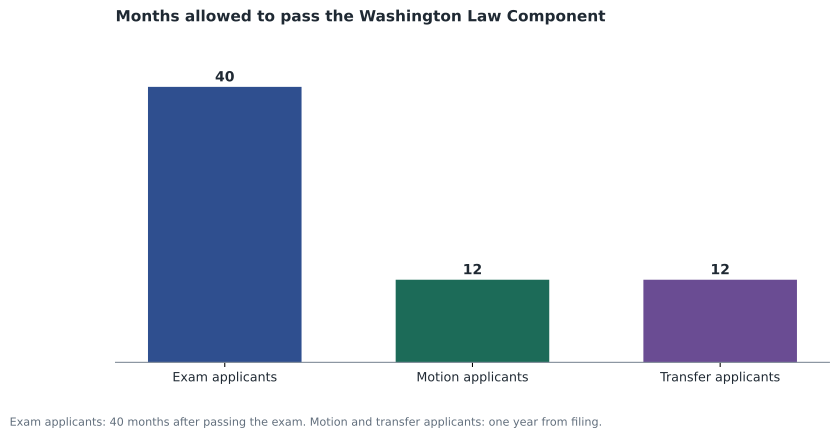
The time limits depend on the route. An applicant by examination must pass the component within 40 months after passing the bar exam, according to the WSBA. An applicant by motion or by transferred UBE score must pass it within one year from the date of filing the application, which matches the general rule in APR 5 that preadmission requirements be completed within one year of filing. In practice, almost every exam applicant should take it well before the exam or immediately after, because admission cannot occur until it is done.
Marchetti's advice on timing is to take the component before full-time study for the NextGen exam begins, or in the weeks right after the exam. Taking it during the final six weeks of exam study splits attention at the worst time. Tessa planned to take it in early December, before her full-time study started on December 14.
What it covers
The WSBA describes the component as testing Washington-specific law, or law that differs substantially from the law tested on the national exam. The Board of Bar Examiners sets the subjects and publishes the outlines, which change from time to time. Applicants should use the current outlines from the admissions portal and not rely on a list from a friend or a commercial course. The outlines can be expected to concentrate on the areas where Washington law most differs from the general rules a candidate learns for the national exam, such as Washington civil procedure, community property and family law, wills and estates, real property, criminal procedure and the state constitution, and the Washington Rules of Professional Conduct. The current list in the portal is the only reliable guide.
Several of those areas are covered in Lessons 7 to 10 of this course, which focus on the Washington rules that most often matter in early practice and that most often trip up candidates who learned the general rule first. Those lessons are not a substitute for the outlines, which are what the component actually tests.
How to prepare: an open-book method
An open-book test rewards preparation of a different kind. Marchetti teaches a four-step method for the component.
First, read each outline once, quickly, for structure. Note its headings, how it is organized and where key rules sit. The aim is a map, not memory.
Second, build a one-page index for each outline. List the main topics and, next to each, where in the outline it appears. Gerrit made his index on paper and kept it next to his laptop during the test.
Third, learn the rules that differ most from what the national exam taught, well enough to recognize them without looking. Questions on Washington's pure comparative fault, its several liability rule, community property presumptions or its rule against punitive damages should be answered from understanding, with the outline used only to confirm.
Fourth, practice timing. Sixty questions in four hours is four minutes a question, which is generous for an applicant who knows the outlines and tight for one who must search for every answer. The applicant should answer the questions they know first, flag the rest and return to them.
Worked problem
Planning the component around the exam
Tessa filed her application on October 2, 2026, and her full-time study for the February 23-24, 2027 exam begins December 14. Dreyer Cosgrove, a Montana lawyer with four years of practice, files for admission by motion on November 9, 2026. When should each take the component, and what are the outer limits?
Show solution
- Tessa: she can take the component any time after filing and paying. The outer limit for an exam applicant is 40 months after passing the exam, but she cannot be admitted until it is done.
- Tessa's best window is late November or early December, before full-time study, so that admission is not delayed after February results.
- Dreyer: as a motion applicant he has one year from filing, so his outer limit is November 9, 2027.
- Dreyer also needs to complete his other preadmission requirements within that year, or file a new application and pay a new fee.
Answer: Both should take it early. Tessa's outer limit is long but admission waits for it; Dreyer's outer limit is one year from filing.
Why the component matters after admission
Marchetti makes the same point to every candidate who asks whether the component is a formality. The component's subjects are the subjects of a new lawyer's first year in Washington: a client who wants to know what happens to the house in a divorce, a car accident case in which the client was partly at fault, a will that names a beneficiary who has died, a tenant who wants a deposit back. A lawyer who learned those rules for the component, rather than looking them up to pass, has a head start. The component also prepares a new lawyer for Washington's ethics rules, which differ from the Model Rules tested on the MPRE in ways that matter in daily practice, especially in trust accounting.
Common mistakes
MistakeThe Washington Law Component is part of the NextGen exam.
InsteadIt is a separate online test taken through the admissions portal.
MistakeMotion applicants do not take it.
InsteadEvery lawyer applicant takes it, including motion and transfer applicants.
MistakeOpen book means no preparation is needed.
InsteadSixty questions in four hours requires knowing where rules are in the outlines and understanding the Washington rules that differ most.
MistakeThe pass mark is 70 percent.
InsteadThe minimum passing score is 80 percent.
MistakeAny list of subjects from a prior year will do.
InsteadThe Board publishes the current outlines; use those.
Building an outline index
Gerrit showed Tessa the index he made for the component. For each of the 15 outlines he wrote a single page with three columns: the topic, where it appears in the outline, and a one-line note on how the Washington rule differs from the general rule he had learned. For the outline on civil procedure, for example, one line read: commencement and tolling, the 90-day service rule, filing tolls only if service follows. For the outline on community property, one line read: wages during marriage are community; all property, community and separate, is before the court at dissolution. His index for each outline took about an hour to make, and he used it on almost every question.
An index works because open-book tests reward speed in finding the right page. A candidate who has to read an outline from the beginning to answer a question runs out of time. A candidate with an index goes straight to the right section, confirms the rule and moves on.
Reading a component question
Component questions are multiple choice, and many describe a short fact pattern and ask what Washington law provides. Marchetti teaches candidates to read the last sentence first, so that they know what is being asked, then read the facts with that question in mind, then decide which outline governs before looking at the options. Candidates who look at the options first often choose an answer that states the general rule they learned for the national exam, which is usually the wrong answer on the component, because the component focuses on where Washington differs.
Common traps on the component
Three kinds of traps appear repeatedly. The first is the national rule offered as an option alongside the Washington rule: a modified comparative fault answer next to a pure comparative fault answer, or an equal-division answer next to a just and equitable answer. The second is an answer that states the Washington rule but misstates a number or a time limit, such as a 60-day service period instead of 90 days, or a 30-day waiting period instead of 60 days for claims against government. The third is an answer that is true but does not respond to the question asked. Reading the last sentence first and confirming numbers in the outline guards against all three.
What happens after a failed attempt
A candidate who falls short of 80 percent can retake the component after a waiting period, according to the WSBA's materials. A failed attempt does not affect the bar exam score or the character and fitness review, but it does delay admission until the component is passed. A candidate who fails should review the outlines where the misses clustered, improve the index and retake it promptly, rather than leaving it until after exam results.
Tessa's component plan
Tessa set aside four evenings in the last two weeks of November to read the outlines for structure and build her index, and she scheduled the component itself for a Saturday morning in early December, before her full-time study began on December 14. She planned to take it at a desk with her index on paper, the outlines open on a second screen, water and a timer. If she passed, she would not think about the component again until her first year of practice. If she did not, she would have time to retake it before the February exam without disrupting her study plan.
Three practice questions in the component's style
Marchetti wrote three original questions to show Tessa the kind of reasoning the component rewards. In the first, a plaintiff files a negligence complaint in superior court two days before the three-year limitations period runs and serves the defendant 120 days later; the question asks whether the action is timely. The correct answer applies RCW 4.16.170: service came more than 90 days after filing, so filing did not toll the statute and the claim is barred. The tempting wrong answer applies the federal rule that an action is commenced by filing.
In the second, spouses married for twenty years divorce; the husband inherited a cabin during the marriage and kept it in his own name; the question asks what the court may do with the cabin. The correct answer says the cabin is the husband's separate property but is before the court, which may award it to either spouse if a just and equitable division requires. The tempting wrong answer says separate property is excluded from the division.
In the third, a jury finds a plaintiff 30 percent at fault and two defendants 50 and 20 percent at fault; the question asks how much the plaintiff can collect from the 50 percent defendant if the other is insolvent. The correct answer applies RCW 4.22.070: because the plaintiff was at fault, liability is several, and she can collect only that defendant's 50 percent share. The tempting wrong answer applies joint and several liability.
Each question turns on a Washington rule that differs from the general rule. That is the component's pattern, and it is why the index column noting differences is the most useful thing a candidate can build.
Summary and key terms
- Every Washington lawyer applicant must pass the Washington Law Component.
- It is based on 15 outlines; 60 multiple-choice questions in four hours; open book; 80 percent to pass.
- It is taken online through the admissions portal after filing and paying.
- Exam applicants must pass it within 40 months of passing the exam; motion and transfer applicants within one year of filing.
- It tests Washington-specific law, the same areas a new lawyer meets in early practice.
- 0
- Washington Law Component
- 1
- outline
- 2
- open book
- 3
- admissions portal
- 4
- preadmission requirement
- 5
- APR 5
Practice problems
Work each problem on paper first, then reveal the answer to check.
How many questions does the Washington Law Component have, and how long is it?
Show answer
Sixty multiple-choice questions in four hours.
What score passes the component?
Show answer
Eighty percent.
When must a motion applicant pass the component?
Show answer
Within one year from the date of filing the application.
What does the component test?
Show answer
Washington-specific law, or law that differs substantially from what the national exam tests, based on the Board's 15 outlines.
Lesson quiz · 5 questions
Score 60% or more to complete this lesson.
Create a free account to save your progress, take quizzes and earn a certificate.