
BAR-233 · Lesson 8 of 12 · 20 min
New York torts: comparative fault, Article 16, the Labor Law and no-fault
▶ Video coming soon A video version of this lesson is on the way.
Most of the files on Gianna's desk are injury cases: a rear-end collision on the Staten Island Expressway, a fall from a ladder on a house renovation in Great Kills, a slip in a supermarket aisle. 'The MBE taught me negligence,' she said. 'This office is teaching me New York negligence.' Ngozi, who will meet these rules on the NYLE and, she hopes, in practice, asked for the four rules that matter most. Hollis listed them: pure comparative fault, Article 16's limits on joint and several liability, the Labor Law's scaffold law, and the no-fault serious injury threshold.
This lesson covers those four areas, along with the settlement credit rule, workers' compensation and the grave injury limit, and a few other New York tort rules a new lawyer meets early.
Pure comparative fault: CPLR 1411
Since 1975, New York has followed pure comparative fault. Under CPLR 1411, a plaintiff's culpable conduct, including contributory negligence and assumption of risk, does not bar recovery; it reduces the damages in proportion to the plaintiff's share of the fault. A plaintiff found 70 percent at fault recovers 30 percent of the damages. There is no 50 or 51 percent bar, as in modified comparative fault states. The defendant has the burden of pleading and proving the plaintiff's culpable conduct.
CPLR 1411 absorbed implied assumption of risk into comparative fault, but the Court of Appeals has kept a doctrine of primary assumption of risk for voluntary participants in sports and recreational activities. In Turcotte v. Fell (1986), a professional jockey injured in a race was held to have consented to the risks inherent in the sport, so the defendants owed no duty to protect him from them. In later cases the Court has applied the doctrine to sporting and recreational activities while cautioning against extending it beyond that setting. Where primary assumption of risk applies, it is a complete defense, not a reduction.
Article 16: limits on joint and several liability
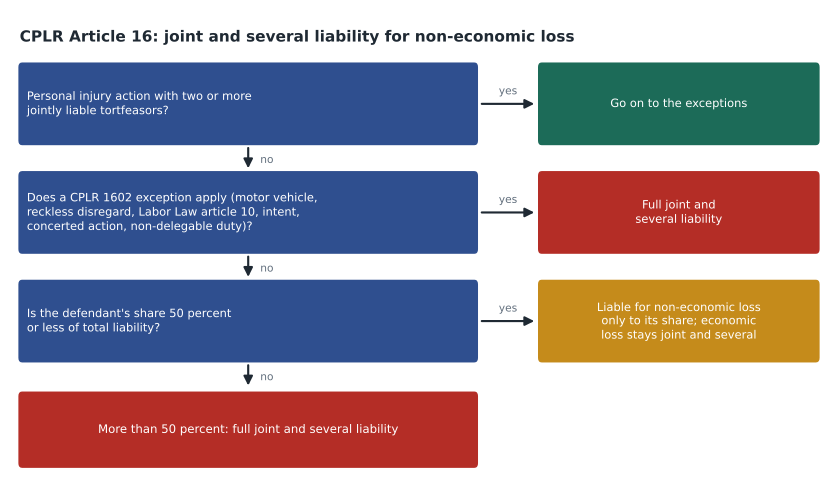
At common law, jointly liable tortfeasors were each liable for the whole of the plaintiff's damages. CPLR Article 16, enacted in 1986, limits that rule for non-economic loss. Under CPLR 1601, in a personal injury action involving two or more tortfeasors jointly liable, or in a claim against the State, a defendant whose share of fault is 50 percent or less of the total liability assigned to all liable persons is liable for the plaintiff's non-economic loss only in proportion to its share. Non-economic loss means pain and suffering, mental anguish, loss of consortium and similar losses. Economic loss, such as medical expenses and lost earnings, remains joint and several.
In apportioning fault, the culpable conduct of a nonparty is generally counted only if the plaintiff could have obtained jurisdiction over that person with due diligence. The conduct of an employer that the plaintiff cannot sue because of workers' compensation is excluded unless the plaintiff suffered a grave injury.
CPLR 1602 sets out many exceptions, in which full joint and several liability continues. Among the most important: defendants liable for the use, operation or ownership of a motor vehicle; defendants who acted with reckless disregard for the safety of others; defendants liable under Article 10 of the Labor Law, which includes the scaffold law; defendants who acted knowingly or intentionally, and in concert, to cause the harm; actions requiring proof of intent; unlawful releases of hazardous substances; and certain product liability cases where the manufacturer cannot be joined. Article 16 also does not limit liability that arises from a non-delegable duty or from vicarious liability.
Settlements: General Obligations Law section 15-108
When one tortfeasor settles before trial, General Obligations Law section 15-108 reduces the plaintiff's claim against the others by the greatest of three amounts: the amount stated in the release, the amount actually paid, or the settling tortfeasor's equitable share of the damages as found at trial. The settling tortfeasor is relieved of liability to the others for contribution, and it cannot itself seek contribution. The rule encourages settlement but means that a plaintiff who settles cheaply with a defendant later found largely at fault may recover much less from the others.
The Labor Law: sections 240(1), 241(6) and 200
New York gives construction workers special protection. Labor Law section 240(1), the scaffold law, requires owners and contractors in the erection, demolition, repair, altering, painting, cleaning or pointing of a building or structure to furnish or erect scaffolding, ladders, hoists and similar devices that are constructed, placed and operated to give proper protection. The Court of Appeals has described the duty as non-delegable and the liability as absolute, in the sense that the owner or contractor is liable even if it did not supervise or control the work, once a violation proximately causes injury.
Section 240(1) covers gravity-related risks: a worker falling from a height, or an object falling on a worker, where a safety device was required and absent or inadequate. In Ross v. Curtis-Palmer Hydro-Electric Co. (1993), the Court held that the statute applies to the special hazards of elevation differentials, not to every injury at a construction site. In Runner v. New York Stock Exchange (2009), it held that the question is whether the harm flowed directly from the application of the force of gravity to an object or person.
Two limits matter. First, the worker's comparative negligence is not a defense to a section 240(1) claim. Second, as the Court explained in Blake v. Neighborhood Housing Services of New York City (2003), liability requires both a violation and proximate cause, so if the worker's own conduct was the sole proximate cause of the accident, for example where adequate devices were available and the worker chose not to use them, there is no liability under the statute.
Labor Law section 241(6) imposes a non-delegable duty on owners and contractors to provide reasonable and adequate protection in construction, excavation and demolition work. A plaintiff must identify a violation of a specific, concrete rule of the Industrial Code, not a general safety standard, and comparative negligence is a defense. Section 200 codifies the common-law duty to provide a safe workplace and applies only to parties who supervised or controlled the work or had notice of a dangerous condition.
| Statute | Scope | Comparative negligence a defense? | What the plaintiff must show |
|---|---|---|---|
| Labor Law 240(1) | Gravity-related risks in listed construction activities | No | A violation of the safety device duty that proximately caused the injury |
| Labor Law 241(6) | Construction, excavation and demolition | Yes | A violation of a specific Industrial Code rule causing injury |
| Labor Law 200 | Any workplace | Yes | Common-law negligence by a party with supervision, control or notice |
Workers' compensation and the grave injury limit
An injured employee's claim against the employer is generally limited to workers' compensation benefits. The worker may still sue third parties, such as an owner or general contractor under the Labor Law. Before 1996, a third party held liable could seek contribution or indemnity from the employer, which brought the employer back into the case. Section 11 of the Workers' Compensation Law, amended in 1996, now bars such third-party claims against the employer unless the employee suffered a grave injury, a defined list of catastrophic injuries such as death, loss of a limb, total blindness or deafness, paraplegia or quadriplegia, or an acquired injury to the brain causing permanent total disability, or unless the employer agreed in a written contract before the accident to indemnify the third party.
No-fault insurance and the serious injury threshold
New York has a no-fault automobile insurance system under Article 51 of the Insurance Law. A person injured in a motor vehicle accident receives first-party benefits from the vehicle's insurer for basic economic loss, such as medical expenses and lost earnings, up to 50,000 dollars, regardless of fault. In exchange, a person covered by no-fault may sue another covered person for non-economic loss, such as pain and suffering, only if the person has suffered a serious injury, or for economic loss above basic economic loss.
Insurance Law section 5102(d) defines serious injury by category: death; dismemberment; significant disfigurement; a fracture; loss of a fetus; permanent loss of use of a body organ, member, function or system; permanent consequential limitation of use of a body organ or member; significant limitation of use of a body function or system; or a medically determined non-permanent injury that prevents the person from performing substantially all of the material acts of daily activities for at least 90 of the 180 days immediately following the accident.
Whether a plaintiff meets the threshold is often decided on summary judgment. The Court of Appeals has required objective medical evidence of the limitation, such as quantified range-of-motion findings or a qualitative comparison with normal function, rather than subjective complaints of pain alone, in Toure v. Avis Rent A Car Systems (2002). In Perl v. Meher (2011), it held that range-of-motion measurements need not be made immediately after the accident to support a claim, and that a qualitative assessment made close to the accident combined with later quantitative measurements can raise a triable issue.
Other New York rules worth knowing
Vehicle and Traffic Law section 388 makes the owner of a motor vehicle vicariously liable for injuries caused by anyone using it with the owner's permission, a rule broader than in many states; federal law, the Graves Amendment, now protects rental and leasing companies from such vicarious liability in most cases. General Obligations Law section 11-101, the Dram Shop Act, gives a person injured by an intoxicated person a claim against a seller who unlawfully sold alcohol to that person, for example while visibly intoxicated. New York has no cap on non-economic damages in ordinary negligence and malpractice cases; instead, under CPLR 5501(c), the Appellate Division reviews awards to determine whether they deviate materially from what would be reasonable compensation. And CPLR 4545 allows the court to reduce an award for economic loss by collateral source payments, such as health insurance, with exceptions.
Worked problem
The ladder in Great Kills
A hypothetical worker, Kazimierz Wierzchowski, employed by a painting subcontractor, falls from an unsecured extension ladder while painting the exterior of a homeowner's two-family house, which the homeowner rents out. The ladder slid on wet pavement. He fractured his leg. He had been told to have a coworker hold the ladder but the coworker was on a break.
Show solution
- Painting a building is a covered activity under Labor Law section 240(1), and the fall from a ladder is a gravity-related risk.
- An unsecured ladder that slides is a device that did not give proper protection: a violation that proximately caused the fall.
- His carelessness in not waiting for the coworker is comparative negligence, which is not a defense under section 240(1); it would bar recovery only if his conduct were the sole proximate cause, which it was not where the ladder itself was inadequate.
- One- and two-family dwelling owners who do not direct or control the work are exempt from sections 240 and 241, but the exemption does not apply where the house is used for commercial purposes, a question the court must decide on the facts.
- He cannot sue his employer, which is protected by workers' compensation; any third-party claim against the employer is barred unless he suffered a grave injury, and a fractured leg is not one.
Answer: He has a strong section 240(1) claim against the general contractor if there is one, and against the homeowner unless the one- and two-family dwelling exemption applies; his own carelessness will not reduce his recovery under that statute.
Common mistakes
MistakeNew York bars recovery if the plaintiff is more than 50 percent at fault.
InsteadCPLR 1411 applies pure comparative fault; damages are reduced, never barred.
MistakeArticle 16 limits all damages for a defendant 50 percent or less at fault.
InsteadIt limits only non-economic loss, and many CPLR 1602 exceptions keep full joint and several liability.
MistakeA worker's own negligence reduces a section 240(1) award.
InsteadComparative negligence is no defense; only sole proximate cause defeats the claim.
MistakeAny car accident injury allows a suit for pain and suffering.
InsteadA covered person must show a serious injury under Insurance Law section 5102(d).
MistakeA settlement reduces the claim against others only by the amount paid.
InsteadSection 15-108 reduces it by the greatest of the release amount, the amount paid or the settlor's equitable share.
Practice problems
Work each problem on paper first, then reveal the answer to check.
What does CPLR 1411 provide?
Show answer
Pure comparative fault: the plaintiff's culpable conduct reduces damages proportionally and does not bar recovery.
What does CPLR 1601 limit, and for whom?
Show answer
Liability for non-economic loss of a defendant whose share is 50 percent or less, to that share.
Name three CPLR 1602 exceptions.
Show answer
Any three of: motor vehicle use, reckless disregard, Labor Law article 10, intentional concerted action, actions requiring intent, hazardous releases, non-delegable duty.
What risks does Labor Law section 240(1) cover?
Show answer
Gravity-related risks of elevation, such as falling workers and falling objects, in covered construction activities.
What is the 90/180 category of serious injury?
Show answer
A medically determined injury preventing substantially all daily activities for at least 90 of the 180 days after the accident.
Summary and key terms
- CPLR 1411: pure comparative fault; primary assumption of risk survives for sports and recreation (Turcotte v. Fell).
- CPLR 1601: a defendant 50 percent or less at fault pays only its share of non-economic loss; CPLR 1602 lists many exceptions.
- GOL 15-108 reduces the claim against non-settling defendants by the greatest of the release amount, the payment or the settlor's share.
- Labor Law 240(1) imposes absolute liability for gravity-related risks; comparative negligence is no defense, but sole proximate cause is (Blake).
- Workers' Compensation Law 11 bars third-party claims against employers unless the injury is grave or there is a written indemnity agreement.
- No-fault pays basic economic loss up to 50,000 dollars; suing for pain and suffering requires a serious injury under section 5102(d).
- pure comparative fault
- A rule that reduces a plaintiff's damages by the plaintiff's share of fault without barring recovery.
- Article 16
- CPLR 1601 to 1603, which limit joint and several liability for non-economic loss.
- scaffold law
- Labor Law section 240(1), imposing absolute liability for elevation-related construction injuries.
- grave injury
- A catastrophic injury listed in Workers' Compensation Law section 11 that allows third-party claims against an employer.
- serious injury
- The no-fault threshold injury, defined in Insurance Law section 5102(d), required to sue for non-economic loss.
Lesson quiz · 5 questions
Score 60% or more to complete this lesson.
Create a free account to save your progress, take quizzes and earn a certificate.