
BAR-233 · Lesson 7 of 12 · 21 min
New York courts and the CPLR
▶ Video coming soon A video version of this lesson is on the way.
Gianna works as a law clerk at a two-lawyer firm on Staten Island that handles injury cases, real estate closings and small business disputes. In her first week, the senior partner, Rosemarie Cutrone, handed her a summons and complaint and said: 'File this in Supreme Court, Richmond County, and serve it within the time the CPLR allows.' Gianna told the group what happened next. 'I said, Supreme Court? For a car accident? She laughed and said every new lawyer from out of state says that.'
New York's court system has names that confuse lawyers from everywhere else, and its civil procedure code, the Civil Practice Law and Rules, differs from the Federal Rules in ways that matter on the NYLE and on the first day of practice. This lesson maps the courts and covers the CPLR rules a new lawyer uses most: commencement, service, personal jurisdiction, limitations periods, notices of claim, pleadings, motions, discovery and appeals.
The courts
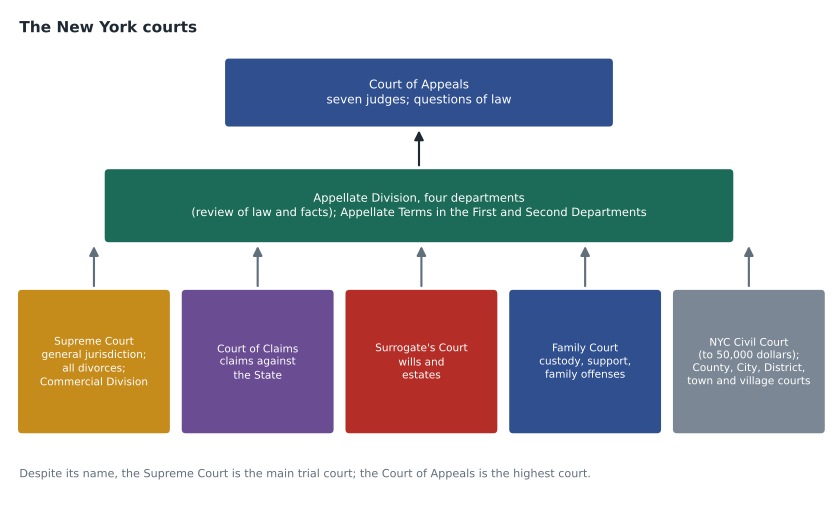
The Court of Appeals is the state's highest court. It has seven judges, including the Chief Judge, who also heads the state court system; as of 2026 the Chief Judge is Rowan D. Wilson. The Court sits in Albany and hears appeals mainly on questions of law.
The Appellate Division of the Supreme Court is the intermediate appellate court, organized in four departments. Unlike the Court of Appeals, the Appellate Division may review both the law and the facts, and it may reverse or modify in the interest of justice. In the First and Second Departments, Appellate Terms of the Supreme Court hear appeals from certain lower courts, such as the New York City Civil Court.
The Supreme Court is New York's general jurisdiction trial court, with a branch in every county. Despite its name, it is not a high court. It hears civil cases of any size and type, including matrimonial actions, which are heard only in Supreme Court, and in New York City it also hears felony cases. Its Commercial Division handles complex business cases under its own rules.
Other trial courts handle specific matters. The Court of Claims hears claims for money damages against the State of New York and certain state entities. The Surrogate's Court in each county handles probate, estates and adoptions. The Family Court handles custody, support, family offense petitions, juvenile delinquency and child protective proceedings, but not divorces. Outside New York City, County Courts hear felony cases and some civil cases. The New York City Civil Court hears civil cases up to 50,000 dollars, and the New York City Criminal Court hears misdemeanors. City, District, town and village courts handle smaller matters elsewhere in the state.
Commencing an action
A civil action in Supreme Court is commenced by filing a summons and complaint, or a summons with notice, with the county clerk, under CPLR 304. Filing, not service, commences the action, which matters for limitations: the action is timely if it is filed before the period expires. Most Supreme Court filings are now made electronically through the New York State Courts Electronic Filing system, which is mandatory for many case types in many counties.
After filing, the plaintiff has 120 days to serve the summons and complaint under CPLR 306-b. If service is not made in time, the court must dismiss without prejudice or extend the time for good cause or in the interest of justice. Courts apply the interest-of-justice standard flexibly, but a plaintiff who files at the end of the limitations period and then misses the 120 days risks losing the claim.
Service of process
CPLR 308 lists the methods of personal service on a natural person, in order. Personal delivery to the defendant is the first. The second is delivery to a person of suitable age and discretion at the defendant's actual place of business, dwelling place or usual place of abode, followed by mailing a copy to the defendant. The third is delivery to an agent the defendant has designated. The fourth, available only after service under the first two methods cannot be made with due diligence, is affixing the papers to the door of the defendant's business, dwelling or abode and mailing a copy, often called nail and mail. The fifth is a method directed by the court when the others are impracticable.
For the second and fourth methods, the server must file proof of service with the clerk within 20 days of the later of the delivery or mailing, and service is complete ten days after the proof is filed. The defendant's time to answer runs from that completion date. Corporations are served under CPLR 311, often by delivery to an officer or a designated agent, or through the Secretary of State under the Business Corporation Law.
Personal jurisdiction
New York courts have general jurisdiction over defendants who are at home in New York under CPLR 301, as limited by the Supreme Court's due process cases, and specific jurisdiction under the long-arm statute, CPLR 302(a). Section 302(a) reaches a non-domiciliary who transacts business in New York or contracts anywhere to supply goods or services in New York, who commits a tortious act in New York, who commits a tortious act outside New York causing injury in New York and meets additional conditions about doing business or deriving revenue, or who owns, uses or possesses real property in New York, where the claim arises from that activity. Notably, CPLR 302(a)(2) excludes defamation from the in-state tort provision, and the out-of-state tort provision also excludes defamation, so defamation claims against non-domiciliaries usually rest on the transacting business provision.
Limitations periods and notices of claim
New York's limitations periods appear mainly in CPLR Article 2. The most important for a new lawyer are these: six years for contract claims under CPLR 213, though sales of goods are governed by the four-year period in UCC 2-725; three years for personal injury and property damage under CPLR 214; two years and six months for medical, dental and podiatric malpractice under CPLR 214-a, with a 2018 amendment known as Lavern's Law adding a discovery rule for failure to diagnose cancer or a malignant tumor, subject to an outer limit of seven years; one year for intentional torts such as assault, battery, false imprisonment and defamation under CPLR 215; and two years for wrongful death under the Estates, Powers and Trusts Law. CPLR 202, the borrowing statute, requires a claim by a nonresident that accrued outside New York to be timely under both New York's period and the period where it accrued.
Claims against municipalities have an extra step. Under General Municipal Law section 50-e, a person injured by the negligence of a city, county, town, village, school district or many public authorities must serve a notice of claim within 90 days after the claim arises. Under section 50-i, the action must then be commenced within one year and 90 days. A court may permit a late notice of claim within the limitations period, considering factors such as whether the public entity had actual knowledge of the essential facts. Claims against the State itself go to the Court of Claims under the Court of Claims Act, which has its own notice and filing deadlines.
| Claim | Period | Source |
|---|---|---|
| Contract (non-sale) | Six years | CPLR 213 |
| Sale of goods | Four years | UCC 2-725 |
| Personal injury and property damage | Three years | CPLR 214 |
| Medical malpractice | Two years six months (cancer discovery rule, seven-year outer limit) | CPLR 214-a |
| Assault, battery, defamation | One year | CPLR 215 |
| Wrongful death | Two years | EPTL |
| Claim against a municipality | Notice within 90 days; suit within one year and 90 days | GML 50-e and 50-i |
Pleadings
New York pleadings are governed by CPLR 3013, which requires statements sufficiently particular to give the court and the parties notice of the transactions and occurrences to be proved and the material elements of each cause of action. CPLR 3016 requires greater particularity for some claims: in defamation, the particular words complained of must be set out, and in fraud, the circumstances constituting the wrong must be stated in detail. In personal injury cases, the defendant may demand a bill of particulars, a distinctively New York device that amplifies the pleadings by stating details of the injuries and the negligence alleged.
Motions
CPLR 3211 governs motions to dismiss. Subdivision (a) lists the grounds, including documentary evidence, lack of subject matter or personal jurisdiction, statute of limitations, release and failure to state a cause of action. On a motion for failure to state a cause of action, the court accepts the facts alleged as true and asks whether they fit any cognizable legal theory. Some defenses, such as lack of personal jurisdiction and improper service, are waived if not raised in the answer or a pre-answer motion, and an objection to service raised in the answer must be followed by a motion within 60 days or it is waived.
CPLR 3212 governs summary judgment. The motion may be made after issue is joined and, unless the court sets a shorter date, no later than 120 days after the filing of the note of issue, the document that places the case on the trial calendar. In Brill v. City of New York (2004), the Court of Appeals held that the deadline is strict and that a late motion may not be considered without good cause for the delay. The movant must make a prima facie showing of entitlement to judgment; the burden then shifts to the opponent to raise a triable issue of fact.
Discovery
Disclosure under CPLR Article 31 extends to all matter material and necessary to the prosecution or defense of an action. The Court of Appeals has long read this standard broadly, to mean information that is useful and reasonable in preparing for trial. The main devices are depositions, interrogatories, document demands, physical and mental examinations in injury cases and notices to admit. Disclosure disputes are often resolved by the court in compliance conferences, and many courts have their own part rules.
Appeals
An appeal to the Appellate Division is taken by serving and filing a notice of appeal within 30 days after service of the judgment or order with notice of its entry, under CPLR 5513. Many interlocutory orders are appealable to the Appellate Division as of right in New York, which is broader than federal practice. Appeals to the Court of Appeals are much more limited. They lie as of right only in narrow categories, such as where at least two Appellate Division justices dissented on a question of law, or where a constitutional question is directly involved; otherwise the party needs leave from the Appellate Division or the Court of Appeals.
Worked problem
A slip on a city sidewalk
A hypothetical client, Bernadette Ugwu-Hale, tripped on a broken sidewalk flag outside a New York City public library branch on March 3, 2026, and fractured her wrist. She first consulted Gianna's firm on July 20, 2026.
Show solution
- A claim against the City for negligence requires a notice of claim within 90 days under General Municipal Law section 50-e; 90 days from March 3, 2026 was June 1, 2026.
- The notice is late, so the firm must move for leave to serve a late notice of claim; the court considers actual knowledge, excuse and prejudice.
- The action must be commenced within one year and 90 days of March 3, 2026, under section 50-i, so the motion and any suit must come before that date.
- Filing in Supreme Court commences the action; service must follow within 120 days under CPLR 306-b.
Answer: The firm should move promptly in Supreme Court for leave to serve a late notice of claim and calendar the one year and 90 day deadline of June 1, 2027.
Common mistakes
MistakeThe Supreme Court is New York's highest court.
InsteadThe Court of Appeals is highest; the Supreme Court is the general trial court.
MistakeService commences an action in Supreme Court.
InsteadFiling commences the action; service must follow within 120 days.
MistakeNail and mail service can be used first.
InsteadIt is available only after personal or suitable age service cannot be made with due diligence.
MistakePersonal injury claims have a two-year period.
InsteadCPLR 214 sets three years; medical malpractice is two years and six months.
MistakeA claim against a city has only a three-year limit.
InsteadA notice of claim is due within 90 days and suit within one year and 90 days.
Practice problems
Work each problem on paper first, then reveal the answer to check.
Which court is New York's general jurisdiction trial court?
Show answer
The Supreme Court.
How long does a plaintiff have to serve after filing?
Show answer
120 days under CPLR 306-b.
What is the limitations period for an assault claim?
Show answer
One year under CPLR 215.
When must a notice of claim against a municipality be served?
Show answer
Within 90 days after the claim arises, under General Municipal Law section 50-e.
When must a summary judgment motion be made?
Show answer
No later than 120 days after the note of issue, unless the court sets a shorter time.
Where to look in practice
Rosemarie Cutrone gave Gianna a short list on her first day, which Gianna shared with the group. Read the CPLR section itself, not a summary, before relying on any deadline. Check the part rules of the assigned judge, because many Supreme Court justices publish their own rules on motions, conferences and courtesy copies. Check whether the county requires electronic filing for the case type. And when a municipality is involved, calendar the notice of claim deadline the day the client walks in. 'Most malpractice in a small firm,' Cutrone told her, 'is a missed date, not a missed argument.'
Summary and key terms
- The Court of Appeals is highest; the Appellate Division sits in four departments; the Supreme Court is the general trial court.
- The Court of Claims hears claims against the State; Surrogate's Court handles estates; Family Court handles custody and support, not divorce.
- Filing commences an action (CPLR 304); service must follow within 120 days (CPLR 306-b) by a CPLR 308 method in order.
- Long-arm jurisdiction under CPLR 302(a) excludes defamation from its tort provisions.
- Limitations: contract six years, injury three years, malpractice two and a half years, intentional torts one year; municipal claims need a 90-day notice.
- Summary judgment is due within 120 days of the note of issue; notices of appeal within 30 days of service with notice of entry.
- CPLR
- The Civil Practice Law and Rules, New York's civil procedure code.
- Supreme Court
- New York's general jurisdiction trial court, with a branch in each county.
- notice of claim
- The notice that must be served on a municipality within 90 days before suing it in negligence.
- bill of particulars
- A New York document amplifying the pleadings with details of the claim.
- note of issue
- The filing that places a case on the trial calendar and starts the summary judgment clock.
Lesson quiz · 5 questions
Score 60% or more to complete this lesson.
Create a free account to save your progress, take quizzes and earn a certificate.