
BAR-233 · Lesson 3 of 12 · 21 min
Character and fitness, the 50-hour pro bono rule, skills competency and the MPRE
▶ Video coming soon A video version of this lesson is on the way.
Gianna arrived at the third session with a stack of paper. 'This is my Second Department application,' she said, holding up a thick printout. 'Employment history, addresses, every traffic ticket, my student loans, two affidavits about pro bono, a skills competency affidavit from my law school and my MPRE score report. Nobody told me the exam was the short part.' Ngozi laughed. 'I am doing my pro bono affidavits now so I am not doing them in March.'
New York adds three requirements to the usual character and fitness review and the MPRE: 50 hours of qualifying pro bono service, a skills competency requirement with several pathways, and an MPRE score of 85. This lesson takes them in turn. All of them must be satisfied before the Appellate Division admits an applicant, and most can be satisfied long before the bar exam.
Character and fitness in New York
Every applicant for admission must show the character and general fitness required of a lawyer. In New York this review happens after the exam, not before it. The Board decides eligibility to sit, but it does not investigate character. Once the Board issues the Notice of Certification, the applicant files an application for admission with the assigned Appellate Division department, and that department's Committee on Character and Fitness reviews it.
The application is long. It asks for the applicant's residences and employment, education, bar admissions elsewhere, any criminal history, civil litigation, financial history such as defaults and bankruptcies, discipline in school or at work, and other matters that bear on honesty, trustworthiness and reliability. It requires supporting documents such as affidavits from employers and people who know the applicant, a certificate from the law school, and the affidavits for pro bono and skills competency. Each department publishes its own forms and instructions, so the details vary.
The committee may ask for more information, and it commonly interviews applicants, either in person or by video. An interview is a routine part of the process in many cases and is not a sign that something is wrong. Where the committee has concerns, it may request explanations, hold a fuller hearing or recommend against admission; the Appellate Division then decides. Applicants who are denied may seek further review in the Appellate Division and, in limited circumstances, in the Court of Appeals.
The guiding principle is candor. New York committees, like those in every jurisdiction, treat a failure to disclose as more serious than most of the conduct an applicant might fear disclosing. A speeding ticket, a debt that went to collections and was paid, or a college disciplinary matter for underage drinking rarely prevents admission when it is disclosed and explained. An omission discovered by the committee raises a question about honesty that is much harder to answer. Hollis told the group: 'If you are unsure whether a question covers something, assume it does, disclose it and explain it.'
Gianna's file is typical. She disclosed a 2021 parking ticket that went unpaid long enough to be referred to collection, which she then paid, and a summer job at a Staten Island restaurant from which she was let go after two weeks during her first year of college because she had two scheduling conflicts. She wrote a short, factual explanation for each. 'I almost left the restaurant out,' she admitted. 'Two weeks seemed like nothing.' Hollis pointed out that the employment question asks for all employment, and the committee can check.
The 50-hour pro bono requirement
Section 520.16 requires every applicant for admission on examination to complete at least 50 hours of qualifying pro bono service before filing the application for admission. New York was the first state to adopt such a rule, which took effect for applicants seeking admission from 2015 onward. The requirement does not apply to lawyers admitted on motion under section 520.10 or admitted pro hac vice for a particular case.
Qualifying service is law-related work for people who cannot afford counsel, for nonprofits, for courts and for government in a public-service role, done under supervision. The supervisor may be a law school faculty member or instructor, a lawyer admitted and in good standing, or, for court work, a judge or a court attorney. Supervision does not require constant physical presence, but it must be enough to train, guide and evaluate the work, and it may happen by phone or video. The work must not involve the unauthorized practice of law.
For applicants from ABA-approved law schools, hours count if done after the applicant began law school, provided the work does not violate the school's own rules on student work. Foreign-educated LLM applicants may count work done up to one year before the LLM begins, during the program or afterward. The service may be done anywhere in the world, including outside New York and outside the United States, if the work and supervision meet the rule; work done abroad must be described in detail.
Some activities do not count. The Court of Appeals' published answers to common questions exclude political campaign work, election litigation and research for political groups; general community service that does not use legal skills; mock trial coaching and teaching students about their rights; projects a student designs and runs without supervision; legal research for scholarship or publication; and time spent traveling to and from the work. Interpreting alone does not count, though it may count when it is part of qualifying legal work.
The applicant proves the hours with a Form Affidavit of Compliance for each project, signed by the supervisor. The Court advises completing the affidavit when the work ends, while the supervisor remembers it and is easy to reach, and keeping it until the application for admission is filed. Waivers are limited to exceptional circumstances; part-time study, a full-time job, LLM status or living abroad do not qualify.
| Counts | Does not count |
|---|---|
| Supervised work at a legal services office for low-income clients | Campaign work or election litigation |
| Supervised work in a court help center or for a judge | General volunteering that uses no legal skills |
| Supervised clinic or externship work for clients who cannot pay, if school rules allow | Coaching mock trial or teaching students about rights |
| Supervised public-interest work done abroad, described in detail | Research for an article or book |
| Interpreting as part of qualifying legal work | Travel and commuting time |
Gianna's 50 hours came from a housing court help desk run by a legal services organization during her second year, supervised by a staff attorney, where she helped tenants complete answer forms and explained hearing procedures under the attorney's direction. She logged 62 hours and has one affidavit for that project. Ngozi's hours came from an asylum assistance program supervised by an immigration lawyer in spring 2026, during her LLM. 'My work in Lagos was paid, so none of it counted,' she said. 'Pro bono means unpaid.'
The skills competency requirement
Section 520.18 requires applicants to show that they have acquired the skills and professional values needed for effective, ethical and responsible practice. It applies to JD applicants whose law study began after August 1, 2016, and to foreign-educated applicants whose qualifying LLM began after August 1, 2018. It does not apply to applicants admitted without examination under section 520.10.
There are five pathways, and an applicant needs only one. Pathway 1 is certification by an ABA-approved law school that it has a published plan for teaching the required skills and values and that the applicant has acquired them. Pathway 2 is certification that the applicant completed 15 credit hours of practice-based experiential coursework, such as clinics, externships and simulation courses; the first four credits of a first-year legal research and writing course do not count, and up to six credits may come from certified summer work supervised by a lawyer, at 50 hours of full-time work per credit. Pathway 3 is completion of the Pro Bono Scholars Program under section 520.17. Pathway 4 is a six-month full-time apprenticeship in a law office, begun after law study ends and supervised by lawyers admitted for at least two years. Pathway 5 is practice in another jurisdiction, in the United States or abroad, for at least one year full-time or two years half-time.
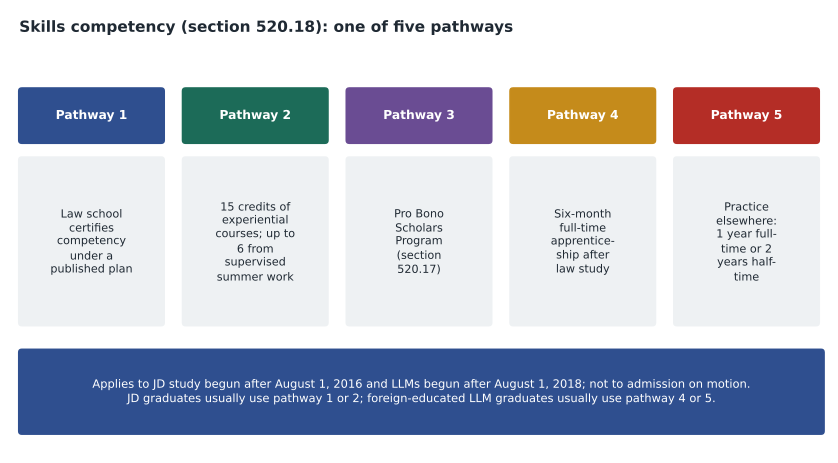
Most JD graduates use pathway 1 or 2, and their law schools certify compliance. Foreign-educated LLM graduates are in a different position, because many law schools do not certify LLM students under pathways 1 or 2. They usually rely on pathway 5, prior practice abroad, or pathway 4, an apprenticeship. Ngozi practiced full-time at a Lagos commercial firm for three years before her LLM, so she will use pathway 5 and file proof of that practice with her affidavit. Gianna's law school will certify her under pathway 2: she completed a housing clinic, an externship with a federal agency and a trial advocacy course, for 17 experiential credits.
The Pro Bono Scholars Program under section 520.17 deserves a word. It allows participating law students to devote their last semester of law school to full-time pro bono service, under supervision, and to sit the February bar exam during their final year. It is run through participating law schools, and applicants should check with their school about current availability and requirements.
The MPRE
The Multistate Professional Responsibility Examination is NCBE's ethics exam. It tests the ABA Model Rules of Professional Conduct, the ABA Model Code of Judicial Conduct and generally accepted principles of professional responsibility, not New York's own rules. It is a computer-based exam of 60 multiple-choice questions, 50 of them scored, taken over about two hours at testing centers, and it is offered several times a year. Scores are scaled from 50 to 150.
New York requires a scaled score of 85, one of the higher MPRE requirements among US jurisdictions. Under the Board's rules the MPRE may be taken before or after the bar exam, and a passing score remains valid for four years from the date of the exam at which it was earned. The applicant has NCBE send the score to New York. A score that has expired must be earned again, so an applicant who took the MPRE early in law school and delays the bar exam should check the date.
Ngozi sat the MPRE on November 12, 2026, at a testing center outside New York City, after preparing with Hollis's Thursday ethics workshops, and she is waiting for her score. Gianna's score of 101 from March 2026 is well above 85 and valid until March 2030.
Worked problem
Will her pro bono count?
A hypothetical applicant, Imogen Vasilakis, a second-year law student, wants to count three activities toward the 50 hours: 30 hours drafting simple wills for elderly clients at a legal aid clinic supervised by a staff attorney; 15 hours knocking on doors for a candidate for city council; and 20 hours teaching high school students about their rights during police stops, which she designed herself.
Show solution
- The wills work is law-related service for clients who cannot afford counsel, supervised by an attorney, done after law school began: it counts.
- Campaign work is excluded from the rule.
- Teaching students about their rights is excluded, and an unsupervised project designed by the student is also excluded.
- She has 30 qualifying hours and needs 20 more.
Answer: Only the 30 hours at the legal aid clinic count. She should find another supervised project for at least 20 more hours and have each supervisor sign a Form Affidavit of Compliance when the work ends.
Common mistakes
MistakeThe Board investigates character before the exam.
InsteadCharacter and fitness is reviewed after certification by the Appellate Division committee.
MistakePaid legal work counts as pro bono.
InsteadPro bono service under section 520.16 must be unpaid, supervised, law-related public service.
MistakePro bono hours must be done in New York.
InsteadThey may be done anywhere, including abroad, if the work and supervision qualify.
MistakeEvery applicant uses law school certification for skills competency.
InsteadForeign-educated LLM applicants usually use practice abroad or an apprenticeship.
MistakeNew York accepts an MPRE score of 80.
InsteadNew York requires 85, valid for four years from the exam date.
Practice problems
Work each problem on paper first, then reveal the answer to check.
How many pro bono hours does New York require, and under which rule?
Show answer
Fifty hours, under section 520.16.
Who is exempt from the pro bono rule?
Show answer
Lawyers admitted on motion under section 520.10 and those admitted pro hac vice.
Name the five skills competency pathways.
Show answer
Law school certification of competency; 15 experiential credits; the Pro Bono Scholars Program; a six-month apprenticeship; one year of full-time practice elsewhere.
What MPRE score does New York require, and how long is it valid?
Show answer
85, valid for four years from the exam date.
When is the character and fitness review done?
Show answer
After the Board certifies the applicant, by the assigned Appellate Division department.
Planning the three requirements together
Hollis suggested building one timeline for all three requirements rather than treating them as separate chores. For a JD student, pro bono hours fit naturally into the second year or a summer, when supervisors are easy to find and affidavits easy to collect; the skills competency requirement is met through courses the student is already choosing, so the only task is to check that the school will certify it; and the MPRE fits in the spring of the second or third year, well inside its four-year validity. For a foreign-educated LLM student the order is different: pro bono hours should begin early in the LLM year, because the year is short and the affidavits must be in hand before the admission application; skills competency usually depends on documenting practice abroad, which means requesting letters from the foreign firm or employer while contacts are fresh; and the MPRE can be taken in the LLM year or after the bar exam.
Ngozi wrote to the managing partner of her Lagos firm in October 2026 to ask for a letter confirming her three years of full-time practice, her role and her standing as a lawyer in Nigeria. 'Lagos is hours ahead of New York and partners are busy,' she said. 'I asked now so I am not asking in April.'
Summary and key terms
- Character and fitness is reviewed after the exam by the Appellate Division committee, usually with an interview; candor is essential.
- Section 520.16 requires 50 hours of supervised, unpaid, law-related pro bono service before the admission application is filed.
- Hours may be done anywhere after law school begins (or up to a year before an LLM), proved by a supervisor-signed affidavit.
- Section 520.18 skills competency has five pathways; JD graduates usually use school certification, LLM graduates practice or an apprenticeship.
- The MPRE score required is 85, valid for four years from the exam date.
- section 520.16
- The 50-hour pro bono requirement for admission on examination.
- section 520.18
- The skills competency and professional values requirement with five pathways.
- Form Affidavit of Compliance
- The supervisor-signed affidavit proving each pro bono project.
- Pro Bono Scholars Program
- A section 520.17 program letting students spend the final semester in full-time pro bono and sit the February exam early.
- MPRE
- NCBE's Multistate Professional Responsibility Examination; New York requires a scaled score of 85.
Lesson quiz · 5 questions
Score 60% or more to complete this lesson.
Create a free account to save your progress, take quizzes and earn a certificate.