
BAR-233 · Lesson 1 of 12 · 22 min
Becoming a lawyer in New York
▶ Video coming soon A video version of this lesson is on the way.
Hollis Marchetti opened the first New York session with two people on the screen and a question for each. To Ngozi Adeyemi, a lawyer qualified in Nigeria who finished her LLM at a US law school in May 2026 and is sitting the February 23-24, 2027 New York bar exam, she asked: 'Who decides whether you become a New York lawyer?' Ngozi answered quickly: 'The Board of Law Examiners.' To Gianna Russo, a new candidate who grew up on Staten Island, earned her JD from a New York law school in May 2026 and passed the July 2026 New York exam, Hollis asked the same question. Gianna hesitated. 'I thought it was the Board too. But my result letter talks about certifying me to the Appellate Division, and now I have a whole second application.'
'You are both partly right,' Hollis said. 'And the difference between your answers is the first thing a New York candidate needs to understand. New York splits the job of admitting lawyers between several bodies. If you know who does what, you know where to send every form, every question and every deadline.'
This lesson maps the New York admission system: the bodies that run it, the rules that govern it, the main paths into the profession and the steps from law school to the swearing-in ceremony. Later lessons take each step in detail.
Why New York is different
New York runs one of the largest bar exams in the country, and it tests far more foreign-educated applicants than any other US jurisdiction. That scale shapes the system. The rules are detailed, the deadlines are firm, and the process is divided between a statewide examining body and four regional courts that decide whether each person is fit to practice. Candidates who arrive from states with a single bar admissions office are often surprised that passing the exam in New York is the middle of the process, not the end.
New York is also a Uniform Bar Examination jurisdiction with a twist. It gives the UBE written and scored by NCBE, but it adds its own requirements on New York law, public service and practical skills that no other UBE jurisdiction imposes in the same form. A candidate with a high UBE score earned in another state still has to satisfy those New York requirements before admission.
The bodies that run admission
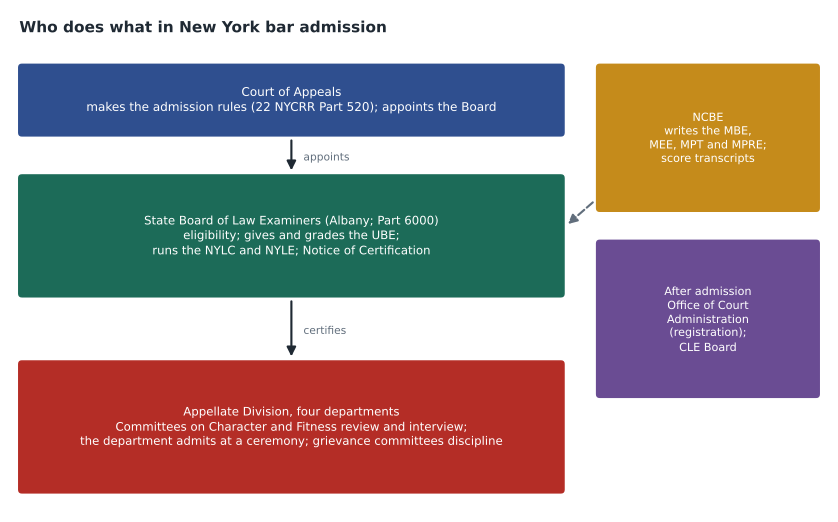
The Court of Appeals is New York's highest court. Under the Judiciary Law it makes the rules for admission to the bar. Those rules are the Rules of the Court of Appeals for the Admission of Attorneys and Counselors at Law, found in Part 520 of Title 22 of the New York Codes, Rules and Regulations, usually cited as 22 NYCRR Part 520. Part 520 sets who may sit the exam, what education counts, the requirements for foreign-educated applicants, the pro bono and skills competency requirements and the rules for admission without examination. When the Court changes the admission requirements, it does so by amending Part 520, often after public comment.
The New York State Board of Law Examiners, usually called the Board or BOLE, is appointed by the Court of Appeals. It decides whether applicants are eligible to sit the exam, administers the bar exam in February and July, runs the New York Law Course and the New York Law Exam, grades the written parts of the UBE given in New York and issues the Notice of Certification that sends a successful applicant to the Appellate Division. The Board has its own rules, found in 22 NYCRR Part 6000, which cover details such as the passing scores, the filing periods, the New York law component and score transfers. Its offices are in Albany.
The Appellate Division of the Supreme Court is New York's intermediate appellate court. It sits in four judicial departments, each covering a group of counties. The Appellate Division, not the Board, actually admits lawyers. Each department has a Committee on Character and Fitness that reviews the admission application, may interview the applicant and recommends admission. The department then admits the applicant at a ceremony where the oath is taken. The Appellate Division also disciplines lawyers after admission through its attorney grievance committees.
NCBE, the National Conference of Bar Examiners, writes the components of the UBE: the Multistate Bar Examination, the Multistate Essay Examination and the Multistate Performance Test. It also writes and scores the MPRE, the ethics exam, and maintains score transcripts used for transfers between UBE jurisdictions. NCBE is a national nonprofit, not a New York body.
After admission, the Office of Court Administration runs attorney registration, and the Continuing Legal Education Board sets the CLE rules. New York has no integrated bar: membership in the New York State Bar Association is voluntary, so a newly admitted lawyer joins the profession by admission and registration, not by enrolling in a mandatory bar association.
The four departments
Which Appellate Division department handles an applicant matters, because each department has its own application forms, its own committee and its own ceremony schedule. The Board assigns a successful applicant to a department based on the residence address the applicant gives, using a list of counties. The First Department covers Manhattan and the Bronx. The Second Department covers Brooklyn, Queens, Staten Island, Long Island and several counties north of the city, including Westchester. The Third Department covers much of upstate eastern and central New York, including Albany. The Fourth Department covers western New York, including Buffalo and Rochester.
An applicant who does not live in New York is certified to the Third Department, unless the applicant works full-time in the state. Ngozi, who lives just outside New York City in New Jersey while she studies, noted this at once. 'So if I still live in New Jersey when I pass and I am not working full-time in New York, Albany is my department.' Hollis agreed, and added that a change of address after certification must be reported to the Appellate Division, not the Board.
Gianna lives on Staten Island, which is Richmond County, so her result letter assigns her to the Second Department. 'That is why my second application went to Brooklyn,' she said.
| Department | Main areas | Notes for applicants |
|---|---|---|
| First | Manhattan and the Bronx | Courthouse in Manhattan |
| Second | Brooklyn, Queens, Staten Island, Long Island, Westchester and other lower Hudson Valley counties | Courthouse in Brooklyn |
| Third | Albany and much of eastern and central upstate New York | Also receives applicants who live outside New York and do not work full-time in the state |
| Fourth | Western New York, including Buffalo and Rochester | Courthouse in Rochester |
Three ways into the New York bar
Part 520 offers three main routes. The first is admission on examination: the applicant qualifies to sit, passes the UBE in New York, completes the New York law component, passes the MPRE, satisfies the pro bono and skills competency requirements and is approved on character and fitness. This is the route Ngozi and Gianna are on, and it is the subject of most of this course.
The second is admission by transferred UBE score. An applicant who sat the UBE in another jurisdiction and earned a score of at least 266 may apply to transfer that score to New York within three years of the exam, provided the applicant also completes the New York law component, the MPRE and the other New York requirements. The applicant never sits an exam in New York, but the New York-specific requirements still apply.
The third is admission without examination, usually called admission on motion, under section 520.10. A lawyer admitted in a reciprocal jurisdiction who has practiced for five of the past seven years and meets the education and age requirements may be admitted in the Appellate Division's discretion without any exam. Lesson 11 covers both transfer and motion in detail.
New York also allows limited forms of practice without full admission, such as registration as in-house counsel under Part 522, temporary practice by lawyers from other jurisdictions under Part 523 and admission pro hac vice for a particular case. Those routes are not substitutes for admission and are mentioned here only so candidates recognize them.
The steps on the examination route
Hollis drew the path on the shared screen in six boxes. First, eligibility: a JD from an ABA-approved law school, or one of the other routes in Part 520 such as foreign legal education plus a qualifying LLM. Second, the application to sit the exam, filed online with the Board during the filing period: October 1 to 31 for a February exam, March 1 to 31 for a July exam. Third, the exam itself, the two-day UBE. Fourth, the New York law component: the New York Law Course, an online course of recorded lectures, followed by the New York Law Exam, a 50-question online test. Fifth, the MPRE, with a scaled score of at least 85. When those pieces are complete, the Board issues the Notice of Certification. Sixth, the application for admission to the Appellate Division, including proof of 50 hours of pro bono service and the skills competency requirement, followed by the character and fitness review and the swearing-in.
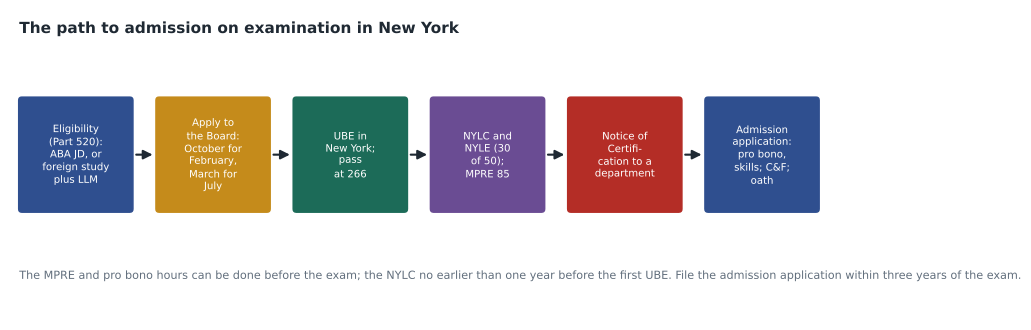
The order is flexible in places. The MPRE may be taken before or after the bar exam. The New York Law Course may be completed up to one year before the applicant first sits the UBE, or any time after, and the New York Law Exam follows the course. Pro bono hours can be completed during law school. What is not flexible is the deadline for the application for admission: it must be filed within three years after the second day of the UBE the applicant passed. An applicant who misses that window may have to sit the exam again.
Gianna's file shows the pieces fitting together. She passed the MPRE in March 2026 during her last semester. She completed her pro bono hours during her second year at a housing court help desk, with signed affidavits for each project. Her law school will certify that she met the skills competency requirement through experiential credits. She sat the UBE on July 28 and 29, 2026, and her passing result arrived on October 23, 2026. She finished the New York Law Course on November 9, 2026 and registered for the December 17, 2026 New York Law Exam before the November 17 deadline. 'Once I pass the NYLE,' she said, 'the Board can certify me and the Second Department takes over.'
Ngozi's path has the same steps in a different order. She is sitting the exam in February 2027, sat the MPRE on November 12, 2026 and is waiting for her score, and has completed her pro bono hours. Her eligibility depended on an evaluation of her Nigerian legal education and her LLM, which lesson 2 explains.
The law that governs admission
Three sets of rules matter. Part 520 of the Court of Appeals rules sets the substantive requirements: education, foreign study, the exam, pro bono, skills competency and admission without examination. Part 6000, the Board's rules, sets the mechanics of the exam and the New York law component: filing periods, passing scores, score validity, withdrawal and attendance rules and transfers. Each Appellate Division department publishes its own rules and forms for the admission application and the character and fitness process. On top of these, the Judiciary Law sets the fees, and NCBE's own policies govern the MPRE and score transcripts.
These rules change. In 2024 the Court amended Part 520 to align New York's eligibility rules with current ABA standards, effective May 8, 2024. In 2026 the Board amended its rules on New York Law Exam registration, effective September 1, 2026, so that applicants must register at least 45 days before the exam. And the Court has announced that the NextGen bar exam will replace the UBE in July 2028. A candidate should read the current rules on the Board's website rather than relying on a prep book or a friend's memory.
The admission ceremony
Admission ends with the oath. The New York constitutional oath of office for attorneys and counselors is taken before the Appellate Division at a ceremony scheduled by the department after the committee has approved the application. Once admitted, a lawyer must register with the Office of Court Administration and begin the CLE requirements for newly admitted attorneys. Lesson 11 describes those duties.
Gianna asked how long the gap is between passing and being sworn in. Hollis's answer was honest: it varies by department, by how quickly the applicant files a complete application and by how many questions the committee has. Many July takers who file promptly are admitted in the winter or spring after the exam. Applicants who still need the NYLE, the MPRE or pro bono hours when their result arrives wait longer, which is why the Board encourages candidates to finish the New York law component before results come out.
Worked problem
Mapping a question to the right body
Three hypothetical applicants send Hollis questions. Reza wants to know whether his foreign law degree qualifies him to sit the exam. Tamar passed the July exam and wants to know when her admission interview will be. Radek, a lawyer in another state, wants to know whether he can practice in New York without sitting an exam.
Show solution
- Eligibility to sit, including evaluation of foreign education, is decided by the Board under Part 520 and Part 6000.
- Interviews and the character and fitness review are handled by the Committee on Character and Fitness of the Appellate Division department to which the applicant is certified.
- Admission without examination is governed by section 520.10 and decided by the Appellate Division, with the Board reviewing the applicant's education and issuing a certificate.
Answer: Reza writes to the Board; Tamar contacts her Appellate Division department; Radek reads section 520.10 and applies through the Board's admission on motion process to the Appellate Division.
Common mistakes
MistakeThe Board of Law Examiners admits lawyers in New York.
InsteadThe Board examines and certifies; the Appellate Division admits after character and fitness review.
MistakePassing the UBE in New York is the last step.
InsteadThe New York law component, the MPRE, pro bono, skills competency and the admission application follow or accompany the exam.
MistakeEvery applicant goes to the Appellate Division in Albany.
InsteadApplicants are certified to one of four departments by residence; nonresidents go to the Third Department unless they work full-time in New York.
MistakeNew York lawyers must join the state bar association.
InsteadNew York has no integrated bar; membership in the state bar association is voluntary.
MistakeThere is no deadline after passing.
InsteadThe admission application must be filed within three years after the second day of the passed UBE.
Practice problems
Work each problem on paper first, then reveal the answer to check.
Which court makes New York's admission rules, and where are they found?
Show answer
The Court of Appeals; 22 NYCRR Part 520.
What does the Board of Law Examiners do?
Show answer
Decides eligibility, gives and grades the exam, runs the New York Law Course and Exam, and certifies successful applicants.
Which body reviews character and fitness?
Show answer
The Committee on Character and Fitness of the Appellate Division department to which the applicant is certified.
To which department is a nonresident certified?
Show answer
The Third Department, unless the applicant works full-time in New York.
Name the three main routes to admission.
Show answer
Admission on examination, admission by transferred UBE score and admission without examination on motion.
Summary and key terms
- The Court of Appeals makes the admission rules (22 NYCRR Part 520); the Board of Law Examiners applies them through Part 6000.
- The Board decides eligibility, gives the UBE, runs the NYLC and NYLE and issues the Notice of Certification.
- The Appellate Division, in four departments, reviews character and fitness and admits lawyers.
- Applicants are certified to a department by residence; nonresidents go to the Third Department unless employed full-time in New York.
- The routes are examination, transferred UBE score and admission on motion.
- The admission application must be filed within three years after the second day of the passed UBE.
- Part 520
- The Court of Appeals rules for admission of attorneys, 22 NYCRR Part 520.
- Board of Law Examiners
- The body appointed by the Court of Appeals to examine applicants and certify them for admission.
- Appellate Division
- New York's intermediate appellate court, which admits and disciplines lawyers in four departments.
- Notice of Certification
- The Board's notice that an applicant has met the examination requirements and is certified to an Appellate Division department.
- Committee on Character and Fitness
- The Appellate Division committee that reviews an applicant's character and fitness.
Lesson quiz · 5 questions
Score 60% or more to complete this lesson.
Create a free account to save your progress, take quizzes and earn a certificate.