
BAR-233 · Lesson 11 of 12 · 20 min
Score transfer, admission on motion and practice after admission in New York
▶ Video coming soon A video version of this lesson is on the way.
The eleventh session became a clinic on routes into New York. Marcus asked about his Missouri NextGen score. Ngozi asked whether, once admitted in New York, she could later add other states without another exam, and whether a Nigerian lawyer could be admitted in New York without the exam at all. Gianna asked the question every new admittee asks: 'What do I have to do after the ceremony so I do not get suspended in my first year?' Hollis took them in order.
This lesson covers admission by transferred UBE score, admission without examination on motion under section 520.10, the limited forms of practice open to lawyers who are not admitted in New York, and the duties of a newly admitted New York lawyer: registration, CLE and the transitional requirements.
Admission by transferred UBE score
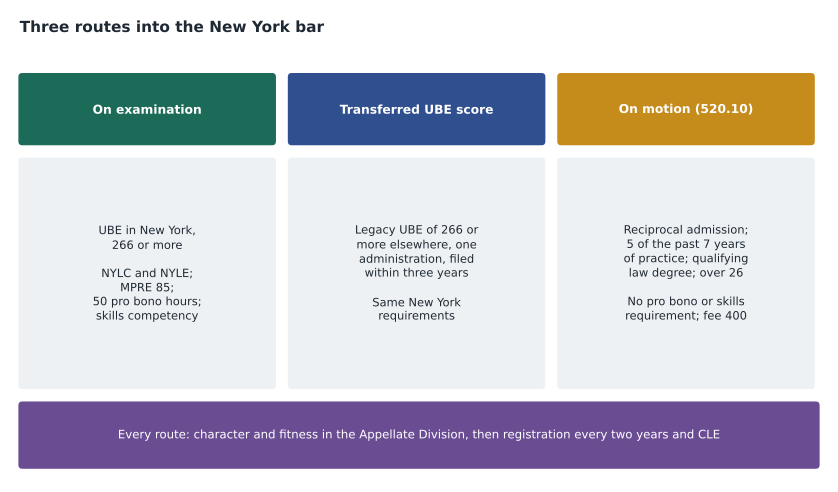
An applicant who sat the UBE in another jurisdiction may use that score to seek admission in New York, under section 6000.5 of the Board's rules and the Part 520 rules. The score must be at least 266, the New York passing score, and it must come from a single administration at which all parts of the UBE were taken in one jurisdiction. The score is proved by an official NCBE score transcript. The complete application must be filed within three years after the second day of the UBE at which the score was earned. New York does not accept transferred MBE scores standing alone, so an applicant cannot combine an MBE score from one state with essays written in New York.
A transfer applicant is not excused from New York's own requirements. The applicant must complete the New York Law Course and pass the New York Law Exam, pass the MPRE with 85, complete 50 hours of pro bono service and satisfy a skills competency pathway, and then pass character and fitness review in the Appellate Division department to which the applicant is certified. The applicant must also meet New York's education requirements under Part 520: a high UBE score from another state does not cure an education that would not qualify the applicant to sit in New York.
New York allows concurrent applications, meaning an applicant may apply for admission by transferred score while also pursuing admission in the jurisdiction where the UBE was taken. And because the UBE score belongs to the examinee, a New York examinee who scores well can transfer the score out to another UBE jurisdiction, at that jurisdiction's passing score and time limit. The Board charges a small fee to send a New York MBE score elsewhere.
Marcus's question has a short answer. His Missouri score was earned on NextGen, and as lesson 5 explained, New York will not accept a NextGen score from any exam given before July 2028. The transfer route is closed to him until he has a qualifying score from a later exam, so his practical route into New York in the long run is admission on motion.
Admission without examination: section 520.10
Section 520.10 allows the Appellate Division, in its discretion, to admit an experienced lawyer without examination. The main requirements are these. The applicant must be admitted to practice in the highest court of another state, territory or the District of Columbia, or as an attorney in the highest court of a country whose jurisprudence is based on the principles of English common law, and must currently be admitted in at least one jurisdiction that would admit a New York lawyer without examination, which is the reciprocity condition. The applicant must have actually practiced for at least five of the seven years immediately before the application. The applicant must meet the rule's education requirement; for US-educated applicants this means a first law degree from a law school that was ABA-approved throughout the applicant's attendance. And the applicant must be over 26.
Qualifying practice includes private practice in the admitting jurisdiction, service as counsel to a corporation, and legal service in the federal military or civilian government in a position requiring bar admission. Service as a judge or law clerk and full-time teaching as a professor at an ABA-approved law school can also count, and the rule allows certain combinations. The applicant files certificates of good standing from every jurisdiction of admission and supporting affidavits, the Board certifies the applicant's education, and the Appellate Division may require further proof of character and fitness, including an interview. The fee under Judiciary Law section 465 is 400 dollars.
Applicants admitted on motion are exempt from the 50-hour pro bono rule and from the skills competency requirement, because both rules apply to admission on examination. The New York Law Course and Exam are tied to the examination and transfer routes. Hollis advised motion applicants to check the Board's current admission on motion instructions for any other requirement, including the MPRE, rather than rely on charts: NCBE's chart for New York lists no time limit on an MPRE score for motion applicants, which is a different question from whether a score is required.
Reciprocity matters. A lawyer whose only admission is in a jurisdiction that does not admit New York lawyers without examination cannot use section 520.10, however long the practice. Several large states do not offer admission on motion to New York lawyers, and their lawyers must use the examination or transfer routes. The Board's website explains how to check whether a given jurisdiction qualifies.
| Requirement | Section 520.10 (motion) | Transferred UBE score |
|---|---|---|
| Exam | None | UBE taken elsewhere, 266 or more |
| Practice experience | Five of the past seven years | None |
| Reciprocity | Required | Not required |
| NYLC and NYLE | Not part of the route | Required |
| Pro bono and skills competency | Exempt | Required |
| Time limit | Practice measured over the past seven years | File within three years of the UBE |
Practicing without full admission
New York offers several limited forms of practice that are not admission. A lawyer admitted elsewhere may register as in-house counsel under Part 522 to work for a single employer in New York, without representing outside clients in court. A lawyer admitted in another US jurisdiction may provide legal services on a temporary basis in New York in limited circumstances under Part 523. A court may admit an out-of-state lawyer pro hac vice for a particular case. And a lawyer admitted in a foreign country may be licensed as a legal consultant under Part 521, which permits advice on the law of the foreign country but not on New York or US law except in narrow circumstances. None of these routes requires the bar exam, and none gives full admission.
Ngozi listened carefully to the last route. 'A legal consultant license would have let me advise on Nigerian law in New York,' she said. 'But I want to practice New York law, so the exam is the only way, unless I wait five years and come back by motion, and the rule asks for practice in the jurisdiction that admitted me.' Hollis agreed that the exam was the right choice for her goals.
After the ceremony: registration
Every lawyer admitted in New York must register with the Office of Court Administration under Judiciary Law section 468-a. The first registration is due after admission, and registration then repeats every two years, in the period around the lawyer's birthday. The registration statement lists the lawyer's addresses and employment and certifies CLE compliance, and the fee must be paid. Failing to register is a violation that can lead to suspension; the Appellate Division periodically moves against lawyers who are delinquent. A lawyer who moves away from New York must keep registering, unless the lawyer formally retires from practice and registers as retired, or resigns.
After the ceremony: CLE for newly admitted lawyers
New York has a separate CLE program for newly admitted lawyers, set by the CLE Board in Part 1500 of the court rules. In each of the first two years after admission, a newly admitted lawyer must complete 16 credit hours of accredited transitional CLE, 32 in all: in each year, 3 hours of ethics and professionalism, 6 hours of skills, and 7 hours of law practice management, areas of professional practice or cybersecurity, privacy and data protection. At least one of the 32 hours must be in cybersecurity, privacy and data protection. The CLE Board restricts the formats in which newly admitted lawyers may earn credit, especially skills credit, so a new lawyer should check that a course is approved as transitional CLE and offered in an accepted format.
Up to 16 approved transitional credits earned between graduation from law school and admission can count toward the first year. Excess credits may carry over within limits, but ethics credits cannot be carried over. After the first two years, the lawyer moves to the experienced attorney requirement: 24 credit hours every two years, including at least 4 in ethics and professionalism, 1 in diversity, inclusion and the elimination of bias, and 1 in cybersecurity, privacy and data protection.
| Lawyer | Requirement | Breakdown |
|---|---|---|
| Newly admitted, year 1 | 16 transitional credits | 3 ethics, 6 skills, 7 practice management, areas of practice or cybersecurity |
| Newly admitted, year 2 | 16 transitional credits | Same breakdown; at least 1 cybersecurity hour across both years |
| Experienced (every two years) | 24 credits | At least 4 ethics, 1 diversity and bias, 1 cybersecurity |
Other early duties
Several other obligations apply from the first day. A lawyer who holds client funds must comply with Rule 1.15 from the first deposit. A lawyer who does not live in New York and practices in New York courts must consider the office requirement of Judiciary Law section 470. A lawyer must report a criminal conviction to the Appellate Division. And a new lawyer who changes firms or addresses must update the registration within 30 days. Gianna wrote these on an index card. 'Register, CLE, escrow, address,' she read. 'Four words.'
Gianna's own plan, if she passes the December 17 NYLE, is to be certified to the Second Department in January 2027, file her admission application immediately, and attend a ceremony in the spring of 2027. She has already earned six transitional CLE credits at bridge-the-gap programs since graduating, which will count toward her first year. Ngozi, if she passes in February 2027, will have her NYLE planned for April 15, 2027, and hopes to be admitted later in 2027.
Worked problem
Can he come in on motion?
A hypothetical lawyer, Linus Kowalski-Nunes, graduated in 2015 from an ABA-approved law school, was admitted in a state that admits New York lawyers on motion in 2016, and has practiced full-time there since, apart from 18 months in 2020 and 2021 when he worked outside law. He is 37 and wants to be admitted in New York in 2027.
Show solution
- He is admitted in a reciprocal jurisdiction, which satisfies the reciprocity condition.
- He must have practiced for five of the seven years immediately before the application; with an 18-month gap in 2020 and 2021, he has well over five of the seven years from 2020 to 2027.
- His first law degree is from a law school that was ABA-approved during his attendance, and he is over 26.
- As a motion applicant he is exempt from the pro bono and skills competency rules; he will file certificates of good standing and pay the 400 dollar fee.
Answer: He appears eligible to apply under section 520.10; admission remains in the Appellate Division's discretion after character and fitness review.
Common mistakes
MistakeA transferred UBE score of 262 is enough for New York.
InsteadThe transferred score must be at least 266.
MistakeTransfer applicants skip the NYLE.
InsteadTransfer applicants must complete the NYLC and NYLE, the MPRE, pro bono and skills competency.
MistakeAny lawyer with five years of practice can be admitted on motion.
InsteadThe lawyer must also be admitted in a reciprocal jurisdiction and meet the education and age rules.
MistakeMotion applicants must complete the 50 pro bono hours.
InsteadThe pro bono and skills competency rules apply only to admission on examination.
MistakeNew lawyers follow the 24-credit experienced CLE cycle.
InsteadThey must complete 32 transitional credits, 16 in each of the first two years.
Practice problems
Work each problem on paper first, then reveal the answer to check.
What transferred UBE score does New York require, and within what time?
Show answer
At least 266, with the application filed within three years after the second day of the UBE.
What practice requirement applies under section 520.10?
Show answer
Practice for at least five of the seven years immediately before applying.
Which requirements do motion applicants avoid?
Show answer
The 50-hour pro bono rule and the skills competency requirement.
What is the newly admitted CLE breakdown in each of the first two years?
Show answer
3 ethics and professionalism, 6 skills, 7 law practice management or areas of practice or cybersecurity.
What does the experienced CLE requirement include?
Show answer
24 credits every two years, with at least 4 ethics, 1 diversity, inclusion and elimination of bias, and 1 cybersecurity.
Summary and key terms
- A transferred legacy UBE score of at least 266 from a single administration may be used within three years; the New York requirements still apply.
- New York does not accept transferred MBE scores alone or NextGen scores from before July 2028.
- Section 520.10: reciprocal admission, five of seven years of practice, qualifying law degree, over 26; exempt from pro bono and skills competency; fee 400 dollars.
- Limited practice routes include in-house registration (Part 522), temporary practice (Part 523), pro hac vice and foreign legal consultants (Part 521).
- Register every two years under Judiciary Law 468-a; newly admitted lawyers need 32 transitional CLE credits over two years.
- Experienced lawyers need 24 credits every two years, including 4 ethics, 1 diversity and 1 cybersecurity.
- transferred UBE score
- A UBE score earned in another jurisdiction and used for admission in New York.
- admission without examination
- Admission on motion under section 520.10 for experienced lawyers from reciprocal jurisdictions.
- reciprocity
- The requirement that the applicant's jurisdiction would admit New York lawyers without examination.
- transitional CLE
- CLE approved for newly admitted lawyers in their first two years.
- legal consultant
- A foreign lawyer licensed under Part 521 to advise on foreign law in New York.
Lesson quiz · 5 questions
Score 60% or more to complete this lesson.
Create a free account to save your progress, take quizzes and earn a certificate.