
BAR-231 · Lesson 8 of 12 · 21 min
New Jersey torts: comparative negligence, the Tort Claims Act and charitable immunity
▶ Video coming soon A video version of this lesson is on the way.
The broken-wrist file grew more complicated by the week. The building where the client fell was owned by a county improvement authority, which leased the ground floor to a private dental practice. The step had been repaired a year earlier by a contractor. The client had been reading a text message as she walked. 'Three possible defendants, one of them public, and a comparative fault problem,' Joan Vellucci said. 'That is a New Jersey torts exam in one file. Lay out the rules for me.'
This lesson covers the New Jersey tort rules a new lawyer applies in nearly every injury case: the Comparative Negligence Act and its limits on joint and several liability, the Tort Claims Act for claims against public entities and employees, and the Charitable Immunity Act. As Lesson 6 stressed, these are practice rules, not exam rules. On the MBE, follow the rule the question gives or the general principle tested.
The Comparative Negligence Act
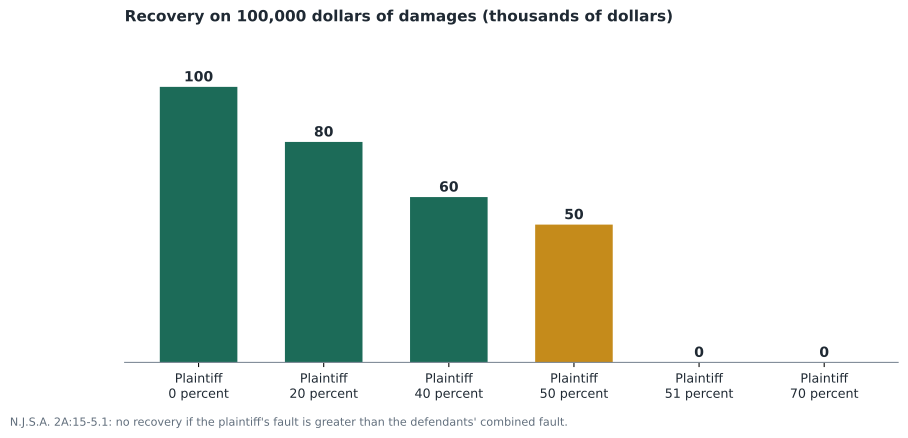
New Jersey abandoned contributory negligence and adopted comparative negligence by statute. Under the Comparative Negligence Act, N.J.S.A. 2A:15-5.1 to -5.8, a plaintiff's negligence does not bar recovery if it is not greater than the negligence of the person or persons against whom recovery is sought. New Jersey is therefore a modified comparative negligence state, often described as following a 51 percent bar: a plaintiff who is 50 percent or less at fault recovers damages reduced by her own percentage, and a plaintiff who is more than 50 percent at fault recovers nothing. New Jersey's model civil jury charge states it in those terms. If the jury finds the plaintiff more than 50 percent at fault, it does not go on to assess damages.
The comparison is between the plaintiff and the defendants against whom recovery is sought, taken together. The jury assigns percentages to every party it finds both negligent and a proximate cause of the harm, and the percentages must add up to 100. The model charge instructs jurors to allocate fault based on the evidence, not on which party is able to pay. The judge then molds the verdict, reducing the plaintiff's damages by the plaintiff's percentage of fault.
Joint and several liability: the 60 percent rule
When there are several defendants, New Jersey limits joint and several liability. Under N.J.S.A. 2A:15-5.3, a plaintiff may recover the full amount of damages from any party found 60 percent or more responsible for the total damages. From a party found less than 60 percent responsible, the plaintiff may recover only that party's percentage share. A defendant who pays more than its share may seek contribution from the other joint tortfeasors. Environmental tort actions, involving injury from the negligent handling of hazardous or toxic substances, follow special rules under the statute that allow fuller recovery from liable parties.
The 60 percent rule matters most when one defendant cannot pay. If an uninsured defendant is assigned 30 percent of the fault and a solvent defendant 40 percent, with the plaintiff at 30 percent, the plaintiff can recover only 40 percent of the damages from the solvent defendant. If the solvent defendant had been assigned 60 percent, the plaintiff could have collected the entire award, less the plaintiff's own share, from it.
Worked problem
Applying the Comparative Negligence Act and the 60 percent rule
A jury finds the client's damages to be 200,000 dollars and allocates fault as follows: the client, 20 percent; the repair contractor, 65 percent; the dental practice, 15 percent. Ignore the public authority for this example. What can the client recover, and from whom?
Show solution
- Bar: the client's 20 percent is not greater than the defendants' combined 80 percent, so she recovers.
- Reduction: 200,000 dollars less 20 percent equals 160,000 dollars.
- Contractor: at 65 percent it is 60 percent or more responsible, so the client can recover the full 160,000 dollars from it.
- Dental practice: at 15 percent, it is liable only for its share, 15 percent of 200,000 dollars, or 30,000 dollars.
- Contribution: if the contractor pays more than its 130,000-dollar share, it may seek contribution from the dental practice.
Answer: The client recovers 160,000 dollars in total and can collect all of it from the contractor; the dental practice's exposure is capped at 30,000 dollars.
The New Jersey Tort Claims Act
Claims against public entities and public employees are governed by the New Jersey Tort Claims Act, Title 59 of the New Jersey Statutes. Its starting point is that a public entity is not liable for an injury except as the Act provides. It then sets out the specific grounds of liability, such as injuries caused by a dangerous condition of public property, together with immunities and defenses. The Act applies to the State, counties, municipalities, school districts, authorities and other public bodies, and it is full of procedural traps that defeat otherwise valid claims.
The notice of claim
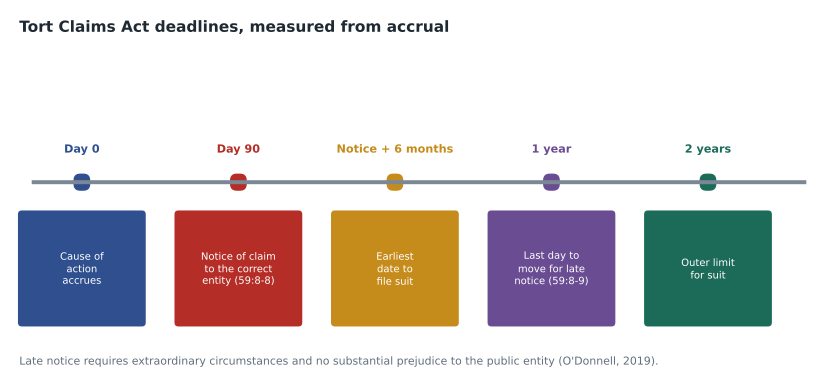
The most important trap is the notice of claim. Under N.J.S.A. 59:8-8, a claimant must file a notice of claim with the public entity no later than the ninetieth day after the cause of action accrues. The notice must contain the information listed in N.J.S.A. 59:8-4 and must be filed with the specific public entity involved, not with some other public body. The claimant may not sue until six months after the public entity receives the notice, which gives the entity time to investigate and, possibly, settle.
A claimant who misses the 90-day deadline may ask the court for leave to file a late notice under N.J.S.A. 59:8-9. The motion must be made within one year after accrual, the claimant must show extraordinary circumstances for the delay, and the public entity must not be substantially prejudiced. In no event may suit be filed more than two years after accrual. The statute does not define extraordinary circumstances, and courts decide them case by case. In O'Donnell v. New Jersey Turnpike Authority (2019), the Supreme Court found extraordinary circumstances where the claimant's lawyer had timely served the State rather than the Turnpike Authority, the claimant had pursued the claim in good faith, and another injured person had timely served the Authority with a notice describing the same accident, so the Authority suffered no prejudice. The Court cautioned that attorney error alone is still not enough.
| Step | Tort Claims Act deadline |
|---|---|
| Filing the notice of claim | Within 90 days after accrual, filed with the correct public entity (N.J.S.A. 59:8-8) |
| Waiting period | No suit until six months after the entity receives the notice |
| Late notice | Motion within one year after accrual; extraordinary circumstances and no substantial prejudice (N.J.S.A. 59:8-9) |
| Outer limit | Suit no later than two years after accrual |
The pain and suffering threshold
Even when liability is established, the Tort Claims Act limits damages. Under N.J.S.A. 59:9-2(d), no damages may be awarded against a public entity or employee for pain and suffering resulting from any injury, with an exception: pain and suffering damages are available in cases of permanent loss of a bodily function, permanent disfigurement or dismemberment where the medical treatment expenses exceed 3,600 dollars. That monetary threshold applies to causes of action arising after September 21, 2000; earlier claims used 1,000 dollars. Future medical expenses can count toward the threshold.
The Supreme Court has read the permanent loss requirement strictly. In Brooks v. Odom (1997), it held that the plaintiff must show a permanent loss that is substantial, though not necessarily total, supported by objective medical evidence; continuing subjective pain alone is not enough. Later cases have applied that test to a range of injuries. The model jury charge summarizes the rule: the loss must be substantial, must be proved by objective, credible medical evidence and cannot rest on subjective discomfort or a temporary injury. A disfigurement must be objectively significant, not a trifling mark noticed only on close inspection.
The threshold does not bar economic damages. A plaintiff who cannot meet it may still recover medical expenses and lost wages from the public entity, subject to the Act's other provisions. And where a public and a private defendant are both liable, the threshold protects only the public defendant; the private defendant remains liable for pain and suffering under ordinary tort rules. The Act also bars punitive damages against a public entity.
Worked problem
Planning the claim against the improvement authority
The client fell on March 3, 2026. Teresa learned on May 20, 2026 that the building is owned by a county improvement authority. The client's medical bills to date are 9,200 dollars, and her surgeon expects a permanent loss of some wrist rotation confirmed by imaging. What should the firm do?
Show solution
- Deadline: 90 days from March 3, 2026 is June 1, 2026. The notice must be filed with the improvement authority itself by then.
- If the deadline had passed, the firm would need a late notice motion within one year of accrual showing extraordinary circumstances and no substantial prejudice.
- Waiting period: suit against the authority cannot be filed until six months after the authority receives the notice.
- Threshold: medical expenses exceed 3,600 dollars, and an objectively documented, substantial permanent loss of wrist function may satisfy Brooks v. Odom.
- Private defendants: the contractor and the dental practice are not protected by the threshold and can be sued within the two-year limitations period.
Answer: File the notice with the authority before June 1, 2026, calendar the six-month waiting period and build the medical record on permanence; sue the private defendants under ordinary rules.
The Charitable Immunity Act
New Jersey also protects many nonprofit organizations through the Charitable Immunity Act, N.J.S.A. 2A:53A-7 to -11. Under section 7, a nonprofit corporation, society or association organized exclusively for religious, charitable or educational purposes is not liable for negligence to a person who was a beneficiary of its works. Section 8 treats nonprofits organized exclusively for hospital purposes differently: they may be liable for negligence, but damages are capped at 250,000 dollars plus interest and costs. The Act directs that it be liberally construed.
In Kuchera v. Jersey Shore Family Health Center (2015), the Supreme Court considered whether a hospital-affiliated clinic offering a free eye screening was fully immune under section 7 or subject to the section 8 cap. The Court held that the entity was organized for hospital purposes, so section 8 applied: the clinic could be liable for negligence, subject to the 250,000-dollar cap. The question turns on the entity's organizational purpose, read with the modern understanding that hospitals provide outpatient, preventive, educational and charity care services, not on what the facility was being used for on a given day.
Charitable immunity is a defense that requires careful analysis of three questions: whether the entity was organized exclusively for qualifying purposes, whether it was promoting those purposes when the injury occurred, and whether the plaintiff was a beneficiary of its works. The Legislature has also narrowed the immunity over time, notably by removing it as a defense to claims arising from sexual abuse. A lawyer facing a charitable immunity defense should research the current statute and case law carefully.
Duty in New Jersey negligence law
New Jersey courts take a flexible approach to duty. In Hopkins v. Fox & Lazo Realtors (1993), the Supreme Court held that a real estate broker holding an open house owed visitors a duty of reasonable care to inspect for and warn of reasonably discoverable dangers. The Court explained that whether a duty exists turns on fairness and policy, weighing the relationship of the parties, the nature of the risk, the opportunity and ability to exercise care and the public interest in the proposed solution. That approach appears throughout New Jersey premises and negligence cases, and it explains why New Jersey courts sometimes reach results that a rigid invitee, licensee and trespasser analysis would not.
For exam purposes, the MBE still tests traditional premises liability categories where the question calls for them. In practice, a New Jersey brief on duty starts with the Hopkins factors.
Common mistakes
MistakeNew Jersey follows pure comparative negligence.
InsteadIt follows modified comparative negligence: a plaintiff more than 50 percent at fault recovers nothing.
MistakeEvery defendant is jointly and severally liable.
InsteadOnly a defendant 60 percent or more responsible is liable for the full damages; others pay their own share.
MistakeA notice of claim can be sent to any state agency.
InsteadIt must be filed with the specific public entity within 90 days of accrual.
MistakeA public entity is liable for pain and suffering whenever it is negligent.
InsteadPain and suffering requires permanent loss of bodily function, disfigurement or dismemberment and medical expenses over 3,600 dollars.
MistakeCharitable hospitals are fully immune.
InsteadHospital nonprofits may be liable for negligence under section 8, capped at 250,000 dollars.
Summary and key terms
- Under the Comparative Negligence Act, a plaintiff 50 percent or less at fault recovers reduced damages; more than 50 percent recovers nothing.
- Under N.J.S.A. 2A:15-5.3, only a defendant 60 percent or more responsible pays the full award; others pay their share, with contribution rights.
- Tort Claims Act: notice within 90 days to the correct entity, a six-month wait, late notice within one year on extraordinary circumstances, suit within two years (O'Donnell, 2019).
- Pain and suffering against public entities requires a substantial permanent loss proved objectively (Brooks v. Odom) and medical expenses over 3,600 dollars.
- The Charitable Immunity Act immunizes qualifying nonprofits as to beneficiaries; hospitals face a 250,000-dollar cap (Kuchera, 2015).
- Hopkins v. Fox & Lazo (1993) frames duty as a question of fairness and policy.
- 0
- Comparative Negligence Act
- 1
- modified comparative negligence
- 2
- 60 percent rule
- 3
- contribution
- 4
- Tort Claims Act
- 5
- notice of claim
- 6
- extraordinary circumstances
- 7
- permanent loss of a bodily function
- 8
- Charitable Immunity Act
Practice problems
Work each problem on paper first, then reveal the answer to check.
A plaintiff is found 51 percent at fault. What does she recover under New Jersey law?
Show answer
Nothing, because her negligence is greater than the defendants' combined negligence.
When must a Tort Claims Act notice be filed?
Show answer
Within 90 days after accrual, with the specific public entity.
What must a late notice applicant show?
Show answer
Extraordinary circumstances and no substantial prejudice, by motion within one year after accrual.
What is the damages cap for a nonprofit hospital under the Charitable Immunity Act?
Show answer
250,000 dollars plus interest and costs.
Lesson quiz · 5 questions
Score 60% or more to complete this lesson.
Create a free account to save your progress, take quizzes and earn a certificate.