
BAR-231 · Lesson 2 of 12 · 20 min
Eligibility, education, deadlines and fees
▶ Video coming soon A video version of this lesson is on the way.
Two weeks before the October 31 deadline, Teresa spread the February 2027 application across Joan Vellucci's conference table after hours. 'It is longer than my law school application,' she said on the video call. Marchetti laughed. 'It is supposed to be. The Board needs enough to confirm you are eligible, and the Committee on Character needs enough to know who you are. The good news is that New Jersey's eligibility rules are short. The work is in the paperwork and the dates.'
This lesson covers who may sit for the New Jersey bar exam, the educational requirement, how the application is filed, the filing deadlines for each administration, the fees, testing accommodations and the documents the Board collects after it acknowledges an application. The facts here come from the Board of Bar Examiners and NCBE's jurisdiction information for New Jersey as of November 2026. Fees and deadlines are set by the Board and can change, so a candidate should always confirm them in the current application instructions.
Who may sit for the exam
New Jersey's eligibility rules focus on legal education and good standing. A candidate must hold a J.D. from a law school approved by the American Bar Association. NCBE's chart for New Jersey states the point both ways: an ABA-approved J.D. is required, and graduates of foreign law schools are not eligible. There is no separate route in New Jersey for a foreign-educated lawyer to qualify by completing an LL.M. at a United States school, a route that some other states offer. A foreign-trained lawyer who wants to practice in New Jersey generally needs either an ABA-approved J.D. or admission elsewhere followed by a route New Jersey recognizes, such as admission by motion after qualifying practice.
Candidates must also be at least 18 years old, and an applicant who has been admitted in another jurisdiction must be in good standing there. An applicant who is suspended or disbarred elsewhere is not in good standing and cannot use the exam to sidestep that status. A candidate who has resigned or whose license elsewhere was administratively revoked should read the instructions closely and explain the history in the Certified Statement.
New Jersey does not require a separate law student registration during law school, unlike states such as Mississippi or Texas. The first formal step is the bar examination application itself. That simplifies the timeline for law students, but it also means the character review starts later, closer to the exam, which is one more reason to file early in the window.
Applying before graduation
A third-year student may apply for the July exam before graduating. The application and Certified Statement go to the Board by the deadline, and the law school completes the Law School Certificate. The certificate form can be submitted to the school before graduation, but the school does not send it to the Board until the degree is conferred. Candidates who graduate in May and sit in July therefore depend on their school's registrar to send the certificate promptly after commencement. A candidate who finishes in December and sits in February follows the same pattern.
Teresa graduated in May 2026 but chose the February 2027 exam because her mother needed help through the summer after a knee replacement. By the time she applied, her degree was already conferred, and the registrar could send the certificate as soon as she submitted Part I.
Filing deadlines
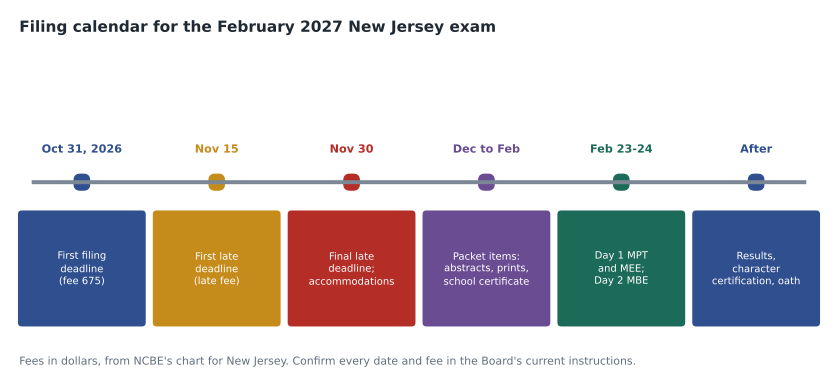
New Jersey uses a first filing deadline followed by two late filing deadlines for each exam. For the February exam, the first filing deadline is October 31, and the late deadlines are November 15 and November 30. For the July exam, the first deadline is March 31, and the late deadlines are April 15 and April 30. Late filing carries additional fees that rise with each late deadline, and the current amounts are listed in the application instructions. After the final late deadline, the application window for that exam is closed.
| Exam | First filing deadline | Late filing deadlines | Testing accommodations request |
|---|---|---|---|
| February 2027 | October 31, 2026 | November 15 and November 30, 2026 | By November 30, 2026 |
| July 2027 | March 31, 2027 | April 15 and April 30, 2027 | By April 30, 2027 |
Deadlines are measured by the date the Board's instructions specify, and candidates should keep proof of when and how they filed. If the instructions measure timeliness by postmark or hand delivery for any paper component, a candidate should use a delivery method that produces a dated record. If the filing is electronic, a screenshot or confirmation email serves the same purpose.
Fees
NCBE's chart lists New Jersey's bar examination fee as 675 dollars for first-time takers, repeat takers and attorney applicants alike. Late filing adds a late fee, and candidates permitted to use a laptop may pay a separate laptop fee set for each administration. The application fee for admission by transferred UBE score is also 675 dollars, and the fee for admission by motion is 1,500 dollars. Fees are generally nonrefundable, so a candidate who is unsure about readiness should think carefully before filing rather than filing and withdrawing.
An incorrect fee is a common reason for an application to be returned. Older Board guidance warned that an application with the wrong fee is treated as not received, and that resubmission after the deadline can trigger late fees. The practical rule is simple: calculate the fee from the current fee scale on the day you file, using the payment method the instructions require, and keep a copy of everything you send.
| Item | Amount listed by NCBE (dollars) |
|---|---|
| Bar exam fee: first-time taker | 675 |
| Bar exam fee: repeat taker | 675 |
| Bar exam fee: attorney applicant | 675 |
| Admission by transferred UBE score | 675 |
| Admission by motion | 1,500 |
| Late filing and laptop fees | Set in the current instructions |
Filing the application
The application process starts online. A candidate registers on the Board's site, waits for the activation email (which sometimes lands in a spam folder), and then completes the application. The core filing consists of the application itself, signed and notarized; the Authorization and Release forms, signed and notarized, which allow the Board and the Committee to obtain records; the Certified Statement of Candidate; and the fee. If any of those core items is missing, the Board treats the application as incomplete and returns it.
The Certified Statement is the heart of the character review, and it asks for a great deal: every residence, every job, every school, financial obligations, driving history, arrests and charges, civil cases, discipline in school or work and more. It must be typed or clearly printed, with any additional information attached and labeled by section number. A candidate who is waiting for a document, such as a certificate of good standing or a court record, should not hold the whole application. The better practice is to file the application and Certified Statement on time with a cover letter listing the items that will follow, and then send those items as soon as they arrive.
The acknowledgment packet
After the Board receives a complete core filing, it sends an acknowledgment packet listing the remaining items. These typically include the Law School Certificate, proof of meeting the professional responsibility requirement, original driver's abstracts and fingerprinting instructions. Each item has its own rules.
The driver's abstracts must be original, complete abstracts from the motor vehicle agency of every state or jurisdiction where the candidate held a driver's license in the past seven years. Abstracts from third-party services and abbreviated three-year abstracts are not accepted. A candidate who lived in several states during college and law school may need to request abstracts from each of them, and some agencies take weeks to respond.
Fingerprints are taken for criminal history checks by the New Jersey State Police and the FBI, following the instructions in the packet. Fingerprint results are valid for two years from the first exam for which they were taken, so a candidate who sits again within that period may not need new prints, while one who returns later will.
The Law School Certificate has two parts. The candidate completes Part I and gives the form to the law school, which completes the rest, including Part II verifying any professional responsibility course the candidate relies on, and sends it directly to the Board after the degree is conferred. The candidate should write the candidate identification number and year on the form so the Board can match it to the file.
Testing accommodations
Candidates with disabilities may request testing accommodations. The request has its own deadline, generally the final late filing deadline for the exam: November 30 for February and April 30 for July. The request needs supporting documentation from qualified professionals and, where relevant, records of accommodations received in law school and on other standardized tests. Requests take time to review, and a candidate who needs accommodations should file the request with the application rather than waiting for the last day.
Planning around the calendar
Filing early pays off in New Jersey for two reasons. First, the Committee on Character needs time to review the Certified Statement and gather records, and an early filer gives it time to resolve questions before results are released. Second, early filing leaves room to fix problems: a missing notarization, a wrong fee or a forgotten abstract can be corrected without late fees if the candidate learns about it in September rather than on October 31.
Joan Vellucci gave Teresa one piece of advice from her own admission decades earlier. 'Make a list of every place you have lived since you were eighteen and every job you have held, with dates, before you touch the form,' she said. 'Half the mistakes people make on that statement are dates that do not line up. The Committee does not expect perfection, but it does expect honesty and care.'
Worked problem
Choosing the deadline and fee
Marco, a classmate of Teresa's, decided on November 10, 2026 that he wants to sit for the February 2027 New Jersey exam. He holds an ABA-approved J.D. conferred in May 2026, has never been admitted anywhere and needs extra time on the exam because of a documented disability. What deadlines and costs apply?
Show solution
- Eligibility: an ABA-approved J.D. and age over 18; he is eligible.
- The first filing deadline, October 31, has passed. He can still file by the November 15 late deadline or, at the latest, by November 30, paying the base fee of 675 dollars plus the late fee in the current instructions.
- His accommodation request is due by November 30 with supporting documentation. Filing it with the application is the safer course.
- He should begin requesting driver's abstracts from every state where he held a license in the past seven years immediately, since packet items take time.
Answer: Marco can still sit in February if he files by November 30, but he will pay a late fee and should file sooner rather than later to protect his accommodations request and give the Committee time.
Common mistakes
MistakeA foreign law degree plus a U.S. LL.M. qualifies a candidate for the New Jersey exam.
InsteadNew Jersey requires an ABA-approved J.D.; graduates of foreign law schools are not eligible to sit.
MistakeNew Jersey requires law students to register during law school.
InsteadThere is no separate student registration; the bar application is the first formal filing.
MistakeThe February deadline is November 30.
InsteadOctober 31 is the first filing deadline. November 15 and November 30 are late deadlines with added fees.
MistakeAny driving record printout will do.
InsteadThe Board requires original, complete abstracts from each motor vehicle agency for the past seven years; third-party and three-year abstracts are not accepted.
MistakeAn application missing one supporting document should be held until it is complete.
InsteadFile the core application on time and list the items to follow in a cover letter.
Common filing mistakes
Marchetti keeps a list of the filing mistakes she has seen most often over fifteen years, and she reads it aloud to every New Jersey candidate. The first is an unsigned or unnotarized page. The application and the Authorization and Release forms must be signed and notarized, and a single missing notary stamp can send the whole package back. The second is an outdated fee: candidates copy the amount from a friend's application from a prior year. The third is a gap in the residence or employment history in the Certified Statement, often a summer job or a short sublet that the candidate forgot. The fourth is a driver's abstract from the wrong source, such as a printout from an insurance company rather than an original abstract from the motor vehicle agency. The fifth is waiting for one missing document instead of filing on time with a cover letter.
Each of these mistakes is easy to prevent with a checklist and an extra day. Teresa built hers in a spreadsheet with a row for each required item, the date requested, the date sent and the date the Board confirmed receipt. She also scanned every page before mailing anything, so that if the Board asked for a replacement she could see exactly what she had sent.
Keeping the file current
Filing is not the end of the candidate's responsibilities. If a candidate moves, changes jobs, changes names or has any other change that affects the application, the candidate should update the Board and, where the change affects an answer in the Certified Statement, amend the statement. Candidates should also watch for emails from the Board, which often set short deadlines for supplemental information. Teresa set up a filter so that every message from the Board went to a dedicated folder she checked each evening.
Summary and key terms
- New Jersey requires an ABA-approved J.D.; foreign law graduates are not eligible to sit.
- Candidates must be at least 18 and in good standing anywhere they are admitted.
- February deadlines: October 31, then late deadlines November 15 and November 30. July: March 31, April 15 and April 30.
- NCBE lists a 675-dollar exam fee for all applicant types, 675 dollars for UBE transfer and 1,500 dollars for motion admission; late and laptop fees are extra.
- The core filing is the notarized application, notarized Authorization and Release forms, the Certified Statement and the fee; the acknowledgment packet adds the law school certificate, professional responsibility proof, driver's abstracts and fingerprints.
- Accommodation requests are due by the final late deadline and need documentation.
- 0
- first filing deadline
- 1
- late filing deadline
- 2
- Authorization and Release
- 3
- acknowledgment packet
- 4
- Law School Certificate
- 5
- driver's abstract
- 6
- testing accommodations
Practice problems
Work each problem on paper first, then reveal the answer to check.
What is the first filing deadline for the February New Jersey exam?
Show answer
October 31 of the preceding year, with late deadlines of November 15 and November 30.
Can a graduate of a foreign law school sit for the New Jersey exam?
Show answer
No. New Jersey requires an ABA-approved J.D.
What driving records does the Board require?
Show answer
Original, complete abstracts from each jurisdiction where the candidate held a license in the past seven years.
When does the law school send the Law School Certificate?
Show answer
After the degree is conferred, directly to the Board.
Lesson quiz · 5 questions
Score 60% or more to complete this lesson.
Create a free account to save your progress, take quizzes and earn a certificate.