
BAR-231 · Lesson 7 of 12 · 20 min
New Jersey courts and civil practice: the entire controversy doctrine and the Affidavit of Merit
▶ Video coming soon A video version of this lesson is on the way.
On Teresa's third Monday at the firm, Joan Vellucci handed her a file and a sticky note. The file was a new matter: a client who had broken her wrist on a broken step at a dentist's office building in Ewing. The sticky note said: 'Who are all the possible defendants? What claims? Which court? What is due when? Answer by Friday.' Teresa spent the week learning that New Jersey civil practice has its own architecture, its own deadlines and two rules that trip up lawyers from other states more than any others: the entire controversy doctrine and the Affidavit of Merit statute.
None of this is tested on the UBE, as Lesson 6 explained. But it is the first thing a new New Jersey litigator meets, it fills a large share of the new-admittee CLE catalog and it is a source of real malpractice exposure. This lesson covers the court system, the main civil practice rules, limitations periods, the entire controversy doctrine and the Affidavit of Merit.
The structure of the New Jersey courts
New Jersey has one of the most unified court systems in the country, created by the 1947 Constitution. At the top is the Supreme Court of New Jersey, with a Chief Justice and six Associate Justices. The Governor nominates justices, and the State Senate must consent. A justice serves an initial seven-year term and, if renominated and confirmed, then serves with tenure until mandatory retirement at age 70. Chief Justice Stuart Rabner has led the Court since 2007. The Supreme Court hears most cases by granting certification, a discretionary review, and it also has broad administrative authority over all the state's courts and over the practice of law.
Below it is the Superior Court, which has a statewide trial court and an intermediate appellate court. The Appellate Division hears appeals as of right from final judgments of the trial divisions and from state agency decisions, generally in panels of two or three judges. The trial level is divided into the Law Division and the Chancery Division, and trial courts are organized into regional vicinages, each led by an assignment judge.
The Law Division has a Civil Part for damages actions, a Criminal Part and the Special Civil Part. The Special Civil Part hears civil cases where the demand is 20,000 dollars or less, and within it the Small Claims section hears claims of 5,000 dollars or less; it also hears landlord-tenant cases. The Chancery Division has a General Equity Part for injunctions and other equitable relief, a Family Part for divorce, custody, support, domestic violence and juvenile matters, and a Probate Part for contested estate matters. The Tax Court hears state and local tax appeals. Municipal courts, operated by each municipality or shared among several, hear traffic cases, disorderly persons offenses and local ordinance violations.
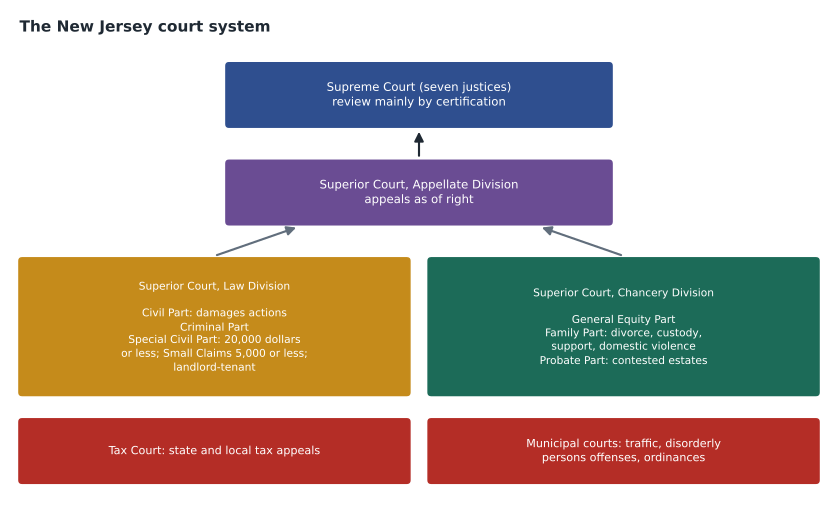
| Court or part | What it hears |
|---|---|
| Supreme Court | Discretionary review by certification; certain appeals as of right; rules and administration |
| Appellate Division | Appeals as of right from final trial court judgments and agency decisions |
| Law Division, Civil Part | Damages actions above the Special Civil Part limit |
| Special Civil Part | Civil claims of 20,000 dollars or less; Small Claims of 5,000 dollars or less; landlord-tenant |
| Chancery Division, General Equity | Injunctions, foreclosures and other equitable claims |
| Chancery Division, Family Part | Divorce, custody, support, domestic violence, juvenile matters |
| Chancery Division, Probate Part | Contested probate and estate matters |
| Tax Court | State and local tax appeals |
| Municipal courts | Traffic, disorderly persons offenses, ordinance violations |
The Rules of Court and the federal courts
The Rules Governing the Courts of the State of New Jersey are adopted by the Supreme Court under its constitutional rulemaking power. Part IV of the Rules governs civil practice in the Superior Court. Many New Jersey rules resemble the Federal Rules, but the numbering and many details differ, and practitioners rely heavily on the annotated rules commentary published each year.
New Jersey's federal court is the United States District Court for the District of New Jersey, with courthouses in Newark, Trenton and Camden, and appeals go to the Third Circuit. A new lawyer handling a case in federal court follows the Federal Rules and the District's Local Civil Rules; in state court, the New Jersey Rules of Court. The same lawyer often does both in the same month.
Limitations periods
The general limitations period for personal injury actions in New Jersey is two years, and for contract actions it is six years, under N.J.S.A. 2A:14-1 and following sections. The discovery rule, recognized by the Supreme Court in Lopez v. Swyer (1973), can delay accrual until the plaintiff knew or reasonably should have known of the injury and that it was caused by another's fault, and disputed accrual facts may be resolved at a hearing known as a Lopez hearing. Claims against public entities have much shorter preliminary deadlines under the Tort Claims Act, which Lesson 8 covers: a notice of claim within 90 days of accrual.
Joan's red-ink calendar exists because these deadlines are unforgiving. Teresa's first entry for the broken-wrist client was a two-year limitations date, and her second, after she learned that the building was owned by a county improvement authority, was a 90-day Tort Claims Act notice date.
The entire controversy doctrine
The entire controversy doctrine is New Jersey's most distinctive procedural rule. In Dimitrakopoulos v. Borrus (2019), the Supreme Court described it as embodying the principle that the adjudication of a legal controversy should occur in one litigation in only one court. Its purposes are complete and final disposition of cases, avoidance of piecemeal decisions, fairness to the parties and efficiency. Under Rule 4:30A, failure to join claims that the doctrine requires to be joined results in preclusion of the omitted claims.
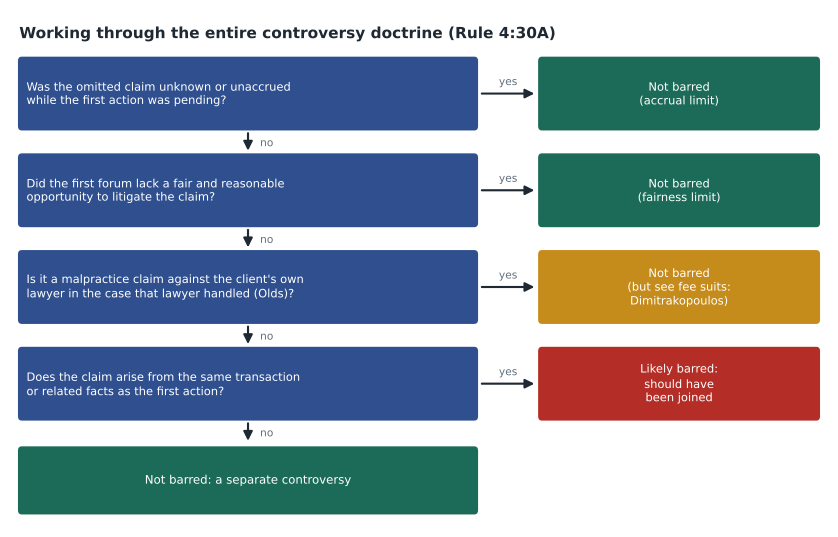
The threshold question is whether the claims arise from related facts or from the same transaction or series of transactions. The claims do not need to share legal theories or remedies. A party who sues on a contract and later sues on a tort theory arising from the same dealings may find the second action barred, even if the theories are completely different.
The doctrine is equitable, and it has limits. It does not bar claims that were unknown or had not accrued when the first action was pending; accrual is judged much as the discovery rule judges it for limitations, and the court may hold a hearing to resolve disputed facts. It does not apply where the first forum did not provide a fair and reasonable opportunity to litigate the claim. And under the earlier decision in Olds v. Donnelly (1997), reaffirmed in Dimitrakopoulos, the doctrine does not require a client to bring a legal malpractice claim against its own lawyer in the underlying litigation in which that lawyer represented the client.
Dimitrakopoulos drew a line. A law firm's collection action against its former client for unpaid fees is not an underlying action of the kind Olds protects. When the firm sues for fees, the client may be required to assert a malpractice claim as a counterclaim, and failing to do so may bar a later malpractice suit, subject to the doctrine's accrual and fairness limits. The Court remanded for a fuller record on those questions.
The Rule 4:5-1(b)(2) certification
The doctrine is supported by a disclosure requirement. Under Rule 4:5-1(b)(2), each party's first pleading must include a certification stating whether the matter is the subject of any other pending action or arbitration, whether any other action or arbitration is contemplated, and the names of any other non-party who should be joined or who is potentially liable because of the same transactional facts. Parties must update the certification if circumstances change. The Supreme Court in Dimitrakopoulos described the certification as implementing the doctrine's philosophy. Failure to disclose can lead to sanctions, including, in appropriate cases, dismissal of a later action.
Over time, the Court narrowed the doctrine's reach on joinder of parties. The rules now focus mandatory joinder on claims, and they address the omission of parties primarily through the certification and the sanctions for failing to disclose. A careful lawyer still treats the doctrine as a reason to think about every claim and every potential party at the start of a case.
Worked problem
Applying the entire controversy doctrine
In 2025, a contractor sued a homeowner in the Law Division for unpaid invoices on a kitchen renovation. The homeowner defended, lost and paid the judgment. In 2026, the homeowner sued the contractor for negligent work that caused a leak she discovered during the first case. Is the second suit barred?
Show solution
- Same transaction: both claims arise from the same renovation contract and the work performed under it.
- Known and accrued: the homeowner discovered the leak while the first case was pending, so the claim was known and had accrued.
- Fair opportunity: the Law Division could have heard the negligence claim as a counterclaim.
- Exceptions: no malpractice-against-own-lawyer issue and no indication the first forum was inadequate.
Answer: The second suit is likely barred under the entire controversy doctrine and Rule 4:30A, because the homeowner should have brought the negligence claim as a counterclaim in the first action.
The Affidavit of Merit statute
The second rule that catches lawyers from other states is the Affidavit of Merit statute, N.J.S.A. 2A:53A-26 to -29. In an action for damages for personal injuries, wrongful death or property damage resulting from alleged malpractice or negligence by a licensed person in a profession or occupation, the plaintiff must provide each defendant with an affidavit from an appropriate licensed person stating that there is a reasonable probability that the care, skill or knowledge exercised by the defendant fell outside acceptable professional standards. The statute covers a list of licensed professionals that includes physicians, dentists, nurses, attorneys, architects, engineers, accountants and others defined in the statute, and health care facilities.
The timing is strict. The plaintiff must provide the affidavit within 60 days after the defendant files its answer. The court may grant one additional period of up to 60 days for good cause. A plaintiff who fails to comply is treated as having failed to state a cause of action, and courts have generally required dismissal with prejudice, subject to narrow equitable doctrines such as substantial compliance and extraordinary circumstances.
To prevent technical dismissals, the Supreme Court in Ferreira v. Rancocas Orthopedic Associates (2003) directed that an accelerated case management conference be held in professional negligence cases within 90 days of the defendant's answer, so that any problems with the affidavit can be identified and fixed. In Moschella v. Hackensack Meridian Jersey Shore University Medical Center (2024), the Court reversed a dismissal, holding that the affiant need not state that he reviewed the medical records, and that a doctor identified in the affidavit as a hospital's agent and as one of the fictitiously named defendants need not have been named individually in the complaint. The Court also stressed that a timely Ferreira conference is essential and that the absence of one would weigh heavily toward finding extraordinary circumstances.
| Step | Affidavit of Merit timing |
|---|---|
| Defendant files answer | Day 0 |
| Affidavit due | Within 60 days after the answer |
| Ferreira conference | Within 90 days after the answer |
| Extension for good cause | One additional period of up to 60 days (up to 120 days total) |
| Failure to comply | Treated as failure to state a cause of action; generally dismissal with prejudice |
Summary judgment and other practice points
New Jersey's summary judgment standard comes from Brill v. Guardian Life Insurance Co. of America (1995). The court asks whether the competent evidential materials presented, viewed in the light most favorable to the non-moving party, are sufficient to permit a rational factfinder to resolve the disputed issue in favor of the non-moving party. The standard was intended to bring New Jersey's approach into line with the federal trilogy of 1986 summary judgment decisions, and it remains the starting point in every New Jersey summary judgment brief.
Other features a new litigator meets early include mandatory nonbinding arbitration for certain categories of cases, such as automobile negligence claims, before trial; track assignments that set discovery periods by case type; and the offer of judgment rule, which shifts certain costs and fees when a party rejects an offer and does worse at trial. Each has its own rule and its own deadlines, and the annotated rules commentary is the place to check the details.
Common mistakes
MistakeThe entire controversy doctrine applies only when the claims share a legal theory.
InsteadIt applies when claims arise from related facts or the same transaction or series of transactions, regardless of legal theory.
MistakeA client must sue its lawyer for malpractice in the same case the lawyer handled.
InsteadOlds v. Donnelly held otherwise, and Dimitrakopoulos reaffirmed it; but a firm's fee collection suit may require a malpractice counterclaim.
MistakeThe Affidavit of Merit can be served any time before trial.
InsteadIt is due within 60 days after the answer, with one extension of up to 60 days for good cause.
MistakeA missing Affidavit of Merit leads to dismissal without prejudice.
InsteadFailure is treated as failure to state a cause of action and generally leads to dismissal with prejudice.
MistakeThe Special Civil Part hears claims up to 15,000 dollars.
InsteadThe limit is 20,000 dollars, with Small Claims up to 5,000 dollars.
Summary and key terms
- The 1947 Constitution created a unified system: the Supreme Court, the Appellate Division and the Superior Court's Law and Chancery Divisions, plus the Tax Court and municipal courts.
- Justices serve an initial seven-year term, then tenure to age 70.
- Personal injury actions generally have two years and contract actions six; Lopez v. Swyer recognized the discovery rule.
- The entire controversy doctrine and Rule 4:30A require joinder of claims arising from the same transaction; the Rule 4:5-1(b)(2) certification supports it.
- Dimitrakopoulos (2019): no malpractice joinder in the underlying case, but a firm's collection suit may require a malpractice counterclaim.
- The Affidavit of Merit is due within 60 days after the answer (one 60-day extension); Ferreira conferences occur within 90 days; Moschella (2024) reversed a technical dismissal.
- Brill v. Guardian Life (1995) sets the summary judgment standard.
- 0
- Superior Court
- 1
- Appellate Division
- 2
- Special Civil Part
- 3
- Chancery Division
- 4
- certification
- 5
- entire controversy doctrine
- 6
- Rule 4:30A
- 7
- Affidavit of Merit
- 8
- Ferreira conference
- 9
- Lopez hearing
Practice problems
Work each problem on paper first, then reveal the answer to check.
What is the jurisdictional limit of the Special Civil Part?
Show answer
Claims of 20,000 dollars or less; Small Claims hears 5,000 dollars or less.
When is an Affidavit of Merit due?
Show answer
Within 60 days after the defendant's answer, with one extension of up to 60 days for good cause.
What did Dimitrakopoulos hold about collection actions?
Show answer
A firm's fee collection action is not an underlying action under Olds, so the client may need to assert malpractice as a counterclaim, subject to accrual and fairness limits.
What does the Rule 4:5-1(b)(2) certification require?
Show answer
Disclosure of other pending or contemplated actions or arbitrations and of non-parties who should be joined or may be liable on the same facts.
Lesson quiz · 5 questions
Score 60% or more to complete this lesson.
Create a free account to save your progress, take quizzes and earn a certificate.